Key Fact
Shapes of atomic orbitals
s-orbital: spherical (1 orbital). p-orbitals: dumbbell along x, y, z (3 orbitals). d-orbitals: complex (5 orbitals). Number of orbitals in subshell = 2l+1.
-- NCERT Class 11 Chemistry, Ch. 2, p. 60The most frequent confusion on orbital shapes is mixing up the number of nodal planes, the orientation labels, and the visual geometry — especially for d orbitals.
What are orbital shapes? An atomic orbital is a mathematical function (ψ) whose square (ψ²) gives the probability density of finding an electron around the nucleus. The "shape" we draw is a boundary surface enclosing ~90% of this probability density. Different values of the azimuthal quantum number l produce different shapes (NCERT Class 11 Chemistry Chapter 2, page 58).
s orbitals (l = 0): Spherically symmetric. No angular node. The 1s orbital is a single sphere; 2s has one spherical (radial) node inside a larger sphere, and so on. All s orbitals look the same in angular shape — only their size and number of radial nodes change with n.
p orbitals (l = 1): Dumbbell-shaped (two lobes on opposite sides of the nucleus). Three orientations: pₓ, p_y, p_z — each aligned along its respective Cartesian axis. Every p orbital has exactly one nodal plane passing through the nucleus (the plane perpendicular to the lobe axis). The three p orbitals are degenerate in the absence of an external field.
d orbitals (l = 2): Five orientations. Four of them — d_xy, d_xz, d_yz, d_{x²−y²} — have a four-lobed (cloverleaf) shape with two nodal planes each. The fifth, d_{z²}, looks different: a dumbbell along z with a torus (doughnut ring) in the xy-plane. Despite the visual difference, d_{z²} is mathematically equivalent in energy to the other four in a free atom.
Common trap in NEET: Confusing the nodal-plane count. s → 0 angular nodes, p → 1, d → 2. Total nodes = n − 1; angular nodes = l; radial nodes = n − l − 1. Questions often test whether you can distinguish angular (planar/conical) nodes from radial (spherical) nodes.
Another high-frequency confusion: d_{x²−y²} has lobes along the axes (x and y), while d_{xy} has lobes between the axes (rotated 45°). Getting these two swapped is a distractor favourite.
Select an option to see the explanation. Wrong answers show why your choice was tempting — and name the exact trap it exploits.
The shape of an s orbital is:
Answer: B. s orbitals (l = 0) have spherical symmetry — the probability density depends only on the distance from the nucleus, not direction (NCERT Class 11 Chemistry Chapter 2, page 58).
Why A is wrong: A — Dumbbell shape belongs to p orbitals (l = 1), not s orbitals.
Why C is wrong: C — Cloverleaf (four-lobed) shape belongs to d orbitals (l = 2), not s orbitals.
Why D is wrong: D — Conical nodal surfaces appear in certain d and f orbitals, but s orbitals have no angular dependence and are spherical.
How many nodal planes does a 2p orbital have?
Answer: C. The number of angular (planar) nodes equals l. For a p orbital, l = 1, so there is exactly one nodal plane passing through the nucleus (NCERT Class 11 Chemistry Chapter 2, page 59).
Why A is wrong: A — Zero angular nodes correspond to s orbitals (l = 0). A p orbital has l = 1, so one nodal plane.
Why B is wrong: B — Two nodal planes correspond to d orbitals (l = 2). The p orbital has only one.
Why D is wrong: D — Three angular nodes belong to f orbitals (l = 3), not p orbitals.
Which d orbital has a shape that includes a doughnut-shaped ring (torus) in the xy-plane?
Answer: A. d_{z²} has a unique shape: two lobes along the z-axis plus a torus (doughnut ring) in the xy-plane. The other four d orbitals have a standard four-lobed cloverleaf shape (NCERT Class 11 Chemistry Chapter 2, page 59).
Why B is wrong: B — d_{x²−y²} has four lobes directed along the x and y axes; no torus.
Why C is wrong: C — d_xy has four lobes lying between the x and y axes (cloverleaf pattern); no torus.
Why D is wrong: D — d_xz has four lobes in the xz-plane (between x and z axes); no torus.
The total number of nodes in a 3s orbital is:
Answer: B. Total nodes = n − 1 = 3 − 1 = 2. For 3s: angular nodes = l = 0, radial nodes = n − l − 1 = 2. Both nodes are spherical (radial) surfaces inside the orbital (NCERT Class 11 Chemistry Chapter 2, page 59).
Why A is wrong: A — Zero nodes applies only to the 1s orbital (n = 1, total nodes = 0). For 3s, n − 1 = 2.
Why C is wrong: C — One total node would correspond to n = 2 (e.g. 2s has 1 radial node). The 3s orbital has n − 1 = 2 nodes.
Why D is wrong: D — Three total nodes would require n = 4 (n − 1 = 3). The 3s orbital has n = 3, giving 2 nodes.
The lobes of the d_{x²−y²} orbital are directed:
Answer: D. d_{x²−y²} has its four lobes directed along the x and y axes. This distinguishes it from d_{xy}, whose lobes lie between the x and y axes (rotated 45°). This axis-vs-between-axis distinction is a common NEET distractor (NCERT Class 11 Chemistry Chapter 2, page 59).
Why A is wrong: A — Lobes between the x and y axes describes d_{xy}, not d_{x²−y²}. Swapping these two is a common confusion.
Why B is wrong: B — Between the x and z axes describes d_{xz}, not d_{x²−y²}.
Why C is wrong: C — Along the z axis only describes the lobe portion of d_{z²}, not d_{x²−y²} which has lobes in the xy-plane along both x and y.
A 4d orbital has how many radial nodes?
Answer: C. Radial nodes = n − l − 1 = 4 − 2 − 1 = 1. The angular nodes equal l = 2. Total nodes = n − 1 = 3, split as 2 angular + 1 radial (NCERT Class 11 Chemistry Chapter 2, page 59).
Why A is wrong: A — Zero radial nodes applies to 3d (n − l − 1 = 3 − 2 − 1 = 0). For 4d, the formula gives 1.
Why B is wrong: B — Two radial nodes would require n − l − 1 = 2, i.e. a 5d orbital (5 − 2 − 1 = 2). The 4d orbital has only 1.
Why D is wrong: D — Three radial nodes from n − l − 1 would require n = 6 for a d orbital (6 − 2 − 1 = 3). For 4d, the answer is 1.
Which of the following statements about the five 3d orbitals in an isolated atom is correct?
Answer: A. In an isolated (free) atom with no external field, all five d orbitals of the same principal quantum number are degenerate — they have identical energy. The visual difference of d_{z²} (dumbbell + torus) does not affect its energy relative to the other four (NCERT Class 11 Chemistry Chapter 2, page 59).
Why B is wrong: B — d_{z²} does NOT have lower energy in a free atom. Splitting occurs only in a crystal field (coordination chemistry), not in an isolated atom.
Why C is wrong: C — In an isolated atom all five d orbitals are degenerate, including d_{z²}. The d_{z²} splitting from others occurs only in ligand-field/crystal-field environments.
Why D is wrong: D — All d orbitals have l = 2, so all have exactly 2 angular nodes. d_{z²} has two conical nodal surfaces (not planes), but the count is still 2.
A 2p orbital has 1 angular node and 0 radial nodes. A 4p orbital has:
Answer: D. For 4p: angular nodes = l = 1. Radial nodes = n − l − 1 = 4 − 1 − 1 = 2. Total nodes = n − 1 = 3, split as 1 angular + 2 radial. The angular node count depends only on l (same for all p orbitals regardless of n), while radial nodes increase with n (NCERT Class 11 Chemistry Chapter 2, page 59).
Why A is wrong: A — This describes 2p (1 angular, 0 radial). For 4p, the principal quantum number is higher, so radial nodes = 4 − 1 − 1 = 2, not 0.
Why B is wrong: B — 1 angular and 1 radial node is a 3p orbital (n − l − 1 = 3 − 1 − 1 = 1). For 4p: n − l − 1 = 4 − 1 − 1 = 2 radial nodes.
Why C is wrong: C — Two angular nodes would require l = 2 (a d orbital). A p orbital always has l = 1, giving exactly 1 angular node.
Get a structured 30-day study plan and a complete formula booklet — delivered to your inbox instantly.
Given
Three orbitals: 2s (n = 2, l = 0), 3p (n = 3, l = 1), 4d (n = 4, l = 2).
Required
Angular nodes, radial nodes, total nodes, and shape for each.
Concept
The shape of an orbital is determined by the azimuthal quantum number l: l = 0 → spherical, l = 1 → dumbbell, l = 2 → cloverleaf (four-lobed) or dumbbell-with-torus (d_{z²}). Nodes are regions of zero electron probability. Angular nodes = l. Radial nodes = n − l − 1. Total nodes = n − 1 (NCERT Class 11 Chemistry Chapter 2, page 59).
Formulas
• Angular nodes = l• Radial nodes = n − l − 1• Total nodes = n − 1
Substitution
| Orbital | n | l | Angular nodes (= l) | Radial nodes (= n−l−1) | Total (= n−1) |
|---------|---|---|---------------------|------------------------|----------------|
| 2s | 2 | 0 | 0 | 2−0−1 = 1 | 1 |
| 3p | 3 | 1 | 1 | 3−1−1 = 1 | 2 |
| 4d | 4 | 2 | 2 | 4−2−1 = 1 | 3 |
Calculation
All arithmetic is simple integer subtraction. The values n and l are exact quantum numbers (counting integers) and do not carry significant-figure considerations.
Final answer
| Orbital | Shape | Angular nodes | Radial nodes | Total nodes |
|---------|--------------------|---------------|--------------|-------------|
| 2s | Spherical | 0 | 1 | 1 |
| 3p | Dumbbell | 1 | 1 | 2 |
| 4d | Cloverleaf / d_{z²}| 2 | 1 | 3 |
Note: n and l are exact integers (quantum numbers). They do not enter any significant-figure analysis.
Common trap
Confusing angular and radial nodes. A common mistake is to say "3p has 2 angular nodes" by accidentally computing the total (n − 1 = 2) and calling it angular. Angular nodes depend only on l, not on n. Another trap: stating d_{z²} has "no angular nodes" because its nodal surfaces are conical rather than planar — it still has 2 angular nodes (conical nodal surfaces count).
Similar NEET-style question
"Determine the number of radial nodes and angular nodes in a 5f orbital. State its expected shape." (Answer: angular = 3, radial = 5 − 3 − 1 = 1, total = 4; shape: complex multilobed.)
---
s-orbital: spherical (1 orbital). p-orbitals: dumbbell along x, y, z (3 orbitals). d-orbitals: complex (5 orbitals). Number of orbitals in subshell = 2l+1.
-- NCERT Class 11 Chemistry, Ch. 2, p. 60More in Structure of Atom: 4 exam traps and mistakes · 5 formulas · 3 question patterns from its other lessons.
2 questions from NEET 2022, 2026. Answers verified against NTA official keys.
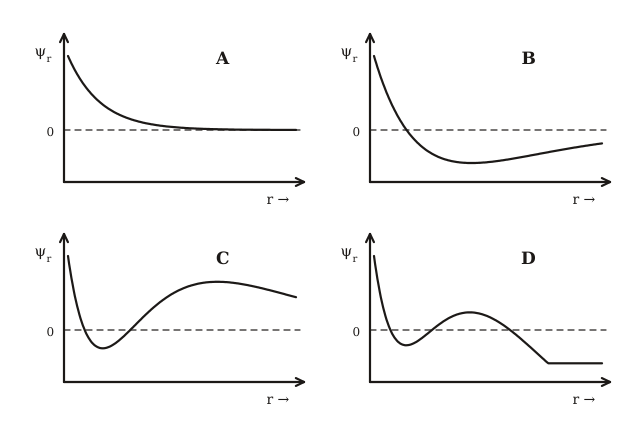
Identify the incorrect statement from the following.
Page numbers are the ones printed in the current NCERT textbook (2023 rationalised edition), unless marked pre-2023. The books are free at ncert.nic.in.
Test yourself on this topic with real past-paper questions:
Practice this topic →