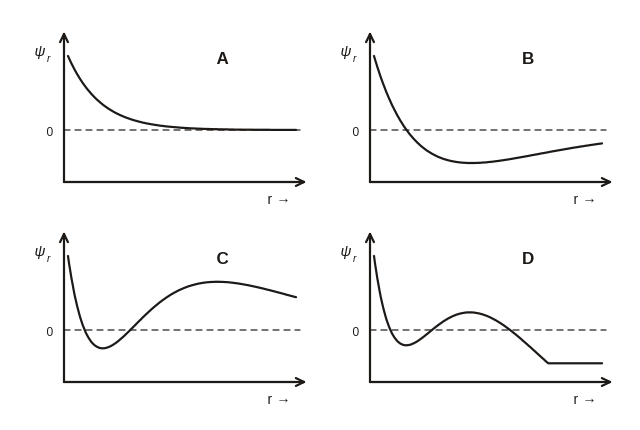
Try this first: NEET 2025 PYQ
- A.En(Li 2+) = –8.72 × 10⁻¹⁶ J; rn(Li2+) = 17.6 pm En(He+ ) = –19.62 × 10⁻¹⁶ J; rn(He+ ) = 17.6 pm
- B.En(Li 2+) = –19.62 × 10⁻¹⁸ J; rn(Li2+) = 17.6 pm En(He+ ) = –8.72 × 10⁻¹⁸ J; rn(He+ ) = 26.4 pm
- C.En(Li 2+) = –8.72 × 10⁻¹⁸ J; rn(Li2+) = 26.4 pm En(He+ ) = –19.62 × 10⁻¹⁸ J; rn(He+ ) = 17.6 pm
- D.En(Li 2+) = –19.62 × 10⁻¹⁶ J; rn(Li2+) = 17.6 pm En(He+ ) = –8.72 × 10⁻¹⁶ J; rn(He+ ) = 26.4 pm
Tap to see the answer
Answer: B.
A is wrong: The energies are 100 times too large and swapped: E1 = −2.18 × 10⁻¹⁸ J × Z² gives −19.62 × 10⁻¹⁸ J for Li2+ (Z = 3) and −8.72 × 10⁻¹⁸ J for He+ (Z = 2); r1 = 52.9/Z pm gives 17.6 pm and 26.4 pm, not 17.6 pm for both.
C is wrong: The values are swapped between the ions: with E1 = −2.18 × 10⁻¹⁸ J × Z² and r1 = 52.9/Z pm, Li2+ (Z = 3) has −19.62 × 10⁻¹⁸ J and 17.6 pm, and He+ (Z = 2) has −8.72 × 10⁻¹⁸ J and 26.4 pm.
D is wrong: The radii are right but the energies are 100 times too large: 2.18 × 10⁻¹⁸ J × Z² gives −19.62 × 10⁻¹⁸ J for Li2+ and −8.72 × 10⁻¹⁸ J for He+.
Topic index in NCERT order
12 of 12 lessons by the NCERT chapter they teach from, in book order. The page is the first printed page of your NCERT book the lesson cites; PYQs are the past NEET questions on that topic.
Class 11 Chemistry, Chapter 2
- EM Radiation Photoelectricp. 301 PYQ
- Hydrogen Spectrump. 450 PYQs
- Bohr Model Hydrogenp. 463 PYQs
- Bohr Limitationsp. 490 PYQs
- Dual Nature de Brogliep. 500 PYQs
- Heisenberg Uncertaintyp. 500 PYQs
- Quantum Mechanical Modelp. 530 PYQs
- Quantum Numbersp. 562 PYQs
- Orbital Shapesp. 602 PYQs
- Aufbau Pauli Hundp. 620 PYQs
- Electronic Configurationp. 621 PYQ
- Half Filled Full Filled Stabilityp. 640 PYQs
All 12 lessons
Questions, revision cards and difficulty mix per lesson
Aufbau Pauli Hund
Bohr Limitations
Bohr Model Hydrogen
Dual Nature de Broglie
Electronic Configuration
EM Radiation Photoelectric
Half Filled Full Filled Stability
Heisenberg Uncertainty
Hydrogen Spectrum
Orbital Shapes
Quantum Mechanical Model
Quantum Numbers
Videos for this unit
Long lessonDo Quantum Numbers Feel Like a Table to Memorise? | Structure of Atom NEET PYQs (14 min)
Past-paper questions from this unit
9 questions, NEET 2021–2026
9 questions from NEET 2021, 2022, 2023, 2024, 2025, 2026. Answers verified against NTA official keys.
By year in our set: 2021 (2) · 2022 (2) · 2023 (1) · 2024 (2) · 2025 (1) · 2026 (1)
Lesson: Orbital Shapes
Lesson: Bohr Model Hydrogen
Energy and radius of first Bohr orbit of He+ and Li2+ are [Given RH = 2.18 × 10⁻¹⁸ J, a0 = 52.9 pm]
Why the other options are wrong
- Option 1: The energies are 100 times too large and swapped: E1 = −2.18 × 10⁻¹⁸ J × Z² gives −19.62 × 10⁻¹⁸ J for Li2+ (Z = 3) and −8.72 × 10⁻¹⁸ J for He+ (Z = 2); r1 = 52.9/Z pm gives 17.6 pm and 26.4 pm, not 17.6 pm for both.
- Option 3: The values are swapped between the ions: with E1 = −2.18 × 10⁻¹⁸ J × Z² and r1 = 52.9/Z pm, Li2+ (Z = 3) has −19.62 × 10⁻¹⁸ J and 17.6 pm, and He+ (Z = 2) has −8.72 × 10⁻¹⁸ J and 26.4 pm.
- Option 4: The radii are right but the energies are 100 times too large: 2.18 × 10⁻¹⁸ J × Z² gives −19.62 × 10⁻¹⁸ J for Li2+ and −8.72 × 10⁻¹⁸ J for He+.
Lesson: Bohr Model Hydrogen
Why the other options are wrong
- Option 2: Energy of hydrogen like species scales as Z²/n². He+ (Z = 2, n = 1) gives 4/1 = 4 and Be3+ (Z = 4, n = 2) gives 16/4 = 4, so the energy is the same, −x, not −x/9.
- Option 3: The factors are equal, not four times apart: Z²/n² is 4/1 for He+ and 16/4 for Be3+, so the energy is −x.
- Option 4: Z²/n² is 4 for both He+ (n = 1) and Be3+ (n = 2), so the ratio is 1 and the energy is −x.
Lesson: Quantum Numbers
Why the other options are wrong
- Option 1: A is III, not I: ml designates the orientation of the orbital. B is IV, not III: ms refers to orientation of the spin of the electron.
- Option 3: C and D are swapped: l defines the three-dimensional shape of the orbital, while n defines the shell, determines the size of the orbital.
- Option 4: Every pair is off: ml designates the orientation of the orbital, ms refers to orientation of the spin of the electron, l gives the shape and n the size of the orbital.
Lesson: Quantum Numbers
Why the other options are wrong
- Option 1: The roles are swapped: for a given l, ml has (2l+1) values, so nₘ = 2l + 1, not l = 2nₘ + 1.
- Option 2: There is no square: ml has (2l+1) values, so nₘ = 2l + 1.
- Option 3: ml has (2l+1) values; nₘ = l + 2 fails for l = 2, where there are five d orbitals, not four.
Lesson: Orbital Shapes
Identify the incorrect statement from the following.
Why the other options are wrong
- Option 2: This statement is correct, so it is not the answer: d orbitals with n greater than 3 have shapes similar to 3d orbital, but differ in energy and size, so each 5d orbital differs in size from its 4d counterpart.
- Option 3: This statement is correct: the d orbitals for which n is greater than 3 (4d, 5d...) also have shapes similar to 3d orbital.
- Option 4: This statement is correct: all five 3d orbitals are equivalent in energy in a free atom.
Lesson: Bohr Model Hydrogen
Why the other options are wrong
- Option 1: The value is 158.7 pm, not Å. Radius scales as n²/Z: He+ with n = 2 gives (4/2) a0 = 105.8 pm, so a0 = 52.9 pm, and Li2+ with n = 3 gives (9/3) × 52.9 = 158.7 pm.
- Option 3: Ten times too small: r = 52.9 × n²/Z pm, and for Li2+ with n = 3 and Z = 3 that is 3 × 52.9 = 158.7 pm.
- Option 4: A hundred times too small: for Li2+ (Z = 3) the third orbit has r = 52.9 × 9/3 = 158.7 pm.
Lesson: EM Radiation Photoelectric
Why the other options are wrong
- Option 1: Using c = νλ, λ = (3.0 × 10^8 m s–1)/(1.368 × 10^6 s–1) = 219.3 m, not centimetres.
- Option 3: 3.0 × 10^8/1.368 × 10^6 = 219.30 m, which rounds to 219.3 m, not 219.2 m.
- Option 4: Ten times too large: λ = c/ν = 3.0 × 10^8/1.368 × 10^6 = 219.3 m.
Lesson: Electronic Configuration
From the following pairs of ions which one is not an iso-electronic pair?
Exam traps and common mistakes in this unit
4 items
Lesson: Bohr Model Hydrogen
Category: Similar Terms
Student forgets Z² scaling when applying Bohr formulas to He⁺ (Z=2) or Li²⁺ (Z=3).
When it triggers
Question involves hydrogen-like ion (He+, Li2+, etc.).
How to avoid
E_n = -13.6 × Z²/n² eV. r_n = (0.529/Z) × n² Å. He+: 4× more bound than H. Li²⁺: 9× more bound. Always include Z².
Lesson: Electronic Configuration
Category: Inorganic Exception
Student writes Cr as [Ar]3d⁴4s² (expected) instead of actual [Ar]3d⁵4s¹. Same for Cu: actual [Ar]3d¹⁰4s¹ (one e⁻ promoted from 4s to 3d).
When it triggers
Question asks for ground-state electronic configuration of Cr (Z=24) or Cu (Z=29).
How to avoid
Half-filled (d⁵) and fully filled (d¹⁰) configurations have extra stability from exchange energy and symmetry. Cr and Cu adopt these configurations by promoting one 4s electron.
Lesson: Bohr Model Hydrogen
Root cause: formula misuse
Correction
Always include Z². E_n = -13.6 × Z²/n². For He+: 4× more energetic than H. For Li²⁺: 9×.
Lesson: Half Filled Full Filled Stability
Root cause: concept gap
Correction
Half-filled (d⁵) and full-filled (d¹⁰) configurations have extra exchange-energy stability. Cr and Cu adopt these by promoting one 4s electron.
Formulas in this unit
5 formulas
Lesson: Bohr Model Hydrogen
Bohr energy (hydrogen-like)
Energy of nth orbit. Negative (bound). Ground state H: -13.6 eV.
| Symbol | Quantity | SI Unit |
|---|---|---|
| E_n | orbit energy | eV |
| Z | nuclear charge | - |
| n | principal | - |
Valid when
- Hydrogen-like atom
- Non-relativistic
Lesson: Bohr Model Hydrogen
Bohr radius (hydrogen-like)
Radius of nth Bohr orbit for hydrogen-like atom of nuclear charge Z.
| Symbol | Quantity | SI Unit |
|---|---|---|
| n | principal quantum number | - |
| Z | nuclear charge | - |
| r_n | orbit radius | Å |
Valid when
- Hydrogen-like (one-electron) atom
- Non-relativistic
Lesson: Dual Nature de Broglie
de Broglie wavelength
Wavelength associated with moving particle of momentum mv.
| Symbol | Quantity | SI Unit |
|---|---|---|
| h | Planck 6.626e-34 | J*s |
| m | mass | kg |
| v | velocity | m/s |
Valid when
- Non-relativistic
Lesson: Heisenberg Uncertainty
Heisenberg uncertainty
Position and momentum cannot both be known with arbitrary precision.
| Symbol | Quantity | SI Unit |
|---|---|---|
| Δx | position uncertainty | m |
| Δp | momentum uncertainty | kg*m/s |
Valid when
- Quantum scale; meaningful only when Δx, Δp comparable to atomic dimensions
Lesson: Hydrogen Spectrum
Rydberg formula (H spectrum)
Spectral wavelengths of hydrogen-like atoms. Lyman (n1=1, UV), Balmer (n1=2, visible), Paschen (n1=3, IR).
| Symbol | Quantity | SI Unit |
|---|---|---|
| lambda | wavelength | m |
| R_H | Rydberg 1.097e7 | 1/m |
| Z | nuclear charge | - |
| n1, n2 | integers, n2>n1 | - |
Valid when
- One-electron atom
NEET question patterns in this unit
3 patterns
Lesson: Aufbau Pauli Hund
Write electronic configuration, especially handling Cr/Cu anomalies and ions.
Common distractors
misses cr cu anomaly
Writes 3d⁴4s² instead of 3d⁵4s¹
Lesson: Bohr Model Hydrogen
Bohr energy difference between two levels; compute photon energy/wavelength using Rydberg or E_n formulas.
Common distractors
forgets z squared
Drops Z² for hydrogen-like
Lesson: Quantum Numbers
Given orbital (e.g. 3p_z) or electron, identify n, l, m_l, m_s. Or check forbidden quantum number combinations.
Common distractors
uses wrong l range
Uses l ≤ n instead of l < n
Questions about this unit
- What does Structure of Atom cover for NEET Chemistry?
- 12 lessons: Aufbau Pauli Hund, Bohr Limitations, Bohr Model Hydrogen, Dual Nature de Broglie, Electronic Configuration, EM Radiation Photoelectric, Half Filled Full Filled Stability, Heisenberg Uncertainty, Hydrogen Spectrum, Orbital Shapes, Quantum Mechanical Model and Quantum Numbers.
- How often has Structure of Atom come up in NEET past papers?
- Our set of verified past papers has 9 questions from this unit, from NEET 2021, 2022, 2023, 2024, 2025 and 2026. Each is answered against the official NTA key.
- Is the Structure of Atom material free?
- Yes. All 12 lessons and 112 practice questions are free, with no login needed.