NEET 2026
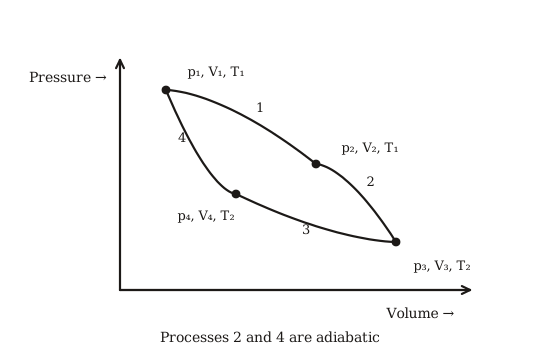
1ΔS_system = 0; ΔS_surroundings = 0
2ΔS_system = 4.606 R; ΔS_surroundings = −4.606 R
3ΔS_system = 0; ΔS_surroundings = 4.606 R
4ΔS_system = 4.606 R; ΔS_surroundings = 0
NTA Answer: Option 4(final)
7 lessons
7 of 7 lessons by the NCERT chapter they teach from, in book order. The page is the first printed page of your NCERT book the lesson cites; PYQs are the past NEET questions on that topic.
13 questions from NEET 2020, 2021, 2023, 2024, 2025, 2026. Answers verified against NTA official keys.
By year in our set: 2020 (3) · 2021 (2) · 2023 (2) · 2024 (3) · 2025 (1) · 2026 (2)
Lesson: Spontaneity Entropy
Lesson: First Law Thermodynamics
Lesson: Enthalpies Various
Lesson: Spontaneity Entropy
Lesson: First Law Thermodynamics
Lesson: Enthalpy Heat Capacity
Lesson: Gibbs Free Energy
Lesson: Enthalpy Heat Capacity
Lesson: Spontaneity Entropy
For irreversible expansion of an ideal gas under isothermal condition, the correct option is:
Lesson: First Law Thermodynamics
The correct option for free expansion of an ideal gas under adiabatic condition is :
Lesson: Gibbs Free Energy
Lesson: Spontaneity Entropy
For the reaction, 2Cl(g) → Cl2 (g), the correct option is :
Lesson: Hess's Law
Category: Sign Convention
When reversing a reaction, ΔH changes sign. Multiply: same as multiply ΔH.
Hess's law problem with combination of multiple reactions.
If reaction is reversed: ΔH → -ΔH. If multiplied by factor n: ΔH → n×ΔH. Apply systematically when combining.
Lesson: Gibbs Free Energy
Root cause: sign error
K > 1: ln K > 0 → ΔG° < 0 (forward favoured). K < 1: ln K < 0 → ΔG° > 0 (reverse favoured). At equilibrium K=1, ΔG°=0.
Lesson: Gibbs Free Energy
Root cause: concept gap
Spontaneity from ΔG = ΔH - TΔS. Endothermic reactions can be spontaneous if TΔS > ΔH (ice melting at room T).
Lesson: Hess's Law
Root cause: sign error
Reversing a reaction: ΔH → -ΔH. Multiplying by n: ΔH → n·ΔH. Apply consistently before summing.
Lesson: Enthalpies Various
From standard formation enthalpies. ΔH°_f of element in standard state = 0.
| Symbol | Quantity | SI Unit |
|---|---|---|
| ΔH°_f | standard formation enthalpy | kJ/mol |
Lesson: Enthalpy Heat Capacity
Enthalpy = internal energy + PV. At constant pressure, heat absorbed equals enthalpy change.
| Symbol | Quantity | SI Unit |
|---|---|---|
| H | enthalpy | J |
| U | internal energy | J |
| P | pressure | Pa |
| V | volume | m^3 |
Lesson: First Law Thermodynamics
Internal energy change = heat added to system + work done ON system. Note: chemistry uses w as work done ON system; physics uses w as work done BY.
| Symbol | Quantity | SI Unit |
|---|---|---|
| ΔU | internal energy change | J |
| q | heat | J |
| w | work on system | J |
Lesson: Gibbs Free Energy
Spontaneity criterion. ΔG<0: spontaneous. ΔG=0: equilibrium. ΔG>0: non-spontaneous.
| Symbol | Quantity | SI Unit |
|---|---|---|
| ΔG | Gibbs energy change | kJ |
| ΔH | enthalpy | kJ |
| ΔS | entropy | kJ/K |
| T | temperature | K |
Lesson: Gibbs Free Energy
Standard free energy change relates to equilibrium constant. K>1: ΔG°<0; K<1: ΔG°>0.
| Symbol | Quantity | SI Unit |
|---|---|---|
| ΔG° | standard free energy | J/mol |
| R | gas constant 8.314 | J/mol/K |
| T | temp | K |
| K | equilibrium constant | - |
Lesson: Hess's Law
Total enthalpy change is independent of path. Useful for computing ΔH of reactions not directly measurable.
| Symbol | Quantity | SI Unit |
|---|---|---|
| ΔH | enthalpy change | J or kJ |
Lesson: Gibbs Free Energy
ignores temperature
Uses ΔH alone for spontaneity
Lesson: Hess's Law
wrong sign when reversing
Forgets to negate ΔH when reversing equation