ΔU = q + w, where q is heat added to system, w is work done ON system (chemistry sign convention; physics uses w = work done BY). Energy is conserved.
-- NCERT Class 11 Chemistry, Ch. 5, p. 139First Law Thermodynamics
8 MCQs1 revision card9-step worked example
Source: NCERT ThermodynamicsPYQ coverage: NEET 2020, 2024, 2026Official key: NTA-verifiedLast updated: 24 Sep 2026
First Law Thermodynamics, explained for NEET
The first law of thermodynamics is a conservation law: energy cannot be created or destroyed, only transferred between a system and its surroundings as heat or work.
In the chemistry sign convention (NCERT Class 11 Chemistry Chapter 5, page 139), the law is written as:
ΔU = q + w
where ΔU is the change in internal energy, q is heat exchanged, and w is work done on the system. This sign convention is the single detail that trips up NEET aspirants on this topic — physics writes w as work done by the system (ΔU = q − w), and mixing the two conventions flips the sign of the work term.
How the signs work in chemistry convention:
- Heat absorbed by system → q is positive.
- Heat released by system → q is negative.
- Work done on system (compression) → w is positive.
- Work done by system (expansion) → w is negative.
For an ideal gas expanding against external pressure, w = −P_ext ΔV. If the gas expands (ΔV > 0), the system does work on the surroundings, so w is negative — the system loses energy through work.
Three special cases you must recognize instantly:
- Adiabatic process (q = 0): ΔU = w. All energy change comes from work.
- Isochoric process (ΔV = 0, so w = 0): ΔU = q_v. Heat at constant volume directly measures ΔU.
- Cyclic process (system returns to initial state): ΔU = 0, so q = −w.
The NEET-relevant confusion: when a question states "work done by the gas is 200 J," you must enter w = −200 J into ΔU = q + w (chemistry convention). Writing +200 J is the sign-convention trap.
Internal energy is a state function — its change depends only on initial and final states, not the path. Heat and work are path functions. This distinction appears in conceptual NEET questions that ask which quantity is path-independent.
Can you answer these First Law Thermodynamics MCQs?
Select an option to see the explanation. Wrong answers show why your choice was tempting — and name the exact trap it exploits.
MCQ 1Direct ApplicationPractice
According to the first law of thermodynamics (chemistry convention), if a system absorbs 500 J of heat and has 200 J of work done on it, what is ΔU?
Show answer and why every option is right or wrong
Answer: D. ΔU = q + w = 500 + 200 = 700 J. Heat absorbed is positive, work done on the system is positive in chemistry convention (NCERT Class 11 Chemistry Chapter 5, page 139).
Why A is wrong: A (300 J) results from subtracting w from q: ΔU = 500 − 200. This uses the physics convention (ΔU = q − w) instead of the chemistry convention (ΔU = q + w).
Why B is wrong: B (−700 J) results from making both q and w negative before adding. When the problem states heat is absorbed and work is done on the system, both are positive in chemistry convention.
Why C is wrong: C (−300 J) results from reversing both signs: ΔU = −q + w or similar misapplication. Neither sign should be flipped when both q and w are already stated with their chemistry-convention signs.
MCQ 2Direct ApplicationPractice
A gas expands against a constant external pressure and does 150 J of work on the surroundings. In the chemistry sign convention, what is the value of w?
Show answer and why every option is right or wrong
Answer: C. In chemistry convention, w is work done ON the system. The gas does 150 J of work on the surroundings, so the surroundings do −150 J on the system. Therefore w = −150 J (NCERT Class 11 Chemistry Chapter 5, page 139).
Why A is wrong: A (+150 J) confuses work done by the system with work done on the system. Chemistry convention defines w as work done on the system; expansion work by the gas is negative.
Why B is wrong: B (0 J) would apply only if there were no volume change (isochoric process). Here the gas explicitly expands, so w ≠ 0.
Why D is wrong: D (+300 J) has no basis — it doubles the magnitude and gets the sign wrong. No operation in ΔU = q + w produces this from 150 J of expansion work.
MCQ 3Easy RecallPractice
For a cyclic process, which of the following is true?
Show answer and why every option is right or wrong
Answer: D. In a cyclic process the system returns to its initial state. Since internal energy is a state function, ΔU = 0. From ΔU = q + w: 0 = q + w, so q = −w (NCERT Class 11 Chemistry Chapter 5, page 139).
Why A is wrong: A (q = 0) would apply to an adiabatic process, not a cyclic one. A cyclic process can exchange heat — the constraint is ΔU = 0, not q = 0.
Why B is wrong: B (w = 0) would apply to an isochoric (constant volume) process. In a cyclic process, work can be non-zero as long as q = −w.
Why C is wrong: C (ΔU = q) applies when w = 0 (isochoric), not in a cyclic process. In a cycle, ΔU = 0 regardless of q and w individually.
MCQ 4Easy RecallPractice
Which of the following quantities is a state function?
Show answer and why every option is right or wrong
Answer: B. Internal energy depends only on the state of the system, not on how the state was reached. Heat and work are path functions — their values depend on the process path (NCERT Class 11 Chemistry Chapter 5, page 139).
Why A is wrong: A is incorrect. Heat (q) is a path function — the amount of heat exchanged depends on the process (adiabatic vs isothermal paths between the same states give different q).
Why C is wrong: C is incorrect. Work (w) is a path function — reversible and irreversible expansion between the same states produce different amounts of work.
Why D is wrong: D is incorrect. Neither q nor w is a state function. Only ΔU (the combination q + w) is path-independent.
MCQ 5Direct ApplicationPractice
In an adiabatic process, a gas is compressed and 300 J of work is done on it. What is ΔU?
Show answer and why every option is right or wrong
Answer: A. Adiabatic means q = 0. So ΔU = q + w = 0 + 300 = +300 J. Work done on the system is positive in chemistry convention (NCERT Class 11 Chemistry Chapter 5, page 139).
Why B is wrong: B (0 J) would be correct for a cyclic process (ΔU = 0), not an adiabatic one. Adiabatic sets q = 0, not ΔU = 0.
Why C is wrong: C (−300 J) reverses the sign of w. When work is done ON the gas (compression), w = +300 J in chemistry convention, not −300 J.
Why D is wrong: D (+600 J) doubles the value with no justification. In ΔU = q + w with q = 0, there is no factor of 2.
MCQ 6Direct ApplicationPractice
For a process at constant volume, a system releases 400 J of heat to its surroundings. What is ΔU for the system?
Show answer and why every option is right or wrong
Answer: A. At constant volume, w = 0 (no PΔV work). ΔU = q + w = q + 0 = q. The system releases heat, so q = −400 J. Therefore ΔU = −400 J (NCERT Class 11 Chemistry Chapter 5, page 139).
Why B is wrong: B (+400 J) gets the sign of q wrong. The system releases heat, meaning q is negative (−400 J), not positive.
Why C is wrong: C (0 J) confuses constant volume with a cyclic process. At constant volume, ΔU = q_v, which is non-zero when heat is exchanged.
Why D is wrong: D is incorrect because at constant volume we don't need pressure. w = −P_ext ΔV = 0 since ΔV = 0, regardless of pressure. ΔU = q is fully determined.
MCQ 7Direct ApplicationPractice
A system absorbs 1000 J of heat and expands, doing 400 J of work on the surroundings. What is ΔU of the system (chemistry convention)?
Show answer and why every option is right or wrong
Answer: C. Heat absorbed: q = +1000 J. Work done by system on surroundings = 400 J, so w = −400 J (chemistry convention: w = work on system). ΔU = q + w = 1000 + (−400) = 600 J (NCERT Class 11 Chemistry Chapter 5, page 139).
Why A is wrong: A (1400 J) adds q and |w| as if both are positive: 1000 + 400. This treats expansion work as work done on the system — the sign-convention trap. Expansion work by the system means w = −400 J.
Why B is wrong: B (1000 J) ignores the work term entirely (sets w = 0). Work was done during expansion, so w ≠ 0.
Why D is wrong: D (400 J) confuses ΔU with the work term alone, ignoring the heat absorbed.
MCQ 8Concept TrapPractice
An ideal gas undergoes free expansion into vacuum. Which of the following is correct?
Show answer and why every option is right or wrong
Answer: B. In free expansion, P_ext = 0, so w = −P_ext ΔV = 0. For an ideal gas, internal energy depends only on temperature; since no work is done and the process is adiabatic (sudden expansion, no heat exchange), q = 0 and ΔU = 0. Temperature remains unchanged (NCERT Class 11 Chemistry Chapter 5, page 139).
Why A is wrong: A assumes the gas gains energy during expansion. With P_ext = 0, no work is done on or by the system, and free expansion into vacuum exchanges no heat.
Why C is wrong: C assumes w < 0 (expansion work). But expansion against zero external pressure means w = −P_ext ΔV = −(0)(ΔV) = 0, not negative.
Why D is wrong: D assumes heat is absorbed. Free expansion into vacuum is a rapid irreversible process with no thermal reservoir interaction; q = 0.
Free NEET study resources
Get a structured 30-day study plan and a complete formula booklet — delivered to your inbox instantly.
First Law Thermodynamics: quick recall before you leave
How do you solve a First Law Thermodynamics question? A worked example
- 1
Given
A gas absorbs 2.5 kJ of heat at constant pressure. During this process, the gas expands and does 0.8 kJ of work on the surroundings.
- 2
Required
Find the change in internal energy (ΔU) of the system.
- 3
Concept
First law of thermodynamics in chemistry convention: ΔU = q + w, where w is work done on the system. Since the gas does work on the surroundings, the work done on the system is the negative of that value.
- 4
Formula
ΔU = q + w
- 5
Substitution
q = +2.5 kJ (heat absorbed → positive)
Work done by system on surroundings = 0.8 kJ → w = −0.8 kJ (chemistry convention)
ΔU = 2.5 + (−0.8) - 6
Calculation
ΔU = 2.5 − 0.8 = 1.7 kJ
- 7
Final answer
ΔU = +1.7 kJ
The system's internal energy increases by 1.7 kJ. The heat absorbed (2.5 kJ) is split: 0.8 kJ goes into expansion work against the surroundings, and the remaining 1.7 kJ raises the internal energy.
Note on exact values: The quantities 2.5 kJ and 0.8 kJ are given values in the problem statement; the arithmetic 2.5 − 0.8 = 1.7 is exact within the precision of the given data. - 8
Common trap
Writing w = +0.8 kJ (forgetting to negate when the gas does work on surroundings). This gives ΔU = 2.5 + 0.8 = 3.3 kJ — the classic sign-convention error between physics and chemistry conventions. Always ask: "Is this work done ON the system or BY the system?"
- 9
Similar NEET-style question
A system at constant pressure absorbs 5.0 kJ of heat while expanding against external pressure, doing 1.2 kJ of work. Calculate ΔU. (Answer: ΔU = 5.0 + (−1.2) = 3.8 kJ)
---
What to remember before solving First Law Thermodynamics questions
Which First Law Thermodynamics formulas do you need for NEET?
First law of thermodynamics (chemistry)
Internal energy change = heat added to system + work done ON system. Note: chemistry uses w as work done ON system; physics uses w as work done BY.
| Symbol | Quantity | SI Unit |
|---|---|---|
| ΔU | internal energy change | J |
| q | heat | J |
| w | work on system | J |
Valid when
- Closed system
- Sign convention chosen consistently
More in Thermodynamics: 4 exam traps and mistakes · 5 formulas · 2 question patterns from its other lessons.
First Law Thermodynamics questions from past NEET papers
3 questions from NEET 2020, 2024, 2026. Answers verified against NTA official keys.
NEET 2026
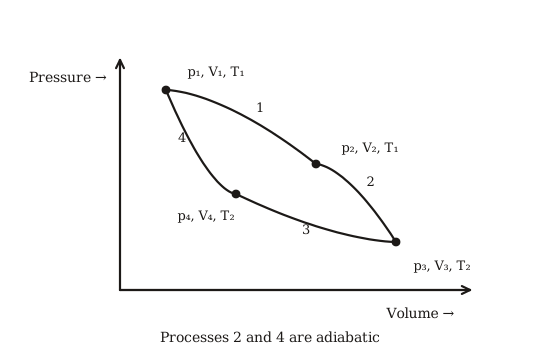
1w₁ + w₃ = −2T₁ ln(V₂/V₁) − 2T₂ ln(V₄/V₃)
2w₂ + w₄ = ΔU₂ − ΔU₄
3w₁ + w₂ = 2T₁ ln(V₂/V₁)
4w₁ + w₂ + w₃ + w₄ = 0
NTA Answer: Option 1(final)
NEET 2024Revised key
10 calorie
2–413.14 calories
3413.14 calories
4100 calories
NTA Answer: Option 2(revised_final)
NEET 2020
The correct option for free expansion of an ideal gas under adiabatic condition is :
1q > 0, ∆T > 0 and w > 0
2q=0, ∆T=0 and w=0
3q=0, ∆T < 0 and w > 0
4q < 0, ∆T=0 and w=0
NTA Answer: Option 2(final)
Sources
NCERT refs: Class 11 Chemistry Chapter 5, p.139
Page numbers are the ones printed in the current NCERT textbook (2023 rationalised edition), unless marked pre-2023. The books are free at ncert.nic.in.
Test yourself on this topic with real past-paper questions:
Practice this topic →