k = A·e^(-Ea/RT), where Ea = activation energy, A = frequency factor. ln k = ln A - Ea/(RT). For two T: ln(k₂/k₁) = (Ea/R)(1/T₁ - 1/T₂).
-- NCERT Class 12 Chemistry, Ch. 3, p. 79Arrhenius Theory
8 MCQs2 revision cards9-step worked example
Source: NCERT Chemical KineticsPYQ coverage: NEET 2021, 2023, 2024, 2026Official key: NTA-verifiedLast updated: 24 Sep 2026
Arrhenius Theory, explained for NEET
The trap first: the Arrhenius two-temperature formula contains the term (1/T₁ − 1/T₂). Swapping T₁ and T₂ flips the sign of Eₐ to negative — a physically meaningless result that costs you the full mark plus the negative-marking penalty.
The Arrhenius equation relates the rate constant k to temperature: k = Ae^(−Eₐ/RT). Here A is the frequency factor (pre-exponential factor), Eₐ is the activation energy in J/mol, R = 8.314 J mol⁻¹ K⁻¹, and T is absolute temperature in kelvin (NCERT Class 12 Chemistry Chapter 3, page 80). The exponential term represents the fraction of molecular collisions possessing sufficient energy to cross the activation barrier. A larger Eₐ means the rate constant is more sensitive to temperature changes.
The NEET-critical working form compares two temperatures: ln(k₂/k₁) = (Eₐ/R)(1/T₁ − 1/T₂). This is derived by writing the Arrhenius equation at T₁ and T₂ and subtracting the logarithmic forms.
Sign discipline: assign labels so T₂ > T₁. Then k₂ > k₁ (reactions speed up at higher temperature), making ln(k₂/k₁) > 0. On the right side, 1/T₁ > 1/T₂ when T₁ < T₂, so the bracket is also positive. Both sides positive → Eₐ positive. If your computed Eₐ is negative, you swapped the temperatures.
An NCERT-stated empirical observation: for many reactions, the rate roughly doubles per 10 K rise (Class 12 Chemistry Chapter 3, page 80). This is a consequence of the Arrhenius equation, not a separate law, and holds only for typical Eₐ values (~50–100 kJ/mol).
Watch-out: NEET problems sometimes state temperatures in °C. Always convert: T(K) = T(°C) + 273.
Can you answer these Arrhenius Theory MCQs?
Select an option to see the explanation. Wrong answers show why your choice was tempting — and name the exact trap it exploits.
MCQ 1Easy RecallPractice
In the Arrhenius equation k = Ae^(−Eₐ/RT), the quantity Eₐ represents:
Show answer and why every option is right or wrong
Answer: B. Eₐ is the activation energy — the minimum energy that colliding reactant molecules must possess for the reaction to proceed (NCERT Class 12 Chemistry Chapter 3, page 80).
Why A is wrong: A is wrong because the energy released during product formation relates to ΔH (enthalpy of reaction), not Eₐ. Activation energy is the barrier height above reactant energy, not the net energy change.
Why C is wrong: C is wrong because ΔH is the difference between product and reactant enthalpies. Eₐ is the height of the energy barrier — a reaction can have a small ΔH but a large Eₐ, or vice versa.
Why D is wrong: D is wrong because the average kinetic energy of molecules is (3/2)RT per mole (from kinetic theory). Eₐ is a reaction-specific constant, not a temperature-dependent average.
MCQ 2Easy RecallPractice
The pre-exponential factor A in the Arrhenius equation has:
Show answer and why every option is right or wrong
Answer: C. Since k = Ae^(−Eₐ/RT) and the exponential is dimensionless, A must carry the same units as k (NCERT Class 12 Chemistry Chapter 3, page 80). For a first-order reaction, A has units s⁻¹; for a second-order reaction, L mol⁻¹ s⁻¹.
Why A is wrong: A is wrong because if A were dimensionless, the equation k = A × (dimensionless) would make k dimensionless. Rate constants have definite units depending on reaction order, so A cannot be unitless.
Why B is wrong: B is wrong because J/mol are units of energy. A represents the frequency of effective collisions, not an energy quantity. The energy term Eₐ/(RT) in the exponent is dimensionless by cancellation.
Why D is wrong: D is wrong because kelvin is a temperature unit. A has the same dimensions as k (e.g., s⁻¹ for first-order), which has nothing to do with temperature units.
MCQ 3Easy RecallPractice
For many reactions, the rate constant approximately doubles for every 10 K rise in temperature. This empirical observation is a direct consequence of:
Show answer and why every option is right or wrong
Answer: B. The doubling rule follows from the exponential temperature dependence in k = Ae^(−Eₐ/RT). For typical Eₐ values (50–100 kJ/mol), a 10 K rise near room temperature approximately doubles the Boltzmann factor (NCERT Class 12 Chemistry Chapter 3, page 80).
Why A is wrong: A is wrong because Le Chatelier's principle describes the shift of equilibrium position under stress. It does not predict the quantitative change in rate constant with temperature.
Why C is wrong: C is wrong because Hess's law states enthalpy change is independent of the reaction path. It is a thermodynamic principle about ΔH, not a kinetic statement about rate-constant variation.
Why D is wrong: D is wrong because the law of mass action gives the form of the equilibrium expression. It does not contain the exponential temperature dependence that explains rate doubling.
MCQ 4Direct ApplicationPractice
The rate constant of a reaction doubles when the temperature is raised from 300 K to 310 K. Using ln 2 = 0.693 and R = 8.314 J mol⁻¹ K⁻¹, the activation energy Eₐ is closest to:
Show answer and why every option is right or wrong
Answer: A. A is correct. From ln(k₂/k₁) = (Eₐ/R)(1/T₁ − 1/T₂): ln 2 = 0.693, and 1/300 − 1/310 = 10/93000 = 1.075 × 10⁻⁴ K⁻¹. So Eₐ = 8.314 × 0.693 / 1.075 × 10⁻⁴ = 5.36 × 10⁴ J/mol = 53.6 kJ/mol. This is the size of activation energy behind the familiar 'rate doubles for 10 K' rule.
Why B is wrong: B is wrong because 23.3 kJ/mol comes from using log₁₀ 2 = 0.301 in the natural-log equation. The log₁₀ form needs a factor of 2.303: log(k₂/k₁) = (Eₐ/2.303R)(1/T₁ − 1/T₂).
Why C is wrong: C is wrong because 6.4 kJ/mol comes from leaving R out: 0.693 / 1.075 × 10⁻⁴ = 6.4 × 10³. That quotient is Eₐ/R, in kelvin; R has to multiply back in.
Why D is wrong: D is wrong because 123 kJ/mol comes from putting a 2.303 into the natural-log form, which multiplies the right answer by 2.303. The 2.303 belongs only with log₁₀.
MCQ 5Direct ApplicationPractice
For a reaction with Eₐ = 100 kJ/mol, a student calculates ln(k₂/k₁) using the two-temperature Arrhenius equation and obtains a negative value. The most likely error is:
Show answer and why every option is right or wrong
Answer: A. When T₂ > T₁, the correct bracket is (1/T₁ − 1/T₂), which is positive. Writing it as (1/T₂ − 1/T₁) gives a negative bracket, making the right side negative. Since Eₐ is always positive, this forces ln(k₂/k₁) to appear negative — a sign error from swapping T₁ and T₂ (related to mistake mistake: arrhenius t subtraction).
Why B is wrong: B is wrong because forgetting °C to K conversion gives incorrect temperature values, producing a wrong numerical answer. However, both temperatures would still yield a positive (1/T₁ − 1/T₂) as long as T₂ > T₁ in whatever scale is used (°C values are both positive above 0°C), so the sign would not flip.
Why C is wrong: C is wrong because using R in J mol⁻¹ K⁻¹ versus kJ mol⁻¹ K⁻¹ changes the magnitude of Eₐ by a factor of 1000, but does not flip the sign. A unit mismatch gives an Eₐ that is 1000× too large or too small, not negative.
Why D is wrong: D is wrong because using log₁₀ instead of ln scales the left side by a factor of 2.303 but does not change its sign. ln(k₂/k₁) and log₁₀(k₂/k₁) are both positive when k₂ > k₁.
MCQ 6Direct ApplicationPractice
For a reaction, k₁ = 1.0 × 10⁻³ s⁻¹ at 500 K and k₂ = 2.0 × 10⁻² s⁻¹ at 700 K. Using R = 8.314 J mol⁻¹ K⁻¹ and ln 20 = 3.0, the activation energy Eₐ is closest to:
Show answer and why every option is right or wrong
Answer: B. B is correct. The ratio of the rate constants is (2.0 × 10⁻²)/(1.0 × 10⁻³) = 20, so ln(k₂/k₁) = ln 20 = 3.0. The temperature bracket is 1/500 − 1/700 = 200/350000 = 5.714 × 10⁻⁴ K⁻¹. Then Eₐ = R ln(k₂/k₁)/(1/T₁ − 1/T₂) = 8.314 × 3.0 / 5.714 × 10⁻⁴ = 4.36 × 10⁴ J/mol = 43.6 kJ/mol.
Why A is wrong: A is wrong because 10.1 kJ/mol comes from taking the ratio as 2 rather than 20 — losing a power of ten between 10⁻² and 10⁻³ — and so using ln 2 = 0.693 instead of ln 20.
Why C is wrong: C is wrong because 18.9 kJ/mol comes from using log₁₀ 20 = 1.30 in the natural-log equation without its factor of 2.303.
Why D is wrong: D is wrong because 100 kJ/mol comes from multiplying the natural-log result by 2.303. That factor converts log₁₀ to ln; applying it to an equation already in ln counts the conversion twice.
MCQ 7CalculationPractice
The rate constant of a reaction is 1.0 × 10⁻³ s⁻¹ at 300 K. The activation energy is 83.14 kJ/mol. Using R = 8.314 J mol⁻¹ K⁻¹, the rate constant at 310 K is closest to:
Show answer and why every option is right or wrong
Answer: A. Eₐ/R = 83140/8.314 = 10000 K. (1/300 − 1/310) = 10/93000 = 1.075 × 10⁻⁴ K⁻¹. ln(k₂/k₁) = 10000 × 1.075 × 10⁻⁴ = 1.075. k₂/k₁ = e^1.075 ≈ 2.93. k₂ = 1.0 × 10⁻³ × 2.93 ≈ 2.9 × 10⁻³ s⁻¹.
Why B is wrong: B is wrong because 2.0 × 10⁻³ s⁻¹ gives k₂/k₁ = 2, implying ln(k₂/k₁) = 0.693. The actual ln(k₂/k₁) = 1.075, which gives a ratio of ~2.93, not 2. This error comes from assuming the rate exactly doubles per 10 K regardless of Eₐ.
Why C is wrong: C is wrong because 1.1 × 10⁻³ s⁻¹ barely changes from the original k. This would correspond to Eₐ ≈ 8 kJ/mol — far too low. A high Eₐ of 83.14 kJ/mol causes a nearly 3-fold increase over 10 K.
Why D is wrong: D is wrong because 5.9 × 10⁻³ s⁻¹ gives k₂/k₁ = 5.9, implying ln(k₂/k₁) ≈ 1.775. This would require doubling the exponent — likely from using (1/T₁ − 1/T₂) = 2.15 × 10⁻⁴ (perhaps subtracting reciprocals incorrectly or using wrong temperature values).
MCQ 8CalculationPractice
For a reaction, Eₐ = 60.0 kJ/mol. At temperature T₁, the rate constant is k₁. The temperature must be raised to T₂ such that the rate constant becomes 10k₁. If T₁ = 300 K, using R = 8.314 J mol⁻¹ K⁻¹ and ln 10 = 2.303, T₂ is closest to:
Show answer and why every option is right or wrong
Answer: D. ln(10k₁/k₁) = ln 10 = 2.303. Eₐ/R = 60000/8.314 = 7215 K. 1/T₁ − 1/T₂ = 2.303/7215 = 3.192 × 10⁻⁴ K⁻¹. 1/T₂ = 1/300 − 3.192 × 10⁻⁴ = 3.333 × 10⁻³ − 0.3192 × 10⁻³ = 3.014 × 10⁻³. T₂ = 332 K.
Why A is wrong: A is wrong because 310 K gives (1/300 − 1/310) = 1.075 × 10⁻⁴, and ln(k₂/k₁) = 7215 × 1.075 × 10⁻⁴ ≈ 0.776, so k₂/k₁ ≈ 2.2 — far short of the required 10-fold increase. A 10 K rise is insufficient for this Eₐ.
Why B is wrong: B is wrong because 600 K gives (1/300 − 1/600) = 1.667 × 10⁻³, and ln(k₂/k₁) = 7215 × 1.667 × 10⁻³ ≈ 12.03, so k₂/k₁ ≈ 167,000. This enormous ratio shows 600 K massively overshoots; likely the student confused T₂ = 2T₁ with 'double the rate.'
Why C is wrong: C is wrong because 360 K gives (1/300 − 1/360) = 5.556 × 10⁻⁴, and ln(k₂/k₁) = 7215 × 5.556 × 10⁻⁴ ≈ 4.01, so k₂/k₁ ≈ 55 — far exceeding the required 10-fold. This overshoots the target temperature.
Free NEET study resources
Get a structured 30-day study plan and a complete formula booklet — delivered to your inbox instantly.
Arrhenius Theory: quick recall before you leave
How do you solve a Arrhenius Theory question? A worked example
Pattern: Arrhenius temperature-dependence calculation (NEET pattern: arrhenius temp dependence — observed in NEET 2021 and 2025).
- 1
Given
A reaction has rate constant k₁ = 2.0 × 10⁻² s⁻¹ at T₁ = 298 K and k₂ = 8.0 × 10⁻² s⁻¹ at T₂ = 318 K. R = 8.314 J mol⁻¹ K⁻¹. Find Eₐ.
- 2
Required
Activation energy Eₐ in kJ/mol.
- 3
Concept
The Arrhenius two-temperature equation relates rate constants measured at two different temperatures to the activation energy.
- 4
Formula
ln(k₂/k₁) = (Eₐ/R)(1/T₁ − 1/T₂)
Rearranged: Eₐ = R × ln(k₂/k₁) / (1/T₁ − 1/T₂) - 5
Substitution
ln(k₂/k₁) = ln(8.0 × 10⁻²/2.0 × 10⁻²) = ln 4 = 2 × ln 2 = 2 × 0.693 = 1.386
1/T₁ − 1/T₂ = 1/298 − 1/318
= (318 − 298)/(298 × 318) = 20/94764 = 2.1104 × 10⁻⁴ K⁻¹ - 6
Calculation
Eₐ = 8.314 × 1.386 / 2.1104 × 10⁻⁴
Numerator: 8.314 × 1.386 = 11.523 J/mol
Eₐ = 11.523 / 2.1104 × 10⁻⁴ = 54,602 J/mol
Note on exact values: ln 2 = 0.693 is a given constant for this calculation. The integer 20 in the numerator of the temperature bracket and the integer 2 in the rate-constant ratio are exact counting values and do not limit significant figures. - 7
Final answer
Eₐ ≈ 54.6 kJ/mol
(Reported to 3 significant figures, consistent with the 2-sig-fig precision of the given rate constants. The rate constants 2.0 × 10⁻² and 8.0 × 10⁻² each have 2 sig figs, but their ratio is an exact integer 4, so the precision is limited by the temperature values at 3 sig figs.) - 8
Common trap
Swapping T₁ and T₂ in the bracket: writing (1/318 − 1/298) gives −2.11 × 10⁻⁴, which yields Eₐ = −54.6 kJ/mol. A negative activation energy is physically meaningless. Quick check: if T₂ > T₁ and k₂ > k₁, both sides of the equation must be positive.
- 9
Similar NEET-style question
A first-order reaction has k = 3.0 × 10⁻⁴ s⁻¹ at 350 K and k = 1.2 × 10⁻³ s⁻¹ at 400 K. Find Eₐ. (Answer: use ln 4 = 1.386, (1/350 − 1/400) = 50/140000 = 3.571 × 10⁻⁴. Eₐ = 8.314 × 1.386/3.571 × 10⁻⁴ ≈ 32.3 kJ/mol.)
---
What to remember before solving Arrhenius Theory questions
Key Fact
Effect of temperature
Rate roughly doubles for every 10°C rise (rule of thumb). True dependence: exponential via Arrhenius. Higher Ea → more T-sensitive rate.
-- NCERT Class 12 Chemistry, Ch. 3, p. 78Which Arrhenius Theory formulas do you need for NEET?
Arrhenius equation
Temperature dependence of rate constant. Higher Ea → more T-sensitive rate.
| Symbol | Quantity | SI Unit |
|---|---|---|
| A | frequency factor | same as k |
| Ea | activation energy | J/mol |
| R | gas constant | J/mol/K |
| T | temp | K |
Valid when
- T in kelvins
- Most reactions in modest T range
Arrhenius for two temperatures
Compare rate constants at two temperatures to find Ea.
| Symbol | Quantity | SI Unit |
|---|---|---|
| k1, k2 | rate constants | same units |
| T1, T2 | temperatures | K |
| Ea | activation energy | J/mol |
Valid when
- A constant across temperature range
- T in kelvins
Where do students lose marks on Arrhenius Theory?
These are the exact patterns that cause wrong answers in NEET. Each trap includes when it triggers and how to avoid it.
Root cause: sign error
Correction
ln(k2/k1) = (Ea/R) × (1/T1 - 1/T2). At higher T2, k2 > k1, so ln(k2/k1) > 0. Need 1/T1 > 1/T2.
More in Chemical Kinetics: 4 exam traps and mistakes · 2 formulas · 1 question pattern from its other lessons.
Arrhenius Theory questions from past NEET papers
5 questions from NEET 2021, 2023, 2024, 2026. Answers verified against NTA official keys.
NEET 2026
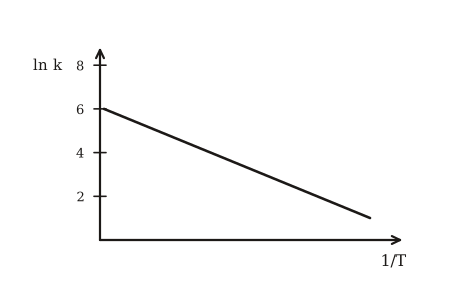
1125 K
2150 K
3200 K
4250 K
NTA Answer: Option 3(final)
NEET 2024Revised key
Activation energy of any chemical reaction can be calculated if one knows the value of
1rate constant at standard temperature
2probability of collision
3orientation of reactant molecules during collision
4rate constant at two different temperatures
NTA Answer: Option 4(revised_final)
NEET 2024Revised key
138.04 kJ/mol
2380.4 kJ/mol
33.80 kJ/mol
43804 kJ/mol
NTA Answer: Option 1(revised_final)
NEET 2023
1Both A and R are true and R is NOT the correct explanation of A
2A is true but R is false
3A is false but R is true
4Both A and R are true and R is the correct explanation of A
NTA Answer: Option 3(final)
NEET 2021
1−83 kJ mol⁻¹
241.5 kJ mol⁻¹
383.0 kJ mol⁻¹
4166 kJ mol⁻¹
NTA Answer: Option 2(final)
How does NEET ask about Arrhenius Theory?
Recurring question shapes from past papers. Each pattern shows why wrong options look tempting.
Find Ea from rate-constant ratio at two temperatures using ln(k2/k1) = Ea/R · (1/T1 − 1/T2).
Multi StepMedium
Common distractors
wrong sign of 1 over t
Mixes T1 and T2 in subtraction
Sources
NCERT refs: Class 12 Chemistry Chapter 3, p.80
Page numbers are the ones printed in the current NCERT textbook (2023 rationalised edition), unless marked pre-2023. The books are free at ncert.nic.in.
Test yourself on this topic with real past-paper questions:
Practice this topic →