Try this first: NEET 2025 PYQ
- A.21.0 s
- B.69.3 s
- C.23.1 s
- D.210 s
Tap to see the answer
Answer: B.
A is wrong: 21.0 s is too short. t = (2.303/k) log ([R]0/[R]) = (2.303/0.03) × log 8 = 76.77 × 0.903 ≈ 69.3 s.
C is wrong: 23.1 s is one half-life (log 2). Going from 7.2 to 0.9 mol L⁻¹ is a factor of 8 = 2³, so t = (2.303/0.03) × 3 × 0.301 ≈ 69.3 s.
D is wrong: 210 s is about three times too long. (2.303/0.03) × log 8 ≈ 69.3 s.
Topic index in NCERT order
8 of 8 lessons by the NCERT chapter they teach from, in book order. The page is the first printed page of your NCERT book the lesson cites; PYQs are the past NEET questions on that topic.
Class 12 Chemistry, Chapter 3
- Rate of Reactionp. 640 PYQs
- Factors Affecting Ratep. 660 PYQs
- Rate Law Rate Constantp. 671 PYQ
- Order Molecularityp. 700 PYQs
- Half Lifep. 731 PYQ
- Zero First Order Kineticsp. 735 PYQs
- Arrhenius Theoryp. 785 PYQs
- Collision Theoryp. 831 PYQ
All 8 lessons
Questions, revision cards and difficulty mix per lesson
Arrhenius Theory
Collision Theory
Factors Affecting Rate
Half Life
Order Molecularity
Rate Law Rate Constant
Rate of Reaction
Zero First Order Kinetics
Past-paper questions from this unit
13 questions, NEET 2020–2026
13 questions from NEET 2020, 2021, 2022, 2023, 2024, 2025, 2026. Answers verified against NTA official keys.
By year in our set: 2020 (2) · 2021 (1) · 2022 (2) · 2023 (2) · 2024 (2) · 2025 (2) · 2026 (2)
Lesson: Zero First Order Kinetics
Lesson: Arrhenius Theory
Lesson: Zero First Order Kinetics
Why the other options are wrong
- Option 1: 21.0 s is too short. t = (2.303/k) log ([R]0/[R]) = (2.303/0.03) × log 8 = 76.77 × 0.903 ≈ 69.3 s.
- Option 3: 23.1 s is one half-life (log 2). Going from 7.2 to 0.9 mol L⁻¹ is a factor of 8 = 2³, so t = (2.303/0.03) × 3 × 0.301 ≈ 69.3 s.
- Option 4: 210 s is about three times too long. (2.303/0.03) × log 8 ≈ 69.3 s.
Lesson: Half Life
Why the other options are wrong
- Option 2: 2 minutes is only two half-lives, which leaves 25% of the reactant. From k = (2.303/t) log ([R]0/[R]), 99.9% completion needs log 1000 = 3, so t = 3 × 2.303/k, about 10 half-lives.
- Option 3: 4 minutes (four half-lives) leaves 1/16 of the reactant, about 6%. 99.9% completion needs log ([R]0/[R]) = 3, which is 3/0.301 ≈ 10 half-lives.
- Option 4: 5 minutes leaves 1/32, about 3%, unreacted. For 99.9% completion, t = (2.303/k) log 1000, about 10 half-lives of 1 minute each.
Lesson: Arrhenius Theory
Activation energy of any chemical reaction can be calculated if one knows the value of
Why the other options are wrong
- Option 1: One rate constant is not enough: ln k = – Ea/RT + ln A has two unknowns, Ea and A. Taking k1 and k2, the rate constants at temperatures T1 and T2, removes A.
- Option 2: Probability of collision is not an input to the calculation. Ea comes from the Arrhenius equation k = A e–Ea/RT, using rate constants measured at different temperatures.
- Option 3: Orientation of the molecules is not an input either. Ea is calculated from the slope of the ln k vs 1/T plot, which needs the rate constant at different temperatures.
Lesson: Arrhenius Theory
Why the other options are wrong
- Option 2: 380.4 kJ/mol is ten times too large. Subtracting ln k1 = – Ea/RT1 + ln A from ln k2 = – Ea/RT2 + ln A gives Ea = 2.303 × 8.314 × 0.6021 × (300 × 330/30) J ≈ 38.04 kJ/mol.
- Option 3: 3.80 kJ/mol is ten times too small. The same two-temperature equation gives about 38.04 kJ/mol.
- Option 4: 3804 kJ/mol is a hundred times too large, a J/kJ mix-up. Ea ≈ 38,040 J/mol = 38.04 kJ/mol.
Lesson: Rate Law Rate Constant
Why the other options are wrong
- Option 1: Six would be 2 × 3. In Rate = k [A]x [B]y the order in A is x = 2, so tripling [A] multiplies the rate by 3² = 9.
- Option 3: A threefold increase would need first order in A. Here the power of [A] is 2, so the rate rises 3² = 9 times.
- Option 4: The rate cannot fall when [A] rises with a positive exponent (2). It increases 3² = 9 times.
Lesson: Arrhenius Theory
Lesson: Zero First Order Kinetics
Why the other options are wrong
- Option 1: 0.2303 min⁻¹ is too small. k = (2.303/t) log ([R]0/[R]) = (2.303/5) × log 100 = 0.9212 min⁻¹.
- Option 2: 1.3818 min⁻¹ uses log 1000 = 3. Here [R]0/[R] = 0.1/0.001 = 100, so k = (2.303/5) × 2 = 0.9212 min⁻¹.
- Option 4: 0.4606 min⁻¹ uses log 10 = 1. The ratio is 100, so k = (2.303/5) × 2 = 0.9212 min⁻¹.
Lesson: Arrhenius Theory
Why the other options are wrong
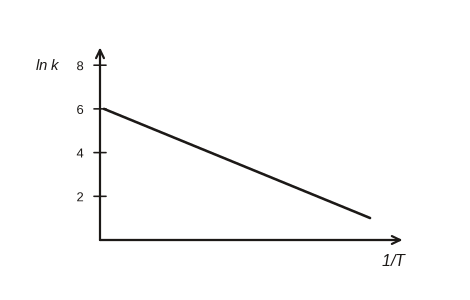
- Option 1: Ea cannot be negative. In the plot between ln k and 1/T, slope = – Ea/R, so Ea = 5 × 10³ K × 8.314 J K⁻¹ mol⁻¹ ≈ 41.5 kJ mol⁻¹.
- Option 3: 83 kJ mol⁻¹ is double the answer, as if the slope were – Ea/2R. With slope = – Ea/R, Ea = 5000 × 8.314 J mol⁻¹ ≈ 41.5 kJ mol⁻¹.
- Option 4: 166 kJ mol⁻¹ is four times the answer. The slope of ln k vs 1/T is – Ea/R, which gives Ea ≈ 41.5 kJ mol⁻¹.
Lesson: Zero First Order Kinetics
Why the other options are wrong
- Option 1: 1000 s is double the answer. t = (2.303/k) log ([R]0/[R]) = (2.303/4.606 × 10⁻³ s⁻¹) × log (2.0/0.2) = 500 s.
- Option 2: 100 s is too short. With [R]0/[R] = 10, t = 2.303/(4.606 × 10⁻³ s⁻¹) = 500 s.
- Option 3: 200 s is too short. The first order equation gives t = 2.303 × log 10/(4.606 × 10⁻³ s⁻¹) = 500 s.
Lesson: Collision Theory
An increase in the concentration of the reactants of a reaction leads to change in :
Exam traps and common mistakes in this unit
5 items
Lesson: Half Life
Category: Similar Terms
Zero-order t_1/2 depends on [A]_0. First-order t_1/2 INDEPENDENT of [A]_0. Student uses wrong formula.
When it triggers
Half-life question with order specified.
How to avoid
1st order: t_1/2 = 0.693/k (constant). Zero order: t_1/2 = [A]_0/(2k) (varies with initial conc). Second order: t_1/2 = 1/(k[A]_0).
Lesson: Arrhenius Theory
Root cause: sign error
Correction
ln(k2/k1) = (Ea/R) × (1/T1 - 1/T2). At higher T2, k2 > k1, so ln(k2/k1) > 0. Need 1/T1 > 1/T2.
Lesson: Half Life
Root cause: formula misuse
Correction
First order: t_1/2 = 0.693/k (constant). Zero order: t_1/2 = [A]_0/(2k) (depends on [A]_0). Second order: t_1/2 = 1/(k[A]_0).
Lesson: Half Life
Root cause: formula misuse
Correction
Zero-order: t_1/2 = [A]_0/(2k) (depends on initial conc). First-order: t_1/2 = 0.693/k (independent of [A]_0).
Lesson: Order Molecularity
Root cause: concept gap
Correction
Rate law from EXPERIMENT, not stoichiometry. Order = sum of exponents in rate = k[A]^x[B]^y. Molecularity follows mechanism.
Formulas in this unit
4 formulas
Lesson: Arrhenius Theory
Arrhenius equation
Temperature dependence of rate constant. Higher Ea → more T-sensitive rate.
| Symbol | Quantity | SI Unit |
|---|---|---|
| A | frequency factor | same as k |
| Ea | activation energy | J/mol |
| R | gas constant | J/mol/K |
| T | temp | K |
Valid when
- T in kelvins
- Most reactions in modest T range
Lesson: Arrhenius Theory
Arrhenius for two temperatures
Compare rate constants at two temperatures to find Ea.
| Symbol | Quantity | SI Unit |
|---|---|---|
| k1, k2 | rate constants | same units |
| T1, T2 | temperatures | K |
| Ea | activation energy | J/mol |
Valid when
- A constant across temperature range
- T in kelvins
Lesson: Half Life
First-order kinetics
Concentration decays exponentially. Half-life independent of [A]_0.
| Symbol | Quantity | SI Unit |
|---|---|---|
| [A] | conc at time t | mol/L |
| k | rate constant | 1/s |
| t | time | s |
Valid when
- First-order reaction (rate = k[A])
Lesson: Half Life
Zero-order kinetics
Concentration decays linearly. Half-life depends on initial concentration.
| Symbol | Quantity | SI Unit |
|---|---|---|
| [A]_0 | initial conc | mol/L |
| k | rate constant | mol/L/s |
| t | time | s |
Valid when
- Zero-order reaction (rate = k, no concentration dependence)
NEET question patterns in this unit
2 patterns
Lesson: Arrhenius Theory
Find Ea from rate-constant ratio at two temperatures using ln(k2/k1) = Ea/R · (1/T1 − 1/T2).
Common distractors
wrong sign of 1 over t
Mixes T1 and T2 in subtraction
Lesson: Half Life
First-order: t_1/2 = 0.693/k. Apply or invert to find k or remaining concentration.
Common distractors
uses zero order formula
Plugs into [A]_0/(2k) wrong-order formula
Questions about this unit
- What does Chemical Kinetics cover for NEET Chemistry?
- 8 lessons: Arrhenius Theory, Collision Theory, Factors Affecting Rate, Half Life, Order Molecularity, Rate Law Rate Constant, Rate of Reaction and Zero First Order Kinetics.
- How often has Chemical Kinetics come up in NEET past papers?
- Our set of verified past papers has 13 questions from this unit, from NEET 2020, 2021, 2022, 2023, 2024, 2025 and 2026. Each is answered against the official NTA key.
- Is the Chemical Kinetics material free?
- Yes. All 8 lessons and 73 practice questions are free, with no login needed.