Nucleophilic addition to C=O
Mechanism: (1) nucleophile attacks electrophilic C; (2) tetrahedral intermediate; (3) protonation of O. Aldehydes more reactive than ketones (less steric hindrance, less +I from one R).
-- NCERT, p. 8The trap first: Students confuse reactivity order in nucleophilic addition. Ketones are NOT more reactive than aldehydes — it is the reverse. Aldehydes have less steric hindrance (one H, one R) and weaker electron donation from a single alkyl group, making their carbonyl carbon more electrophilic.
Nucleophilic addition to carbonyls is the signature reaction of aldehydes and ketones. The carbonyl C=O has a polarised carbon (δ+) attacked by nucleophiles. The general mechanism: nucleophile attacks Cδ+ → π-bond breaks → oxygen becomes negatively charged → protonation gives the addition product.
Three nucleophiles NEET targets:
HCN addition — produces cyanohydrins (R-CH(OH)-CN from aldehydes, R₂C(OH)-CN from ketones). Requires a trace of base (CN⁻ is the actual nucleophile). The product gains one carbon — this is a chain-lengthening reaction.
NH₃ derivatives (NH₂OH, NH₂NH₂, 2,4-DNP, semicarbazide) — carbonyl + H₂N-G → C=N-G + H₂O. These are condensation reactions forming oximes, hydrazones, 2,4-DNP derivatives, and semicarbazones respectively. The C=N linkage is called a Schiff base when G = aryl/alkyl.
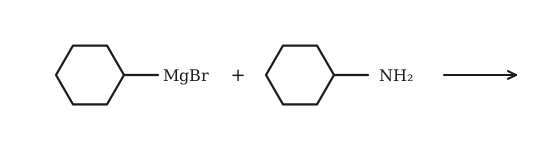
Grignard reagent (RMgX) — the carbanion (R⁻) attacks Cδ+. HCHO → 1° alcohol; other aldehydes → 2° alcohol; ketones → 3° alcohol. Hydrolysis with dilute acid completes the reaction.
Reactivity order: HCHO > other aldehydes > ketones (steric + electronic). This ordering is the single most tested concept in NEET nucleophilic addition questions (NCERT Class 12 Chemistry Chapter 12, page 8).
Watch-out: When a question says "addition of HCN to propanone," the product is 2-hydroxy-2-methylpropanenitrile — not propanal cyanohydrin. Match the carbonyl substrate to the correct product skeleton.
Select an option to see the explanation. Wrong answers show why your choice was tempting — and name the exact trap it exploits.
The addition of HCN to acetaldehyde in the presence of a base produces:
The reaction of an aldehyde with hydroxylamine (NH₂OH) produces:
The reaction of formaldehyde with methylmagnesium bromide (CH₃MgBr) followed by hydrolysis gives:
Arrange the following in decreasing order of reactivity towards nucleophilic addition: (I) HCHO, (II) CH₃CHO, (III) (CH₃)₂CO, (IV) (C₆H₅)₂CO
The product formed when acetone reacts with HCN followed by hydrolysis is:
Which of the following Grignard reactions produces a tertiary alcohol?
An unknown carbonyl compound X reacts with 2,4-DNP to give an orange precipitate, but does NOT reduce Tollens' reagent. X reacts with CH₃MgBr followed by acid hydrolysis to give 2-methyl-2-butanol. Compound X is:
Compound A (C₃H₆O) forms a cyanohydrin B with HCN. Hydrolysis of B gives compound C (a hydroxy acid). C has a chiral centre. Compound A is:
Given
- Substrate: benzaldehyde (C₆H₅CHO) — an aromatic aldehyde - Nucleophiles: (a) HCN/NaCN, (b) C₆H₅MgBr then dilute H₂SO₄
Required
- Product for each reaction - Reactivity comparison with acetophenone (C₆H₅COCH₃)
Concept
Nucleophilic addition to carbonyl: Nu⁻ attacks Cδ+ → tetrahedral alkoxide → protonation. Reactivity depends on steric accessibility and electrophilicity of carbonyl carbon.
Formula/Principle
Reactivity order: Aldehyde > Ketone (less steric hindrance at carbonyl C; fewer electron-donating groups).
Substitution / Application
(a) C₆H₅CHO + CN⁻ → C₆H₅CH(O⁻)CN → protonation → C₆H₅CH(OH)CN (mandelonitrile / benzaldehyde cyanohydrin) (b) C₆H₅CHO + C₆H₅MgBr → C₆H₅CH(O⁻MgBr)(C₆H₅) → H₃O⁺ → (C₆H₅)₂CHOH (benzhydrol, a secondary alcohol)
Calculation/reasoning
No numerical calculation needed. The logic is mechanistic: in both cases, the nucleophile (CN⁻ or C₆H₅⁻) attacks the electrophilic carbonyl carbon, breaking the C=O π-bond.
Final answer
- (a) Product: mandelonitrile, C₆H₅CH(OH)CN - (b) Product: benzhydrol, (C₆H₅)₂CHOH (a 2° alcohol) - Benzaldehyde is more reactive than acetophenone because: (i) the aldehyde has only one substituent on carbonyl C vs two in ketone → less steric crowding; (ii) the methyl group in acetophenone provides +I electron donation, reducing Cδ+ character further.
Common trap
Students may invert the reactivity, assuming that acetophenone's conjugated phenyl makes it "more activated." In fact, both compounds have a phenyl ring, but the additional methyl group in acetophenone adds both steric and electronic deactivation. The relevant mistake: believing ketones are more reactive than aldehydes toward nucleophilic addition.
Similar NEET-style question
"Arrange the following in decreasing order of reactivity toward addition of HCN: (I) HCHO, (II) C₆H₅CHO, (III) CH₃COCH₃, (IV) C₆H₅COC₆H₅." Expected answer: I > II > III > IV.
Mechanism: (1) nucleophile attacks electrophilic C; (2) tetrahedral intermediate; (3) protonation of O. Aldehydes more reactive than ketones (less steric hindrance, less +I from one R).
-- NCERT, p. 8+HCN → cyanohydrin. +NaHSO₃ → bisulphite addition product (test for aldehydes/methyl ketones). +NH₃ derivatives → imines, oximes, hydrazones (used to identify carbonyls). +Grignard (RMgX) → 1°/2°/3° alcohol.
-- NCERT, p. 10Stronger acid than phenol due to more effective resonance over two equivalent oxygens. EWG substituents (Cl, NO2) increase acidity.
| Symbol | Quantity | SI Unit |
|---|---|---|
| pKa | -log Ka | - |
Phenols ~10⁶× more acidic than aliphatic alcohols due to resonance stabilisation of phenoxide ion. Electron-withdrawing substituents lower pKa further.
| Symbol | Quantity | SI Unit |
|---|---|---|
| pKa | -log Ka | - |
These are the exact patterns that cause wrong answers in NEET. Each trap includes when it triggers and how to avoid it.
Category: Organic Reaction Conditions
1° alcohol: PCC/PDC → aldehyde (stops). KMnO4/K2Cr2O7 in acidic → carboxylic acid (continues). 2° alcohol: any oxidiser → ketone. 3° alcohol: not oxidised by ordinary reagents.
Question gives 1° alcohol oxidation with specified reagent.
PCC, PDC, Swern, DMP: mild → stop at aldehyde. KMnO4, K2Cr2O7, CrO3, jones: strong → carboxylic acid. Reagent choice matches desired product.
Root cause: concept gap
Aldehydes more reactive: less steric hindrance, less +I from one R group. Order: HCHO > RCHO > R₂CO.
Root cause: concept gap
Iodoform test ONLY positive for: methyl ketones (CH₃-CO-R), ethanol, secondary alcohols of form CH₃-CH(OH)-R, ethanal.
20 questions from NEET 2021, 2022, 2023, 2024, 2025. Answers verified against NTA official keys.
Identify the suitable reagent for the following conversion.
The correct order of decreasing acidity of the following aliphatic acids is
Identify the correct reagents that would bring about the following transformation.
In which of the following equilibria, K and K are NOT equal? p c
Taking stability as the factor, which one of the following represents correct relationship?
The right option for the statement "Tyndall effect is exhibited by", is :
Which of the following reactions is the metal displacement reaction? Choose the right option. → ↑
Recurring question shapes from past papers. Each pattern shows why wrong options look tempting.
inverts aldehyde ketone reactivity
Believes ketones more reactive
includes non methyl ketones
Treats all ketones as positive
ignores resonance vs induction balance
Uses inductive only without considering resonance
Test yourself on this topic with real past-paper questions:
Practice this topic →Get a structured 30-day study plan and a complete formula booklet — delivered to your inbox instantly.