Alpha Hydrogen Aldol

8 MCQs9-step worked example
Source: NCERT BiomoleculesPYQ coverage: NEET 2021, 2022, 2023, 2024, 2025Official key: NTA-verifiedLast reviewed: May 2026

Lesson

α-Hydrogen acidity and aldol condensation is one of the most productive reaction pathways in carbonyl chemistry — and a topic where NEET questions test whether you truly understand why the α-hydrogen is acidic, not just that it is.

Why is the α-hydrogen acidic?

The hydrogen on the carbon adjacent to the carbonyl group (the α-carbon) is acidic because the conjugate base — the enolate ion — is stabilised by resonance. The negative charge delocalises across both the α-carbon and the carbonyl oxygen, forming a resonance-stabilised anion. This is the key fact: ordinary C–H bonds (pKa ~50) are not acidic, but α-C–H bonds in aldehydes and ketones have pKa values around 19–20, making them removable by strong bases like dilute NaOH or LDA (NCERT Class 12 Chemistry, Chapter 12, Part 2, page 14).

The aldol reaction

When an aldehyde possessing an α-hydrogen is treated with dilute NaOH at low temperature, the base abstracts the α-hydrogen to form the enolate. This enolate acts as a nucleophile and attacks the carbonyl carbon of a second molecule, yielding a β-hydroxy aldehyde — the "aldol" (aldehyde + alcohol). On heating, the aldol readily undergoes dehydration to give an α,β-unsaturated aldehyde (the aldol condensation product).

Acetaldehyde (ethanal) is the textbook example: two molecules of CH₃CHO with dilute NaOH give 3-hydroxybutanal (the aldol), which on heating gives crotonaldehyde (but-2-enal).

Ketones undergo the same reaction, though less favourably due to steric hindrance at the carbonyl carbon. Acetone gives diacetone alcohol, then mesityl oxide on dehydration.

Watch-out: Formaldehyde (HCHO) has no α-hydrogen — it cannot undergo the aldol reaction. Similarly, benzaldehyde has no α-hydrogen. When NEET asks "which compound cannot undergo aldol condensation?", check for the α-hydrogen first.

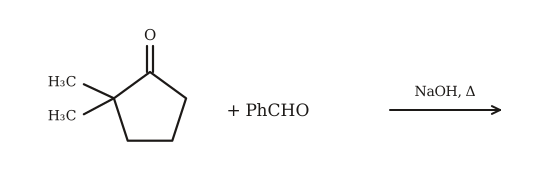
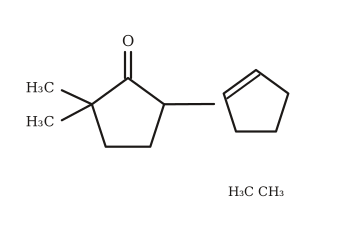
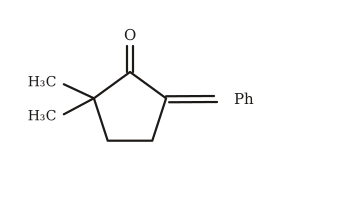
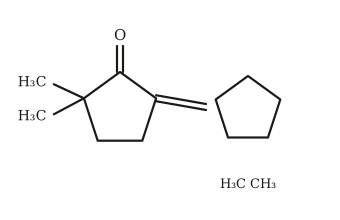
Crossed aldol reactions (between two different aldehydes) give mixtures unless one partner has no α-hydrogen (e.g. HCHO or PhCHO as the electrophilic partner).


Practice MCQs

Select an option to see the explanation. Wrong answers show why your choice was tempting — and name the exact trap it exploits.

MCQ 1Easy RecallPractice

Which of the following statements correctly describes the α-hydrogen in a carbonyl compound?

MCQ 2Easy RecallPractice

The acidity of the α-hydrogen in carbonyl compounds is primarily due to:

MCQ 3Easy RecallPractice

Which of the following compounds CANNOT undergo aldol condensation?

MCQ 4Direct ApplicationPractice

When acetaldehyde is treated with dilute NaOH at room temperature, the initial product is:

MCQ 5Direct ApplicationPractice

In the aldol condensation of acetaldehyde, the dehydration step produces an α,β-unsaturated aldehyde. What drives the dehydration to be thermodynamically favourable?

MCQ 6Direct ApplicationPractice

A crossed aldol reaction between benzaldehyde and acetaldehyde in the presence of dilute NaOH is synthetically useful because:

MCQ 7Concept TrapPractice

Among acetaldehyde, acetone, and di-tert-butyl ketone [(CH₃)₃C–CO–C(CH₃)₃], the ease of aldol reaction follows the order:

MCQ 8CalculationPractice

Identify the final product when propanal (CH₃CH₂CHO) undergoes aldol condensation (i.e. aldol reaction followed by heating):

Worked Example

  1. 1

    Given

    - Substrate: Acetaldehyde (CH₃CHO), two molecules - Base: dilute NaOH (catalytic) - Conditions: first at low temperature (aldol step), then heating (dehydration step)

  2. 2

    Required

    Identify the aldol intermediate and the final condensation product. Name both.

  3. 3

    Concept

    The aldol reaction occurs in two stages: 1. Base abstracts an α-hydrogen from one molecule of CH₃CHO, forming the resonance-stabilised enolate ion. 2. The enolate (nucleophile) attacks the carbonyl carbon of a second CH₃CHO molecule (electrophile), forming a new C–C bond. Protonation gives the β-hydroxy aldehyde (the aldol). 3. On heating, the aldol loses water (dehydration) to form an α,β-unsaturated aldehyde.

  4. 4

    Formula / Reaction scheme

    CH₃CHO + CH₃CHO → (dilute NaOH, low temp) → CH₃CH(OH)CH₂CHO → (heat, –H₂O) → CH₃CH=CHCHO

  5. 5

    Substitution / Mechanism outline

    1. NaOH abstracts one α-hydrogen from CH₃CHO: CH₃CHO + OH⁻ → ⁻CH₂CHO (enolate) + H₂O 2. Enolate attacks the carbonyl C of the second CH₃CHO: ⁻CH₂CHO + CH₃CHO → CH₃CH(O⁻)CH₂CHO 3. Protonation by water: CH₃CH(O⁻)CH₂CHO + H₂O → CH₃CH(OH)CH₂CHO + OH⁻ (Aldol intermediate: 3-hydroxybutanal) 4. Heating causes E1cb-type elimination of water: CH₃CH(OH)CH₂CHO → CH₃CH=CHCHO + H₂O (Final product: but-2-enal, commonly called crotonaldehyde)

  6. 6

    Calculation

    This is a reaction-prediction problem, not a numerical calculation. The key reasoning steps are: - Identify the α-hydrogen (on the –CH₃ group of acetaldehyde) — three equivalent α-hydrogens available. - Recognise that the enolate is the nucleophile and the intact carbonyl is the electrophile. - Count carbons: 2 (from first CH₃CHO) + 2 (from second CH₃CHO) = 4-carbon product.

  7. 7

    Final answer

    - **Aldol intermediate:** 3-hydroxybutanal (β-hydroxy aldehyde) - **Condensation product:** but-2-enal (crotonaldehyde, an α,β-unsaturated aldehyde)

  8. 8

    Common trap

    Confusing the aldol (3-hydroxybutanal) with the condensation product (crotonaldehyde). NEET questions sometimes ask for the "aldol product" (meaning the intermediate *before* dehydration) versus the "aldol condensation product" (meaning *after* dehydration). Read the question carefully — if it says "aldol condensation," the answer includes the dehydration step.

  9. 9

    Similar NEET-style question

    "When propanal is treated with dilute NaOH followed by heating, the major product is:" — apply the same two-step approach (aldol formation → dehydration) to a three-carbon aldehyde. ---

Before solving, remember these

Two molecules of aldehyde or ketone with α-H, in presence of dilute base, combine: forms β-hydroxy carbonyl (aldol), which dehydrates on heating to α,β-unsaturated carbonyl. Acetaldehyde → 3-hydroxybutanal → but-2-enal.

-- NCERT, p. 14

Formulas

pKa of carboxylic acid

Stronger acid than phenol due to more effective resonance over two equivalent oxygens. EWG substituents (Cl, NO2) increase acidity.

SymbolQuantitySI Unit
pKa-log Ka-

Valid when

  • Aqueous solution
  • α-substituent effects strongest

pKa of phenol vs aliphatic alcohol

Phenols ~10⁶× more acidic than aliphatic alcohols due to resonance stabilisation of phenoxide ion. Electron-withdrawing substituents lower pKa further.

SymbolQuantitySI Unit
pKa-log Ka-

Valid when

  • Aqueous solution
  • Substituent effects shift values

Exam Traps & Common Mistakes

These are the exact patterns that cause wrong answers in NEET. Each trap includes when it triggers and how to avoid it.

Category: Organic Reaction Conditions

1° alcohol: PCC/PDC → aldehyde (stops). KMnO4/K2Cr2O7 in acidic → carboxylic acid (continues). 2° alcohol: any oxidiser → ketone. 3° alcohol: not oxidised by ordinary reagents.

When it triggers

Question gives 1° alcohol oxidation with specified reagent.

How to avoid

PCC, PDC, Swern, DMP: mild → stop at aldehyde. KMnO4, K2Cr2O7, CrO3, jones: strong → carboxylic acid. Reagent choice matches desired product.

Past Year Questions

20 questions from NEET 2021, 2022, 2023, 2024, 2025. Answers verified against NTA official keys.

NEET 2024Revised key

Given below are two statements: Statement I : Aniline does not undergo Friedel-Crafts alkylation reaction. Statement II : Aniline cannot be prepared through Gabriel synthesis . In the light of the above statements, choose the correct answer from the options given below:

1Both statement I and Statement II are true
2Both Statement I and Statement II are false
3Statement I is correct but Statement II is false
4Statement I is incorrect but Statement II is true
NTA Answer: Option 1(revised_final)
NEET 2024Revised key

Fehling’s solution ‘A’ is

1aqueous copper sulphate
2alkaline copper sulphate
3alkaline solution of sodium potassium tartrate (Rochelle’s salt)
4aqueous sodium citrate
NTA Answer: Option 1(revised_final)
NEET 2022

Given below are two statements: Statement I: In Lucas test, primary, secondary and tertiary alcohols are distinguished on the basis of their reactivity with conc. HCl + ZnCl , known as Lucas Reagent. 2 Statement II: Primary alcohols are most reactive and immediately produce turbidity at room temperature on reaction with Lucas Reagent. In the light of the above statements, choose the most appropriate answer from the options given below:

1Statement I is incorrect but Statement II is correct
2Both Statement I and Statement II are correct
3Both Statement I and Statement II are incorrect
4Statement I is correct but Statement II is incorrect
NTA Answer: Option 4(final)
NEET 2021

Match List-I with List-II List-I List-II CO, HCI (a) (i) Hell-Volhard-Zelinsky Anhyd. AlCl/ Cu3Cl reaction O R — C — CH + (b) (ii) Gattermann-Koch 3 NaOX reaction R — CH — OH (c) (iii) Haloform reaction 2 +R′ COOH Conc. HSO 2 4 (d) R — CH COOH (iv) Esterification 2 ( II) X /Red P 2 (ii) HO 2 Choose the correct answer from the options given below.

1(a) - (ii), (b) - (iii), (c) - (iv), (d) - (i)
2(a) - (iv), (b) - (i), (c) - (ii), (d) - (iii)
3(a) - (iii), (b) - (ii), (c) - (i), (d) - (iv)
4(a) - (i), (b) - (iv), (c) - (iii), (d) - (ii)
NTA Answer: Option 1(final)

How NEET usually asks this

Recurring question shapes from past papers. Each pattern shows why wrong options look tempting.

Test yourself on this topic with real past-paper questions:

Practice this topic →

Free NEET study resources

Get a structured 30-day study plan and a complete formula booklet — delivered to your inbox instantly.