Key Fact
Wolff-Kishner reduction
C=O + NH₂NH₂ + base/heat → CH₂. Reduces aldehydes/ketones to alkanes via hydrazone. Useful when acid-sensitive groups present.
-- NCERT Class 12 Chemistry, Ch. 8, p. 239The trap that costs marks in oxidation-reduction of carbonyls is confusing mild and strong oxidising agents for primary alcohols. A question names a reagent — PCC, Jones reagent, KMnO₄ — and the correct product depends entirely on whether that reagent stops at the aldehyde or pushes through to the carboxylic acid.
The reagent-selectivity hierarchy (NCERT Class 12 Chemistry, Chapter 8, page 238):
Mild oxidising agents — PCC (pyridinium chlorochromate), PDC (pyridinium dichromate), Swern oxidation, DMP (Dess-Martin periodinane) — oxidise a primary alcohol to an aldehyde and stop. They work in anhydrous, non-aqueous conditions that prevent over-oxidation.
Strong oxidising agents — KMnO₄, K₂Cr₂O₇ (acidified), CrO₃/H₂SO₄ (Jones reagent) — oxidise a primary alcohol all the way to the carboxylic acid. These reagents operate in aqueous acidic media; the aldehyde intermediate is further oxidised before it can be isolated.
Secondary alcohols are oxidised to ketones by both mild and strong reagents. The ketone resists further oxidation because breaking the C–C bond would be required.
Tertiary alcohols are not oxidised by conventional reagents (no α-hydrogen on the carbon bearing –OH).
Reduction of carbonyls: Wolff-Kishner reduction (hydrazine/KOH, strong base, high temperature) and Clemmensen reduction (Zn-Hg/conc. HCl, strongly acidic) both convert the C=O of an aldehyde or ketone to –CH₂–. The key distinction is reaction conditions: Wolff-Kishner is basic, Clemmensen is acidic. Choose the reduction method compatible with other functional groups in the substrate — base-sensitive groups survive Clemmensen; acid-sensitive groups survive Wolff-Kishner.
Watch-out: When a stem says "oxidation of 1-butanol with PCC," the answer is butanal, not butanoic acid. Reagent identity determines the product — not the alcohol class alone.
Select an option to see the explanation. Wrong answers show why your choice was tempting — and name the exact trap it exploits.
Which of the following reagents oxidises a primary alcohol to an aldehyde without further oxidation to the carboxylic acid?
Answer: A. PCC is a mild oxidising agent that operates in anhydrous conditions (typically in CH₂Cl₂), stopping oxidation at the aldehyde stage. NCERT Class 12 Chemistry Chapter 8, page 238 lists PCC as a selective reagent for this conversion.
Why B is wrong: B is wrong because acidified K₂Cr₂O₇ is a strong oxidising agent that pushes oxidation past the aldehyde to the carboxylic acid (trap: reagent selectivity).
Why C is wrong: C is wrong because acidified KMnO₄ is a strong oxidising agent that oxidises primary alcohols all the way to carboxylic acids (trap: confusing reagent strength — mild vs strong determines where oxidation stops).
Why D is wrong: D is wrong because Jones reagent (CrO₃/H₂SO₄) is a strong oxidant in aqueous acidic conditions and converts primary alcohols to carboxylic acids, not aldehydes (trap: reagent selectivity).
Clemmensen reduction converts a carbonyl compound (aldehyde or ketone) to a hydrocarbon using:
Answer: B. Clemmensen reduction uses zinc amalgam (Zn-Hg) with concentrated HCl under strongly acidic conditions to reduce C=O to –CH₂–. NCERT Class 12 Chemistry Chapter 8, page 238.
Why A is wrong: A is wrong because hydrazine/KOH at high temperature describes Wolff-Kishner reduction, which achieves the same transformation but under strongly basic conditions — not Clemmensen (trap: confusing the two name reactions).
Why C is wrong: C is wrong because LiAlH₄ reduces carbonyl groups to alcohols (–CHOH– or –CH₂OH), not to methylene (–CH₂–). It does not remove oxygen entirely (trap: conflating reduction to alcohol with reduction to hydrocarbon).
Why D is wrong: D is wrong because NaBH₄ is a mild reducing agent that converts aldehydes/ketones to alcohols, not to hydrocarbons (trap: same as option C — reduction to alcohol ≠ deoxygenation).
Wolff-Kishner reduction is carried out under which conditions?
Answer: A. Wolff-Kishner reduction uses hydrazine and KOH (a strong base) at high temperature to convert C=O to –CH₂–. NCERT Class 12 Chemistry Chapter 8, page 238.
Why B is wrong: B is wrong because catalytic hydrogenation with Pd/C reduces C=O to –CHOH (alcohol) rather than removing the oxygen entirely to give –CH₂– (trap: confusing catalytic hydrogenation with deoxygenation name reactions).
Why C is wrong: C is wrong because Zn-Hg/conc. HCl describes Clemmensen reduction, not Wolff-Kishner. The two reactions achieve the same product but under opposite pH conditions (trap: swapping Wolff-Kishner and Clemmensen conditions).
Why D is wrong: D is wrong because dilute H₂SO₄ does not reduce carbonyl groups. Neither Wolff-Kishner nor Clemmensen operates under mildly acidic conditions (trap: inventing a middle ground between the two named reactions).
1-Propanol is treated with Jones reagent (CrO₃/H₂SO₄). The major product is:
Answer: B. Jones reagent is a strong oxidising agent (CrO₃ in aqueous H₂SO₄). A primary alcohol is oxidised past the aldehyde stage to the carboxylic acid. 1-Propanol → propanoic acid. NCERT Class 12 Chemistry Chapter 8, page 238.
Why A is wrong: A is wrong because propanal is the intermediate aldehyde, but Jones reagent does not stop there — it continues oxidation to propanoic acid. Only mild oxidants like PCC would give propanal as the isolated product (trap: reagent selectivity — believing all oxidants stop at aldehyde).
Why C is wrong: C is wrong because propanone is a ketone (C₃). Primary alcohols do not rearrange to ketones upon oxidation; a ketone would require oxidation of a secondary alcohol (trap: confusing primary and secondary alcohol oxidation products).
Why D is wrong: D is wrong because primary alcohols are readily oxidised by strong reagents. Only tertiary alcohols resist oxidation under ordinary conditions (trap: applying tertiary-alcohol behaviour to a primary alcohol).
2-Butanol is oxidised with acidified K₂Cr₂O₇. The product is:
Answer: C. 2-Butanol is a secondary alcohol. Oxidation of secondary alcohols (whether by mild or strong reagents) gives the corresponding ketone. 2-Butanol → 2-butanone. The ketone resists further oxidation. NCERT Class 12 Chemistry Chapter 8, page 238.
Why A is wrong: A is wrong because butanal is an aldehyde that would come from oxidation of 1-butanol (a primary alcohol), not 2-butanol (trap: picking the aldehyde product that belongs to the primary alcohol isomer).
Why B is wrong: B is wrong because butanoic acid forms from over-oxidation of a primary alcohol, not from a secondary alcohol. Ketones resist the C–C cleavage needed for further oxidation (trap: assuming strong oxidant always gives carboxylic acid regardless of alcohol class).
Why D is wrong: D is wrong because secondary alcohols are oxidised by acidified K₂Cr₂O₇. Only tertiary alcohols resist oxidation under these conditions (trap: applying tertiary-alcohol behaviour to a secondary alcohol).
A substrate contains both a ketone group and an acid-sensitive functional group (e.g., an acetal). To reduce the ketone to a methylene (–CH₂–) without cleaving the acetal, which method is appropriate?
Answer: B. The acetal is acid-sensitive. Clemmensen uses strongly acidic conditions (conc. HCl) and would cleave the acetal. Wolff-Kishner uses strongly basic conditions (KOH, high temperature), which leave the acid-sensitive acetal intact while reducing C=O to –CH₂–. NCERT Class 12 Chemistry Chapter 8, page 238.
Why A is wrong: A is wrong because Clemmensen reduction uses concentrated HCl — strongly acidic conditions that would hydrolyse the acid-sensitive acetal, destroying a functional group the question requires you to preserve (trap: ignoring substrate compatibility when choosing between Wolff-Kishner and Clemmensen).
Why C is wrong: C is wrong because catalytic hydrogenation reduces C=O to –CHOH (an alcohol), not to –CH₂–. It does not remove the oxygen entirely (trap: confusing reduction to alcohol with complete deoxygenation).
Why D is wrong: D is wrong because NaBH₄ reduces the carbonyl to an alcohol (–CHOH–), not to a methylene (–CH₂–). The question asks for deoxygenation, not simple reduction to alcohol (trap: same as option C).
2-Methyl-2-propanol (tert-butyl alcohol) is treated with acidified KMnO₄. What is observed?
Answer: B. 2-Methyl-2-propanol is a tertiary alcohol. The carbon bearing –OH has no hydrogen atom available for oxidation. Tertiary alcohols are not oxidised by conventional oxidising agents like KMnO₄ or K₂Cr₂O₇ under ordinary conditions. NCERT Class 12 Chemistry Chapter 8, page 238.
Why A is wrong: A is wrong because forming an aldehyde would require oxidation at the α-carbon, which in a tertiary alcohol bears no hydrogen. Aldehydes only form from primary alcohols (trap: not recognising tertiary alcohol resistance to oxidation).
Why C is wrong: C is wrong because acetone forms from oxidation of 2-propanol (a secondary alcohol), not from 2-methyl-2-propanol (a tertiary alcohol). These are different substrates (trap: confusing isopropanol with tert-butanol).
Why D is wrong: D is wrong because carboxylic acid formation requires oxidation through the aldehyde intermediate — impossible for a tertiary alcohol that lacks an α-hydrogen on the hydroxyl-bearing carbon (trap: assuming any strong oxidant can oxidise any alcohol).
An unknown primary alcohol X is treated with PCC to give compound Y. Compound Y is then treated separately with (i) Wolff-Kishner reduction and (ii) Clemmensen reduction. Which statement is correct?
Answer: D. PCC oxidises primary alcohol X to aldehyde Y (mild oxidant stops at aldehyde). Both Wolff-Kishner (basic conditions) and Clemmensen (acidic conditions) reduce the C=O of an aldehyde to –CH₂–, giving the same alkane. The two methods differ in conditions but achieve the identical transformation on aldehydes as well as ketones. NCERT Class 12 Chemistry Chapter 8, page 238.
Why A is wrong: A is wrong because both Wolff-Kishner and Clemmensen reduce C=O → –CH₂– regardless of whether the substrate is an aldehyde or ketone. The products are identical — conditions differ, not outcomes (trap: believing the two reductions give different functional groups).
Why B is wrong: B is wrong because Clemmensen also gives an alkane, not an alcohol. Clemmensen reduction removes the oxygen entirely (C=O → CH₂), just like Wolff-Kishner (trap: confusing Clemmensen with NaBH₄/LiAlH₄ reduction, which stops at the alcohol).
Why C is wrong: C is wrong because both Wolff-Kishner and Clemmensen work on aldehydes and ketones alike. Neither reaction is restricted to ketones only (trap: incorrectly limiting these name reactions to ketones).
Get a structured 30-day study plan and a complete formula booklet — delivered to your inbox instantly.
Given
1-Pentanol is treated first with PCC in CH₂Cl₂, and the product is then treated with acidified KMnO₄.
Required
Identify the final product after both steps.
Concept
Oxidation of primary alcohols depends on reagent strength. PCC is a mild oxidant (stops at aldehyde). KMnO₄ (acidified) is a strong oxidant (oxidises aldehydes further to carboxylic acids). NCERT Class 12 Chemistry Chapter 8, page 238.
Formula/Rule
• PCC + primary alcohol → aldehyde (mild, anhydrous, stops here)• KMnO₄ (acidified) + aldehyde → carboxylic acid (strong, aqueous, continues)
Substitution
• Step A: 1-Pentanol + PCC → Pentanal• Step B: Pentanal + acidified KMnO₄ → Pentanoic acid
Calculation
No numerical calculation required. This is a reagent-identification and product-prediction problem. The reasoning is sequential: identify the intermediate (pentanal) from the mild oxidant, then apply the strong oxidant to that intermediate.
Final answer
The final product is pentanoic acid (CH₃CH₂CH₂CH₂COOH).
Common trap
The high-frequency error is selecting pentanal as the final product — forgetting that step B uses acidified KMnO₄ (strong oxidant), which pushes the aldehyde intermediate to the carboxylic acid. This is trap trap: oxidation reagent selectivity: reagent strength determines where oxidation stops.
Similar NEET-style question
"1-Butanol is heated with K₂Cr₂O₇/H₂SO₄. The organic product formed is: (A) Butanal (B) Butanone (C) Butanoic acid (D) 1-Butene." Answer: (C) Butanoic acid — K₂Cr₂O₇/H₂SO₄ is a strong oxidant, so the primary alcohol is fully oxidised.
---
C=O + NH₂NH₂ + base/heat → CH₂. Reduces aldehydes/ketones to alkanes via hydrazone. Useful when acid-sensitive groups present.
-- NCERT Class 12 Chemistry, Ch. 8, p. 239C=O + Zn(Hg) + concentrated HCl → CH₂. Reduces aldehydes/ketones to alkanes. Useful when base-sensitive groups present.
-- NCERT Class 12 Chemistry, Ch. 8, p. 238These are the exact patterns that cause wrong answers in NEET. Each trap includes when it triggers and how to avoid it.
Category: Organic Reaction Conditions
1° alcohol: PCC/PDC → aldehyde (stops). KMnO4/K2Cr2O7 in acidic → carboxylic acid (continues). 2° alcohol: any oxidiser → ketone. 3° alcohol: not oxidised by ordinary reagents.
Question gives 1° alcohol oxidation with specified reagent.
PCC, PDC, Swern, DMP: mild → stop at aldehyde. KMnO4, K2Cr2O7, CrO3, jones: strong → carboxylic acid. Reagent choice matches desired product.
More in Alcohols, Phenols, Ethers and Carbonyl Compounds: 2 exam traps and mistakes · 2 formulas · 3 question patterns from its other lessons.
8 questions from NEET 2020, 2021, 2024, 2025, 2026. Answers verified against NTA official keys.
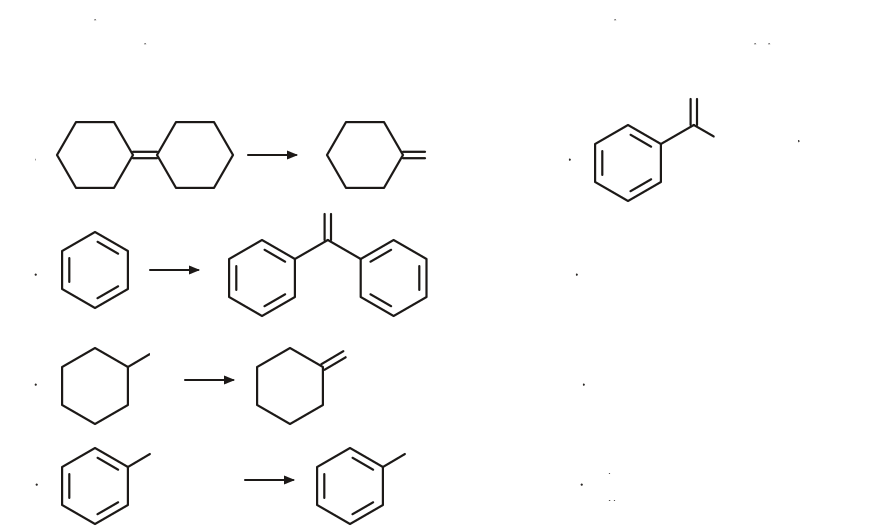
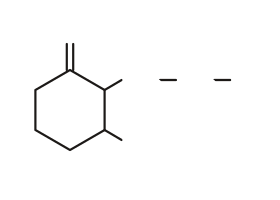
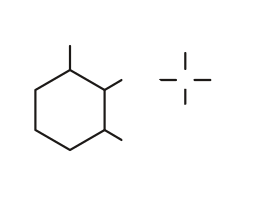
Identify the suitable reagent for the following conversion.
Identify the correct reagents that would bring about the following transformation.

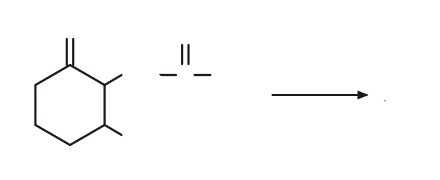
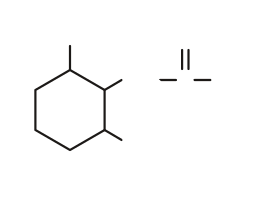
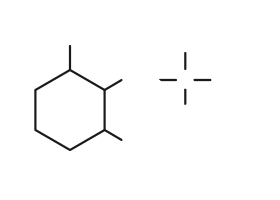
The product formed in the following chemical reaction is:
All 23 past-paper questions from Alcohols, Phenols, Ethers and Carbonyl Compounds →
Page numbers are the ones printed in the current NCERT textbook (2023 rationalised edition), unless marked pre-2023. The books are free at ncert.nic.in.
Test yourself on this topic with real past-paper questions:
Practice this topic →ShortPd on BaSO4 is a held-back catalyst: why Rosenmund reduction of benzoyl chloride stops at benzaldehyde, not benzyl alcohol (2:27)
Watch on YouTube