Formula
Terminal velocity
Sphere falling through viscous fluid reaches terminal velocity when net force = 0: v_t = (2/9) r² g (ρ_s - ρ_f) / η, where ρ_s, ρ_f are sphere and fluid densities.
-- NCERT Class 11 Physics, Ch. 9, p. 192A sphere dropped into a viscous liquid does not accelerate forever. As it speeds up, the viscous drag force (Stokes' law: F = 6πηrv) grows until it, together with buoyancy, exactly balances the gravitational pull. From that instant onward, the net force is zero and the sphere falls at a constant speed called terminal velocity.
The expression follows directly from setting weight equal to buoyancy plus drag:
v_t = (2r²g(ρ_s − ρ_f)) / (9η)
where r is the sphere radius, ρ_s and ρ_f are the densities of the sphere and fluid, η is the fluid viscosity, and g is the acceleration due to gravity (NCERT Class 11 Physics, Chapter 9 — Mechanical Properties of Fluids, page 192).
The high-frequency trap in this topic: treating terminal velocity as proportional to r (linear) instead of r². Stokes' drag is proportional to r·v, but gravitational minus buoyant force is proportional to r³ (volume). When you balance them, v_t comes out proportional to r². Doubling the radius quadruples the terminal velocity — not doubles it.
Shape of the v–t curve. The sphere starts from rest with maximum acceleration (g_eff). As v increases, drag increases, so acceleration decreases continuously. The curve is concave-down, asymptotically approaching v_t. It is NOT a straight line followed by a flat line — there is no sharp kink.
Watch-out for negative (ρ_s − ρ_f). If the sphere is less dense than the fluid, the "terminal velocity" is upward (the sphere rises). The formula still applies; the direction reverses.
Select an option to see the explanation. Wrong answers show why your choice was tempting — and name the exact trap it exploits.
At terminal velocity, the net force on a sphere falling through a viscous fluid is:
Answer: B. Terminal velocity is reached when the sphere stops accelerating, meaning the net force is zero — gravity is exactly balanced by buoyancy plus viscous drag (NCERT Class 11 Physics, Chapter 9, page 192).
Why A is wrong: A is wrong because weight is only one of three forces acting. At terminal velocity, weight is balanced by buoyancy + drag, not unbalanced.
Why C is wrong: C is wrong because buoyant force alone does not balance weight — viscous drag also contributes.
Why D is wrong: D is wrong because drag alone does not balance weight; buoyancy also acts upward. The net of all three forces is zero.
A small spherical drop falls through air and reaches a terminal velocity v. A drop of the same liquid with twice the radius will reach a terminal velocity of:
Answer: A. A is correct. At terminal velocity the weight (less buoyancy) balances the viscous drag: (4/3)πr³(ρ − σ)g = 6πηrv, so v = 2r²(ρ − σ)g/(9η). v goes as r², and doubling r quadruples it.
Why B is wrong: B is wrong because 2v assumes terminal velocity goes as r. The weight grows as r³ while the drag grows only as r, leaving v ∝ r².
Why C is wrong: C is wrong because 8v tracks only the weight, which goes as r³, and forgets that the drag also grows, in proportion to r.
Why D is wrong: D is wrong because v/2 has larger drops falling SLOWER. Larger drops fall faster, which is why big raindrops hit harder than drizzle.
Stokes' law for viscous drag on a sphere is valid when:
Answer: C. Stokes' law (F = 6πηrv) applies to slow, laminar flow around a sphere — the low Reynolds number regime. At high speeds, turbulence sets in and the drag law changes (NCERT Class 11 Physics, Chapter 9, page 188).
Why A is wrong: A is wrong because at high speeds the flow becomes turbulent and Stokes' linear drag law breaks down. The law requires slow (low Reynolds number) flow.
Why B is wrong: B is wrong because Stokes' law assumes an incompressible Newtonian fluid in laminar flow, the opposite of compressible turbulent conditions.
Why D is wrong: D is wrong because Stokes' law is derived specifically for a sphere. Non-spherical bodies have different drag coefficients.
A metal sphere of radius r falls through a viscous liquid and reaches terminal velocity v_t. A second sphere of the same material and density but radius 2r falls through the same liquid. Its terminal velocity is:
Answer: C. Terminal velocity is proportional to r². Doubling r gives (2r)²/r² = 4 times the original terminal velocity, so the answer is 4v_t (NCERT Class 11 Physics, Chapter 9, page 192).
Why A is wrong: A is wrong because this assumes v_t ∝ r (linear). The correct dependence is v_t ∝ r², so doubling r quadruples v_t, not doubles it. This is a common mistake — Stokes drag is linear in r, but gravity minus buoyancy scales as r³, making v_t ∝ r².
Why B is wrong: B is wrong because 8v_t would require v_t ∝ r³. Since v_t = (2r²g(ρ_s − ρ_f))/(9η), the dependence is r², not r³.
Why D is wrong: D is wrong because terminal velocity increases (not decreases) with radius. A larger sphere has more gravitational force relative to drag.
Two identical spheres fall through two different viscous liquids. Liquid A has viscosity η and liquid B has viscosity 3η. Both liquids have the same density. The ratio of terminal velocities v_A : v_B is:
Answer: B. From v_t = (2r²g(ρ_s − ρ_f))/(9η), terminal velocity is inversely proportional to η. With all other quantities identical, v_A/v_B = η_B/η_A = 3η/η = 3. So v_A : v_B = 3 : 1 (NCERT Class 11 Physics, Chapter 9, page 192).
Why A is wrong: A is wrong because this reverses the inverse relationship. Higher viscosity means lower terminal velocity, so the sphere in the less viscous liquid (A) is faster, giving 3 : 1 not 1 : 3.
Why C is wrong: C is wrong because v_t ∝ 1/η (inverse first power), not 1/η². Squaring the viscosity ratio is not justified by the terminal velocity formula.
Why D is wrong: D is wrong because v_t ∝ 1/η gives a ratio of 3 : 1, not 9 : 1. The ratio 9 : 1 would apply if v_t ∝ 1/η².
A sphere of density 2.5 × 10³ kg/m³ falls through a liquid of density 1.5 × 10³ kg/m³. If the liquid density were changed to 2.0 × 10³ kg/m³ (same viscosity, same sphere), the terminal velocity would become:
Answer: A. v_t ∝ (ρ_s − ρ_f). Originally (ρ_s − ρ_f) = (2.5 − 1.5) × 10³ = 1.0 × 10³ kg/m³. New: (2.5 − 2.0) × 10³ = 0.5 × 10³ kg/m³. Ratio = 0.5/1.0 = 1/2. Terminal velocity halves (NCERT Class 11 Physics, Chapter 9, page 192).
Why B is wrong: B is wrong because increasing the fluid density reduces (ρ_s − ρ_f), which decreases terminal velocity, not increases it.
Why C is wrong: C is wrong because terminal velocity depends on the density difference (ρ_s − ρ_f). Changing ρ_f changes this difference and hence v_t.
Why D is wrong: D is wrong because the density difference halved (from 1.0 × 10³ to 0.5 × 10³), so v_t halves — not reduces to one-fifth.
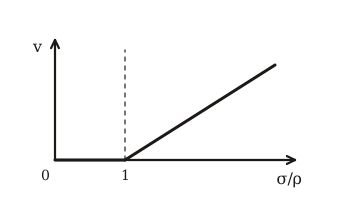
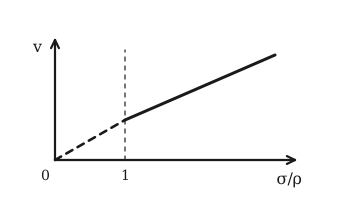
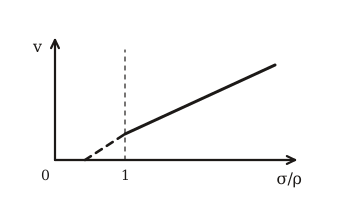
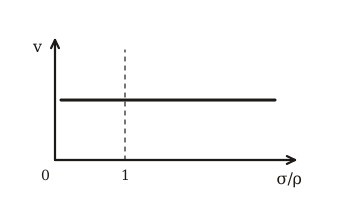
A sphere is released from rest in a viscous liquid. Which of the following best describes the velocity–time graph?
Answer: B. Initially, drag is zero and the sphere accelerates. As speed increases, drag (∝ v) increases, reducing net force and hence acceleration. The v–t curve is concave-down, asymptotically approaching terminal velocity — a curve with decreasing slope leveling off (NCERT Class 11 Physics, Chapter 9, page 192).
Why A is wrong: A is wrong because a straight line implies constant acceleration. Here, viscous drag increases with velocity, continuously reducing acceleration. The slope decreases over time.
Why C is wrong: C is wrong because velocity does not decrease after reaching a maximum. Once terminal velocity is reached, the sphere continues at that constant speed — there is no deceleration phase.
Why D is wrong: D is wrong because the sphere starts from rest (v = 0 at t = 0) and must accelerate to reach terminal velocity. A horizontal line would mean it was already at terminal velocity from the start.
A sphere of radius 1.0 × 10⁻³ m and density 8.0 × 10³ kg/m³ falls through oil of density 1.0 × 10³ kg/m³ and viscosity 9.8 Pa·s. Taking g = 9.8 m/s² (exact for this problem), the terminal velocity is approximately:
Answer: D. v_t = (2r²g(ρ_s − ρ_f))/(9η) = (2 × (1.0 × 10⁻³)² × 9.8 × (7.0 × 10³))/(9 × 9.8) = (2 × 10⁻⁶ × 9.8 × 7.0 × 10³)/(9 × 9.8). The 9.8 cancels: = (2 × 10⁻⁶ × 7.0 × 10³)/9 = (14.0 × 10⁻³)/9 ≈ 1.56 × 10⁻³ m/s ≈ 1.5 × 10⁻³ m/s. Here g = 9.8 m/s² is treated as exact (problem-defined) and does not limit significant figures (NCERT Class 11 Physics, Chapter 9, page 192).
Why A is wrong: A is wrong because it is off by a factor of 10. A careful substitution gives the numerator as 14.0 × 10⁻³ and denominator 9, yielding ~1.56 × 10⁻³, not 10⁻².
Why B is wrong: B is wrong because 10⁻¹ m/s is far too large. With η = 9.8 Pa·s (a highly viscous oil) and a millimeter-sized sphere, the terminal velocity is of order 10⁻³ m/s.
Why C is wrong: C is wrong because it is off by a factor of 10 in the other direction. The r² term gives 10⁻⁶, multiplied by density difference 7.0 × 10³ gives 7.0 × 10⁻³ in the numerator — leading to ~10⁻³ order, not 10⁻⁴.
Get a structured 30-day Mechanics plan and a complete formula booklet — delivered to your inbox instantly.
Pattern: Terminal velocity scaling (based on PYQ pattern NEET pattern: terminal velocity scaling — observed in NEET 2021, 2022)
Given
A steel ball of radius r₁ = 2.0 × 10⁻³ m reaches terminal velocity v₁ = 4.0 × 10⁻² m/s in a viscous liquid. A second steel ball of radius r₂ = 4.0 × 10⁻³ m is dropped into the same liquid.
Required
Terminal velocity v₂ of the second ball.
Concept
Terminal velocity is proportional to r² (from v_t = (2r²g(ρ_s − ρ_f))/(9η)). When the material (ρ_s), fluid (ρ_f, η), and g are all the same, the ratio v₂/v₁ = (r₂/r₁)².
Formula
v₂ = v₁ × (r₂/r₁)²
Substitution
v₂ = 4.0 × 10⁻² × (4.0 × 10⁻³ / 2.0 × 10⁻³)²
Calculation
r₂/r₁ = 2.0 (exact ratio — both radii are given to 2 significant figures, and the ratio is a counting number)
(r₂/r₁)² = 4.0
v₂ = 4.0 × 10⁻² × 4.0 = 16 × 10⁻² = 1.6 × 10⁻¹ m/s
Final answer
v₂ = 1.6 × 10⁻¹ m/s (= 0.16 m/s), reported to 2 significant figures matching the given data. The ratio 2.0 is exact (problem-defined integer ratio) and does not limit significant figures.
Common trap
Treating v_t as proportional to r (linear) gives v₂ = 2 × 4.0 × 10⁻² = 8.0 × 10⁻² m/s — exactly half the correct answer. This is the most common wrong-option pattern for terminal velocity scaling questions.
Similar NEET-style question
A raindrop of radius R falls at terminal velocity V through air. If a second raindrop has radius 3R (same density, same air conditions), what is its terminal velocity?
Answer: v_t ∝ r², so the new terminal velocity = V × (3R/R)² = 9V.
---
Sphere falling through viscous fluid reaches terminal velocity when net force = 0: v_t = (2/9) r² g (ρ_s - ρ_f) / η, where ρ_s, ρ_f are sphere and fluid densities.
-- NCERT Class 11 Physics, Ch. 9, p. 192Constant velocity reached when net force is zero (gravity balanced by buoyancy + viscous drag).
| Symbol | Quantity | SI Unit |
|---|---|---|
| v_t | terminal velocity | m/s |
| r | sphere radius | m |
| rho_s | sphere density | kg/m^3 |
| rho_f | fluid density | kg/m^3 |
| eta | viscosity | Pa*s |
These are the exact patterns that cause wrong answers in NEET. Each trap includes when it triggers and how to avoid it.
Root cause: formula misuse
v_t ∝ r² (because Stokes drag ∝ r v, gravity ∝ r³ - r³ = r³_diff). Doubling radius quadruples terminal velocity, not doubles.
More in Properties of Bulk Matter: 4 exam traps and mistakes · 11 formulas · 4 question patterns from its other lessons.
All 17 past-paper questions from Properties of Bulk Matter →
expects linear acceleration
Default to constant acceleration without recognising drag-induced terminal v
Page numbers are the ones printed in the current NCERT textbook (2023 rationalised edition), unless marked pre-2023. The books are free at ncert.nic.in.
Test yourself on this topic with real past-paper questions:
Practice this topic →