NEET 2026
1100
2200
3300
4400
NTA Answer: Option 4(final)
20 lessons
20 of 20 lessons by the NCERT chapter they teach from, in book order. The page is the first printed page of your NCERT book the lesson cites; PYQs are the past NEET questions on that topic.
17 questions from NEET 2020, 2021, 2022, 2023, 2024, 2025, 2026. Answers verified against NTA official keys.
By year in our set: 2020 (2) · 2021 (2) · 2022 (2) · 2023 (3) · 2024 (3) · 2025 (1) · 2026 (4)
Lesson: Bernoulli's Principle
Lesson: Terminal Velocity
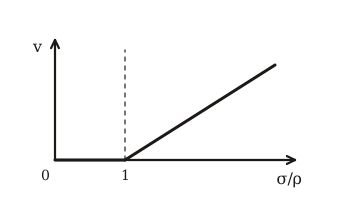
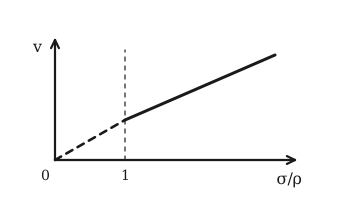
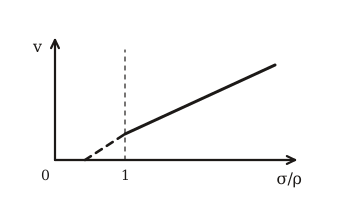
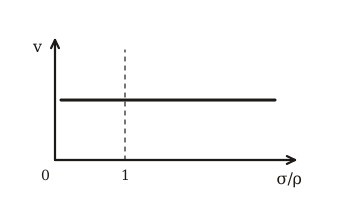
Lesson: Heat Temperature Thermal Expansion
Lesson: Heat Transfer
Lesson: Surface Energy Tension
Lesson: Young's Modulus
Lesson: Surface Energy Tension
Lesson: Young's Modulus
Lesson: Surface Energy Tension
Lesson: Bernoulli's Principle
Lesson: Stress Strain Hooke's
Lesson: Excess Pressure Curved Surface
If a soap bubble expands, the pressure inside the bubble
Lesson: Stress Strain Hooke's
Lesson: Terminal Velocity
Lesson: Heat Transfer
Lesson: Capillary Rise
Lesson: Specific Heat Calorimetry
Lesson: Bulk Modulus
Category: Similar Terms
Student uses Y formula when problem is about volumetric compression (use K) or vice versa.
Problem describes longitudinal stretching (use Y), volumetric pressure (use K), or shear (use G).
Y: longitudinal stress/strain. K: volumetric. G: shear. Match modulus to deformation type.
Lesson: Excess Pressure Curved Surface
Category: Similar Terms
Student uses 2T/r for soap bubble (drop formula). Bubble has 2 surfaces → 4T/r.
Question mentions soap bubble OR liquid drop OR air bubble in liquid.
Drop in air: 1 surface → 2T/r. Soap bubble in air: 2 surfaces → 4T/r. Air bubble in liquid: 1 surface → 2T/r.
Lesson: Bulk Modulus
Root cause: formula misuse
Y for longitudinal stretch (FL/A·ΔL); K for volumetric compression (-V·dP/dV); G for shear. Match modulus type to deformation type before computing.
Lesson: Excess Pressure Curved Surface
Root cause: concept gap
Drop in air: 1 surface → ΔP = 2T/r. Soap bubble: 2 surfaces (inner + outer) → ΔP = 4T/r. Air bubble inside liquid: 1 surface → 2T/r.
Lesson: Terminal Velocity
Root cause: formula misuse
v_t ∝ r² (because Stokes drag ∝ r v, gravity ∝ r³ - r³ = r³_diff). Doubling radius quadruples terminal velocity, not doubles.
Lesson: Angle of Contact
Height a liquid rises (or falls) in a capillary tube. cos(theta) > 0: rises (wetting); < 0: depresses.
| Symbol | Quantity | SI Unit |
|---|---|---|
| h | capillary height | m |
| T | surface tension | N/m |
| theta | contact angle | rad |
| rho | density | kg/m^3 |
| r | tube radius | m |
Lesson: Bernoulli's Principle
Conservation of energy along a streamline of incompressible non-viscous flow.
| Symbol | Quantity | SI Unit |
|---|---|---|
| P | pressure | Pa |
| rho | density | kg/m^3 |
| v | speed | m/s |
| g | gravity | m/s^2 |
| h | height | m |
Lesson: Bulk Modulus
Resistance of a material to uniform compression. Inverse: compressibility.
| Symbol | Quantity | SI Unit |
|---|---|---|
| K | bulk modulus | Pa |
| V | volume | m^3 |
| P | pressure | Pa |
Lesson: Change of State Latent Heat
Heat absorbed/released during phase change at constant T. L_fusion or L_vaporisation.
| Symbol | Quantity | SI Unit |
|---|---|---|
| Q | heat | J |
| m | mass | kg |
| L | latent heat | J/kg |
Lesson: Excess Pressure Curved Surface
Excess internal pressure due to surface tension. Bubble has 2 surfaces, hence factor 4.
| Symbol | Quantity | SI Unit |
|---|---|---|
| Delta_P | excess pressure | Pa |
| T | surface tension | N/m |
| r | radius | m |
Lesson: Fluid Pressure
Pressure at depth h below free surface of fluid of density rho.
| Symbol | Quantity | SI Unit |
|---|---|---|
| P | total pressure | Pa |
| P0 | atmospheric/surface pressure | Pa |
| rho | density | kg/m^3 |
| h | depth | m |
Lesson: Heat Temperature Thermal Expansion
Fractional change in length, area, volume per degree temperature change.
| Symbol | Quantity | SI Unit |
|---|---|---|
| alpha | linear coefficient | 1/K |
| beta | volume coefficient | 1/K |
| Delta_T | temperature change | K |
Lesson: Heat Transfer
Radiation power from a body. Black body epsilon=1; net to surroundings P = sigma*epsilon*A*(T^4 - T_s^4).
| Symbol | Quantity | SI Unit |
|---|---|---|
| sigma | Stefan-Boltzmann = 5.67e-8 | W/m^2/K^4 |
| epsilon | emissivity (0-1) | - |
| A | surface area | m^2 |
| T | absolute temp | K |
Lesson: Specific Heat Calorimetry
Heat required to raise mass m by temperature Delta_T. Specific heat c is material property.
| Symbol | Quantity | SI Unit |
|---|---|---|
| Q | heat | J |
| m | mass | kg |
| c | specific heat | J/kg/K |
| Delta_T | temp change | K |
Lesson: Stokes' Law
Drag force on a sphere of radius r moving with velocity v through viscous fluid (low Reynolds number).
| Symbol | Quantity | SI Unit |
|---|---|---|
| F | drag force | N |
| eta | viscosity | Pa*s |
| r | sphere radius | m |
| v | velocity | m/s |
Lesson: Terminal Velocity
Constant velocity reached when net force is zero (gravity balanced by buoyancy + viscous drag).
| Symbol | Quantity | SI Unit |
|---|---|---|
| v_t | terminal velocity | m/s |
| r | sphere radius | m |
| rho_s | sphere density | kg/m^3 |
| rho_f | fluid density | kg/m^3 |
| eta | viscosity | Pa*s |
Lesson: Young's Modulus
Ratio of longitudinal stress to longitudinal strain in a stretched wire/rod within elastic limit.
| Symbol | Quantity | SI Unit |
|---|---|---|
| Y | Young's modulus | Pa |
| F | applied force | N |
| A | cross-section area | m^2 |
| L | original length | m |
| Delta_L | extension | m |
Lesson: Bernoulli's Principle
forgets height term
Drops rho*g*h term
equates pressures incorrectly
Picks wrong reference points
Lesson: Excess Pressure Curved Surface
uses 2T r instead of 4T r for bubble
Treats soap bubble like a drop
Lesson: Specific Heat Calorimetry
ignores mass difference
Compares only specific heats, not masses
Lesson: Stokes' Law
expects linear acceleration
Default to constant acceleration without recognising drag-induced terminal v
Lesson: Young's Modulus
uses bulk modulus formula
Confuses Y with K