Kinetic Theory

10 lessons

Practice this unit →

Try this first: NEET 2025 PYQ

An oxygen cylinder of volume 30 litre has 18.20 moles of oxygen. After some oxygen is withdrawn from the cylinder, its gauge pressure drops to 11 atmospheric pressures at temperature 27°C. The mass of the oxygen withdrawn from the cylinder is nearly equal to:
[Given, R = 100/12 J mol⁻¹ K⁻¹, and molecular mass of O₂ = 32, 1 atm pressure = 1.01 × 10⁵ N/m]
  1. A.0.156 kg
  2. B.0.125 kg
  3. C.0.144 kg
  4. D.0.116 kg
Tap to see the answer

Answer: D.

A is wrong: 0.156 kg puts the gauge pressure (11 atm) into PV = µRT. The absolute pressure is 11 + 1 = 12 atm, so µ = PV/RT = 12 × 1.01 × 10⁵ × 0.030/(100/12 × 300) ≈ 14.5 mol remain, and (18.20 – 14.5) × 32 g ≈ 0.116 kg is withdrawn.

B is wrong: 0.125 kg does not follow from PV = µRT. At 12 atm absolute about 14.5 mol remain, so about 3.66 mol × 32 g ≈ 0.116 kg is withdrawn.

C is wrong: 0.144 kg is too large. With the absolute pressure of 12 atm, µ ≈ 14.5 mol remain and about 0.116 kg is withdrawn.

All 8 past-paper questions from this unit →

Topic index in NCERT order

10 of 10 lessons by the NCERT chapter they teach from, in book order. The page is the first printed page of your NCERT book the lesson cites; PYQs are the past NEET questions on that topic.

Class 11 Physics, Chapter 11

  1. Work Compressing Gasp. 2310 PYQs

Class 11 Physics, Chapter 12

  1. Avogadro Numberp. 2461 PYQ
  2. Equation of State Perfect Gasp. 2472 PYQs
  3. Kinetic Theory Assumptionsp. 2480 PYQs
  4. Concept of Pressure Kinetic Theoryp. 2500 PYQs
  5. Degrees of Freedomp. 2521 PYQ
  6. Equipartition Energyp. 2521 PYQ
  7. Mean Free Pathp. 2552 PYQs
  8. Kinetic Interpretation Temperaturep. 2560 PYQs
  9. RMS Speed Gasp. 2561 PYQ

All 10 lessons

Questions, revision cards and difficulty mix per lesson

Past-paper questions from this unit

8 questions, NEET 2020–2026

8 questions from NEET 2020, 2022, 2023, 2024, 2025, 2026. Answers verified against NTA official keys.

By year in our set: 2020 (2) · 2022 (1) · 2023 (1) · 2024 (1) · 2025 (1) · 2026 (2)

Lesson: Mean Free Path

NEET 2026

The mean free path of molecules in an ideal gas A is half that of another ideal gas B. The diameter of the spherical molecules of gas A is twice the diameter of the molecules of B. If number densities of the gases A and B are nA and nB, respectively, then the correct option is :

1nA = nB
2nA = 2nB
3nA = (1/4) nB
4nA = (1/2) nB
NTA Answer: Option 4(final)

Why the other options are wrong

  • Option 1: Equal densities would make lA = lB/4, since dA² = 4dB². From l = 1/(√2 nπd²), lA = lB/2 needs 4nA = 2nB, i.e. nA = nB/2.
  • Option 2: nA = 2nB would make lA = lB/8. Setting nA(2dB)² = 2nB dB² gives nA = nB/2.
  • Option 3: nA = nB/4 would make lA = lB. The required lA = lB/2 gives nA = nB/2.
Lesson: Equation of State Perfect Gas

NEET 2025

An oxygen cylinder of volume 30 litre has 18.20 moles of oxygen. After some oxygen is withdrawn from the cylinder, its gauge pressure drops to 11 atmospheric pressures at temperature 27°C. The mass of the oxygen withdrawn from the cylinder is nearly equal to: [Given, R = 100/12 J mol⁻¹ K⁻¹, and molecular mass of O₂ = 32, 1 atm pressure = 1.01 × 10⁵ N/m]

10.156 kg
20.125 kg
30.144 kg
40.116 kg
NTA Answer: Option 4(final)

Why the other options are wrong

  • Option 1: 0.156 kg puts the gauge pressure (11 atm) into PV = µRT. The absolute pressure is 11 + 1 = 12 atm, so µ = PV/RT = 12 × 1.01 × 10⁵ × 0.030/(100/12 × 300) ≈ 14.5 mol remain, and (18.20 – 14.5) × 32 g ≈ 0.116 kg is withdrawn.
  • Option 2: 0.125 kg does not follow from PV = µRT. At 12 atm absolute about 14.5 mol remain, so about 3.66 mol × 32 g ≈ 0.116 kg is withdrawn.
  • Option 3: 0.144 kg is too large. With the absolute pressure of 12 atm, µ ≈ 14.5 mol remain and about 0.116 kg is withdrawn.

Lesson: Equation of State Perfect Gas

NEET 2024Revised key

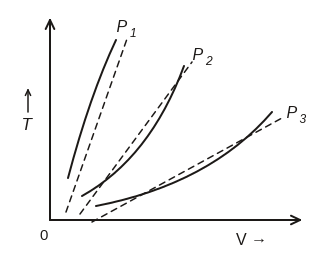
The following graph represents the T-V curves of an ideal gas (where T is the temperature and V the volume) at three pressures P1, P2 and P3 compared with those of Charles’s law represented as dotted lines. Then the correct relation is:

Question diagram
1P3 > P2 > P1
2P1 > P3 > P2
3P2 > P1 > P3
4P1 > P2 > P3
NTA Answer: Option 4(revised_final)

Why the other options are wrong

  • Option 1: Reversed. From PV = µRT, at fixed pressure V ∝ T, so T = (P/µR)V and the steeper T-V line has the higher pressure. P1 is the steepest curve, so P1 > P2 > P3.
  • Option 2: P3 is the least steep curve in the figure, so it has the lowest pressure, not the middle one: P1 > P2 > P3.
  • Option 3: P1 is the steepest T-V curve, so it has the highest pressure. The order is P1 > P2 > P3.

Lesson: RMS Speed Gas

NEET 2023

The temperature of a gas is –50°C. To what temperature the gas should be heated so that the rms speed is increased by 3 times?

13295°C
23097 K
3223 K
4669°C
NTA Answer: Option 1(final)

Why the other options are wrong

  • Option 2: 3097 K matches neither 9 × 223 K = 2007 K nor 16 × 223 K = 3568 K. Since vrms = √(3kBT/m), raising the speed by 3 times (to 4 times) needs T = 16 × 223 K = 3568 K ≈ 3295 °C.
  • Option 3: 223 K is the starting temperature (–50 °C). vrms does not change if T does not.
  • Option 4: 669 °C = 942 K is only about 4.2 × 223 K, which roughly doubles vrms. Four times the speed needs 16 × 223 K ≈ 3295 °C.

Lesson: Equipartition Energy

NEET 2020

The average thermal energy for a mono-atomic gas is : (kB is Boltzmann constant and T, absolute temperature)

17/2 kBT
21/2 kBT
33/2 kBT
45/2 kBT
NTA Answer: Option 3(final)

Why the other options are wrong

  • Option 1: 7/2 kBT needs seven squared terms, as in a vibrating diatomic molecule. Molecules of a monatomic gas like argon have only translational degrees of freedom: three terms of ½ kBT each, or 3/2 kBT.
  • Option 2: ½ kBT is the average for one degree of freedom. A monatomic molecule has three translational degrees of freedom, which gives 3/2 kBT.
  • Option 4: 5/2 kBT is for a rigid diatomic molecule, which has 5 degrees of freedom: 3 translational and 2 rotational. A monatomic gas has only the 3 translational ones: 3/2 kBT.

Lesson: Mean Free Path

NEET 2020

The mean free path for a gas, with molecular diameter d and number density n can be expressed as :

11/(√2 n²π²d²)
21/(√2 nπd)
31/(√2 nπd²)
41/(√2 n²πd²)
NTA Answer: Option 3(final)

Why the other options are wrong

  • Option 1: n, π and d are all squared here. The mean free path is l = 1/(√2 nπd²): it depends inversely on the number density and the size of the molecules, with n and π to the first power and d squared.
  • Option 2: d must be squared. A molecule suffers nπd²<v>∆t collisions in time ∆t, so l = 1/(√2 nπd²).
  • Option 4: n is not squared. The mean free path depends inversely on the number density to the first power: l = 1/(√2 nπd²).

Exam traps and common mistakes in this unit

3 items

Lesson: RMS Speed Gas

Category: Similar Terms

Student treats v_rms ∝ T instead of √T. Doubling T does NOT double v_rms; it multiplies by √2.

When it triggers

Question asks for new v_rms after T change.

How to avoid

v_rms = √(3RT/M). v_rms ∝ √T. To double v_rms, T must quadruple.

Lesson: RMS Speed Gas

Lesson: Work Compressing Gas

Formulas in this unit

8 formulas

Lesson: Degrees of Freedom

Cv from degrees of freedom

Each quadratic DoF contributes (1/2)R to molar Cv. Mono: f=3, Cv=3R/2; di-rigid: f=5, Cv=5R/2; poly-rigid: f=6, Cv=3R.

SymbolQuantitySI Unit
Cvmolar specific heatJ/mol/K
fdegrees of freedom-
Rgas constantJ/mol/K

Valid when

  • Equipartition holds (temperature high enough)
  • Quadratic energy modes

Lesson: Equation of State Perfect Gas

Ideal gas equation

Fundamental equation of state of ideal gas relating pressure, volume, temperature.

SymbolQuantitySI Unit
PpressurePa
Vvolumem^3
nmolesmol
R8.314J/mol/K
Nmolecule count-
kBoltzmann 1.38e-23J/K
TtempK

Valid when

  • Gas obeys ideal gas approximation (low pressure, high temperature relative to phase transitions)

Lesson: Equipartition Energy

Average translational KE per molecule

Microscopic interpretation of temperature: T is direct measure of average translational kinetic energy.

SymbolQuantitySI Unit
kBoltzmann constantJ/K
Tabsolute temperatureK

Valid when

  • Translational degrees of freedom only
  • Ideal gas

Lesson: Kinetic Interpretation Temperature

RMS speed of gas molecules

Root-mean-square molecular speed; depends on T and molar mass M (or molecular mass m).

SymbolQuantitySI Unit
Rgas constantJ/mol/K
TtempK
Mmolar masskg/mol
kBoltzmannJ/K
mmolecular masskg

Valid when

  • Ideal gas
  • Maxwell-Boltzmann distribution

Lesson: Mean Free Path

Mean free path of gas molecule

Average distance between successive molecular collisions.

SymbolQuantitySI Unit
lambdamean free pathm
nnumber density1/m^3
dmolecular diameterm

Valid when

  • Hard-sphere model
  • Equilibrium gas

Lesson: Work Compressing Gas

Work done by a gas against a constant pressure

Work done by the gas on its surroundings when its volume changes by dV at constant pressure P. Negative dV (compression) gives negative work by the gas, that is work done on the gas.

SymbolQuantitySI Unit
PPressure of the gasPa
dVChange in volume of the gasm^3

Valid when

  • Pressure constant over the volume change (or dV small enough that P is constant)

Do NOT use when

  • For a finite change with varying P, integrate P dV (isothermal: W = mu R T ln(V2/V1))

Lesson: Work Compressing Gas

Work done in isothermal process (ideal gas)

Work done by ideal gas during isothermal expansion. Q = W (since Delta_U = 0). Reverse for compression.

SymbolQuantitySI Unit
nmolesmol
Rgas constant 8.314J/mol/K
TtemperatureK
V_i, V_finitial/final volumem^3

Valid when

  • Ideal gas
  • Quasi-static (reversible) isothermal

Unit-wide

First law of thermodynamics

Change in internal energy = heat ADDED minus work DONE BY the system. Energy conservation including thermal energy.

SymbolQuantitySI Unit
Delta_Uchange in internal energyJ
Qheat added to systemJ
Wwork done BY systemJ

Valid when

  • Closed system (no mass exchange)
  • Sign convention: Q>0 heat in, W>0 system does work

NEET question patterns in this unit

5 patterns

Lesson: Equation of State Perfect Gas

Lesson: Equipartition Energy

Lesson: Mean Free Path

Lesson: RMS Speed Gas

Unit-wide

Questions about this unit

What does Kinetic Theory cover for NEET Physics?
10 lessons: Avogadro Number, Concept of Pressure Kinetic Theory, Degrees of Freedom, Equation of State Perfect Gas, Equipartition Energy, Kinetic Interpretation Temperature, Kinetic Theory Assumptions, Mean Free Path, RMS Speed Gas and Work Compressing Gas.
How often has Kinetic Theory come up in NEET past papers?
Our set of verified past papers has 8 questions from this unit, from NEET 2020, 2022, 2023, 2024, 2025 and 2026. Each is answered against the official NTA key.
Is the Kinetic Theory material free?
Yes. All 10 lessons and 92 practice questions are free, with no login needed.