Electrostatics

23 lessons

Practice this unit →

Try this first: NEET 2025 PYQ

An electric dipole with dipole moment 5 × 10⁻⁶ C m is aligned with the direction of a uniform electric field of magnitude 4 × 10⁵ N/C. The dipole is then rotated through an angle of 60° with respect to the electric field. The change in the potential energy of the dipole is:
  1. A.1.5 J
  2. B.0.8 J
  3. C.1.0 J
  4. D.1.2 J
Tap to see the answer

Answer: C.

A is wrong: With U = −pE cos θ, ΔU = pE(1 − cos 60°) = 2 J × 0.5 = 1.0 J; 1.5 J would need cos θ = 0.25.

B is wrong: pE = 5 × 10⁻⁶ × 4 × 10⁵ = 2 J, and the change is pE(1 − cos 60°) = 1.0 J, not 0.8 J.

D is wrong: With pE = 2 J, rotating from 0° to 60° changes the energy by pE(1 − cos 60°) = 1.0 J.

All 25 past-paper questions from this unit →

Topic index in NCERT order

23 of 23 lessons by the NCERT chapter they teach from, in book order. The page is the first printed page of your NCERT book the lesson cites; PYQs are the past NEET questions on that topic.

Class 12 Physics, Chapter 1

  1. Electric Charges Conservationp. 41 PYQ
  2. Coulomb's Lawp. 71 PYQ
  3. Superposition Principlep. 110 PYQs
  4. Electric Field Linesp. 150 PYQs
  5. Electric Field Point Chargep. 150 PYQs
  6. Electric Fluxp. 220 PYQs
  7. Electric Dipolep. 243 PYQs
  8. Torque Dipolep. 272 PYQs
  9. Gauss's Lawp. 301 PYQ
  10. Field Long Wire Gaussp. 340 PYQs
  11. Field Plane Sheet Gaussp. 350 PYQs
  12. Field Spherical Shell Gaussp. 354 PYQs

Class 12 Physics, Chapter 2

  1. Electric Potentialp. 485 PYQs
  2. Equipotential Surfacesp. 541 PYQ
  3. Potential Differencep. 550 PYQs
  4. Electrical Potential Energy Two Chargesp. 560 PYQs
  5. Electrical Potential Energy Dipole Fieldp. 600 PYQs
  6. Conductors Insulatorsp. 610 PYQs
  7. Dielectrics Polarizationp. 650 PYQs
  8. Capacitors Capacitancep. 680 PYQs
  9. Parallel Plate Capacitorp. 693 PYQs
  10. Capacitors Series Parallelp. 722 PYQs
  11. Energy in Capacitorp. 752 PYQs

All 23 lessons

Questions, revision cards and difficulty mix per lesson
01

Capacitors Capacitance

10 MCQsWorked example
Easy Recall (3)Direct Application (3)Calculation (4)
02

Capacitors Series Parallel

8 MCQs2 PYQs1 revision cardWorked example
Easy Recall (3)Direct Application (3)Calculation (2)
03

Conductors Insulators

10 MCQsWorked example
Easy Recall (4)Direct Application (3)Calculation (2)Concept Trap (1)
04

Coulomb's Law

9 MCQs1 PYQs1 revision cardWorked example
Easy Recall (3)Direct Application (4)Calculation (2)
05

Dielectrics Polarization

10 MCQsWorked example
Easy Recall (4)Direct Application (3)Calculation (2)Concept Trap (1)
06

Electric Charges Conservation

9 MCQs1 PYQsWorked example
Easy Recall (3)Direct Application (4)Calculation (2)
07

Electric Dipole

8 MCQs3 PYQs1 revision cardWorked example
Easy Recall (3)Direct Application (3)Calculation (2)
08

Electric Field Lines

10 MCQsWorked example
Easy Recall (4)Direct Application (3)Calculation (1)Concept Trap (2)
09

Electric Field Point Charge

10 MCQs1 revision cardWorked example
Easy Recall (4)Direct Application (3)Calculation (3)
10

Electric Flux

10 MCQsWorked example
Easy Recall (4)Direct Application (3)Calculation (3)
11

Electric Potential

8 MCQs5 PYQs1 revision cardWorked example
Easy Recall (3)Direct Application (3)Calculation (2)
12

Electrical Potential Energy Dipole Field

10 MCQsWorked example
Easy Recall (3)Direct Application (3)Calculation (4)
13

Electrical Potential Energy Two Charges

10 MCQsWorked example
Easy Recall (3)Direct Application (3)Calculation (4)
14

Energy in Capacitor

8 MCQs2 PYQs1 revision cardWorked example
Easy Recall (3)Direct Application (3)Calculation (2)
15

Equipotential Surfaces

9 MCQs1 PYQsWorked example
Easy Recall (3)Direct Application (3)Concept Trap (2)Calculation (1)
16

Field Long Wire Gauss

10 MCQs1 revision cardWorked example
Easy Recall (3)Direct Application (3)Calculation (2)Concept Trap (2)
17

Field Plane Sheet Gauss

10 MCQs1 revision cardWorked example
Easy Recall (3)Direct Application (3)Calculation (4)
18

Field Spherical Shell Gauss

8 MCQs4 PYQs1 revision cardWorked example
Easy Recall (3)Direct Application (3)Calculation (2)
19

Gauss's Law

9 MCQs1 PYQs1 revision cardWorked example
Easy Recall (3)Direct Application (3)Calculation (1)Concept Trap (2)
20

Parallel Plate Capacitor

8 MCQs3 PYQs1 revision cardWorked example
Easy Recall (3)Direct Application (3)Calculation (2)
21

Potential Difference

10 MCQsWorked example
Easy Recall (3)Direct Application (3)Calculation (3)Concept Trap (1)
22

Superposition Principle

10 MCQsWorked example
Easy Recall (3)Direct Application (3)Calculation (3)Concept Trap (1)
23

Torque Dipole

8 MCQs2 PYQs1 revision cardWorked example
Easy Recall (3)Direct Application (3)Calculation (2)

Videos for this unit

Past-paper questions from this unit

25 questions, NEET 2020–2026

25 questions from NEET 2020, 2021, 2022, 2023, 2024, 2025, 2026. Answers verified against NTA official keys.

By year in our set: 2020 (4) · 2021 (2) · 2022 (4) · 2023 (4) · 2024 (5) · 2025 (2) · 2026 (4)

All 25 past-paper questions from this unit → Newest 3 shown here.

Lesson: Energy in Capacitor

NEET 2026

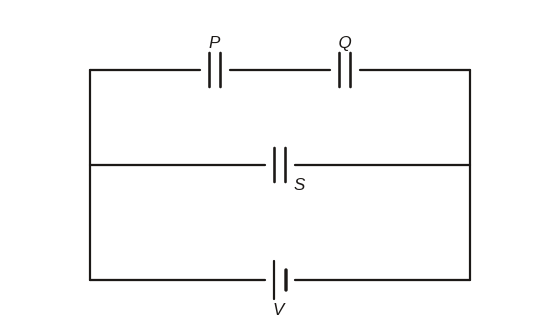
Three identical capacitors P, Q and S, each of the capacitance C, are connected to a battery of voltage V, as shown in the figure. If the energy stored in the capacitor P and total energy stored in the system are UP and UT, respectively, then the ratio UP/UT is :

Question diagram
12/3
21/3
31/2
41/6
NTA Answer: Option 4(final)

Why the other options are wrong

  • Option 1: 2/3 is the share of the energy in S alone: U_S = (1/2)CV² and U_T = (3/4)CV². P is in series with Q, and each takes half of V, so U_P = (1/2)C(V/2)² = CV²/8 and U_P/U_T = 1/6.
  • Option 2: 1/3 is the share of the P–Q branch (CV²/4 out of 3CV²/4), not of P alone. P and Q are identical and carry the same charge, so they split that branch energy equally: U_P/U_T = 1/6.
  • Option 3: 1/2 would need P to hold as much energy as Q and S together. S is directly across the battery ('the same potential difference is applied across both the capacitors' in parallel) and stores CV²/2, while P, in series with Q, sees only V/2 and stores CV²/8: U_P/U_T = (1/8)/(3/4) = 1/6.
Exam traps and common mistakes in this unit

3 items

Lesson: Capacitors Series Parallel

Category: Similar Terms

Student uses series formula for parallel circuit (or vice versa). Series capacitors: 1/C reciprocals add; parallel: C add directly. Note: opposite of resistor rules.

When it triggers

Capacitor combination problem.

How to avoid

Capacitors in SERIES → reciprocals add (like resistors in parallel). Capacitors in PARALLEL → values add (like resistors in series). Counter-intuitive vs resistor rules — memorise carefully.

Lesson: Capacitors Series Parallel

Lesson: Field Spherical Shell Gauss

Formulas in this unit

11 formulas

Lesson: Capacitors Capacitance

Parallel plate capacitor

Capacitance of parallel-plate capacitor. eps_r = 1 for vacuum/air.

SymbolQuantitySI Unit
CcapacitanceF
Aplate aream^2
dplate separationm
eps_rrelative permittivity-

Valid when

  • Plate separation << plate dimensions (uniform field)
  • Uniform dielectric

Lesson: Capacitors Series Parallel

Capacitors series and parallel

Series: same Q on each, voltages add. Parallel: same V across each, charges add.

SymbolQuantitySI Unit
C_eqequivalent capacitanceF
C_iindividualF

Valid when

  • Series: same charge through chain
  • Parallel: same voltage across all

Lesson: Coulomb's Law

Coulomb's law

Force between two point charges in vacuum. 1/(4*pi*eps0) ~ 9e9 N*m^2/C^2.

SymbolQuantitySI Unit
FforceN
q1,q2chargesC
rseparationm
eps0permittivity 8.85e-12F/m

Valid when

  • Point charges (or spherically symmetric)
  • r > body sizes

Lesson: Electric Dipole

Electric field of dipole — axial

Field on dipole axis at distance r >> dipole size; directed along p.

SymbolQuantitySI Unit
pdipole momentC*m
rdistance from centrem

Valid when

  • r >> 2a (dipole size)
  • Along axis

Lesson: Electric Field Point Charge

Electric field of point charge

Field magnitude from point charge q at distance r, directed radially.

SymbolQuantitySI Unit
Eelectric fieldN/C or V/m
qpoint chargeC
rdistancem

Valid when

  • Point or spherically symmetric source
  • r > source body radius

Lesson: Electric Potential

Electric potential of point charge

Scalar potential at distance r from point charge q, with V→0 at infinity.

SymbolQuantitySI Unit
VpotentialV
qpoint chargeC
rdistancem

Valid when

  • Reference V=0 at infinity

Lesson: Energy in Capacitor

Energy stored in capacitor

Energy stored as work to charge the capacitor.

SymbolQuantitySI Unit
CcapacitanceF
VvoltageV
QchargeC

Valid when

  • Linear capacitor
  • Static charging or quasi-static

Lesson: Field Long Wire Gauss

Field of long line charge (Gauss)

Radial field at perpendicular distance r from infinite line of linear charge density lambda.

SymbolQuantitySI Unit
EfieldV/m
lambdalinear charge densityC/m
rperp distancem

Valid when

  • Infinite line (or much longer than r)
  • Uniform charge density

Lesson: Field Plane Sheet Gauss

Field of charged plane sheet

Uniform field perpendicular to a non-conducting infinite plane sheet of surface charge density sigma. Independent of distance.

SymbolQuantitySI Unit
sigmasurface charge densityC/m^2
eps0permittivityF/m

Valid when

  • Infinite plane sheet
  • Non-conducting (otherwise sigma is split between surfaces)

Lesson: Field Spherical Shell Gauss

Field of charged spherical shell

Spherical shell behaves like point charge outside; field is zero inside.

SymbolQuantitySI Unit
Qtotal chargeC
Rshell radiusm
rdistance from centrem

Valid when

  • Spherically symmetric charge distribution
  • Static

Lesson: Gauss's Law

Gauss's law

Total electric flux through closed surface equals enclosed charge over permittivity.

SymbolQuantitySI Unit
Phi_Etotal fluxV*m
Q_encenclosed chargeC

Valid when

  • Closed surface
  • All sources accounted for

NEET question patterns in this unit

6 patterns

Lesson: Capacitors Series Parallel

Lesson: Coulomb's Law

Lesson: Electric Dipole

Lesson: Electric Potential

Lesson: Field Spherical Shell Gauss

Lesson: Parallel Plate Capacitor

Questions about this unit

What does Electrostatics cover for NEET Physics?
23 lessons: Capacitors Capacitance, Capacitors Series Parallel, Conductors Insulators, Coulomb's Law, Dielectrics Polarization, Electric Charges Conservation, Electric Dipole, Electric Field Lines, Electric Field Point Charge, Electric Flux, Electric Potential, Electrical Potential Energy Dipole Field, Electrical Potential Energy Two Charges, Energy in Capacitor, Equipotential Surfaces, Field Long Wire Gauss, Field Plane Sheet Gauss, Field Spherical Shell Gauss, Gauss's Law, Parallel Plate Capacitor, Potential Difference, Superposition Principle and Torque Dipole.
How often has Electrostatics come up in NEET past papers?
Our set of verified past papers has 25 questions from this unit, from NEET 2020, 2021, 2022, 2023, 2024, 2025 and 2026. Each is answered against the official NTA key.
Is the Electrostatics material free?
Yes. All 23 lessons and 212 practice questions are free, with no login needed.