Outside (r > R): E = (1/4πε₀) Q/r² (acts as point charge at centre). Inside (r < R): E = 0.
-- NCERT Class 12 Physics, Ch. 1, p. 35Field Spherical Shell Gauss
8 MCQs1 revision card9-step worked example
Source: NCERT ElectrostaticsPYQ coverage: NEET 2020, 2024, 2026Official key: NTA-verifiedLast updated: 21 Sep 2026
Field Spherical Shell Gauss, explained for NEET
The trap: putting a point inside a charged shell into q/4πε₀r² and getting a non-zero field. Inside a uniformly charged thin spherical shell the field is zero at every point.
The setup (NCERT Class 12 Physics Part I, Chapter 1, Section 1.14.3, page 35). A thin spherical shell of radius R carries uniform surface charge density σ, so its total charge is q = 4πR²σ. By spherical symmetry the field at any point depends only on r, the distance from the centre, and is radial. The Gaussian surface is a sphere of radius r centred on the shell; the flux through it is E × 4πr².
Outside the shell (r > R). The Gaussian sphere encloses the whole charge q, so
E = q / (4πε₀r²), radial (NCERT Chapter 1, Eq. 1.34, page 35)
The field points outward if q > 0 and inward if q < 0. NCERT's reading: for outside points the shell acts as if its entire charge were concentrated at its centre.
Inside the shell (r < R). The Gaussian sphere encloses no charge, so E × 4πr² = 0, giving
E = 0 (NCERT Chapter 1, Eq. 1.35, page 36)
This holds at all points inside, not only at the centre. NCERT adds that the experimental verification of this result confirms the 1/r² dependence in Coulomb's law (page 36).
Bridge to NEET. The shell pattern gives q (or σ and R) and a distance r, and asks for E. First decide where the point is — inside or outside. Common slips: using R in place of r for an outside point, dropping the square, measuring the distance from the shell surface instead of from the centre, and applying the outside formula to an inside point.
Watch out: in r², r is always the distance from the centre. With concentric shells, a point feels only the shells it lies outside of; a shell that encloses the point adds nothing to the field there.
Can you answer these Field Spherical Shell Gauss MCQs?
Select an option to see the explanation. Wrong answers show why your choice was tempting — and name the exact trap it exploits.
MCQ 1Easy RecallPractice
A thin spherical shell of radius R carries a total charge q spread uniformly over it. What is the magnitude of the electric field at a point inside the shell, at a distance r (< R) from its centre?
Show answer and why every option is right or wrong
Answer: B. A Gaussian sphere of radius r < R encloses no charge, so E × 4πr² = 0 and E = 0 at every inside point (NCERT Class 12 Physics Part I, Chapter 1, Eq. 1.35, page 36).
Why A is wrong: A is wrong because q/(4πε₀R²) is the outside formula evaluated at r = R; carrying that value to inside points gives a non-zero field where the enclosed charge is zero.
Why C is wrong: C is wrong because it applies the outside result (Eq. 1.34) to a point with r < R; that formula needs the Gaussian sphere to enclose q, and here it encloses nothing.
Why D is wrong: D is wrong because it treats the charge as if it sat at the nearest point of the shell, measuring distance from the shell surface; inside the shell the field is zero, not a point-charge value.
MCQ 2Easy RecallPractice
According to NCERT, for points outside a uniformly charged thin spherical shell, the electric field is:
Show answer and why every option is right or wrong
Answer: C. NCERT Class 12 Physics Part I, Chapter 1, Section 1.14.3 (page 35): Eq. 1.34 is exactly the field of a charge q placed at the centre, so for outside points the shell acts as if its whole charge were at the centre.
Why A is wrong: A is wrong because it applies the inside result to an outside point; a Gaussian sphere outside the shell encloses the full charge q, so the field is not zero.
Why B is wrong: B is wrong because the distance in Eq. 1.34 is r, measured from the centre of the shell, not from the nearest point on its surface.
Why D is wrong: D is wrong because NCERT states the field is directed outward if q > 0 and inward if q < 0.
MCQ 3Easy RecallPractice
NCERT notes that the experimental verification of the result "field inside a uniformly charged thin shell is zero" confirms which of the following?
Show answer and why every option is right or wrong
Answer: C. NCERT Class 12 Physics Part I, Chapter 1, page 36: the zero-field-inside result follows from Gauss's law, and its experimental verification confirms the 1/r² dependence in Coulomb's law.
Why A is wrong: A is wrong because quantisation (q = ne) is a basic property of charge; the zero field inside a shell tests how the force falls off with distance, not whether charge comes in units of e.
Why B is wrong: B is wrong because conservation concerns the total charge of an isolated system staying constant; it is not what the shell measurement tests.
Why D is wrong: D is wrong because additivity concerns adding charges algebraically; the shell result is a test of the inverse-square distance dependence.
MCQ 4Direct ApplicationPractice
A thin spherical shell of radius 0.20 m carries a charge of +5.0 × 10⁻⁹ C spread uniformly. Taking 1/(4πε₀) = 9.0 × 10⁹ N m² C⁻², what is the magnitude of the electric field at a point 0.50 m from the centre of the shell?
Show answer and why every option is right or wrong
Answer: A. The point is outside (0.50 m > 0.20 m), so E = (9.0 × 10⁹)(5.0 × 10⁻⁹)/(0.50)² = 45/0.25 = 1.8 × 10² N/C, directed radially outward (NCERT Class 12 Physics Part I, Chapter 1, Eq. 1.34, page 35).
Why B is wrong: B is wrong because 1.1 × 10³ N/C comes from 45/(0.20)² = 45/0.04, using the shell radius R instead of the distance r of the point from the centre.
Why C is wrong: C is wrong because 5.0 × 10² N/C comes from 45/(0.30)² = 45/0.09, measuring the distance from the shell surface (0.50 − 0.20) instead of from the centre.
Why D is wrong: D is wrong because 9.0 × 10¹ N/C comes from 45/0.50, dividing by r instead of r².
MCQ 5Direct ApplicationPractice
A thin spherical shell of radius 0.25 m carries a charge of −2.0 × 10⁻⁹ C spread uniformly. Taking 1/(4πε₀) = 9.0 × 10⁹ N m² C⁻², what is the magnitude of the electric field at a point 0.10 m from the centre of the shell?
Show answer and why every option is right or wrong
Answer: D. The point is inside (0.10 m < 0.25 m). A Gaussian sphere of radius 0.10 m encloses no charge, so E = 0 whatever the sign or size of the shell's charge (NCERT Class 12 Physics Part I, Chapter 1, Eq. 1.35, page 36).
Why A is wrong: A is wrong because 1.8 × 10³ N/C comes from 18/(0.10)² = 18/0.01, applying the outside formula to an inside point, which is the trap of computing a non-zero field inside the shell.
Why B is wrong: B is wrong because 8.0 × 10² N/C comes from 18/(0.15)² = 18/0.0225, measuring the distance from the shell surface (0.25 − 0.10) and treating the shell like a point charge.
Why C is wrong: C is wrong because 2.9 × 10² N/C comes from 18/(0.25)² = 18/0.0625 = 288, the outside formula evaluated at r = R and then carried to an inside point.
MCQ 6Direct ApplicationPractice
A uniformly charged thin spherical shell has radius R. Points P and Q are at distances 2R and 3R from its centre. The ratio of field magnitudes E_Q : E_P is:
Show answer and why every option is right or wrong
Answer: B. Both points are outside, so E ∝ 1/r² (NCERT Class 12 Physics Part I, Chapter 1, Eq. 1.34, page 35). E_Q : E_P = (1/9R²) : (1/4R²) = 4 : 9.
Why A is wrong: A is wrong because 9 : 4 inverts the ratio, as if the field grew with r²; outside the shell the field falls as 1/r², so the farther point Q has the weaker field.
Why C is wrong: C is wrong because 2 : 3 comes from taking E ∝ 1/r, dropping the square in Eq. 1.34.
Why D is wrong: D is wrong because 3 : 2 comes from taking E ∝ r, so the field would grow with distance; outside the shell it decreases.
MCQ 7CalculationPractice
A thin spherical shell of radius R has uniform surface charge density σ (σ > 0). What is the magnitude of the electric field at a point at distance 2R from its centre?
Show answer and why every option is right or wrong
Answer: A. Total charge q = 4πR²σ (NCERT page 35). For r = 2R (outside), E = q/(4πε₀r²) = 4πR²σ/(4πε₀ · 4R²) = σR²/(ε₀ · 4R²) = σ/(4ε₀), directed outward (NCERT Class 12 Physics Part I, Chapter 1, Eq. 1.34, page 35).
Why B is wrong: B is wrong because σ/ε₀ comes from σR²/(ε₀r²) with r set equal to R, ignoring that the point is at 2R.
Why C is wrong: C is wrong because zero is the result for points inside the shell; at 2R the Gaussian sphere encloses the whole charge q.
Why D is wrong: D is wrong because σ/(2ε₀) comes from σR/(ε₀r) with r = 2R, using the ratio R/r instead of (R/r)², i.e. dropping the square.
MCQ 8CalculationPYQ Pattern
Two concentric thin spherical shells share a common centre. The inner shell (radius R) carries charge +q and the outer shell (radius 2R) carries charge −q, each spread uniformly. What is the magnitude of the electric field at a point at distance 1.5R from the centre?
Show answer and why every option is right or wrong
Answer: D. The point is outside the inner shell, so it contributes q/[4πε₀(1.5R)²] = q/(9πε₀R²), outward (Eq. 1.34, page 35). The point is inside the outer shell, so the outer shell contributes zero (Eq. 1.35, page 36). Net field = q/(9πε₀R²) (NCERT Class 12 Physics Part I, Chapter 1).
Why A is wrong: A is wrong because it lets the outer shell act like a charge −q at the centre, cancelling the inner shell; the point is inside the outer shell, where that shell's field is zero.
Why B is wrong: B is wrong because 2q/(9πε₀R²) adds a field of the same size from the outer shell, computing a non-zero field inside that shell.
Why C is wrong: C is wrong because q/(4πε₀R²) uses the inner shell's radius R instead of the point's distance 1.5R from the centre.
Free NEET study resources
Get a structured 30-day Mechanics plan and a complete formula booklet — delivered to your inbox instantly.
Field Spherical Shell Gauss: quick recall before you leave
How do you solve a Field Spherical Shell Gauss question? A worked example
- 1
Given
A thin spherical shell of radius R = 0.10 m carries a charge q = +2.0 × 10⁻⁹ C spread uniformly over it. Take 1/(4πε₀) = 9.0 × 10⁹ N m² C⁻². Point A is 0.050 m from the centre; point B is 0.30 m from the centre. (Original problem.)
- 2
Required
The magnitude and direction of the electric field at (a) point A and (b) point B.
- 3
Concept
Compare each distance with R. Point A (0.050 m < 0.10 m) is inside: a Gaussian sphere through A encloses no charge, so E = 0. Point B (0.30 m > 0.10 m) is outside: a Gaussian sphere through B encloses all of q, so the shell acts like a charge q at its centre.
- 4
Formula
Inside: E = 0 (NCERT Eq. 1.35). Outside: E = q/(4πε₀r²) (NCERT Eq. 1.34).
- 5
Substitution
(a) r = 0.050 m < R, so E_A = 0.
(b) E_B = (9.0 × 10⁹)(2.0 × 10⁻⁹)/(0.30)² - 6
Calculation
(b) Numerator: 9.0 × 10⁹ × 2.0 × 10⁻⁹ = 18 N m² C⁻¹. Denominator: (0.30)² = 0.090 m². E_B = 18/0.090 = 2.0 × 10² N/C.
The exponent 2 in r² and the factor 4π inside the given constant are exact and do not limit the significant figures; the given data have two significant figures, so the answer is reported to two. - 7
Final answer
(a) E_A = 0. (b) E_B = 2.0 × 10² N/C, directed radially outward (q is positive).
- 8
Common trap
Putting point A into the outside formula: 18/(0.050)² = 7.2 × 10³ N/C, a non-zero field where the true field is zero. At point B, using R instead of r gives 18/(0.10)² = 1.8 × 10³ N/C, nine times too large.
- 9
Similar NEET-style question
"A thin spherical shell of radius 0.20 m carries a uniformly spread charge of −4.0 × 10⁻⁹ C. Taking 1/(4πε₀) = 9.0 × 10⁹ N m² C⁻², find the electric field at 0.15 m and at 0.60 m from its centre."
Strategy: 0.15 m < 0.20 m, so E = 0 there. 0.60 m is outside: E = (9.0 × 10⁹)(4.0 × 10⁻⁹)/(0.60)² = 36/0.36 = 1.0 × 10² N/C, directed radially inward because the charge is negative.
---
What to remember before solving Field Spherical Shell Gauss questions
Which Field Spherical Shell Gauss formulas do you need for NEET?
1 formula — click to collapse
Field of charged spherical shell
Spherical shell behaves like point charge outside; field is zero inside.
| Symbol | Quantity | SI Unit |
|---|---|---|
| Q | total charge | C |
| R | shell radius | m |
| r | distance from centre | m |
Valid when
- Spherically symmetric charge distribution
- Static
Where do students lose marks on Field Spherical Shell Gauss?
These are the exact patterns that cause wrong answers in NEET. Each trap includes when it triggers and how to avoid it.
1 item — click to collapse
Root cause: concept gap
Correction
Gauss's law: enclosed charge inside the shell is zero (charge is all on outside surface), so E = 0 inside. Outside: behaves like point charge.
More in Electrostatics: 2 exam traps and mistakes · 10 formulas · 5 question patterns from its other lessons.
Field Spherical Shell Gauss questions from past NEET papers
4 questions from NEET 2020, 2024, 2026. Answers verified against NTA official keys. — click to collapse
NEET 2026
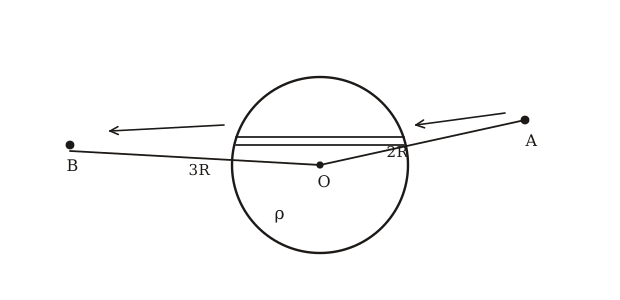
12
26
39
418
NTA Answer: Option 4(final)
NEET 2026
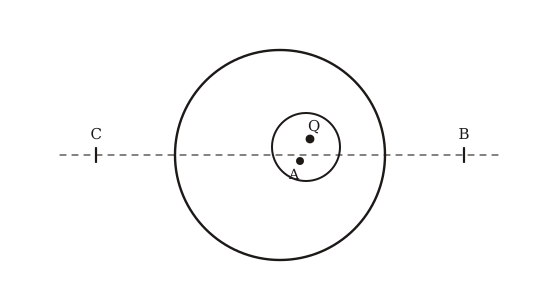
1E_A = 0, E_B = E_C
2E_A ≠ 0, E_B = E_C
3E_A = 0, E_B > E_C
4E_A ≠ 0, E_B < E_C
NTA Answer: Option 2(final)
NEET 2024Revised key
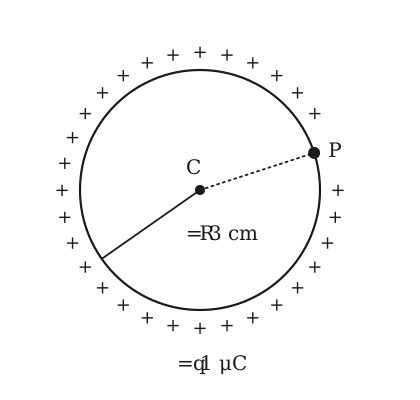
13 × 10⁵
21 × 10⁵
30.5 × 10⁵
4Zero
NTA Answer: Option 4(revised_final)
NEET 2020
11.28 × 10⁷ N/C
21.28 × 10⁴ N/C
31.28 × 10⁵ N/C
41.28 × 10⁶ N/C
NTA Answer: Option 3(final)
How does NEET ask about Field Spherical Shell Gauss?
1 recurring pattern from past papers — click to collapse
Charged spherical shell: field inside zero, outside as point charge. Apply Gauss's law to find E at given r.
InterpretationMedium
Common distractors
treats shell like solid sphere
Includes interior charge contribution where there is none
Sources
Page numbers are the ones printed in the current NCERT textbook (2023 rationalised edition), unless marked pre-2023. The books are free at ncert.nic.in.
Test yourself on this topic with real past-paper questions:
Practice this topic →Prefer to watch this?
7 real NEET Electrostatics questions (2022–2025), from field lines to capacitors, solved step by step (14 min)
Watch on YouTube