NEET 2026
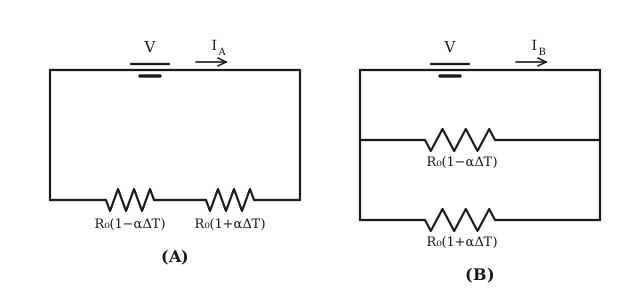
1I_A remains constant while I_B increases
2I_A decreases while I_B increases
3I_A increases while I_B decreases
4both I_A and I_B remain constant
NTA Answer: Option 1(final)
12 lessons
12 of 12 lessons by the NCERT chapter they teach from, in book order. The page is the first printed page of your NCERT book the lesson cites; PYQs are the past NEET questions on that topic.
18 questions from NEET 2020, 2021, 2022, 2023, 2024, 2026. Answers verified against NTA official keys.
By year in our set: 2020 (4) · 2021 (3) · 2022 (4) · 2023 (3) · 2024 (3) · 2026 (1)
Lesson: Temperature Dependence Resistance
Lesson: Internal Resistance EMF
Lesson: Resistors Series Parallel
Lesson: Electrical Energy Power
Lesson: Resistors Series Parallel
Lesson: Resistors Series Parallel
Lesson: Temperature Dependence Resistance
Lesson: Electrical Energy Power
Lesson: Temperature Dependence Resistance
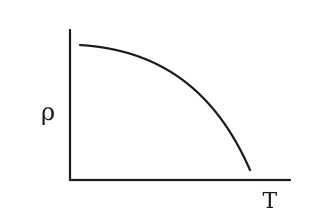
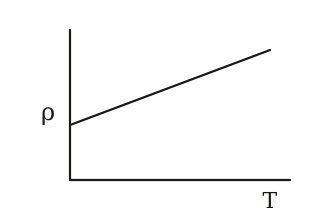
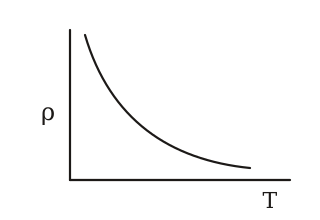
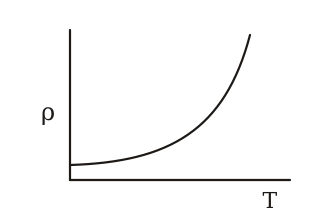
As the temperature increases, the electrical resistance
Lesson: Resistivity Conductivity
Lesson: Wheatstone Bridge
Lesson: Drift Velocity Mobility
Lesson: Internal Resistance EMF
Lesson: Resistors Series Parallel
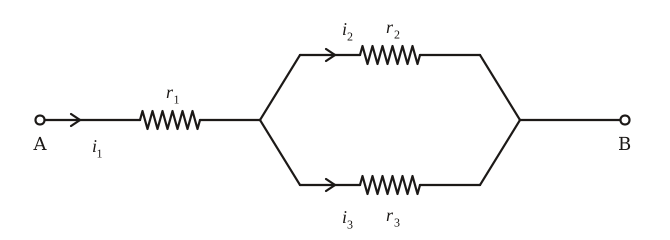
Lesson: Metre Bridge
Lesson: Temperature Dependence Resistance
The solids which have the negative temperature coefficient of resistance are :
Lesson: Drift Velocity Mobility
Lesson: Temperature Dependence Resistance
Lesson: Metre Bridge
Category: Similar Terms
Student writes Q/P = R/S or S/R = P/Q instead of P/Q = R/S. Order of arms in the proportion matters.
Wheatstone bridge problem with 4 named arms.
Standard convention: P, Q in one branch (P top, Q bottom from input node); R, S in other branch. Balance: P/Q = R/S.
Lesson: Temperature Dependence Resistance
Root cause: concept gap
Metals: α > 0 (R increases with T). Semiconductors: α < 0 (R decreases with T) because more thermal carriers. Carbon, silicon, germanium have negative α.
Lesson: Wheatstone Bridge
Root cause: concept gap
Standard convention P/Q = R/S. P, Q in one branch; R, S in other. Always write four arms in the same rotational order around the bridge.
Lesson: Drift Velocity Mobility
Macroscopic current expressed in terms of microscopic drift velocity. n = electron density.
| Symbol | Quantity | SI Unit |
|---|---|---|
| I | current | A |
| n | electron density | 1/m^3 |
| e | electron charge | C |
| A | cross-section | m^2 |
| v_d | drift velocity | m/s |
Lesson: Electrical Energy Power
Power dissipated as heat in resistor (Joule heating).
| Symbol | Quantity | SI Unit |
|---|---|---|
| P | power | W |
| V | voltage | V |
| I | current | A |
| R | resistance | Ω |
Lesson: Electrical Resistance
Linear ohmic conductor: voltage = current x resistance at constant T.
| Symbol | Quantity | SI Unit |
|---|---|---|
| V | voltage | V |
| I | current | A |
| R | resistance | Ω |
Lesson: Internal Resistance EMF
Terminal voltage of cell with internal resistance r when current I flows.
| Symbol | Quantity | SI Unit |
|---|---|---|
| epsilon | EMF | V |
| r | internal resistance | Ω |
| I | current | A |
| V_t | terminal voltage | V |
Lesson: Metre Bridge
Balance condition: no current through galvanometer when P/Q = R/S. Used to measure unknown resistance.
| Symbol | Quantity | SI Unit |
|---|---|---|
| P,Q,R,S | four arm resistances | Ω |
Lesson: Resistivity Conductivity
Resistance from material resistivity, length, cross-sectional area.
| Symbol | Quantity | SI Unit |
|---|---|---|
| R | resistance | Ω |
| rho | resistivity | Ω*m |
| L | length | m |
| A | area | m^2 |
Lesson: Resistors Series Parallel
Same current through series; same voltage across parallel.
| Symbol | Quantity | SI Unit |
|---|---|---|
| R | equivalent | Ω |
| R_i | individual resistor | Ω |
Lesson: Electrical Energy Power
uses wrong form
Picks I^2 R when V is constant or vice versa
Lesson: Electrical Resistance
misuses power formula
Uses P = VI as if I = P/R
Lesson: Kirchhoff's Laws
forgets sign convention
Mixes signs around loop
Lesson: Metre Bridge
inverts ratio
Uses Q/P or S/R instead
Lesson: Resistors Series Parallel
treats bridge as pure series parallel
Misses Wheatstone-like bridge structure
Lesson: Temperature Dependence Resistance
treats semiconductor like metal
Uses α > 0 for semiconductors