Formula
Temperature dependence of R
R(T) = R₀ [1 + α (T - T₀)], where α is the temperature coefficient (1/°C). For metals α > 0; for semiconductors α < 0.
-- NCERT Class 12 Physics, Ch. 3, p. 90The trap: treating every material like a metal. Metals have a positive temperature coefficient α — resistance rises when they are heated. Semiconductors and insulators behave the opposite way: their resistivity falls as temperature rises. Giving a semiconductor a positive α is a common confusion, and NEET options are built around it.
The relation. NCERT Class 12 Physics Part I, Chapter 3, Section 3.8 (page 90, Eq. 3.26) gives, over a limited range of temperature:
ρ_T = ρ₀[1 + α(T − T₀)]
Here ρ₀ is the resistivity at the reference temperature T₀, and α has the dimension (temperature)⁻¹. For metals α is positive. When the wire's dimensions change negligibly, the same form is used for resistance, R_T = R₀[1 + α(T − T₀)] — this is how NCERT's toaster (Example 3.3) and platinum thermometer (Example 3.4) problems are solved.
Why the sign differs (NCERT page 91, Eq. 3.27): ρ = m/(ne²τ).
Alloys. Nichrome, manganin and constantan have resistivity with a very weak dependence on temperature, which is why they are used in standard resistors (NCERT page 90).
Bridge to NEET. Questions come in two forms: (1) sign/concept — "which solids have a negative temperature coefficient?" (insulators and semiconductors); (2) two-temperature calculation — find α from R at two temperatures, or find a temperature from a measured resistance.
Watch-out. α = (R_T − R₀)/[R₀(T − T₀)]. The denominator uses the resistance at the reference temperature, not the heated value, and uses the temperature difference, not the final temperature. Check the power of ten at the end — 3×10⁻² and 3×10⁻³ both appear as options.
Select an option to see the explanation. Wrong answers show why your choice was tempting — and name the exact trap it exploits.
For a metallic conductor, which statement about the temperature coefficient of resistivity α is correct?
Answer: A. A is correct. NCERT Class 12 Physics Part I, Chapter 3, page 90 states that α is positive for metals; with ρ_T = ρ₀[1 + α(T − T₀)], a positive α means resistivity increases with temperature.
Why B is wrong: B is wrong because a negative α describes semiconductors and insulators, not metals (trap: swapping the metal and semiconductor behaviour).
Why C is wrong: C is wrong because metals do show temperature dependence; only certain alloys such as nichrome, manganin and constantan show a very weak dependence, and even that is not zero.
Why D is wrong: D is wrong because it contradicts itself: with a positive α the term α(T − T₀) is positive when T > T₀, so resistivity must rise, not fall.
Which solids have a negative temperature coefficient of resistance?
Answer: B. B is correct. NCERT Class 12 Physics Part I, Chapter 3, page 91 explains that in insulators and semiconductors the carrier density n increases with temperature, so resistivity decreases — a negative coefficient.
Why A is wrong: A is wrong because metals have a positive α; their resistivity rises with temperature since τ decreases while n stays nearly constant.
Why C is wrong: C is wrong because it includes metals, whose coefficient is positive (trap: treating all solids alike).
Why D is wrong: D is wrong because it includes metals; semiconductors have a negative coefficient but metals do not (trap: giving metals and semiconductors the same sign).
Nichrome, manganin and constantan are used to make standard resistors mainly because:
Answer: A. A is correct. NCERT Class 12 Physics Part I, Chapter 3, page 90 notes that these alloys show a very weak dependence of resistivity on temperature, so their resistance value stays nearly fixed — the property a standard resistor needs.
Why B is wrong: B is wrong because a large α would make the resistance change noticeably with temperature, which is the opposite of what a standard resistor needs.
Why C is wrong: C is wrong because these are metallic alloys, not semiconductors; a large negative α would also make the resistance drift with temperature (trap: attaching semiconductor behaviour to a metal).
Why D is wrong: D is wrong because a rapid rise in carrier density with temperature is the mechanism in semiconductors and insulators, and it would make resistance strongly temperature dependent.
A metal wire has resistance 10.0 Ω at 0 °C. Its temperature coefficient of resistance is 4.0×10⁻³ °C⁻¹. Assuming the linear relation holds and the wire's dimensions change negligibly, what is its resistance at 50.0 °C?
Answer: D. D is correct. R_T = R₀[1 + α(T − T₀)] = 10.0 × [1 + (4.0×10⁻³)(50.0)] = 10.0 × 1.20 = 12.0 Ω (NCERT Class 12 Physics Part I, Chapter 3, page 90).
Why A is wrong: A is wrong because it adds αΔT = 0.20 directly to 10.0 Ω instead of multiplying R₀ by (1 + αΔT); the increase is R₀αΔT = 2.0 Ω.
Why B is wrong: B is wrong because it uses 1 − αΔT = 0.80, as if the metal had a negative coefficient (trap: treating a metal like a semiconductor).
Why C is wrong: C is wrong because it misreads α as 4.0×10⁻² °C⁻¹, giving αΔT = 2.0 and R = 10.0 × 3.0 = 30.0 Ω — a power-of-ten slip.
A platinum resistance thermometer reads 4.00 Ω at the ice point (0 °C) and 4.40 Ω at the steam point (100 °C). When placed in a bath it reads 4.60 Ω. Assuming a linear variation, the bath temperature is:
Answer: C. C is correct. t = [(R_t − R₀)/(R₁₀₀ − R₀)] × 100 °C = (0.60/0.40) × 100 °C = 1.50×10² °C. This is the same method as NCERT Class 12 Physics Part I, Chapter 3, Example 3.4 (page 92).
Why A is wrong: A is wrong because it divides the change 0.60 Ω by R₀ = 4.00 Ω instead of by the 0–100 °C change of 0.40 Ω, giving 0.15 × 100 = 15.0 °C.
Why B is wrong: B is wrong because it measures the rise from the steam-point reading, (4.60 − 4.40)/0.40 × 100 = 50.0 °C, and then forgets to add the 100 °C of that reference point.
Why D is wrong: D is wrong because it takes the plain ratio 4.60/4.40 × 100 ≈ 105 °C, ignoring that the relation is linear in the resistance change from R₀, not proportional to R itself.
A nichrome heating element has resistance 75.3 Ω at 27.0 °C. At its steady operating temperature its resistance is 85.8 Ω. Taking α = 1.70×10⁻⁴ °C⁻¹ (averaged over the range) and using room temperature as the reference, the steady temperature of the element is:
Answer: C. C is correct. T₂ − T₁ = (R₂ − R₁)/(R₁α) = 10.5/(75.3 × 1.70×10⁻⁴) ≈ 820 °C, so T₂ = 820 + 27.0 = 847 °C. This matches NCERT Class 12 Physics Part I, Chapter 3, Example 3.3 (page 91).
Why A is wrong: A is wrong because it puts the hot resistance 85.8 Ω in the denominator: 10.5/(85.8 × 1.70×10⁻⁴) ≈ 720 °C, then adds 27.0 °C. The reference resistance belongs in the denominator.
Why B is wrong: B is wrong because 820 °C is only the temperature rise T₂ − T₁; the reference temperature 27.0 °C must be added to get T₂.
Why D is wrong: D is wrong because it subtracts 27.0 °C from the rise (820 − 27.0) instead of adding it.
Using ρ = m/(ne²τ), which explanation correctly accounts for the fall in resistivity of a semiconductor as its temperature rises?
Answer: B. B is correct. NCERT Class 12 Physics Part I, Chapter 3, page 91: in insulators and semiconductors n increases with temperature, and this increase more than compensates any decrease in τ, so ρ decreases.
Why A is wrong: A is wrong because τ does not increase with temperature; NCERT describes τ as decreasing as temperature rises.
Why C is wrong: C is wrong because constant n with falling τ is the mechanism for metals, and it makes ρ increase, not decrease (trap: applying the metal explanation to a semiconductor).
Why D is wrong: D is wrong because the electron mass m is a constant in this relation; the temperature effect enters through n and τ.
A metal wire has resistance 2.50 Ω at 20.0 °C and 3.00 Ω at 70.0 °C. Taking 20.0 °C as the reference temperature and assuming the linear relation holds, what is its resistance at 120.0 °C?
Answer: D. D is correct. Step 1: α = (3.00 − 2.50)/(2.50 × 50.0) = 4.00×10⁻³ °C⁻¹. Step 2: R = 2.50 × [1 + (4.00×10⁻³)(100.0)] = 2.50 × 1.40 = 3.50 Ω (NCERT Class 12 Physics Part I, Chapter 3, page 90).
Why A is wrong: A is wrong because it uses the final temperature 120.0 °C instead of the difference T − T₀ = 100.0 °C: 2.50 × (1 + 0.480) = 3.70 Ω.
Why B is wrong: B is wrong because it uses 1 − αΔT = 0.600, as if the metal had a negative coefficient (trap: treating a metal like a semiconductor).
Why C is wrong: C is wrong because α was found with the hot resistance 3.00 Ω in the denominator (≈ 3.33×10⁻³ °C⁻¹), giving 2.50 × 1.333 ≈ 3.33 Ω; the reference resistance 2.50 Ω belongs in the denominator.
Get a structured 30-day Mechanics plan and a complete formula booklet — delivered to your inbox instantly.
Given
A platinum wire has resistance R₀ = 2 Ω at T₀ = 0 °C and R_T = 6.8 Ω at T = 80 °C. The values are used as stated in the question and treated as exact.
Required
The temperature coefficient of resistance α of platinum.
Concept
For a metal, resistance varies linearly with temperature over a limited range, with α positive (NCERT Class 12 Physics Part I, Chapter 3, Section 3.8, page 90). Since resistance rose on heating, α must come out positive.
Formula
R_T = R₀[1 + α(T − T₀)], rearranged: α = (R_T − R₀)/[R₀(T − T₀)]
Substitution
α = (6.8 − 2)/[2 × (80 − 0)]
Calculation
Numerator: 6.8 − 2 = 4.8 Ω. Denominator: 2 × 80 = 160 Ω °C. α = 4.8/160 = 0.03 °C⁻¹. The 0 °C reference and the values as given in the question are treated as exact, so they do not limit the significant figures of the result.
Final answer
α = 3×10⁻² °C⁻¹
Common trap
Writing 3×10⁻³ °C⁻¹ — a decimal slip in 4.8/160 — appears as a distractor. Other errors: dividing by the hot resistance 6.8 Ω instead of R₀ = 2 Ω (giving about 8.8×10⁻³ °C⁻¹), or reporting a negative α, which would describe a semiconductor, not platinum. Treat 3×10⁻² °C⁻¹ as the answer this question's data gives, not as a value of platinum to memorise — for comparison, NCERT's nichrome example uses α = 1.70×10⁻⁴ °C⁻¹.
Similar NEET-style question
"A metal wire has resistance 3.0 Ω at 0 °C and 3.6 Ω at 50.0 °C. Find its temperature coefficient of resistance."
Strategy: α = (3.6 − 3.0)/(3.0 × 50.0) = 0.6/150 = 4×10⁻³ °C⁻¹. Check the power of ten, and confirm the sign is positive for a metal.
---
R(T) = R₀ [1 + α (T - T₀)], where α is the temperature coefficient (1/°C). For metals α > 0; for semiconductors α < 0.
-- NCERT Class 12 Physics, Ch. 3, p. 90These are the exact patterns that cause wrong answers in NEET. Each trap includes when it triggers and how to avoid it.
Root cause: concept gap
Metals: α > 0 (R increases with T). Semiconductors: α < 0 (R decreases with T) because more thermal carriers. Carbon, silicon, germanium have negative α.
More in Current Electricity: 2 exam traps and mistakes · 7 formulas · 5 question patterns from its other lessons.
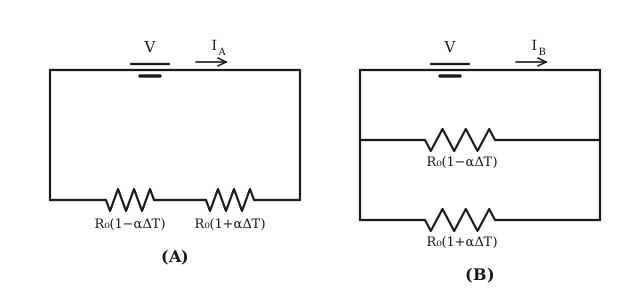
As the temperature increases, the electrical resistance
The solids which have the negative temperature coefficient of resistance are :
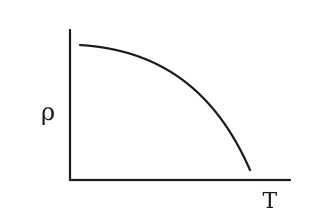
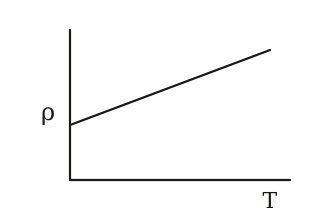
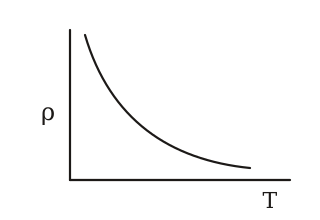
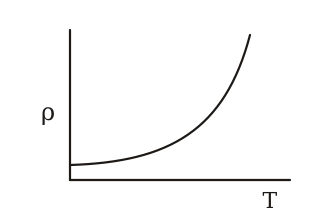
treats semiconductor like metal
Uses α > 0 for semiconductors
Page numbers are the ones printed in the current NCERT textbook (2023 rationalised edition), unless marked pre-2023. The books are free at ncert.nic.in.
Test yourself on this topic with real past-paper questions:
Practice this topic →8 real NEET Current Electricity questions (2022–2025) on animated circuits: watch the current flow (15 min)
Watch on YouTube