Resistors Series Parallel

8 MCQs1 revision card9-step worked example
Source: NCERT Current ElectricityPYQ coverage: NEET 2021, 2023, 2024Official key: NTA-verifiedLast updated: 26 Sep 2026

Resistors Series Parallel, explained for NEET

The common slip: you add the reciprocals for a parallel group — 1/4 + 1/12 = 1/3 — and then write "1/3 Ω" as the answer. The sum of reciprocals is 1/R_p, not R_p. Invert last: R_p = 3 Ω. A second slip is stretching the two-resistor shortcut R₁R₂/(R₁ + R₂) to three or more resistors; for three resistors "product over sum" has units of Ω², so it cannot be a resistance.

The two rules

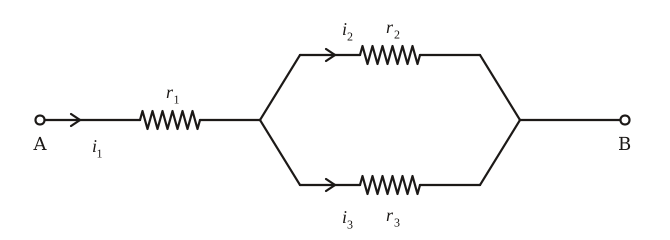
  • Series (one path, the same current through every resistor): R_s = R₁ + R₂ + … + R_n. The potential differences add up to the applied voltage.
  • Parallel (every resistor across the same two nodes, the same potential difference across each): 1/R_p = 1/R₁ + 1/R₂ + … + 1/R_n. The branch currents add up to the total current.

Quick checks: R_s is larger than the largest resistor; R_p is smaller than the smallest. For n identical resistors R: series gives nR, parallel gives R/n.

Where this sits in your books. The 2026-27 reprint of NCERT Class 12 Physics, Chapter 3 (Current Electricity) no longer has a section on combinations of resistors, although later pages still use these results. The NTA NEET (UG) 2026 syllabus, Physics Unit 12, still lists "Series and parallel combinations of resistors", so the topic is examinable. The last edition that taught them states both rules: NCERT Class 12 Physics (pre-2023 edition), Chapter 3, pages 107–109 (Eq. 3.39 for series, Eq. 3.51 for parallel).

Bridge to NEET. Questions usually ask you to reduce a small network in stages: find the pure series or pure parallel groups, replace each by one resistor, repeat. Recent examples: 10 identical resistors switched from series to parallel on the same ideal battery (NEET 2023, current rises 100 times), and a 100 Ω wire cut into 10 equal pieces and regrouped (NEET 2024, 52 Ω).

Watch-out: when a wire is cut into equal pieces, each piece has a fraction of the original resistance. Divide first, then combine.


Can you answer these Resistors Series Parallel MCQs?

Select an option to see the explanation. Wrong answers show why your choice was tempting — and name the exact trap it exploits.

MCQ 1Easy RecallPYQ Pattern

Several resistors of different values are connected in series across a battery. Which quantity is the same for every resistor?

Show answer and why every option is right or wrong

Answer: D. A series combination offers only one path, so the same current flows through every resistor (standard result; listed in the NTA NEET (UG) 2026 syllabus, Physics Unit 12).

Why A is wrong: A is wrong because equal potential difference is the property of a parallel combination; in series the voltages divide in proportion to the resistances.

Why B is wrong: B is wrong because the question states the resistors have different values; being in series does not change each resistor's own resistance.

Why C is wrong: C is wrong because power in each resistor is I²R; with the same current but different R, the powers differ.

MCQ 2Easy RecallPYQ Pattern

Resistors R₁, R₂, …, R_n are connected in parallel. Their equivalent resistance R_p is given by:

Show answer and why every option is right or wrong

Answer: B. For a parallel combination the reciprocals add: 1/R_p = Σ(1/R_i) (standard result; listed in the NTA NEET (UG) 2026 syllabus, Physics Unit 12).

Why A is wrong: A is wrong because adding the resistances directly is the series rule, not the parallel rule.

Why C is wrong: C is wrong because it forgets the final inversion — the sum of reciprocals equals 1/R_p, not R_p. It even has units of 1/Ω.

Why D is wrong: D is wrong because 'product over sum' works only for two resistors. For three or more it gives units of Ω² or higher, so it cannot be a resistance.

MCQ 3Easy RecallPYQ Pattern

When resistors of different values are connected in parallel, the equivalent resistance is:

Show answer and why every option is right or wrong

Answer: D. Each extra parallel branch adds another path for current, so 1/R_p exceeds 1/R_smallest and R_p is less than the smallest resistance (standard result; NTA NEET (UG) 2026 syllabus, Physics Unit 12).

Why A is wrong: A is wrong because being greater than the largest resistance is the property of a series combination.

Why B is wrong: B is wrong because it assumes the parallel value is some kind of middle value; adding branches always lowers the resistance below every single branch.

Why C is wrong: C is wrong because averaging resistances has no physical basis for either series or parallel combinations.

MCQ 4Direct ApplicationPYQ Pattern

Resistors of 2 Ω, 3 Ω and 6 Ω are connected in parallel. The equivalent resistance is:

Show answer and why every option is right or wrong

Answer: C. 1/R_p = 1/2 + 1/3 + 1/6 = 3/6 + 2/6 + 1/6 = 6/6 = 1 Ω⁻¹, so R_p = 1 Ω. Check: 1 Ω is less than the smallest resistor (2 Ω).

Why A is wrong: A is wrong because 2 + 3 + 6 = 11 Ω is the series sum; the resistors are in parallel.

Why B is wrong: B is wrong because it stretches the two-resistor 'product over sum' shortcut to three resistors: (2 × 3 × 6)/(2 + 3 + 6) = 36/11. That expression has units of Ω², so it is not a valid resistance.

Why D is wrong: D is wrong because 11/3 Ω is the average of the three resistances, which is not a combination rule.

MCQ 5Direct ApplicationPYQ Pattern

Five identical resistors, each of 15 Ω, are connected in parallel. The equivalent resistance is:

Show answer and why every option is right or wrong

Answer: C. For n identical resistors R in parallel, R_p = R/n = 15/5 = 3 Ω. The count 5 is an exact counting number.

Why A is wrong: A is wrong because 5 × 15 = 75 Ω is the series value nR, not the parallel value.

Why B is wrong: B is wrong because it assumes identical resistors in parallel keep the value of one resistor; each added branch lowers the equivalent resistance.

Why D is wrong: D is wrong because 5 × (1/15) = 1/3 is the value of 1/R_p. Forgetting to invert gives 1/3 instead of 3 Ω.

MCQ 6Direct ApplicationPYQ Pattern

A 4 Ω resistor and a 12 Ω resistor are connected in parallel across an ideal 6 V cell. The potential difference across the 12 Ω resistor is:

Show answer and why every option is right or wrong

Answer: A. Resistors in parallel share the same two nodes, so each has the full cell voltage across it: 6 V (ideal cell, no internal resistance).

Why B is wrong: B is wrong because 6 × 12/16 = 4.5 V is the series voltage-divider share of the 12 Ω resistor; in parallel there is no voltage division.

Why C is wrong: C is wrong because 6 × 4/16 = 1.5 V treats the resistors as a series voltage divider (voltage across the 4 Ω in series); they are in parallel.

Why D is wrong: D is wrong because it splits the voltage equally between two branches; parallel branches each get the full voltage, while the current is what divides.

MCQ 7CalculationPractice

Ten identical resistors are first connected in series across an ideal battery, and then all ten are connected in parallel across the same battery. The current drawn from the battery in the parallel case is how many times the current in the series case?

Show answer and why every option is right or wrong

Answer: A. Series: R_s = 10R. Parallel: R_p = R/10. With the same voltage V, I = V/R_eq, so I_p/I_s = R_s/R_p = 10R ÷ (R/10) = 100. The number 10 is an exact count. (This matches a NEET 2023 question.)

Why B is wrong: B is wrong because it applies the factor n = 10 only once — either to the series or to the parallel value — instead of to both; the ratio is n² = 100.

Why C is wrong: C is wrong because it inverts the ratio: 1/100 is I_s/I_p. The parallel combination has lower resistance, so it draws the larger current.

Why D is wrong: D is wrong because it assumes the same battery always gives the same current; the current depends on the equivalent resistance, which changes by a factor of 100.

MCQ 8CalculationPYQ Pattern

A uniform wire of resistance 24 Ω is cut into 4 equal pieces. Two pieces are joined in parallel, the other two are joined in series, and the two groups are then connected in series. The total resistance is:

Show answer and why every option is right or wrong

Answer: B. Each piece is 24/4 = 6 Ω. Parallel pair: 6/2 = 3 Ω. Series pair: 6 + 6 = 12 Ω. Groups in series: 3 + 12 = 15 Ω. The counts 4 and 2 are exact.

Why A is wrong: A is wrong because it forgets to divide the wire's resistance among the pieces: using 24 Ω per piece gives 24/2 + 24 + 24 = 60 Ω.

Why C is wrong: C is wrong because it assumes cutting and rejoining leaves the resistance unchanged; putting pieces in parallel lowers the total.

Why D is wrong: D is wrong because it forgets to invert for the parallel pair: 1/6 + 1/6 = 1/3 is taken as 1/3 Ω, giving 12 + 1/3 ≈ 12.3 Ω.

Free NEET study resources

Get a structured 30-day Mechanics plan and a complete formula booklet — delivered to your inbox instantly.

Resistors Series Parallel: quick recall before you leave

How do you solve a Resistors Series Parallel question? A worked example

Pattern: reduce a resistor network to its equivalent, combining series and parallel sections (NEET 2024).

  1. 1

    Given

    A wire of resistance 100 Ω (exact, as stated in the question) is cut into 10 equal parts. 5 parts are joined in series, the other 5 parts are joined in parallel, and the two groups are then connected in series.

  2. 2

    Required

    The total resistance of the arrangement.

  3. 3

    Concept

    A uniform wire cut into equal pieces gives pieces of equal resistance (total ÷ number of pieces). Reduce each group with the series or parallel rule, then add the two groups because they are in series.

  4. 4

    Formula

    Series: R_s = ΣR_i. Parallel: 1/R_p = Σ(1/R_i); for n identical resistors R, R_s = nR and R_p = R/n.

  5. 5

    Substitution

    Resistance of each piece: R = 100/10 Ω.
    Series group: R_s = 5 × R.
    Parallel group: R_p = R/5.

  6. 6

    Calculation

    R = 10 Ω per piece.
    R_s = 5 × 10 = 50 Ω.
    R_p = 10/5 = 2 Ω.
    Total = 50 + 2 = 52 Ω.

    The numbers 10 (pieces) and 5 (pieces per group) are exact counting numbers and do not limit significant figures.

  7. 7

    Final answer

    Total resistance = 52 Ω

  8. 8

    Common trap

    Two slips produce wrong options here. (1) Not dividing the wire first: using 100 Ω per piece gives 500 + 20 = 520 Ω. (2) Forgetting to invert for the parallel group: 5 × (1/10) = 0.5 taken as 0.5 Ω gives 50.5 Ω.

  9. 9

    Similar NEET-style question

    "A wire of resistance 48 Ω is cut into 8 equal parts. 4 parts are joined in series and the other 4 in parallel; the two groups are connected in series. Find the total resistance."

    Strategy: each piece = 48/8 = 6 Ω; series group = 4 × 6 = 24 Ω; parallel group = 6/4 = 1.5 Ω; total = 25.5 Ω.

    ---

What to remember before solving Resistors Series Parallel questions

In the NEET syllabus; removed from current NCERT.

Resistors in series (only one of their end points joined) carry the same current I, so V = I(R1 + R2 + ...) and Req = R1 + R2 + ... + Rn (Eq. 3.39). Resistors in parallel (one end of all joined together, and the other ends joined together) have the same potential difference V across each, and the current divides, I = I1 + I2 + ...; 1/Req = 1/R1 + 1/R2 + ... + 1/Rn (Eq. 3.51).

-- NCERT Class 12 Physics (pre-2023 edition), Chapter 3, p. 107
Which Resistors Series Parallel formulas do you need for NEET?

1 formula — click to collapse

Resistors series/parallel

Same current through series; same voltage across parallel.

SymbolQuantitySI Unit
RequivalentΩ
R_iindividual resistorΩ

Valid when

  • Static linear network
  • Ideal wires

More in Current Electricity: 3 exam traps and mistakes · 6 formulas · 5 question patterns from its other lessons.

Resistors Series Parallel questions from past NEET papers

4 questions from NEET 2021, 2023, 2024. Answers verified against NTA official keys. — click to collapse

All 18 past-paper questions from Current Electricity →

How does NEET ask about Resistors Series Parallel?

1 recurring pattern from past papers — click to collapse

Sources

Page numbers are the ones printed in the current NCERT textbook (2023 rationalised edition), unless marked pre-2023. The books are free at ncert.nic.in.

Report an error · Every fix is public: corrections log

Test yourself on this topic with real past-paper questions:

Practice this topic →

Prefer to watch this?

  • ShortName the third band: reading a resistor's colour code without memorising a table (1:22)

    Watch on YouTube
  • 8 real NEET Current Electricity questions (2022–2025) on animated circuits: watch the current flow (15 min)

    Watch on YouTube