Definition
Electric dipole
Two equal and opposite charges (+q, -q) separated by small distance 2a. Dipole moment p = 2qa, pointing from -q to +q. SI unit: C·m.
-- NCERT Class 12 Physics, Ch. 1, p. 24The trap: treating the axial and equatorial dipole fields as the same formula, or giving both the same direction. On the axis the far field is 2p/(4πε₀r³) and points along p. On the equatorial plane it is p/(4πε₀r³) — half as strong at the same r — and points opposite to p.
The dipole. NCERT Class 12 Physics Part I, Chapter 1, Section 1.10 (page 23): an electric dipole is a pair of equal and opposite point charges q and −q separated by a distance 2a. By convention its direction is from −q to q. Its total charge is zero, but NCERT stresses this does not make its field zero: the two fields do not exactly cancel.
Dipole moment (Eq. 1.19, page 24): p = q × 2a, directed from −q to q. SI unit: C m.
Far fields (r >> a) (page 24):
NCERT (page 25) points out that the dipole field at large distances falls off as 1/r³, not 1/r² as for a single charge. It depends on q and a only through the product p. For a point dipole (2a → 0 with p finite), Eqs. 1.20 and 1.21 are exact for any r.
Bridge to NEET. Questions give q and the separation (find p), or give p and r (find E), or change q, a and r together and ask for the new field. The slips that make distractors: using a instead of 2a in p, using 1/r² instead of 1/r³, swapping the factor 2 between axial and equatorial, and reversing the equatorial direction.
Watch out: separation "d" in a question is 2a. p = q × d, not q × d/2. Doubling r cuts a far dipole field to one-eighth, not one-quarter.
Select an option to see the explanation. Wrong answers show why your choice was tempting — and name the exact trap it exploits.
By the convention used in NCERT, the direction of the electric dipole moment vector of a dipole is:
Answer: B. NCERT Class 12 Physics Part I, Chapter 1 (pages 23–24): the direction of the dipole, and of p = q × 2a, is along the line from −q to q.
Why A is wrong: A is wrong because it reverses the convention; field lines leave +q, but the dipole moment points from −q to +q.
Why C is wrong: C is wrong because p lies along the dipole axis, the line joining the two charges, not perpendicular to it.
Why D is wrong: D is wrong because zero total charge does not remove the direction; p is defined by the separation vector from −q to q, and NCERT notes the dipole field is not zero either.
At distances much larger than the separation of its charges, the electric field of a dipole varies with distance r from its centre as:
Answer: B. NCERT Class 12 Physics Part I, Chapter 1 (page 25): the dipole field at large distances falls off as 1/r³, not 1/r² (Eqs. 1.20 and 1.21, page 24).
Why A is wrong: A is wrong because 1/r² is the dependence for a single point charge; the fields of +q and −q nearly cancel far away, so a dipole field falls off faster.
Why C is wrong: C is wrong because 1/r falls off more slowly than even a single charge's 1/r²; NCERT says a dipole field falls off faster than 1/r², as 1/r³.
Why D is wrong: D is wrong because NCERT says zero total charge does not make the dipole field zero; the two charges are separated, so their fields do not exactly cancel.
At a far point on the equatorial plane of an electric dipole, the electric field is directed:
Answer: A. NCERT Class 12 Physics Part I, Chapter 1, Eq. 1.21 (page 24): E = −p/(4πε₀r³) on the equatorial plane; the components normal to the axis cancel and the total field is opposite to p.
Why B is wrong: B is wrong because the components of the two fields perpendicular to the axis cancel; what survives is along the axis, pointing opposite to p.
Why C is wrong: C is wrong because only the perpendicular components cancel; the components parallel to the axis add, so the field is not zero.
Why D is wrong: D is wrong because 'along p' is the direction on the axis (Eq. 1.20), not on the equatorial plane.
Two point charges +2.0 nC and −2.0 nC are separated by 3.0 mm. The magnitude of the dipole moment is:
Answer: B. p = q × 2a, and 2a is the full separation: p = (2.0 × 10⁻⁹ C)(3.0 × 10⁻³ m) = 6.0 × 10⁻¹² C m (NCERT Chapter 1, Eq. 1.19, page 24).
Why A is wrong: A is wrong because 3.0 × 10⁻¹² C m = (2.0 × 10⁻⁹)(1.5 × 10⁻³) uses half the separation (a) instead of the full separation 2a.
Why C is wrong: C is wrong because 1.2 × 10⁻¹¹ C m = (2.0 × 10⁻⁹)(2 × 3.0 × 10⁻³) doubles a separation that is already 2a.
Why D is wrong: D is wrong because 6.7 × 10⁻⁷ comes from dividing q by the separation (2.0 × 10⁻⁹ / 3.0 × 10⁻³); dipole moment is a product, with unit C m, not C/m.
A point dipole of moment 3.0 × 10⁻⁹ C m is in vacuum. Taking 1/(4πε₀) = 9.0 × 10⁹ N m² C⁻², find the electric field at a point on its axis 0.30 m from it.
Answer: C. E = 2p/(4πε₀r³) = (9.0 × 10⁹)(2 × 3.0 × 10⁻⁹)/(0.30)³ = 54/0.027 = 2.0 × 10³ N C⁻¹, directed along p (NCERT Chapter 1, Eq. 1.20, page 24; direction page 26).
Why A is wrong: A is wrong because 1.0 × 10³ N C⁻¹ = (9.0 × 10⁹)(3.0 × 10⁻⁹)/0.027 drops the factor 2, which is the equatorial formula used for an axial point.
Why B is wrong: B is wrong because 6.0 × 10² N C⁻¹ = (9.0 × 10⁹)(2 × 3.0 × 10⁻⁹)/(0.30)² divides by r² instead of r³, treating the dipole like a single charge.
Why D is wrong: D is wrong because the magnitude is right but the direction is reversed; on the axis the dipole field points along p.
A point dipole of moment 4.0 × 10⁻⁹ C m is in vacuum. Taking 1/(4πε₀) = 9.0 × 10⁹ N m² C⁻², find the electric field at a point on its equatorial plane 0.20 m from it.
Answer: D. E = p/(4πε₀r³) = (9.0 × 10⁹)(4.0 × 10⁻⁹)/(0.20)³ = 36/0.008 = 4.5 × 10³ N C⁻¹, directed opposite to p (NCERT Chapter 1, Eq. 1.21, page 24).
Why A is wrong: A is wrong because 9.0 × 10³ N C⁻¹ = (9.0 × 10⁹)(2 × 4.0 × 10⁻⁹)/0.008 includes the factor 2 that belongs only to the axial formula.
Why B is wrong: B is wrong because the magnitude is right but the direction is reversed; on the equatorial plane the field is opposite to p, as the minus sign in Eq. 1.21 shows.
Why C is wrong: C is wrong because 9.0 × 10² N C⁻¹ = (9.0 × 10⁹)(4.0 × 10⁻⁹)/(0.20)² divides by r² instead of r³.
For a short electric dipole, point X is on the axis at distance r from the centre, and point Y is on the equatorial plane at distance 2r from the centre (both far from the dipole). The ratio of field magnitudes E_X : E_Y is:
Answer: C. E_X = 2p/(4πε₀r³); E_Y = p/(4πε₀(2r)³) = p/(4πε₀ · 8r³). Ratio = 2 ÷ (1/8) = 16 : 1 (NCERT Chapter 1, Eqs. 1.20 and 1.21, page 24).
Why A is wrong: A is wrong because 2 : 1 is the axial-to-equatorial ratio at the same distance; it ignores that Y is twice as far, which divides E_Y by 2³ = 8.
Why B is wrong: B is wrong because 8 : 1 = 2 ÷ (1/2²) keeps the factor 2 but uses 1/r² for the distance change; it is also what you get by using 1/r³ but dropping the factor 2.
Why D is wrong: D is wrong because 4 : 1 = 1 ÷ (1/2²) drops the axial factor 2 and also uses 1/r² instead of 1/r³.
For a short dipole, the charge on each end is doubled, the separation between the charges is halved, and the far point on the axis is moved to twice its original distance from the centre. The new field at that point is what fraction of the original field?
Answer: A. New p = (2q) × (2a/2) = q × 2a, so p is unchanged: doubling q and halving the separation cancel. With p fixed, E ∝ 1/r³, so doubling r gives (1/2)³ = 1/8 of the original field (NCERT Chapter 1, Eqs. 1.19–1.20, page 24; the far field depends only on the product qa).
Why B is wrong: B is wrong because 1/4 = 2 × (1/8) counts the doubled charge but ignores the halved separation, so p is wrongly doubled; 1/4 also results from keeping p fixed but using 1/r².
Why C is wrong: C is wrong because 1/2 = 2 × (1/2²) wrongly doubles p (ignoring the halved separation) and also uses 1/r² instead of 1/r³.
Why D is wrong: D is wrong because 1/16 = (1/2) × (1/8) counts the halved separation but ignores the doubled charge, so p is wrongly halved.
Get a structured 30-day Mechanics plan and a complete formula booklet — delivered to your inbox instantly.
Pattern: dipole-field pattern from the dossier (worked through NCERT Class 12 Physics Part I, Chapter 1, Example 1.9, pages 25–27)
Given
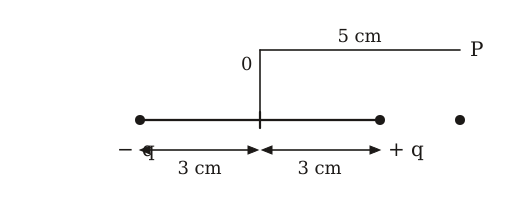
Two charges ±10 μC (magnitude 1.0 × 10⁻⁵ C) are placed 5.0 mm apart, so a = 0.25 cm. Point P is on the dipole axis, 15 cm from the centre O, on the side of the positive charge. Point Q is 15 cm from O on the line through O normal to the axis. In NCERT's figure the negative charge is at A and the positive charge at B. ε₀ = 8.854 × 10⁻¹² C² N⁻¹ m⁻².
Required
(a) The electric field at P. (b) The electric field at Q. Check each against the far-field dipole formula.
Concept
The exact field is the vector sum of the two point-charge fields. Because OP/OB = 15/0.25 = 60 is large, the far-field formulas (Eqs. 1.20 and 1.21) should give nearly the same answer.
Formula
p = q × 2a; on the axis E = 2p/(4πε₀r³), along p; on the equatorial line E = p/(4πε₀r³), opposite to p.
Substitution
(a) Exact: field of +q at P uses distance (15 − 0.25) cm; field of −q uses (15 + 0.25) cm.
Far-field: p = (1.0 × 10⁻⁵ C)(5.0 × 10⁻³ m) = 5.0 × 10⁻⁸ C m; E = 2 × 5.0 × 10⁻⁸ / [4π(8.854 × 10⁻¹²)(0.15)³].
(b) Exact: each charge is at distance √(15² + 0.25²) cm from Q; the perpendicular components cancel and the parallel components add, with the factor 0.25/√(15² + 0.25²).
Far-field: E = 5.0 × 10⁻⁸ / [4π(8.854 × 10⁻¹²)(0.15)³].
Calculation
(a) Field of +q at P = 4.13 × 10⁶ N C⁻¹ along BP; field of −q at P = 3.87 × 10⁶ N C⁻¹ along PA. Resultant = 2.7 × 10⁵ N C⁻¹ along BP. The far-field formula 2p/(4πε₀r³) gives the same value, about 2.67 × 10⁵ N C⁻¹, along AB; NCERT prints it as 2.6 × 10⁵ N C⁻¹ (NCERT page 26).
(b) Field of each charge at Q = 3.99 × 10⁶ N C⁻¹. Resultant = 2 × (0.25/√(15² + 0.25²)) × 3.99 × 10⁶ = 1.33 × 10⁵ N C⁻¹ along BA. The far-field formula gives 1.33 × 10⁵ N C⁻¹ (NCERT pages 26–27).
The factor 2 in 2p, the 2 in "2 ×" for the two equal fields, and 4π are exact constants and do not limit significant figures; the given data (10 μC, 5.0 mm, 15 cm) carry two significant figures.
Final answer
(a) 2.7 × 10⁵ N C⁻¹ at P, along BP (the direction of p, from −q to +q); the far-field formula agrees (≈ 2.67 × 10⁵ N C⁻¹; NCERT prints 2.6 × 10⁵).
(b) 1.33 × 10⁵ N C⁻¹ at Q, along BA — opposite to the dipole moment.
Common trap
Giving the field at Q the same direction as at P. On the axis the field points along p; on the equatorial line it points opposite to p. A second slip is using half the separation (a = 2.5 mm) instead of the full separation 2a = 5.0 mm when computing p — that halves p and every far-field answer.
Similar NEET-style question
"A point dipole of moment 1.0 × 10⁻¹¹ C m is in vacuum. Taking 1/(4πε₀) = 9.0 × 10⁹ N m² C⁻², find the field at a point on its axis 0.10 m away."
Strategy: E = 2kp/r³ = (9.0 × 10⁹)(2 × 1.0 × 10⁻¹¹)/(0.10)³ = 0.18/1.0 × 10⁻³ = 1.8 × 10² N C⁻¹, along p. Do not divide by r² (18 N C⁻¹) or drop the factor 2 (90 N C⁻¹).
---
Two equal and opposite charges (+q, -q) separated by small distance 2a. Dipole moment p = 2qa, pointing from -q to +q. SI unit: C·m.
-- NCERT Class 12 Physics, Ch. 1, p. 24Axial: E = (1/4πε₀)(2p/r³). Equatorial: E = -(1/4πε₀)(p/r³). Falls off as 1/r³ (faster than point charge's 1/r²).
-- NCERT Class 12 Physics, Ch. 1, p. 24V = (1/4πε₀)(p cos θ)/r², where θ is angle from dipole axis. Falls off as 1/r² (faster than point charge). V = 0 on equatorial plane.
-- NCERT Class 12 Physics, Ch. 2, p. 51Field on dipole axis at distance r >> dipole size; directed along p.
| Symbol | Quantity | SI Unit |
|---|---|---|
| p | dipole moment | C*m |
| r | distance from centre | m |
More in Electrostatics: 3 exam traps and mistakes · 10 formulas · 5 question patterns from its other lessons.
uses r cubed formula for far field when near charges
Wrong formula regime
Page numbers are the ones printed in the current NCERT textbook (2023 rationalised edition), unless marked pre-2023. The books are free at ncert.nic.in.
Test yourself on this topic with real past-paper questions:
Practice this topic →7 real NEET Electrostatics questions (2022–2025), from field lines to capacitors, solved step by step (14 min)
Watch on YouTube