Try this first: NEET 2025 PYQ
- A.E⃗ is parallel to B⃗ and its magnitude is 27 × 10⁴ V m⁻¹
- B.E⃗ is perpendicular to B⃗ and its magnitude is 27 × 10⁴ V m⁻¹
- C.E⃗ is perpendicular to B⃗ and its magnitude is 27 × 10² V m⁻¹
- D.E⃗ is parallel to B⃗ and its magnitude is 27 × 10² V m⁻¹
Tap to see the answer
Answer: C.
A is wrong: E parallel to B cannot cancel the magnetic force. In F = q [E + v × B], v × B is perpendicular to B, so E must be perpendicular to B as well. The size is also wrong: E = vB = 3 × 106 × 9 × 10–4 = 27 × 102 V m–1.
B is wrong: The direction is right, but E = vB = (3 × 10⁸/100) × 9 × 10–4 = 2700 V m–1 = 27 × 102, not 27 × 104.
D is wrong: The size is right, but E parallel to B does not balance the magnetic force q [v × B], which is perpendicular to B.
Topic index in NCERT order
20 of 20 lessons by the NCERT chapter they teach from, in book order. The page is the first printed page of your NCERT book the lesson cites; PYQs are the past NEET questions on that topic.
Class 12 Physics, Chapter 4
- Lorentz Force on Chargep. 1092 PYQs
- Force on Current Conductorp. 1101 PYQ
- Biot Savart Lawp. 1142 PYQs
- Biot Savart Circular Loopp. 1164 PYQs
- Ampere's Lawp. 1180 PYQs
- Ampere's Law Straight Wirep. 1201 PYQ
- Ampere's Law Solenoidp. 1222 PYQs
- Definition of Amperep. 1230 PYQs
- Force Between Parallel Currentsp. 1231 PYQ
- Current Loop Dipole Momentp. 1260 PYQs
- Torque Current Loopp. 1260 PYQs
- Ammeter Voltmeter Conversionp. 1300 PYQs
- Galvanometer Sensitivityp. 1300 PYQs
- Moving Coil Galvanometerp. 1300 PYQs
Class 12 Physics, Chapter 5
- Magnetic Field Linesp. 1380 PYQs
- Bar Magnet As Solenoidp. 1391 PYQ
- Magnetic Field of Dipolep. 1412 PYQs
- Torque Magnetic Dipolep. 1410 PYQs
- Para Dia Ferromagneticp. 1472 PYQs
- Temperature Effect Magnetic Propertiesp. 1480 PYQs
All 20 lessons
Questions, revision cards and difficulty mix per lesson
Ammeter Voltmeter Conversion
Ampere's Law
Ampere's Law Solenoid
Ampere's Law Straight Wire
Bar Magnet As Solenoid
Biot Savart Circular Loop
Biot Savart Law
Current Loop Dipole Moment
Definition of Ampere
Force Between Parallel Currents
Force on Current Conductor
Galvanometer Sensitivity
Lorentz Force on Charge
Magnetic Field Lines
Magnetic Field of Dipole
Moving Coil Galvanometer
Para Dia Ferromagnetic
Temperature Effect Magnetic Properties
Torque Current Loop
Torque Magnetic Dipole
Not sure where to start in Magnetic Effects of Current and Magnetism? Take the ten-question readiness check: ten past NEET questions, then the three lessons to open first.
Videos for this unit
Long lesson100 Turns: Does the Field Count Every Turn? | NEET Magnetic Field, 8 Questions (9 min)
Past-paper questions from this unit
18 questions, NEET 2020–2026
18 questions from NEET 2020, 2021, 2022, 2023, 2024, 2025, 2026. Answers verified against NTA official keys.
By year in our set: 2020 (1) · 2021 (2) · 2022 (3) · 2023 (3) · 2024 (5) · 2025 (2) · 2026 (2)
Lesson: Biot Savart Circular Loop
Lesson: Force Between Parallel Currents
Why the other options are wrong
- Option 1: µ₀I²/(2πλg) drops the factor 2 in the current 2I. Since 'Parallel currents attract, and antiparallel currents repel', wire B pulls A up with f = µ₀(I)(2I)/(2πh) = µ₀I²/(πh) per unit length; A stays down while f ≤ λg, so h ≥ µ₀I²/(πλg).
- Option 3: 2µ₀I²/(πλg) doubles the force. With f = µ₀IaIb/(2πd), Ia = I and Ib = 2I give µ₀I²/(πh), and setting this equal to λg gives h = µ₀I²/(πλg). The pull is upward because 'currents flowing in the same direction attract each other'.
- Option 4: 4µ₀I²/(πλg) is four times too large: f = µ₀ × I × 2I/(2πh) = µ₀I²/(πh) = λg gives h = µ₀I²/(πλg). The pull is upward because 'currents flowing in the same direction attract each other'.
Lesson: Lorentz Force on Charge
Why the other options are wrong
- Option 1: E parallel to B cannot cancel the magnetic force. In F = q [E + v × B], v × B is perpendicular to B, so E must be perpendicular to B as well. The size is also wrong: E = vB = 3 × 106 × 9 × 10–4 = 27 × 102 V m–1.
- Option 2: The direction is right, but E = vB = (3 × 10⁸/100) × 9 × 10–4 = 2700 V m–1 = 27 × 102, not 27 × 104.
- Option 4: The size is right, but E parallel to B does not balance the magnetic force q [v × B], which is perpendicular to B.
Lesson: Biot Savart Circular Loop
Why the other options are wrong
- Option 1: This inverts the ratio. m = I A with A = πr2, so for radii 1 : 2 the moments are 1 : 4.
- Option 3: 1 : 2 treats the moment as proportional to r. The magnetic moment of the current loop is m = I A, and area goes as r2, so the ratio is 1 : 4.
- Option 4: 2 : 1 is inverted and uses r instead of r2. With the same current, m ∝ r2, so 1 : 4.
Lesson: Magnetic Field of Dipole
Why the other options are wrong
- Option 1: 5π² does not follow from the data. The needle’s motion 'represents a simple harmonic motion' with T = 2π√(I/mB), so m = 4π²I/(BT²). With T = 5 s / 20 = 0.25 s: 4π² × 9.8 × 10⁻⁶/(0.049 × 0.0625) = 12.8π² × 10⁻³ = 1280π² × 10⁻⁵ A m².
- Option 2: 128π² is a power-of-ten slip: 12.8π² × 10⁻³ A m² is 1280π² × 10⁻⁵, not 128π² × 10⁻⁵. 'The square of the angular frequency is' ω² = mB/I, which gives m = 4π²I/(BT²) with T = 0.25 s.
- Option 3: 50π² does not satisfy the period. The time for one oscillation is 5 s / 20 = 0.25 s, and since 'The square of the angular frequency is' ω² = mB/I, m = 4π²I/(BT²) = 4π² × 9.8 × 10⁻⁶/(0.049 × 0.0625) = 1280π² × 10⁻⁵ A m².
Lesson: Biot Savart Circular Loop
Why the other options are wrong
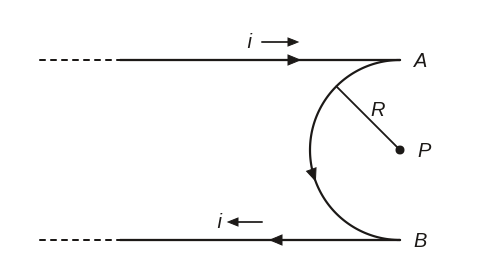
- Option 1: 44 mT is ten times too big. At the centre of the loop B = µ0I/2R per turn, so B = 4π × 10–7 × 100 × 7 / (2 × 0.1) = 4.4 × 10⁻³ T.
- Option 2: 4.4 T is a thousand times too big; the answer is 4.4 × 10⁻³ T, i.e. 4.4 mT.
- Option 4: 44 T is off by 10,000. For N = 100, I = 7 A, R = 0.1 m, B = µ0NI/2R = 4.4 mT.
Lesson: Para Dia Ferromagnetic
Why the other options are wrong
- Option 2: B-I and C-III mix up the classes: a material is 'ferro- if χ is large and positive' (χ >> 1, III), and paramagnetic is 0 < χ < ε (IV). χ = 0 (I) is the non-magnetic case.
- Option 3: A-III makes a diamagnet strongly positive, but 'a material is diamagnetic if χ is negative' (0 > χ ≥ −1, II). Ferromagnetic is χ >> 1 (III), not II.
- Option 4: A-IV and C-II swap the signs: 'a material is diamagnetic if χ is negative' (II), and 'para- if χ is positive and small' (IV, where 'ε is a small positive number').
Lesson: Para Dia Ferromagnetic
Why the other options are wrong
- Option 1: B and D are the two cases that need no force: a non-magnetic sheet is not pulled toward the pole, and a non-conducting sheet carries no eddy currents to oppose its motion. A force is needed for a magnetic sheet, since ferromagnets 'get strongly attracted to a magnet' (A), and for a conducting sheet, where 'The flux change induces eddy currents in the plate' (C).
- Option 3: D needs no force: a non-conducting sheet has no eddy currents, and a non-polar, non-magnetic sheet is not attracted. Only a conductor’s motion is opposed, as with the copper plate where 'It is found that the motion is damped'. The answer is A and C only.
- Option 4: C alone misses A: a magnetic sheet near a strong pole is pulled toward it (ferromagnets 'get strongly attracted to a magnet'), so a force is needed to hold it in place.
Lesson: Bar Magnet As Solenoid
Why the other options are wrong
- Option 1: M would need the poles still L apart. A bar magnet of length 2l has 'magnetic moment qm (2l)', pole strength × separation. Bending at 60° makes the two L/2 arms and the line between the poles an equilateral triangle, so the separation is L/2 and the moment is M/2.
- Option 3: 2M would need the poles twice as far apart, but bending can only bring them closer. The moment is pole strength × separation ('magnetic moment qm (2l)'), and the 60° bend leaves the poles L/2 apart: M/2.
- Option 4: M/√3 uses the wrong geometry. The two L/2 arms at 60° form an equilateral triangle, so the poles are L/2 apart, and with 'magnetic moment qm (2l)' the new moment is M/2.
Lesson: Magnetic Field of Dipole
The net magnetic flux through any closed surface is
Why the other options are wrong
- Option 1: A positive net flux would need an isolated north pole inside the surface. Gauss’s law for magnetism says 'The net magnetic flux through any closed surface is zero': every field line that enters the surface also leaves it.
- Option 2: The flux of a finite field through a finite closed surface cannot be infinite, and by Gauss’s law for magnetism 'The net magnetic flux through any closed surface is zero'.
- Option 3: A negative net flux would need an isolated south pole inside the surface. With no magnetic monopoles, 'The net magnetic flux through any closed surface is zero'.
Lesson: Force on Current Conductor
Why the other options are wrong
- Option 1: √5 IL keeps only part of B. F = I L × B with L along x drops the x-part (2î) and keeps 3ĵ and –4k̂, so |F| = IL√(9 + 16) = 5 IL.
- Option 3: √3 IL has no link to the components. The perpendicular part of B is (3, –4), whose magnitude is 5, so F = 5 IL.
- Option 4: 3 IL keeps only the ĵ part. The k̂ part (–4) is also perpendicular to the wire, so |F| = IL√(32 + 42) = 5 IL.
Lesson: Biot Savart Circular Loop
Lesson: Biot Savart Law
Why the other options are wrong
- Option 1: Statement II is the incorrect one: NCERT says the electrostatic field is produced by a scalar source, namely, the electric charge, and the magnetic field is produced by a vector source I dl. Statement I is correct.
- Option 2: Statement II swaps the sources. The magnetic field is produced by a vector source I dl, and the electrostatic field by a scalar source, the charge.
- Option 3: Statement I is correct: Biot-Savart's law gives the magnetic field of a current element I dl. Only Statement II is wrong.
Lesson: Ampere's Law Solenoid
Why the other options are wrong
- Option 1: 100 turns per mm is 105 turns per metre. B = µ0 n I = 4π × 10–7 × 105 × 1 = 12.56 × 10⁻² T; 6.28 × 10⁻⁴ T misses by 200 times.
- Option 2: 6.28 × 10⁻² T is half the answer (µ0 taken as 2π × 10–7). With 4π × 10–7, B = 12.56 × 10⁻² T.
- Option 4: 12.56 × 10⁻⁴ T uses n = 1000 per metre. Converting 100 per mm gives n = 105 per metre, so B = 12.56 × 10⁻² T. The radius does not enter the long solenoid formula.
Lesson: Ampere's Law Straight Wire
Why the other options are wrong
- Option 1: B does not decrease inside the wire: the enclosed current grows as r², so B = µ₀Ir/(2πa²) rises with r (Eq. 4.15(b)). Outside, B is 'the familiar expression for a long straight wire', µ₀I/(2πr), which falls as 1/r rather than increasing.
- Option 2: B is not uniform. Figure 4.14 'shows a plot of the magnitude of B with distance r from the centre of the wire': it rises as r inside (B = µ₀Ir/2πa²) and falls as 1/r outside.
- Option 3: The inside part is right (B ∝ r), but outside B is 'the familiar expression for a long straight wire', B = µ₀I/(2πr), which falls as 1/r, not linearly.
Lesson: Lorentz Force on Charge
Why the other options are wrong
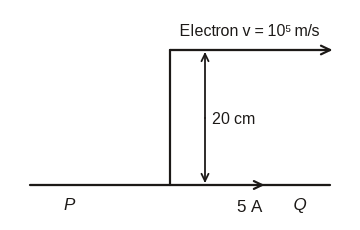
- Option 2: 4 × 10⁻²⁰ N halves the field. For a long straight wire B = µ0I/(2πr) = 5 × 10⁻⁶ T at 0.2 m, and with v perpendicular to B, F = qvB = 1.6 × 10⁻¹⁹ × 10⁵ × 5 × 10⁻⁶ = 8 × 10⁻²⁰ N.
- Option 3: The π cancels. B = µ0I/(2πr) with µ0 = 4π × 10⁻⁷ gives 2 × 10⁻⁷ × 5/0.2 = 5 × 10⁻⁶ T, so F = 8 × 10⁻²⁰ N with no π left.
- Option 4: 4π × 10⁻²⁰ N keeps a π that cancels in µ0I/(2πr), and also halves the force. F = qvB = 8 × 10⁻²⁰ N.
Lesson: Biot Savart Law
Why the other options are wrong
- Option 1: The wire of 12a makes 4 triangles of side a and 3 squares of side a. With m = N I A, the triangle gives 4 × (√3/4)a2 I = √3 Ia2, not 4 Ia2.
- Option 3: 3 Ia2 for the triangle and Ia2 for the square miss the turn counts. m = N I A gives √3 Ia2 (4 turns) and 3 Ia2 (3 turns).
- Option 4: These are the turn counts alone, swapped, with the areas dropped.The triangle has 4 turns of area (√3/4)a2, so m = √3 Ia2; the square has 3 turns of area a2, so m = 3 Ia2.
Lesson: Ampere's Law Solenoid
Why the other options are wrong
- Option 1: With B = µ0 n I, n = 100/0.5 = 200 turns per metre, so B = 4π × 10–7 × 200 × 2.5 = 6.28 × 10⁻⁴ T; 3.14 × 10⁻⁵ T is 20 times too small.
- Option 3: 3.14 × 10⁻⁴ T is half the answer, as if n were 100 per metre. The 50 cm length makes n = 200 turns per metre.
- Option 4: 6.28 × 10⁻⁵ T is ten times too small. B = µ0 n I = 4π × 10–7 × 200 × 2.5 = 6.28 × 10⁻⁴ T.
Exam traps and common mistakes in this unit
3 items
Lesson: Ampere's Law Straight Wire
Category: Similar Terms
Student uses μ_0 I/(2πr) (straight wire) when asked about circular loop centre (μ_0 I/(2R)) — or vice versa.
When it triggers
Magnetic field magnitude question with specific geometry (straight wire, loop, solenoid).
How to avoid
Straight wire: B = μ_0 I/(2πr) at perpendicular distance r. Circular loop centre: B = μ_0 I/(2R). Solenoid: B = μ_0 nI. Match formula to geometry.
Lesson: Ampere's Law Solenoid
Root cause: formula misuse
Correction
B = μ_0 n I where n = N/L (turns per metre). If N=100 over 50 cm, then n=200/m and B = μ_0 × 200 × I.
Lesson: Ampere's Law Straight Wire
Root cause: formula misuse
Correction
Straight wire (long, infinite): B = μ_0 I/(2πr). Circular loop, centre: B = μ_0 I/(2R). The 'π' is in straight-wire; missing in loop.
Formulas in this unit
11 formulas
Lesson: Ampere's Law
Ampere's circuital law
Line integral of B around closed loop = mu0 x current enclosed.
| Symbol | Quantity | SI Unit |
|---|---|---|
| I_enc | current enclosed | A |
| mu0 | permeability | T*m/A |
Valid when
- Steady current (Maxwell-Ampere needed if displacement current present)
- Closed Amperian loop
Lesson: Ampere's Law Solenoid
B inside long solenoid
Uniform field inside long solenoid; n = turns per unit length. Approximately zero outside.
| Symbol | Quantity | SI Unit |
|---|---|---|
| n | turns per metre | 1/m |
| I | current | A |
Valid when
- Long solenoid (length >> radius)
- Tightly wound
Lesson: Ampere's Law Straight Wire
B near long straight wire
Field at perpendicular distance r from infinite straight wire carrying I.
| Symbol | Quantity | SI Unit |
|---|---|---|
| B | field | T |
| I | current | A |
| r | perp distance | m |
Valid when
- Wire >> r (effectively infinite)
- r > wire radius
Lesson: Biot Savart Circular Loop
B at centre of circular loop
Magnetic field at centre of circular current loop of radius R carrying current I.
| Symbol | Quantity | SI Unit |
|---|---|---|
| B | field | T |
| I | current | A |
| R | loop radius | m |
Valid when
- Single loop
- At loop centre
Lesson: Biot Savart Law
Biot-Savart law
Magnetic field from current element. mu0 = 4*pi*10^-7 T*m/A.
| Symbol | Quantity | SI Unit |
|---|---|---|
| I | current | A |
| dl | element length | m |
| r | distance | m |
| mu0 | permeability | T*m/A |
Valid when
- Steady current
- Free space
Lesson: Current Loop Dipole Moment
Torque on current loop
Torque on N-turn loop of area A carrying I in field B; magnetic moment m = NIA.
| Symbol | Quantity | SI Unit |
|---|---|---|
| N | turns | - |
| A | loop area | m^2 |
| B | field | T |
| m | magnetic moment | A*m^2 |
| theta | angle between m and B | rad |
Valid when
- Uniform B
- Loop in plane
Lesson: Definition of Ampere
Force between parallel currents
Force per unit length between long parallel wires separated by d. Same direction → attractive.
| Symbol | Quantity | SI Unit |
|---|---|---|
| I1, I2 | currents | A |
| d | separation | m |
Valid when
- Long parallel wires
- Steady currents
Lesson: Force on Current Conductor
Force on current-carrying wire
Force on straight current-carrying wire of length L in field B. Theta = angle between L and B.
| Symbol | Quantity | SI Unit |
|---|---|---|
| I | current | A |
| L | length | m |
| B | field | T |
| theta | angle | rad |
Valid when
- Uniform B
- Straight wire
Lesson: Lorentz Force on Charge
Cyclotron radius / period
Charge q moves in circle of radius r in uniform B perpendicular to v. Period independent of v.
| Symbol | Quantity | SI Unit |
|---|---|---|
| r | radius | m |
| T | period | s |
| m | mass | kg |
| v | speed | m/s |
| q | charge | C |
| B | field | T |
Valid when
- v ⊥ B
- Uniform B
- Non-relativistic
Lesson: Lorentz Force on Charge
Lorentz force
Total force on charge q in electric and magnetic fields. Magnetic part always perpendicular to v.
| Symbol | Quantity | SI Unit |
|---|---|---|
| F | force | N |
| q | charge | C |
| E | electric field | V/m |
| v | velocity | m/s |
| B | magnetic field | T |
Valid when
- Point particle
- Non-relativistic
Lesson: Magnetic Field of Dipole
Magnetic dipole field (axial/equatorial)
Magnetic field from dipole moment m at distance r along axis or equatorial.
| Symbol | Quantity | SI Unit |
|---|---|---|
| m | dipole moment | A*m^2 |
| r | distance | m |
Valid when
- r >> dipole size
- Far-field approximation
NEET question patterns in this unit
5 patterns
Lesson: Ampere's Law Solenoid
Long solenoid: B = mu_0 n I. Plug in turns/m and current.
Common distractors
uses total N not n
Forgets to divide by length
Lesson: Ampere's Law Straight Wire
Field from long straight wire: B = mu_0 I/(2 pi r).
Common distractors
forgets pi in denominator
Confuses with circular loop formula
Lesson: Biot Savart Circular Loop
Field at centre of circular loop: B = mu_0 I / (2R).
Common distractors
forgets 2 in denominator
Uses mu_0 I/R instead of mu_0 I/(2R)
Lesson: Lorentz Force on Charge
Charge in uniform B (perpendicular to v): r = mv/(qB). Compute radius or speed.
Common distractors
forgets charge or mass in formula
Drops m or q from r formula
Lesson: Magnetic Field of Dipole
Magnetic dipole field at axial / equatorial point. Axial 2m/r^3, equatorial m/r^3.
Common distractors
uses axial formula equatorial
Mixes axial 2m vs equatorial m factor
Questions about this unit
- What does Magnetic Effects of Current and Magnetism cover for NEET Physics?
- 20 lessons: Ammeter Voltmeter Conversion, Ampere's Law, Ampere's Law Solenoid, Ampere's Law Straight Wire, Bar Magnet As Solenoid, Biot Savart Circular Loop, Biot Savart Law, Current Loop Dipole Moment, Definition of Ampere, Force Between Parallel Currents, Force on Current Conductor, Galvanometer Sensitivity, Lorentz Force on Charge, Magnetic Field Lines, Magnetic Field of Dipole, Moving Coil Galvanometer, Para Dia Ferromagnetic, Temperature Effect Magnetic Properties, Torque Current Loop and Torque Magnetic Dipole.
- How often has Magnetic Effects of Current and Magnetism come up in NEET past papers?
- Our set of verified past papers has 18 questions from this unit, from NEET 2020, 2021, 2022, 2023, 2024, 2025 and 2026. Each is answered against the official NTA key.
- Is the Magnetic Effects of Current and Magnetism material free?
- Yes. All 20 lessons and 184 practice questions are free, with no login needed.