At centre: B = μ₀ I / (2R). On axis at distance x: B = μ₀ I R² / [2(R² + x²)^(3/2)]. Field on axis always along axis.
-- NCERT Class 12 Physics, Ch. 4, p. 116Biot Savart Circular Loop
8 MCQs1 revision card9-step worked example
Source: NCERT Magnetic Effects of Current and MagnetismPYQ coverage: NEET 2023, 2024, 2025, 2026Official key: NTA-verifiedLast updated: 25 Sep 2026
Biot Savart Circular Loop, explained for NEET
The loop formula has no π. The straight-wire formula does. That one difference is the documented trap on this topic, and it costs a full four marks when the wrong one is reached for under time pressure.
At the centre of a circular loop of radius R carrying steady current I:
B = μ₀I / (2R)
NCERT Class 12 Physics, Chapter 4, page 116 derives this by integrating the Biot-Savart contribution around the loop. Every current element dl sits at the same distance R from the centre and is perpendicular to the radius vector, so sin θ = 1 for all of them and the vector contributions all point the same way along the axis. The integral collapses to (μ₀I / 4πR²) × (total length 2πR), and the 2π in the numerator cancels the 4π, leaving 2 in the denominator. That cancellation is why π vanishes — not an arbitrary quirk to memorise.
Two structural consequences worth holding:
- B scales as 1/R, not 1/R². Doubling the radius halves the centre field. A loop is not a point source.
- N turns multiply. A tight coil of N turns gives B = μ₀NI / (2R), since each turn contributes identically at the shared centre.
Direction comes from the right-hand grip rule applied to the loop: curl the fingers along the current, and the thumb gives the field direction through the loop — perpendicular to the loop plane, along the axis.
The formula holds only at the centre. Off-axis points and points along the axis at distance x require the fuller axial expression; the bare μ₀I/(2R) is not a general loop result.
Watch-out: when a stem gives you a distance from a wire, you want 2πr. When it gives you a loop radius and asks about the centre, you want 2R. Read the geometry word before touching the formula.
Can you answer these Biot Savart Circular Loop MCQs?
Select an option to see the explanation. Wrong answers show why your choice was tempting — and name the exact trap it exploits.
MCQ 1Easy RecallPractice
The magnetic field at the centre of a circular current loop of radius R carrying a steady current I is given by which expression?
Show answer and why every option is right or wrong
Answer: C. C is correct. NCERT Class 12 Physics, Chapter 4, page 116 gives the centre-of-loop field as μ₀I/(2R), with no π in the denominator.
Why A is wrong: A is wrong because μ₀I/(2πR) is the long-straight-wire field at perpendicular distance R, not the loop-centre field. Carrying the π across from the wire formula is the classic geometry mix-up.
Why B is wrong: B is wrong because μ₀I/(4πR) is the bare Biot-Savart prefactor applied once, without integrating around the full loop circumference.
Why D is wrong: D is wrong because μ₀I/R drops the factor 2 that survives after the 2π of the circumference cancels the 4π of the Biot-Savart prefactor.
MCQ 2Direct ApplicationPractice
A circular loop of radius 5.00 cm carries a steady current of 2.00 A. Taking μ₀ = 4π × 10⁻⁷ T·m/A, the magnitude of the magnetic field at the centre of the loop is closest to
Show answer and why every option is right or wrong
Answer: B. B is correct. B = μ₀I/(2R) = (4π × 10⁻⁷ × 2.00) / (2 × 0.0500) = 2.51 × 10⁻⁵ T. NCERT Class 12 Physics, Chapter 4, page 116.
Why A is wrong: A is wrong because 8.00 × 10⁻⁶ T is what the straight-wire expression μ₀I/(2πr) yields with r = 0.0500 m — the π has been wrongly kept in the denominator.
Why C is wrong: C is wrong because 1.26 × 10⁻⁵ T results from using μ₀I/(4R), doubling the denominator by mis-cancelling the circumference factor.
Why D is wrong: D is wrong because 4.00 × 10⁻⁶ T follows from μ₀I/(4πR), which applies the Biot-Savart prefactor without integrating over the loop.
MCQ 3Concept TrapPractice
A stem reads: "Find the magnetic field at a point 6.0 cm from a long straight conductor carrying 3.0 A." A student writes B = μ₀I/(2R) with R = 0.060 m. The error in this approach is that
Show answer and why every option is right or wrong
Answer: B. B is correct. A perpendicular distance from a straight wire calls for μ₀I/(2πr); the student has substituted the loop-centre form, which has no π. NCERT Class 12 Physics, Chapter 4, pages 114–116 separates the two geometries.
Why A is wrong: A is wrong because the student did convert correctly — 6.0 cm was written as 0.060 m. The conversion is not the defect.
Why C is wrong: C is wrong because no halving of current is involved in either geometry; the whole steady current I enters both expressions.
Why D is wrong: D is wrong because Biot-Savart applies to any steady current distribution, straight conductors included — integrating it along an infinite straight wire is precisely how μ₀I/(2πr) is obtained.
MCQ 4Direct ApplicationPractice
A circular coil of 50 turns (exact) and radius 10.0 cm carries a current of 0.400 A. Taking μ₀ = 4π × 10⁻⁷ T·m/A, the magnetic field at the centre of the coil is
Show answer and why every option is right or wrong
Answer: A. A is correct. For N identical turns sharing a centre, B = μ₀NI/(2R) = (4π × 10⁻⁷ × 50 × 0.400) / (2 × 0.100) = 1.26 × 10⁻⁴ T. NCERT Class 12 Physics, Chapter 4, page 116.
Why B is wrong: B is wrong because 2.51 × 10⁻⁶ T is the single-turn result — the factor N = 50 has been dropped, treating a coil as one loop.
Why C is wrong: C is wrong because 4.00 × 10⁻⁵ T comes from inserting a π in the denominator, i.e. using the straight-wire structure μ₀NI/(2πR).
Why D is wrong: D is wrong because 6.28 × 10⁻⁵ T uses a denominator of 4R instead of 2R, halving the correct value.
MCQ 5CalculationPractice
A single circular loop of radius R carrying current I produces a field B₀ at its centre. The loop is then re-formed as a single circular turn of radius R/2, carrying the same steady current I. The new field at the centre is
Show answer and why every option is right or wrong
Answer: D. D is correct. Since B = μ₀I/(2R) varies as 1/R, halving the radius doubles the centre field to 2B₀. NCERT Class 12 Physics, Chapter 4, page 116.
Why A is wrong: A is wrong because B₀/2 would follow if B were directly proportional to R; the radius sits in the denominator, so shrinking the loop raises the field.
Why B is wrong: B is wrong because 4B₀ assumes an inverse-square dependence on R. The centre field of a loop goes as 1/R, not 1/R², because the growing circumference partly offsets the growing distance.
Why C is wrong: C is wrong because B₀/4 combines both errors — a direct-square dependence on R — and is the furthest from the 1/R behaviour.
MCQ 6Easy RecallPractice
In deriving the centre-of-loop field from the Biot-Savart law, why does every current element dl contribute with sin θ = 1?
Show answer and why every option is right or wrong
Answer: B. B is correct. For a circular loop, the tangential element dl is everywhere perpendicular to the radius drawn to the centre, so the cross product in the Biot-Savart law carries its maximum value. NCERT Class 12 Physics, Chapter 4, page 116.
Why A is wrong: A is wrong because steady current guarantees the magnitude I is uniform, but it says nothing about the angle between dl and the radius vector, which is what sin θ measures.
Why C is wrong: C is wrong because contributions at the centre add rather than cancel — they all point the same way along the loop axis, which is why the integral yields a non-zero field.
Why D is wrong: D is wrong because θ = 0 would give sin θ = 0 and a vanishing contribution. The geometry gives θ = 90°, not zero.
MCQ 7Direct ApplicationPractice
A circular loop of radius 8.0 cm is required to produce a magnetic field of 5.0 × 10⁻⁵ T at its centre. Taking μ₀ = 4π × 10⁻⁷ T·m/A, the steady current the loop must carry is closest to
Show answer and why every option is right or wrong
Answer: C. C is correct. Rearranging B = μ₀I/(2R) gives I = 2RB/μ₀ = (2 × 0.080 × 5.0 × 10⁻⁵) / (4π × 10⁻⁷) = 6.4 A. NCERT Class 12 Physics, Chapter 4, page 116.
Why A is wrong: A is wrong because 20 A follows from inverting the straight-wire form, I = 2πrB/μ₀, which multiplies the correct answer by π.
Why B is wrong: B is wrong because 3.2 A results from rearranging μ₀I/R rather than μ₀I/(2R), dropping the factor 2 that the circumference-to-prefactor cancellation leaves behind.
Why D is wrong: D is wrong because 0.64 A is off by a factor of ten, indicating the radius was carried as 8.0 mm rather than 8.0 cm.
MCQ 8CalculationPractice
Loop P has radius R and carries current I. Loop Q has radius 3R and carries current 3I. Comparing the magnetic field magnitudes at their respective centres, B_P : B_Q equals
Show answer and why every option is right or wrong
Answer: A. A is correct. B ∝ I/R for the centre of a loop, so tripling both current and radius leaves the ratio unchanged: B_P : B_Q = (I/R) : (3I/3R) = 1 : 1. NCERT Class 12 Physics, Chapter 4, page 116.
Why B is wrong: B is wrong because 1 : 9 treats B as proportional to I × R, putting the radius in the numerator: (I × R) : (3I × 3R) = 1 : 9. The field at the centre falls as the loop gets bigger, B ∝ I/R.
Why C is wrong: C is wrong because 9 : 1 ignores the current change and treats B as proportional to 1/R², the inverse-square dependence that belongs to point sources: (1/R²) : (1/9R²) = 9 : 1.
Why D is wrong: D is wrong because 1 : 3 counts only the current increase and ignores the compensating radius increase in the denominator.
Free NEET study resources
Get a structured 30-day Mechanics plan and a complete formula booklet — delivered to your inbox instantly.
Biot Savart Circular Loop: quick recall before you leave
How do you solve a Biot Savart Circular Loop question? A worked example
- 1
Given
• Number of turns, N = 25 (exact, a counting number)• Radius, R = 4.00 cm = 4.00 × 10⁻² m (3 sig figs)• Current, I = 1.50 A (3 sig figs)• Permeability of free space, μ₀ = 4π × 10⁻⁷ T·m/A (defined constant)
- 2
Required
Magnitude of the magnetic field B at the centre of the coil, in tesla.
- 3
Concept
Each of the 25 turns is a circular loop of the same radius sharing the same centre. Every current element of a turn lies perpendicular to the radius drawn to the centre, and all contributions point the same way along the coil axis, so the fields of the turns add arithmetically rather than partially cancelling.
- 4
Formula
B = μ₀NI / (2R)
- 5
Substitution
B = (4π × 10⁻⁷ × 25 × 1.50) / (2 × 4.00 × 10⁻²)
- 6
Calculation
Numerator: 4π × 10⁻⁷ × 25 × 1.50 = 4π × 37.5 × 10⁻⁷ = 4.712 × 10⁻⁵
Denominator: 2 × 4.00 × 10⁻² = 8.00 × 10⁻²
B = 4.712 × 10⁻⁵ / 8.00 × 10⁻² = 5.890 × 10⁻⁴ T
Note on exact quantities: the turn count N = 25, the factor 2 in the denominator, and π inside μ₀ are all exact — counting numbers and mathematical constants do not limit significant figures. The sig-fig count is set by the measured quantities R (3 s.f.) and I (3 s.f.), so the answer carries 3 significant figures. - 7
Final answer
B = 5.89 × 10⁻⁴ T, directed along the coil axis, its sense given by the right-hand grip rule applied to the current direction.
- 8
Common trap
The dominant error on this pattern is substituting 2πR for 2R in the denominator, importing the straight-wire structure into a loop problem. That returns 1.87 × 10⁻⁴ T — a plausible-looking number that is smaller by exactly π. A second error is dropping N and reporting the single-turn value 2.36 × 10⁻⁵ T. Check the stem for the word "turns" before substituting, and check whether the geometry word is radius (loop) or distance from the wire (straight conductor).
- 9
Similar NEET-style question
A circular coil of 40 turns and radius 12.0 cm produces a magnetic field of 4.19 × 10⁻⁴ T at its centre. Taking μ₀ = 4π × 10⁻⁷ T·m/A, what steady current does the coil carry?
*(Answer: I = 2RB/(μ₀N) = (2 × 0.120 × 4.19 × 10⁻⁴)/(4π × 10⁻⁷ × 40) = 2.00 A.)*
What to remember before solving Biot Savart Circular Loop questions
Which Biot Savart Circular Loop formulas do you need for NEET?
1 formula — click to collapse
B at centre of circular loop
Magnetic field at centre of circular current loop of radius R carrying current I.
| Symbol | Quantity | SI Unit |
|---|---|---|
| B | field | T |
| I | current | A |
| R | loop radius | m |
Valid when
- Single loop
- At loop centre
Where do students lose marks on Biot Savart Circular Loop?
These are the exact patterns that cause wrong answers in NEET. Each trap includes when it triggers and how to avoid it.
2 items — click to collapse
Category: Similar Terms
Student uses μ_0 I/(2πr) (straight wire) when asked about circular loop centre (μ_0 I/(2R)) — or vice versa.
When it triggers
Magnetic field magnitude question with specific geometry (straight wire, loop, solenoid).
How to avoid
Straight wire: B = μ_0 I/(2πr) at perpendicular distance r. Circular loop centre: B = μ_0 I/(2R). Solenoid: B = μ_0 nI. Match formula to geometry.
Root cause: formula misuse
Correction
Straight wire (long, infinite): B = μ_0 I/(2πr). Circular loop, centre: B = μ_0 I/(2R). The 'π' is in straight-wire; missing in loop.
More in Magnetic Effects of Current and Magnetism: 1 exam trap or mistake · 10 formulas · 4 question patterns from its other lessons.
Biot Savart Circular Loop questions from past NEET papers
4 questions from NEET 2023, 2024, 2025, 2026. Answers verified against NTA official keys. — click to collapse
NEET 2026
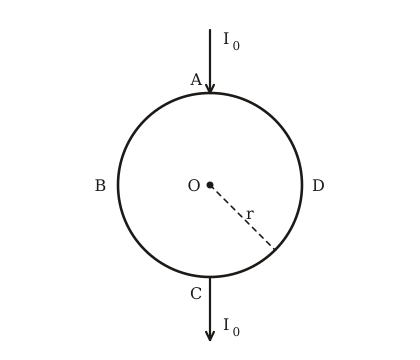
1μ₀I₀/12r
2μ₀I₀/4r
3μ₀I₀/2r
4μ₀I₀/2πr
NTA Answer: Option 1(final)
NEET 2025
14 : 1
21 : 4
31 : 2
42 : 1
NTA Answer: Option 2(final)
NEET 2024Revised key
144 mT
24.4 T
34.4 mT
444 T
NTA Answer: Option 3(revised_final)
NEET 2023
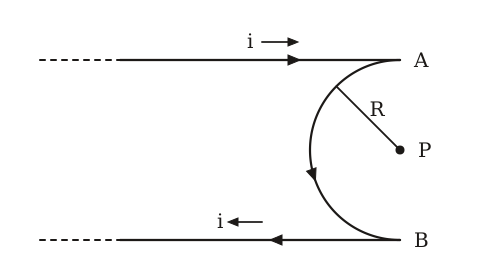
1(μ₀i/4R) pointed away from the page
2(μ₀i/4R)[1 − 2/π] pointed away from page
3(μ₀i/4R)[1 − 2/π] pointed into the page
4(μ₀i/4R) pointed into the page
NTA Answer: Option 2(final)
All 17 past-paper questions from Magnetic Effects of Current and Magnetism →
How does NEET ask about Biot Savart Circular Loop?
1 recurring pattern from past papers — click to collapse
Field at centre of circular loop: B = mu_0 I / (2R).
Direct ApplicationEasy
Common distractors
forgets 2 in denominator
Uses mu_0 I/R instead of mu_0 I/(2R)
Sources
NCERT refs: Class 12 Physics Chapter 4, p.116
Page numbers are the ones printed in the current NCERT textbook (2023 rationalised edition), unless marked pre-2023. The books are free at ncert.nic.in.
Test yourself on this topic with real past-paper questions:
Practice this topic →