NEET 2026
10
21
32
43
NTA Answer: Option 2(final)
20 lessons
20 of 20 lessons by the NCERT chapter they teach from, in book order. The page is the first printed page of your NCERT book the lesson cites; PYQs are the past NEET questions on that topic.
21 questions from NEET 2020, 2021, 2022, 2023, 2024, 2025, 2026. Answers verified against NTA official keys.
By year in our set: 2020 (3) · 2021 (3) · 2022 (4) · 2023 (2) · 2024 (3) · 2025 (4) · 2026 (2)
Lesson: Refraction Light
Lesson: Lenses in Contact
Lesson: Lenses in Contact
Lesson: Microscope
Lesson: Polaroid
Lesson: Polarization Brewster
Lesson: Interference YDSE
If the monochromatic source in Young’s double slit experiment is replaced by white light, then
Lesson: Polarization Brewster
An unpolarised light beam strikes a glass surface at Brewster's angle. Then
Lesson: Astronomical Telescope
Lesson: Total Internal Reflection
Lesson: Interference YDSE
Lesson: Lens Makers Formula
Lesson: Fringe Width YDSE
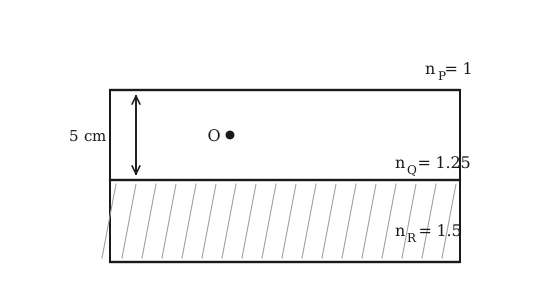
Lesson: Refraction Light
Lesson: Refraction Light
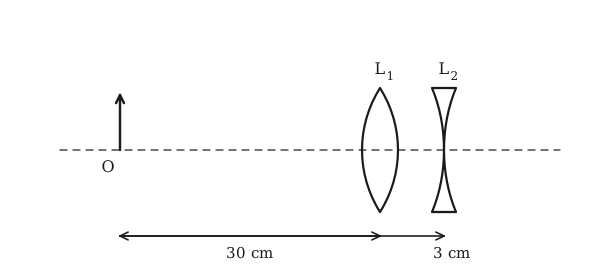
Lesson: Lenses in Contact
Lesson: Refraction Prism
Find the value of the angle of emergence from the 3 prism. Refractive index of the glass is . 60°
Lesson: Lenses in Contact
Lesson: Astronomical Telescope
Lesson: Polarization Brewster
The Brewsters angle ib for an interface should be :
Lesson: Fringe Width YDSE
Lesson: Fringe Width YDSE
Category: Similar Terms
Student writes β = λd/D instead of λD/d. Consequences: doubling D should INCREASE fringe width, not decrease.
YDSE fringe width question with changes to slit separation or screen distance.
β = λD/d. D is screen distance (large); d is slit separation (small). β scales with D/d. Mnemonic: 'D for distance increases width'.
Lesson: Lenses in Contact
Category: Negative Marking
Sequential 1/F = 1/f1 + 1/f2 across multiple lenses. Each f sign error or reciprocal-skip propagates. Common with diopter conversions (P = 1/f in metres).
Multi-lens optical system; asks for equivalent focal length or power.
Standard procedure: (1) note signs of each f (concave negative); (2) sum 1/f_i; (3) take reciprocal at end. Skip the final reciprocal and the answer is off by orders of magnitude — always present as distractor.
Lesson: Mirror Formula
Category: Sign Convention
Student inverts the sign of u, v, or f in mirror/lens formulas. Convention: distances measured from pole/optical centre; positive in direction of light propagation.
Mirror or lens problem requiring formula application.
Cartesian sign convention: pole at origin; light travels in +x direction; distances measured along axis are signed. Concave mirror f<0 on convention where light incident from left (or vice versa per text). Apply ONE convention throughout.
Lesson: Refraction Prism
Category: Negative Marking
Multi-step prism problem combining angle of incidence, refraction (Snell at each face), and minimum deviation formula. Each sin/sin⁻¹ inversion or angle-mode (deg vs rad) confusion compounds.
Prism problem with refractive index, prism angle A, angle of incidence i.
Use sequential angle bookkeeping: at first face, n sin(r1) = sin(i1); at second face, similar; r1 + r2 = A. Compute deviation δ = (i1 + i2) − A. Plug into minimum-deviation formula only when symmetric (i1 = i2).
Lesson: Fringe Width YDSE
Root cause: formula misuse
β = λD/d. D = screen distance (large), d = slit separation (small). β ∝ D/d. Larger D → wider fringes.
Lesson: Lenses in Contact
Root cause: arithmetic
Procedure: (1) compute Σ1/f_i with signed f values; (2) take reciprocal at end to get F. Skipping the final reciprocal gives 1/F (in 1/m = dioptres) instead of F (in metres).
Lesson: Mirror Formula
Root cause: sign error
Use Cartesian convention consistently: pole/optical-centre at origin, light travels in +x direction. Object usually has u < 0 (left of pole). Concave mirror f < 0 (most conventions). Apply ONE convention throughout.
Lesson: Polarization Brewster
Root cause: formula misuse
Brewster's law: tan(i_B) = n (NOT sin). Different from Snell's critical angle sin(θ_c) = 1/n. Brewster ~57° for glass (n≈1.5); critical ~42°.
Lesson: Polaroid
Root cause: formula misuse
Malus: I = I_0 cos²(θ). For θ=60°: I = I_0 × (1/4), not I_0 × 0.5.
Lesson: Astronomical Telescope
Magnification of astronomical telescope in normal adjustment (final image at infinity).
| Symbol | Quantity | SI Unit |
|---|---|---|
| f_o | objective focal length | m |
| f_e | eyepiece focal length | m |
Lesson: Fringe Width YDSE
Fringe width in Young's double-slit experiment. Wavelength lambda, slit separation d, screen distance D.
| Symbol | Quantity | SI Unit |
|---|---|---|
| beta | fringe width | m |
| lambda | wavelength | m |
| D | screen distance | m |
| d | slit separation | m |
Lesson: Lens Makers Formula
Focal length from refractive index and surface curvatures.
| Symbol | Quantity | SI Unit |
|---|---|---|
| f | focal length | m |
| n | refractive index | - |
| R1, R2 | radii of curvature | m |
Lesson: Lenses in Contact
Equivalent focal length for thin lenses in contact. Powers add.
| Symbol | Quantity | SI Unit |
|---|---|---|
| F | equivalent focal length | m |
| f_i | individual | m |
Lesson: Magnification
Spherical mirror formula. Sign convention: distances from pole, positive in direction of incident light.
| Symbol | Quantity | SI Unit |
|---|---|---|
| v | image distance | m |
| u | object distance | m |
| f | focal length | m |
| m | magnification | - |
Lesson: Polarization Brewster
When light is incident at Brewster's angle on a dielectric, the reflected light is fully plane-polarised.
| Symbol | Quantity | SI Unit |
|---|---|---|
| i_B | Brewster's angle | rad |
| n | refractive index | - |
Lesson: Polaroid
Intensity through a polariser depends on angle theta between light's polarisation and polariser axis.
| Symbol | Quantity | SI Unit |
|---|---|---|
| I | transmitted intensity | W/m^2 |
| I0 | incident intensity | W/m^2 |
| theta | angle | rad |
Lesson: Power of Lens
Thin lens formula. Power P = 1/f (in dioptres if f in metres).
| Symbol | Quantity | SI Unit |
|---|---|---|
| v | image distance | m |
| u | object distance | m |
| f | focal length | m |
Lesson: Refraction Light
Refraction at boundary between two media of different refractive indices.
| Symbol | Quantity | SI Unit |
|---|---|---|
| n1, n2 | refractive indices | - |
| theta1, theta2 | angles from normal | rad |
Lesson: Refraction Prism
At minimum deviation (i1 = i2), refractive index from prism angle A and minimum deviation delta_m.
| Symbol | Quantity | SI Unit |
|---|---|---|
| n | refractive index | - |
| A | prism angle | rad |
| delta_m | minimum deviation | rad |
Lesson: Total Internal Reflection
Beyond this angle of incidence, total internal reflection occurs.
| Symbol | Quantity | SI Unit |
|---|---|---|
| theta_c | critical angle | rad |
| n1 | denser medium index | - |
| n2 | rarer medium index | - |
Lesson: Astronomical Telescope
inverts fo fe
Uses f_e/f_o instead of f_o/f_e
Lesson: Fringe Width YDSE
inverts D d relation
Uses d/D instead of D/d
Lesson: Lenses in Contact
forgets sign of concave
Treats concave f as positive
Lesson: Polarization Brewster
uses sin instead of tan
Confuses with Snell's critical angle
Lesson: Polaroid
uses cos not cos squared
Drops square on cos
Lesson: Refraction Prism
forgets small angle approx
Uses full formula when only A is given
Lesson: Total Internal Reflection
inverts ratio
Uses n instead of 1/n