Atoms and Nuclei

12 lessons

Practice this unit →

Try this first: NEET 2025 PYQ

A particle of mass m is moving around the origin with a constant force F pulling it towards the origin. If Bohr model is used to describe its motion, the radius of the nth orbit and the particle’s speed ν in the orbit depend on n as
  1. A.r ∝ n4/3; ν ∝ n–1/3
  2. B.r ∝ n1/3; ν ∝ n1/3
  3. C.r ∝ n1/3; ν ∝ n2/3
  4. D.r ∝ n2/3; ν ∝ n1/3
Tap to see the answer

Answer: D.

A is wrong: These satisfy mvr ∝ n but not the force law: F = mv²/r constant needs v² ∝ r, and n^(−2/3) ≠ n^(4/3). The consistent pair is r ∝ n^(2/3), v ∝ n^(1/3).

B is wrong: Here mvr ∝ n^(2/3), which breaks Bohr's rule L = nh/2π. Combining F = mv²/r (so v² ∝ r) with mvr ∝ n gives r³ ∝ n², i.e. r ∝ n^(2/3) and v ∝ n^(1/3).

C is wrong: These satisfy mvr ∝ n but not the force law: v² ∝ n^(4/3) while r ∝ n^(1/3), so mv²/r would not stay constant. The consistent pair is r ∝ n^(2/3), v ∝ n^(1/3).

All 12 past-paper questions from this unit →

Topic index in NCERT order

12 of 12 lessons by the NCERT chapter they teach from, in book order. The page is the first printed page of your NCERT book the lesson cites; PYQs are the past NEET questions on that topic.

Class 11 Chemistry, Chapter 2

  1. Hydrogen Spectrump. 452 PYQs

Class 12 Physics, Chapter 12

  1. Alpha Scatteringp. 2911 PYQ
  2. Rutherford Modelp. 2910 PYQs
  3. Bohr Modelp. 2933 PYQs
  4. Energy Levels Bohrp. 2951 PYQ

Class 12 Physics, Chapter 13

  1. Nuclear Composition Sizep. 3090 PYQs
  2. Atomic Massesp. 3100 PYQs
  3. Mass Energy Relationp. 3102 PYQs
  4. Binding Energy Variationp. 3110 PYQs
  5. Mass Defect Binding Energyp. 3111 PYQ
  6. Nuclear Fissionp. 3152 PYQs
  7. Nuclear Fusionp. 3160 PYQs

All 12 lessons

Questions, revision cards and difficulty mix per lesson

Videos for this unit

Past-paper questions from this unit

12 questions, NEET 2020–2026

12 questions from NEET 2020, 2021, 2022, 2023, 2024, 2025, 2026. Answers verified against NTA official keys.

By year in our set: 2020 (2) · 2021 (1) · 2022 (2) · 2023 (2) · 2024 (1) · 2025 (1) · 2026 (3)

Lesson: Mass Energy Relation

NEET 2026

Consider the following nuclear reaction : ²³⁸U → ²³⁴Th + ⁴He. Take masses of ²³⁸U, ²³⁴Th and ⁴He as 238.050 u, 234.043 u and 4.003 u, respectively. The Q value for the reaction, in keV, is : [Given : 1 u = 931.5 MeV c⁻²]

13726
23730
33736
43740
NTA Answer: Option 1(final)

Why the other options are wrong

  • Option 2: 3730 keV does not follow from the masses. Q = ('sum of initial masses' − sum of final masses)c² = (238.050 − 234.043 − 4.003) u × c² = 0.004 u × c², and with '1u = 931.5 MeV/c' that is 0.004 × 931.5 MeV = 3.726 MeV = 3726 keV.
  • Option 3: 3736 keV is 10 keV too high. The mass difference is 238.050 − (234.043 + 4.003) = 0.004 u, and Q = ('sum of initial masses' − sum of final masses)c² = 0.004 × 931.5 MeV = 3726 keV.
  • Option 4: 3740 keV would need 1 u = 935 MeV/c². With Q = ('sum of initial masses' − sum of final masses)c² = 0.004 u and 931.5 MeV per u, Q = 3.726 MeV = 3726 keV.
Lesson: Alpha Scattering

NEET 2026

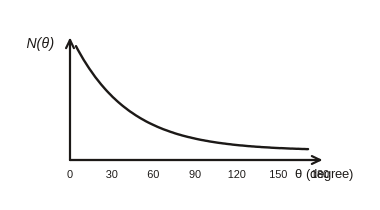
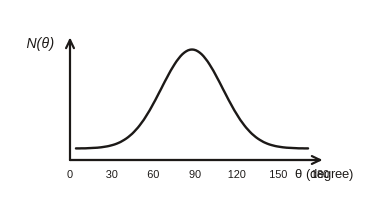
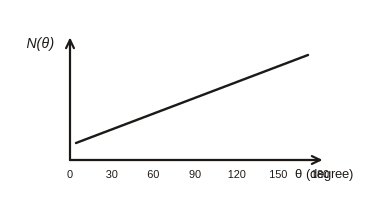
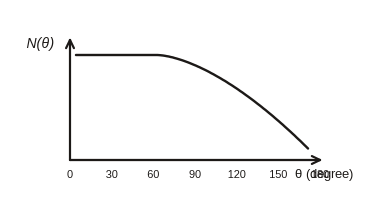
In Geiger-Marsden experiment, the number of scattered α-particles N(θ) is plotted as a function of scattering angle θ. Which of the following options represents the correct plot ?

1Option 1 diagram
2Option 2 diagram
3Option 3 diagram
4Option 4 diagram
NTA Answer: Option 3(final)

Why the other options are wrong

  • Option 1: N(θ) rising with θ would put most particles at large angles, but most 'pass through the foil' with little deflection, and only 'about 1 in 8000 deflect by more than 90'°. N(θ) falls steeply as θ grows.
  • Option 2: A flat plateau up to about 60° would mean as many particles scatter at 60° as at small angles, but 'Only about 0.14% of the incident' particles scatter by more than 1°. N(θ) falls from the smallest angles onward.
  • Option 4: A peak near 90° contradicts the counts: only 'about 1 in 8000 deflect by more than 90'°. N(θ) is largest at small θ and falls off steeply.

Lesson: Bohr Model

NEET 2026

Consider that an electron is revolving in an excited state of Hydrogen atom with velocity √25.6 × 10⁵ ms⁻¹. The radius of the orbit is x × 10⁻⁹ m. The value of x is : [Take the mass of electron to be 9 × 10⁻³¹ kg, charge of electron = −1.6 × 10⁻¹⁹ C and 1/(4πε₀) = 9 × 10⁹ N m² C⁻²]

14
23
32
41
NTA Answer: Option 4(final)

Why the other options are wrong

  • Option 1: x = 4 would need v² four times smaller, since r ∝ 1/v². The electrostatic attraction 'provides the requisite centripetal force': e²/(4πε₀r²) = mv²/r, so r = e²/(4πε₀mv²) = 9 × 10⁹ × (1.6 × 10⁻¹⁹)²/(9 × 10⁻³¹ × 25.6 × 10¹⁰) = 2.304 × 10⁻²⁸/2.304 × 10⁻¹⁹ = 1 × 10⁻⁹ m.
  • Option 2: x = 3 would need v² three times smaller. With the Coulomb force as the one that 'provides the requisite centripetal force', r = e²/(4πε₀mv²) = 1 × 10⁻⁹ m, so x = 1.
  • Option 3: x = 2 would need v² half as large. Setting e²/(4πε₀r²) = mv²/r (the attraction 'provides the requisite centripetal force') gives r = 9 × 10⁹ × 2.56 × 10⁻³⁸/(9 × 10⁻³¹ × 25.6 × 10¹⁰) = 1 × 10⁻⁹ m.

Lesson: Bohr Model

NEET 2025

A particle of mass m is moving around the origin with a constant force F pulling it towards the origin. If Bohr model is used to describe its motion, the radius of the nth orbit and the particle’s speed ν in the orbit depend on n as

1r ∝ n4/3; ν ∝ n–1/3
2r ∝ n1/3; ν ∝ n1/3
3r ∝ n1/3; ν ∝ n2/3
4r ∝ n2/3; ν ∝ n1/3
NTA Answer: Option 4(final)

Why the other options are wrong

  • Option 1: These satisfy mvr ∝ n but not the force law: F = mv²/r constant needs v² ∝ r, and n^(−2/3) ≠ n^(4/3). The consistent pair is r ∝ n^(2/3), v ∝ n^(1/3).
  • Option 2: Here mvr ∝ n^(2/3), which breaks Bohr's rule L = nh/2π. Combining F = mv²/r (so v² ∝ r) with mvr ∝ n gives r³ ∝ n², i.e. r ∝ n^(2/3) and v ∝ n^(1/3).
  • Option 3: These satisfy mvr ∝ n but not the force law: v² ∝ n^(4/3) while r ∝ n^(1/3), so mv²/r would not stay constant. The consistent pair is r ∝ n^(2/3), v ∝ n^(1/3).

Lesson: Hydrogen Spectrum

NEET 2024Revised key

Match List I with List II. List I List II (Spectral Lines of (Wavelengths (nm)) Hydrogen for transitions from) A. n2 = 3 to n1 = 2 I. 410.2 B. n2 = 4 to n1 = 2 II. 434.1 C. n2 = 5 to n1 = 2 III. 656.3 D. n2 = 6 to n1 = 2 IV. 486.1 Choose the correct answer from the options given below:

1A-II, B-I, C-IV, D-III
2A-III, B-IV, C-II, D-I
3A-IV, B-III, C-I, D-II
4A-I, B-II, C-III, D-IV
NTA Answer: Option 2(revised_final)

Why the other options are wrong

  • Option 1: 3 → 2 is the lowest-energy Balmer line, so it has the longest wavelength, 656.3 nm, not 434.1 nm. Wavelength falls as n2 rises: 656.3, 486.1, 434.1, 410.2 nm.
  • Option 3: Wavelength must fall as n2 rises, since 1/λ = R_H(1/2² − 1/n2²) grows with n2. A (3 → 2) is 656.3 nm and D (6 → 2) is 410.2 nm.
  • Option 4: This is reversed. The 3 → 2 transition has the smallest 1/λ, so the longest wavelength (656.3 nm); 6 → 2 has the shortest (410.2 nm).

Lesson: Hydrogen Spectrum

NEET 2023

In hydrogen spectrum, the shortest wavelength in the Balmer series is λ. The shortest wavelength in the Bracket series is

14λ
29λ
316λ
42λ
NTA Answer: Option 1(final)

Why the other options are wrong

  • Option 2: 9λ would be the Paschen series (n1 = 3). Brackett has n1 = 4, and the shortest line (n2 → ∞) scales as n1², so λ' = (4/2)² λ = 4λ.
  • Option 3: 16λ compares Brackett with the Lyman series (n1 = 1). Against Balmer (n1 = 2) the ratio is (4/2)² = 4, so λ' = 4λ.
  • Option 4: The shortest line is the series limit, n2 → ∞, so 1/λ = R_H/n1² and λ ∝ n1². Brackett (n1 = 4) against Balmer (n1 = 2) gives 4, not 2.

Lesson: Bohr Model

NEET 2023

The radius of inner most orbit of hydrogen atom is 5.3 × 10⁻¹¹ m. What is the radius of third allowed orbit of hydrogen atom?

11.06 Å
21.59 Å
34.77 Å
40.53 Å
NTA Answer: Option 3(final)

Why the other options are wrong

  • Option 1: That is 2 × 0.53 Å. Bohr radii grow as n², so r3 = 9 × 0.53 Å = 4.77 Å.
  • Option 2: That is 3 × 0.53 Å, taking r ∝ n. Bohr orbits have r ∝ n², so r3 = 9 a0 = 4.77 Å.
  • Option 4: That is the innermost orbit itself, the Bohr radius a0. The third orbit is 3² = 9 times larger: 4.77 Å.

Lesson: Energy Levels Bohr

NEET 2022

Let T1 and T2 be the energy of an electron in the first and second excited states of hydrogen atoms, respectively. According to the Bohr’s model of an atom, the ratio T1 : T2 is

19 : 4
21 : 4
34 : 1
44 : 9
NTA Answer: Option 1(final)

Why the other options are wrong

  • Option 2: 1 : 4 compares n = 1 with n = 2. 'The n = 1 state is called ground state', so the first and second excited states are n = 2 and n = 3; with Eₙ = −13.6 eV/n², T₁ : T₂ = (1/4) : (1/9) = 9 : 4.
  • Option 3: 4 : 1 is the ratio of the ground state (n = 1) to the first excited state (n = 2). 'Higher values of n correspond to excited states', so T₁ is n = 2 and T₂ is n = 3, and T₁ : T₂ = 9 : 4.
  • Option 4: 4 : 9 inverts the ratio, as if energy grew as n². It goes as 1/n²: T₁ : T₂ = (13.6/4) : (13.6/9) = 9 : 4, where 'Higher values of n correspond to excited states'.

Lesson: Nuclear Fission

NEET 2022

A nucleus of mass number 189 splits into two nuclei having mass number 125 and 64. The ratio of radius of two daughter nuclei respectively is

125 : 16
21 : 1
34 : 5
45 : 4
NTA Answer: Option 4(final)

Why the other options are wrong

  • Option 1: That is the ratio of R², i.e. of surface areas. With R = R0 A1/3, R1 : R2 = (125/64)^(1/3) = 5 : 4.
  • Option 2: The radii differ because the mass numbers differ: R = R0 A1/3 gives 5 : 4 for A = 125 and 64.
  • Option 3: Reversed order. The question asks for 125 then 64: 125^(1/3) : 64^(1/3) = 5 : 4.

Lesson: Mass Defect Binding Energy

NEET 2021

A nucleus with mass number 240 breaks into two fragments each of mass number 120, the binding energy per nucleon of unfragmented nuclei is 7.6 MeV while that of fragments is 8.5 MeV. The total gain in the Binding Energy in the process is

1216 MeV
20.9 MeV
39.4 MeV
4804 MeV
NTA Answer: Option 1(final)

Why the other options are wrong

  • Option 2: 0.9 MeV is the gain per nucleon. The total gain in binding energy is 240×0.9 or 216 MeV.
  • Option 3: 9.4 MeV does not follow. The gain in binding energy for nucleon is about 0.9 MeV, and the total gain is 240×0.9 or 216 MeV.
  • Option 4: 804 MeV does not follow. Ebn rises from about 7.6 MeV to about 8.5 MeV, so the total gain is 240×0.9 or 216 MeV.

Lesson: Nuclear Fission

NEET 2020

When a uranium isotope ²³⁵₉₂U is bombarded with a neutron, it generates ⁸⁹₃₆Kr, three neutrons and :

1¹⁰³₃₆Kr
2¹⁴⁴₅₆Ba
3⁹¹₄₀Zr
4¹⁰¹₃₆Kr
NTA Answer: Option 2(final)

Why the other options are wrong

  • Option 1: ¹⁰³₃₆Kr keeps Z = 36, so the charges would total 36 + 36 = 72, not 92. In Eq. (13.10) U-235 'breaks into two intermediate mass nuclear fragments', Ba-144 (Z = 56) and Kr-89 (Z = 36), with 3 neutrons: 92 = 56 + 36 and 236 = 144 + 89 + 3.
  • Option 3: ⁹¹₄₀Zr fails both balances: 40 + 36 = 76, not 92, and 91 + 89 + 3 = 183, not 236. 'The same reaction can produce other pairs of intermediate mass fragments', but each pair must balance charge and mass number, and with Kr-89 and 3 neutrons the partner is Ba-144.
  • Option 4: ¹⁰¹₃₆Kr again has Z = 36, leaving 92 − 36 − 36 = 20 protons unaccounted for, and 101 + 89 + 3 = 193, not 236. Balancing gives A = 236 − 89 − 3 = 144 and Z = 92 − 36 = 56: the Ba-144 of Eq. (13.10), one of the 'two intermediate mass nuclear fragments'.

Lesson: Mass Energy Relation

NEET 2020

The energy equivalent of 0.5 g of a substance is :

10.5 × 10¹³ J
24.5 × 10¹⁶ J
34.5 × 10¹³ J
41.5 × 10¹³ J
NTA Answer: Option 3(final)

Why the other options are wrong

  • Option 1: Mass must be multiplied by c² = 9 × 10¹⁶ m² s⁻². E = 0.5 × 10⁻³ kg × 9 × 10¹⁶ = 4.5 × 10¹³ J.
  • Option 2: The mass was left in grams. In SI units m = 0.5 × 10⁻³ kg, so E = 4.5 × 10¹³ J, half of NCERT's 9 × 10¹³ J for 1 g.
  • Option 4: E = mc² = 0.5 × 10⁻³ × (3 × 10⁸)² = 4.5 × 10¹³ J; 1.5 × 10¹³ J is a third of that.

Exam traps and common mistakes in this unit

3 items

Lesson: Hydrogen Spectrum

Category: Sign Convention

Student writes 1/λ = R(1/n_2² − 1/n_1²) (negative wavelength). Convention: n_2 > n_1, so 1/λ = R(1/n_1² − 1/n_2²) is positive.

When it triggers

Hydrogen spectrum problem with electronic transition.

How to avoid

n_1 is the LOWER (final for emission, initial for absorption) level. n_2 > n_1 is the HIGHER level. Bracket arrangement: smaller-n term first inside the parens. Result must be positive.

Lesson: Hydrogen Spectrum

Lesson: Nuclear Composition Size

Formulas in this unit

6 formulas

Lesson: Atomic Masses

Mass-energy equivalence

Einstein's mass-energy relation. 1 atomic mass unit = 931.5 MeV in energy units.

SymbolQuantitySI Unit
EenergyJ or MeV
mmasskg or u
cspeed of lightm/s

Valid when

  • Conversion of mass to energy (or vice versa)

Lesson: Binding Energy Variation

Mass defect and binding energy

Mass defect = sum of constituent masses minus nuclear mass. Binding energy = mass defect in energy units.

SymbolQuantitySI Unit
Zproton number-
Nneutron number-
m_p, m_nproton, neutron massu
Bbinding energyMeV

Valid when

  • Non-relativistic
  • Stable nucleus

Lesson: Bohr Model

Bohr energy levels

Energy of n-th Bohr orbit in hydrogen. n=1 ground state -13.6 eV; ionisation energy = 13.6 eV.

SymbolQuantitySI Unit
E_nenergy of n-th leveleV
nprincipal quantum number-

Valid when

  • Hydrogen atom
  • Non-relativistic

Lesson: Bohr Model

Bohr orbit radius

Allowed radii in Bohr model of hydrogen atom. Quantised by integer n.

SymbolQuantitySI Unit
r_nn-th orbit radiusm
a0Bohr radius 5.29e-11m
nquantum number-

Valid when

  • Hydrogen-like atom (single electron)
  • Non-relativistic

Lesson: Hydrogen Spectrum

Rydberg formula (hydrogen spectrum)

Wavelengths of hydrogen spectral lines. R = 1.097e7 1/m. Lyman (n1=1, UV), Balmer (n1=2, visible), Paschen+ (IR).

SymbolQuantitySI Unit
lambdawavelengthm
RRydberg constant1/m
n1, n2integers, n2>n1-

Valid when

  • Hydrogen atom
  • Single electron transition

Lesson: Nuclear Composition Size

Nuclear radius scaling

Nuclear radius scales with cube root of mass number A. Implies constant nuclear density.

SymbolQuantitySI Unit
Rnuclear radiusm
Amass number-
R0~1.2e-15m

Valid when

  • Spherical nucleus assumption

NEET question patterns in this unit

5 patterns

Lesson: Bohr Model

Lesson: Hydrogen Spectrum

Lesson: Mass Energy Relation

Lesson: Nuclear Composition Size

Lesson: Nuclear Fission

Questions about this unit

What does Atoms and Nuclei cover for NEET Physics?
12 lessons: Alpha Scattering, Atomic Masses, Binding Energy Variation, Bohr Model, Energy Levels Bohr, Hydrogen Spectrum, Mass Defect Binding Energy, Mass Energy Relation, Nuclear Composition Size, Nuclear Fission, Nuclear Fusion and Rutherford Model.
How often has Atoms and Nuclei come up in NEET past papers?
Our set of verified past papers has 12 questions from this unit, from NEET 2020, 2021, 2022, 2023, 2024, 2025 and 2026. Each is answered against the official NTA key.
Is the Atoms and Nuclei material free?
Yes. All 12 lessons and 109 practice questions are free, with no login needed.