Alpha Scattering

8 MCQs9-step worked example
Source: NCERT Atoms and NucleiPYQ coverage: NEET 2026Official key: NTA-verifiedLast updated: 25 Sep 2026

Alpha Scattering, explained for NEET

The confusion that costs marks here is treating the Geiger–Marsden result as a measurement of nuclear size or of electron orbits. It is neither. The experiment establishes one thing: that the positive charge and essentially all the mass of an atom sit in a tiny central region. What the model built on top of that says is a separate lesson.

The setup: alpha particles from a radioactive source, collimated into a narrow beam, strike a thin gold foil. A movable zinc sulphide screen with a microscope counts scintillations at each scattering angle. Gold is used because it can be beaten to a few hundred atoms thick — thin enough that most alphas pass through after a single encounter rather than many.

The result: the overwhelming majority of alphas pass through nearly undeviated. A small fraction deflect through large angles, and roughly one in 8000 comes back at more than 90°. NCERT Class 12 Physics Chapter 12, page 291, records this observation directly.

Why that is decisive. Thomson's atom spread positive charge over the whole atomic volume, so the electric field inside stayed weak and a massive alpha could never be turned around. Large-angle scattering needs a strong, concentrated repulsive field — hence a small, dense, positive core. The undeviated majority says that core occupies a negligible fraction of the atom's cross-section.

Two details examiners lean on. Electrons cannot deflect alphas appreciably: an alpha is about 7300 times more massive, so an electron collision changes its path about as much as a dust grain changes a bowling ball's. And the scattering force is Coulomb repulsion between two positive charges — nothing nuclear, nothing gravitational.

Watch out: "most alphas went straight through" is evidence about the emptiness of the atom; "a few bounced back" is evidence about the concentration of charge and mass. Questions routinely swap which observation supports which conclusion.

Can you answer these Alpha Scattering MCQs?

Select an option to see the explanation. Wrong answers show why your choice was tempting — and name the exact trap it exploits.

MCQ 1Easy RecallPractice

In the Geiger–Marsden alpha-scattering experiment, the detector used to register the arrival of scattered alpha particles was a

Show answer and why every option is right or wrong

Answer: B. Scattered alphas struck a movable ZnS screen and each impact produced a tiny flash counted visually through a microscope, as described in NCERT Class 12 Physics Chapter 12, page 291.

Why A is wrong: A is wrong because the count at each angle had to be read while the angle was held fixed; a plate developed afterwards records positions but not the angle-by-angle counting the experiment required.

Why C is wrong: C is wrong because the cloud chamber visualises particle tracks and was not the detection method in this foil experiment.

Why D is wrong: D is wrong because although Geiger later developed the counter tube bearing his name, the scattering experiment itself was read as visual scintillations on ZnS.

MCQ 2Concept TrapPractice

Which single observation from the alpha-scattering experiment is the direct evidence that most of the atom is empty space?

Show answer and why every option is right or wrong

Answer: A. Undeviated transmission means the alphas encountered no strong field along almost every path, so the deflecting matter occupies a negligible fraction of the foil's cross-section — NCERT Class 12 Physics Chapter 12, page 291.

Why B is wrong: B is wrong because large-angle backscattering is evidence for the concentration of charge and mass in a tiny core, not for the emptiness around it. This is the observation-to-conclusion swap the topic is built around.

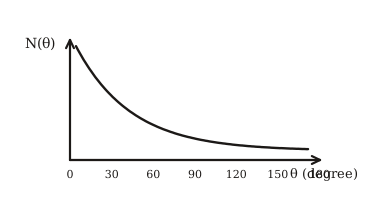
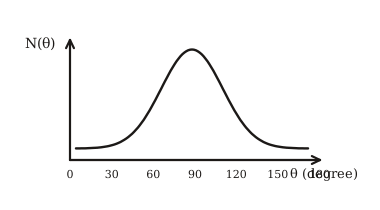
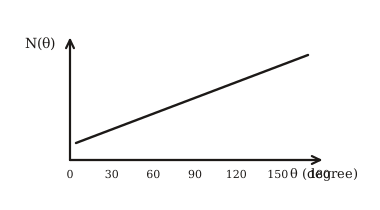
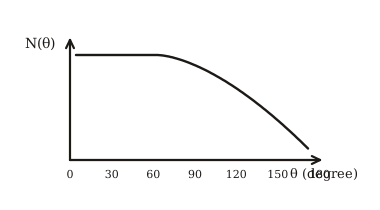
Why C is wrong: C is wrong because the falling angular distribution describes how scattering varies with angle; on its own it says nothing about what fraction of the atomic volume is occupied.

Why D is wrong: D is wrong because deflection occurring at all only shows a repulsive interaction exists, which Thomson's model also permitted in weak form.

MCQ 3Easy RecallPractice

The force responsible for the deflection of an alpha particle in the gold-foil experiment is

Show answer and why every option is right or wrong

Answer: C. Both the alpha particle and the central core carry positive charge, and their Coulomb repulsion produces the deflection; NCERT Class 12 Physics Chapter 12, page 291.

Why A is wrong: A is wrong because gravitational attraction between the alpha particle and a gold nucleus is smaller than the electrostatic force by roughly thirty-five orders of magnitude (both fall as 1/r², so the ratio does not depend on distance) and is completely negligible here.

Why B is wrong: B is wrong because the alphas in this experiment do not approach closely enough for the short-range strong force to act; the whole deflection is accounted for by Coulomb repulsion.

Why D is wrong: D is wrong because no external magnetic field is applied and the deflections occur equally for alphas of any orientation of motion.

MCQ 4Concept TrapPractice

A student claims that the electrons in the gold atoms contribute significantly to the large-angle deflection of alpha particles. The claim fails because

Show answer and why every option is right or wrong

Answer: B. The alpha-to-electron mass ratio is about 7300, so momentum transfer in an alpha–electron encounter is tiny and cannot produce large-angle deflection; NCERT Class 12 Physics Chapter 12, page 291.

Why A is wrong: A is wrong because binding energy is not the obstacle — even a free electron could not appreciably deflect an alpha. The argument rests on mass, not on binding.

Why C is wrong: C is wrong because electrons are negative and alphas positive, so they attract rather than repel; an interaction certainly exists, it is simply too feeble to matter.

Why D is wrong: D is wrong because electron speed does not remove the interaction, and invoking it misses the mass argument that actually settles the question.

MCQ 5Direct ApplicationPractice

Thomson's model of the atom is ruled out by the alpha-scattering results because that model predicts

Show answer and why every option is right or wrong

Answer: D. With positive charge diffused over the full atomic volume, the internal electric field is weak everywhere, so Thomson's atom can produce only slight deflections and cannot turn an alpha back — which is exactly what the experiment contradicts. See NCERT Class 12 Physics Chapter 12, page 291.

Why A is wrong: A is wrong because Thomson's model does permit small deflections from the diffuse charge; the disagreement with experiment concerns large angles, not any deflection at all.

Why B is wrong: B is wrong because absorption is not a prediction of either model; both expect alphas to traverse a thin foil.

Why C is wrong: C is wrong because it inverts the prediction. Universal large-angle scattering is what neither model predicts and what the experiment did not observe.

MCQ 6Direct ApplicationPractice

In the experiment, the gold foil was made only a few hundred atomic layers thick. The purpose of using such a thin foil was to

Show answer and why every option is right or wrong

Answer: B. A single-encounter geometry is what allows the measured angular distribution to be interpreted as scattering from one core; a thick foil would blur this into many successive small deflections. See NCERT Class 12 Physics Chapter 12, page 291.

Why A is wrong: A is wrong because some ionisation energy loss occurs regardless of thickness; eliminating it is not achievable and is not the reason for thinness.

Why C is wrong: C is wrong because the ZnS screen sits on the far side of the scattering path and its flashes are viewed directly; no light needs to travel through the foil.

Why D is wrong: D is wrong because a thinner foil would if anything be more vulnerable to beam heating, so this reverses the reasoning.

MCQ 7CalculationPractice

Roughly one alpha particle in 8000 was scattered through more than 90°. If the experiment were repeated with a foil of the same metal but twice the thickness, still thin enough for single scattering, the fraction backscattered would be closest to

Show answer and why every option is right or wrong

Answer: A. In the single-scattering regime each alpha sees a number of nuclei proportional to the foil thickness, so doubling the thickness doubles the backscattered fraction to about one in 4000. The observed fraction of about 1/8000 for the original foil is recorded in NCERT Class 12 Physics Chapter 12, page 291.

Why B is wrong: B is wrong because it treats the result as an attenuation; energy loss in an extra few hundred atomic layers is not what sets the large-angle fraction.

Why C is wrong: C is wrong because the backscattered fraction is not a property of the element alone — it scales with how many nuclei lie in the beam path, and that is set by thickness.

Why D is wrong: D is wrong because it invents an inverse-square dependence on path length; the count of scattering centres grows linearly with thickness, it does not suppress the effect.

MCQ 8CalculationPractice

Suppose the gold foil were replaced by an aluminium foil containing the same number of atoms in the beam path. Compared with gold, the fraction of alpha particles scattered through large angles would be

Show answer and why every option is right or wrong

Answer: C. The deflection comes from Coulomb repulsion between the alpha and the nuclear charge, so aluminium's much smaller Z gives a weaker repulsive field at the same distance and far fewer large-angle events. The Coulomb origin of the deflection is set out in NCERT Class 12 Physics Chapter 12, page 291.

Why A is wrong: A is wrong because easier recoil of the target nucleus removes energy from the encounter and reduces, rather than increases, large-angle deflection of the alpha.

Why B is wrong: B is wrong because it counts scattering centres while ignoring their charge; the strength of each encounter depends on the nuclear charge, not only on how many nuclei are present.

Why D is wrong: D is wrong because bulk density is not the operative quantity and aluminium nuclei do scatter alphas — less strongly than gold, but not negligibly.
Free NEET study resources

Get a structured 30-day Mechanics plan and a complete formula booklet — delivered to your inbox instantly.

How do you solve a Alpha Scattering question? A worked example

  1. 1

    Given

    A collimated beam of alpha particles is directed at a gold foil. Of the alphas incident on the foil, the fraction scattered through angles greater than 90° is 1.25 × 10⁻⁴ (that is, about one in 8000). The foil thickness is t. A second gold foil of thickness 3.0 t is prepared, still thin enough that each transmitted alpha undergoes at most one significant deflection. The factor 3.0 is exact by construction of the second foil.

  2. 2

    Required

    The fraction of incident alpha particles scattered through more than 90° by the thicker foil.

  3. 3

    Concept

    In the single-scattering regime, an alpha particle either misses every nucleus or has one close encounter. The probability of the close encounter is proportional to the number of nuclei lying in the beam's path, which is proportional to the foil thickness for a given metal. This linear-in-thickness relation is what makes the experiment interpretable; it is the reason the foil had to be thin in the first place.

  4. 4

    Formula

    fraction scattered beyond a given angle ∝ (number of nuclei in the path) ∝ (foil thickness), provided at most one significant deflection per alpha.

  5. 5

    Substitution

    f₂ / f₁ = t₂ / t₁ = 3.0 t / t, with f₁ = 1.25 × 10⁻⁴.

  6. 6

    Calculation

    f₂ = 3.0 × 1.25 × 10⁻⁴ = 3.75 × 10⁻⁴. The thickness ratio 3.0 is exact by the terms of the problem and the integer 1 in "one in 8000" is a counting number; neither limits the significant figures. The precision is set by the given fraction 1.25 × 10⁻⁴, which carries three significant figures.

  7. 7

    Final answer

    f₂ = 3.75 × 10⁻⁴, or about one alpha in 2700.

  8. 8

    Common trap

    Students who remember "one in 8000" as a fixed property of gold answer 1.25 × 10⁻⁴ unchanged. It is not a property of the element — it is a property of that particular foil, and it scales with how many nuclei sit in the path. The complementary error is to assume the fraction saturates or falls with thickness, importing an attenuation picture that applies to absorption, not to single scattering.

  9. 9

    Similar NEET-style question

    In an alpha-scattering experiment with a thin gold foil, 1 alpha in 8000 is deflected through more than 90°. If the foil is replaced by one of the same metal whose thickness is one-fourth of the original, the fraction deflected through more than 90° becomes closest to (a) 1 in 2000 (b) 1 in 8000 (c) 1 in 32 000 (d) 1 in 64 000.

What to remember before solving Alpha Scattering questions

Rutherford's experiment (1911): most α particles passed through gold foil with little deflection; few were scattered through large angles. Conclusion: atom has a small dense nucleus.

-- NCERT Class 12 Physics, Ch. 12, p. 291

More in Atoms and Nuclei: 3 exam traps and mistakes · 6 formulas · 5 question patterns from its other lessons.

Sources

NCERT refs: Class 12 Physics Chapter 12, p.291

Page numbers are the ones printed in the current NCERT textbook (2023 rationalised edition), unless marked pre-2023. The books are free at ncert.nic.in.

Report an error · Every fix is public: corrections log

Test yourself on this topic with real past-paper questions:

Practice this topic →