Dual Nature of Matter and Radiation

6 lessons

Practice this unit →

Try this first: NEET 2025 PYQ

De-Broglie wavelength of an electron orbiting in the n = 2 state of hydrogen atom is close to (Given Bohr radius = 0.052 nm)
  1. A.2.67 nm
  2. B.0.067 nm
  3. C.0.67 nm
  4. D.1.67 nm
Tap to see the answer

Answer: C.

A is wrong: 2.67 nm is about four times too large. With rₙ ∝ n², r₂ = 4 × 0.052 = 0.208 nm, and a standing wave on the orbit (Figure 12.8 'illustrates a standing particle wave on a circular orbit') needs 2πr₂ = 2λ, so λ = πr₂ ≈ 0.65 nm, close to 0.67 nm.

B is wrong: 0.067 nm is ten times too small: λ = 2πr₂/2 = π × 0.208 nm ≈ 0.65 nm. The condition 2πrₙ = nλ is the wave picture of orbits whose angular momentum 'is some integral multiple of h/2π'.

D is wrong: 1.67 nm does not fit 2πr₂ = 2λ with r₂ = n² × 0.052 nm = 0.208 nm, which gives λ = π × 0.208 ≈ 0.65 nm. The page 'illustrates a standing particle wave on a circular orbit', with a whole number of wavelengths around the circumference.

All 11 past-paper questions from this unit →

Topic index in NCERT order

6 of 6 lessons by the NCERT chapter they teach from, in book order. The page is the first printed page of your NCERT book the lesson cites; PYQs are the past NEET questions on that topic.

Class 12 Physics, Chapter 11

  1. Dual Nature Radiationp. 2760 PYQs
  2. Hertz Lenard Observationsp. 2760 PYQs
  3. Photoelectric Effectp. 2766 PYQs
  4. Einstein Photoelectric Equationp. 2790 PYQs
  5. Matter Wavesp. 2854 PYQs
  6. Particle Nature Lightp. 2851 PYQ

All 6 lessons

Questions, revision cards and difficulty mix per lesson

Videos for this unit

Past-paper questions from this unit

11 questions, NEET 2020–2026

11 questions from NEET 2020, 2022, 2023, 2024, 2025, 2026. Answers verified against NTA official keys.

By year in our set: 2020 (3) · 2022 (1) · 2023 (1) · 2024 (1) · 2025 (2) · 2026 (3)

Lesson: Photoelectric Effect

NEET 2026

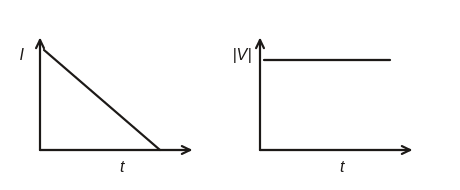
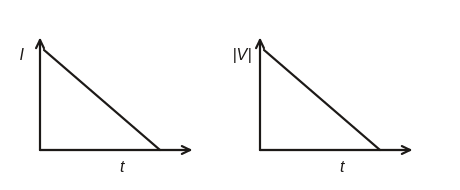
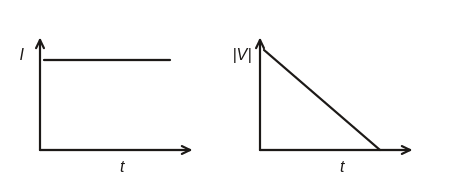
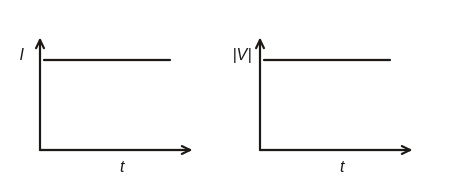
A beam of light falls on a metal surface such that photo-electrons are generated. If power of the light source starts to decrease linearly with time t, then variation of the photocurrent I and magnitude of the stopping potential |V| with time is best represented by :

1Option 1 diagram
2Option 2 diagram
3Option 3 diagram
4Option 4 diagram
NTA Answer: Option 1(final)

Why the other options are wrong

  • Option 2: This graph makes |V| fall with time as well. The stopping potential measures the maximum kinetic energy of the photoelectrons, which 'is independent of its intensity'; only the current, 'directly proportional to the intensity of incident light', falls as the power drops.
  • Option 3: This graph keeps I constant and makes |V| fall, the reverse of the facts: 'the photoelectric current is directly proportional to the intensity of incident light', while the maximum kinetic energy, and so |V|, 'is independent of its intensity'.
  • Option 4: Keeping both constant ignores the falling power. Fewer photons per second free fewer electrons, since 'the photoelectric current is directly proportional to the intensity of incident light', so I falls linearly while |V| stays fixed.

Lesson: Photoelectric Effect

NEET 2026

A ray of light with wavelength λ is incident on three different photo-electric cells namely 1, 2 and 3. The threshold wavelength of these photo-electric cells are λ₁, λ₂ and λ₃, respectively and the magnitude of stopping potentials of these cells are V₁, V₂ and V₃, respectively. The relation between λ and threshold wavelengths are λ₁ < λ, λ₂ > λ and λ₃ >> λ. The correct option is :

1V₁ = 0, V₂ < V₃
2V₁ = 0, V₂ > V₃
3V₁ > V₂, V₃ = 0
4V₁ < V₂, V₃ = 0
NTA Answer: Option 1(final)

Why the other options are wrong

  • Option 2: V₂ > V₃ reverses the order. A longer threshold wavelength means a lower threshold frequency and work function ('the greater the work function', 'the higher the minimum or threshold frequency'), so cell 3, with λ₃ >> λ, has the smaller φ₀ and, from eV₀ = hν − φ₀, the larger stopping potential: V₂ < V₃.
  • Option 3: V₃ = 0 is wrong: cell 3 has λ₃ >> λ, so the light is well above its threshold frequency and it emits. The cell with no emission is cell 1, because λ > λ₁ puts the light below its threshold frequency, 'below which no photoelectric emission is possible': V₁ = 0.
  • Option 4: V₃ = 0 and V₁ > 0 both fail. For cell 1, λ > λ₁ means ν < ν₀, 'below which no photoelectric emission is possible', so V₁ = 0, while cell 3 emits with the largest stopping potential.

Lesson: Matter Waves

NEET 2026

A photon and an electron, each of 20 eV energy, move in free space. The ratio of linear momentum of electron pe to that of photon pPh, pe/pPh, is : (Take speed of light = 3 × 10⁸ ms⁻¹, charge of electron = −1.6 × 10⁻¹⁹ C and mass of electron = 9 × 10⁻³¹ kg)

12/450
21/250
3225
4275
NTA Answer: Option 3(final)

Why the other options are wrong

  • Option 1: 2/450 = 1/225 is the inverse ratio, p_Ph/p_e. The electron’s momentum is p_e = √(2mE) (from K = ½mv²) and the photon’s is p = E/c, so p_e/p_Ph = c√(2m/E) = 3 × 10⁸ × √(2 × 9 × 10⁻³¹/3.2 × 10⁻¹⁸) = 225. Both enter the de Broglie relation as the momentum p, the wavelength 'associated with a particle of momentum p' being h/p.
  • Option 2: 1/250 has the ratio upside down: at the same 20 eV the electron, not the photon, has the larger momentum. p_e/p_Ph = √(2mE)/(E/c) = c√(2m/E) = 225.
  • Option 4: 275 does not follow from the numbers: c√(2m/E) = 3 × 10⁸ × √(1.8 × 10⁻³⁰/3.2 × 10⁻¹⁸) = 3 × 10⁸ × 7.5 × 10⁻⁷ = 225.

Lesson: Matter Waves

NEET 2025

De-Broglie wavelength of an electron orbiting in the n = 2 state of hydrogen atom is close to (Given Bohr radius = 0.052 nm)

12.67 nm
20.067 nm
30.67 nm
41.67 nm
NTA Answer: Option 3(final)

Why the other options are wrong

  • Option 1: 2.67 nm is about four times too large. With rₙ ∝ n², r₂ = 4 × 0.052 = 0.208 nm, and a standing wave on the orbit (Figure 12.8 'illustrates a standing particle wave on a circular orbit') needs 2πr₂ = 2λ, so λ = πr₂ ≈ 0.65 nm, close to 0.67 nm.
  • Option 2: 0.067 nm is ten times too small: λ = 2πr₂/2 = π × 0.208 nm ≈ 0.65 nm. The condition 2πrₙ = nλ is the wave picture of orbits whose angular momentum 'is some integral multiple of h/2π'.
  • Option 4: 1.67 nm does not fit 2πr₂ = 2λ with r₂ = n² × 0.052 nm = 0.208 nm, which gives λ = π × 0.208 ≈ 0.65 nm. The page 'illustrates a standing particle wave on a circular orbit', with a whole number of wavelengths around the circumference.

Lesson: Matter Waves

NEET 2025

A photon and an electron (mass m) have the same energy E. The ratio (λphoton/λelectron) of their de Broglie wavelengths is: (c is the speed of light)

1(1/c)√(E/2m)
2√(E/2m)
3c√(2mE)
4c√(2m/E)
NTA Answer: Option 4(final)

Why the other options are wrong

  • Option 1: (1/c)√(E/2m) is the inverse of the answer. Each wavelength is h/p, the wavelength 'associated with a particle of momentum p'. The photon has p = E/c, so λ_photon = hc/E; the electron has p = √(2mE) from K = ½mv², so λ_electron = h/√(2mE); the ratio is c√(2mE)/E = c√(2m/E).
  • Option 2: √(E/2m) has units of speed, not a pure number, and it misses c. With λ = h/p for both ('associated with a particle of momentum p'), λ_photon/λ_electron = p_e/p_photon = √(2mE)/(E/c) = c√(2m/E).
  • Option 3: c√(2mE) keeps E in the numerator. Dividing p_e = √(2mE) by p_photon = E/c gives c√(2mE)/E = c√(2m/E), since each wavelength is h/p, 'associated with a particle of momentum p'.

Lesson: Particle Nature Light

NEET 2024Revised key

If c is the velocity of light in free space, the correct statements about photon among the following are: A. The energy of a photon is E = hν. B. The velocity of a photon is c. C. The momentum of a photon, p = hν/c. D. In a photon-electron collision, both total energy and total momentum are conserved. E. Photon possesses positive charge. Choose the correct answer from the options given below:

1A and B only
2A, B, C and D only
3A, C and D only
4A, B, D and E only
NTA Answer: Option 2(revised_final)

Why the other options are wrong

  • Option 1: A and B only leaves out two true statements: each photon has momentum p = hν/c (C), and 'In a photon-particle collision (such as photon-electron collision), the total energy and total momentum are conserved' (D).
  • Option 3: A, C and D leaves out B, which is also true: each photon moves with 'speed c, the speed of light'.
  • Option 4: E is false: 'Photons are electrically neutral and are not deflected by electric and magnetic fields'. This option also leaves out C, p = hν/c.

Lesson: Photoelectric Effect

NEET 2023

The work functions of Caesium (Cs), Potassium (K) and Sodium (Na) are 2.14 eV, 2.30 eV and 2.75 eV respectively. If incident electromagnetic radiation has an incident energy of 2.20 eV, which of these photosensitive surfaces may emit photoelectrons?

1Both Na and K
2K only
3Na only
4Cs only
NTA Answer: Option 4(final)

Why the other options are wrong

  • Option 1: Na (2.75 eV) and K (2.30 eV) have work functions above the photon energy of 2.20 eV. The light is below their threshold frequency, so no photoelectric emission is possible even if the intensity is large.
  • Option 2: K's work function (2.30 eV) is above 2.20 eV, so the light is below K's threshold frequency and K emits nothing. Only Cs (2.14 eV) can emit.
  • Option 3: Na has the largest work function (2.75 eV), well above 2.20 eV, so it cannot emit. Only Cs (2.14 eV < 2.20 eV) can.

Lesson: Photoelectric Effect

NEET 2022

When two monochromatic lights of frequency, ν and ν/2 are incident on a photoelectric metal, their stopping potential becomes Vₛ/2 and Vₛ respectively. The threshold frequency for this metal is

1(3/2)ν
22ν
33ν
4(2/3)ν
NTA Answer: Option 1(final)

Why the other options are wrong

  • Option 2: Note first: this question's data cannot describe a real metal. The stopping potential is more negative for higher frequencies of incident radiation, yet here ν gets Vs/2 and ν/2 gets Vs. Taking the two equations as printed, eVs/2 = hν − hν₀ and eVs = hν/2 − hν₀; subtracting gives eVs = −hν, and then hν₀ = hν/2 + hν, so ν₀ = 3ν/2 (NTA's key). 2ν does not satisfy them.
  • Option 3: 3ν does not satisfy the printed equations: they give eVs = −hν and ν₀ = 3ν/2 (the key). Both values show the premise is impossible (a negative stopping potential, and a threshold above both incident frequencies, below which no emission of photoelectrons takes place), so treat 3ν/2 as the answer the algebra gives, not as a real metal.
  • Option 4: 2ν/3 inverts the ratio the equations give. As printed, subtracting eVs = hν/2 − hν₀ from eVs/2 = hν − hν₀ gives eVs = −hν, and then ν₀ = 3ν/2, NTA's key. The data themselves are unphysical, because the stopping potential rises with frequency.

Lesson: Photoelectric Effect

NEET 2020

Light with an average flux of 20 W/cm² falls on a non-reflecting surface at normal incidence having surface area 20 cm². The energy received by the surface during time span of 1 minute is :

148 × 10³ J
210 × 10³ J
312 × 10³ J
424 × 10³ J
NTA Answer: Option 4(final)

Why the other options are wrong

  • Option 1: 48 × 10³ J is twice the answer, as if the light fell for 2 minutes. Average power is 'the ratio of the work, W, to the total time t taken', so energy = power × time = (20 W cm⁻² × 20 cm²) × 60 s = 400 W × 60 s = 24 × 10³ J.
  • Option 2: 10 × 10³ J does not follow from the data. The surface receives 20 W cm⁻² × 20 cm² = 400 W, and since power is 'the time rate at which work is done or energy is transferred', 1 minute gives 400 W × 60 s = 24 × 10³ J.
  • Option 3: 12 × 10³ J is half the answer, as if only 30 s were counted. With average power as 'the ratio of the work, W, to the total time t taken', the energy is 400 W × 60 s = 24 × 10³ J.

Lesson: Matter Waves

NEET 2020

An electron is accelerated from rest through a potential difference of V volt. If the de Broglie wavelength of the electron is 1.227×10⁻² nm, the potential difference is :

1104 V
210 V
3102 V
4103 V
NTA Answer: Option 1(final)

Why the other options are wrong

  • Option 2: At 10 V, λ = h/p = h/√(2meV) gives 1.227/√10 ≈ 0.39 nm, far longer than 1.227 × 10⁻² nm. √V = 1.227/0.01227 = 100 gives V = 10⁴ V.
  • Option 3: At 10² V, λ = 1.227/10 = 0.1227 nm, ten times too long. The given λ needs √V = 100, i.e. 10⁴ V.
  • Option 4: At 10³ V, λ = 1.227/31.6 ≈ 0.039 nm, still too long. √V = 100 gives 10⁴ V.

Lesson: Photoelectric Effect

NEET 2020

Light of frequency 1.5 times the threshold frequency is incident on a photosensitive material. What will be the photoelectric current if the frequency is halved and intensity is doubled ?

1zero
2doubled
3four times
4one-fourth
NTA Answer: Option 1(final)

Why the other options are wrong

  • Option 2: Doubling the intensity cannot help below threshold. Halving 1.5ν0 gives 0.75ν0, and no electrons were emitted at all when the frequency of the incident light was smaller than a certain minimum value, called the threshold frequency.
  • Option 3: Four times assumes the current scales with intensity whatever the frequency. At 0.75ν0 the light is below the threshold frequency, so the current is zero.
  • Option 4: Below the threshold frequency there is no emission at all, so the current is zero, not one-fourth.

Exam traps and common mistakes in this unit

2 items

Lesson: Einstein Photoelectric Equation

Category: Similar Terms

Student writes K_max = hν (forgets W). For frequencies above threshold, K_max = hν − W; W is non-zero.

When it triggers

Photoelectric question with given metal work function or threshold frequency.

How to avoid

Always: K_max = hν − W. If asked for stopping potential V_0: eV_0 = K_max = hν − W.

Lesson: Einstein Photoelectric Equation

Formulas in this unit

3 formulas

Lesson: Dual Nature Radiation

Photon energy and momentum

Energy and momentum of a photon. h = 6.626e-34 J*s.

SymbolQuantitySI Unit
EenergyJ
nufrequencyHz
lambdawavelengthm
pmomentumkg*m/s
hPlanck constantJ*s

Valid when

  • Vacuum (c=speed of light)
  • Photon = EM quantum

Lesson: Einstein Photoelectric Equation

Einstein's photoelectric equation

Maximum kinetic energy of photoelectron equals photon energy minus work function. Stopping potential V0 satisfies eV0 = K_max.

SymbolQuantitySI Unit
K_maxmax KEJ
hPlanck constantJ*s
nuphoton freqHz
Wwork functionJ
V0stopping potentialV
eelectron chargeC

Valid when

  • nu > nu_threshold = W/h (else no emission)
  • One-photon absorption

Lesson: Matter Waves

de Broglie wavelength

Wavelength associated with any moving particle of momentum p. For electron through V volts: lambda ~ 12.27/sqrt(V) angstroms.

SymbolQuantitySI Unit
lambdade Broglie wavelengthm
hPlanck constantJ*s
pmomentumkg*m/s
mmasskg
vspeedm/s

Valid when

  • Non-relativistic (v << c)

NEET question patterns in this unit

2 patterns

Lesson: Einstein Photoelectric Equation

Lesson: Matter Waves

Questions about this unit

What does Dual Nature of Matter and Radiation cover for NEET Physics?
6 lessons: Dual Nature Radiation, Einstein Photoelectric Equation, Hertz Lenard Observations, Matter Waves, Particle Nature Light and Photoelectric Effect.
How often has Dual Nature of Matter and Radiation come up in NEET past papers?
Our set of verified past papers has 11 questions from this unit, from NEET 2020, 2022, 2023, 2024, 2025 and 2026. Each is answered against the official NTA key.
Is the Dual Nature of Matter and Radiation material free?
Yes. All 6 lessons and 55 practice questions are free, with no login needed.