Photoelectric Effect

8 MCQs1 revision card9-step worked example
Source: NCERT Dual Nature of Matter and RadiationPYQ coverage: NEET 2020, 2022, 2023, 2026Official key: NTA-verifiedLast updated: 24 Sep 2026

Photoelectric Effect, explained for NEET

A measured stopping potential is not a measured photon energy. When a question hands you both the incident photon energy and the metal's work function, the work function is there to be subtracted: the maximum kinetic energy is the photon energy minus the work function, and the stopping potential satisfies (electron charge × stopping potential) = maximum kinetic energy. Dropping the work function term is the distractor deliberately planted in this pattern.

The experiment itself is plain. An evacuated tube holds an emitter plate and a collector plate. Monochromatic light of controllable frequency and intensity falls on the emitter, and a variable potential between the plates is swept from positive to negative while a microammeter is read. NCERT Class 12 Physics, Chapter 11, page 278 records four results from this arrangement.

First, at large positive collector potential every emitted electron is collected and the current levels off — the saturation current. Second, at fixed frequency the saturation current is proportional to intensity: brighter light means more electrons per second, not faster ones. Third, sweeping the collector negative drives the current to zero at the stopping potential, and that stopping potential does not shift when intensity changes — it responds only to frequency, and below a metal-specific threshold frequency no current flows at all. Fourth, emission begins within about 10⁻⁹ s of illumination, however feeble the light.

The second and third results are what a NEET question actually tests. This chapter supplies roughly one question a year, and the pattern carries a high negative-marking risk because the intensity-dependent quantity and the frequency-dependent quantity are both offered as options. Einstein's equation, which explains why the split exists, is treated in its own lesson; here, know which measured quantity answers to which control.

Watch the retarding region. A small current below the stopping potential is not experimental error — photoelectrons leave with kinetic energies spread from zero up to the maximum, so a partial retarding field stops only the slower ones.

Can you answer these Photoelectric Effect MCQs?

Select an option to see the explanation. Wrong answers show why your choice was tempting — and name the exact trap it exploits.

MCQ 1Easy RecallPractice

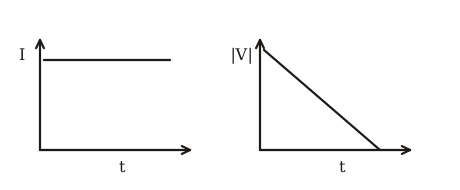
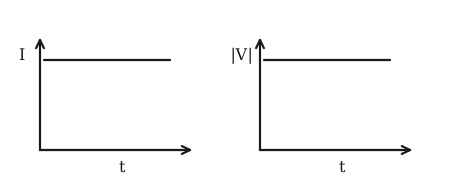
In the experimental arrangement for studying photoelectric emission, the photocurrent rises as the collector is made more positive and then levels off at a maximum value beyond which further positive potential produces no increase. This maximum value is called the:

Show answer and why every option is right or wrong

Answer: C. C is correct. Once the collector potential is large enough to collect every electron emitted per second, the current can rise no further; NCERT Class 12 Physics, Chapter 11, page 278 names this plateau the saturation current.

Why A is wrong: A is wrong because 'stopping' refers to the negative collector potential at which the current falls to zero, not to the plateau at positive potential; the stopping quantity in this experiment is a potential, not a current.

Why B is wrong: B is wrong because 'threshold' in this chapter names a frequency — the minimum incident frequency below which no emission occurs — and is a property of the metal, not a plateau on the current axis.

Why D is wrong: D is wrong because dark current is the residual current with the light switched off; here the plateau is reached with the emitter fully illuminated and is a photocurrent.

MCQ 2Easy RecallPractice

Measurements on photoelectric emission show that the delay between the emitter being illuminated and the first photoelectrons appearing is:

Show answer and why every option is right or wrong

Answer: A. A is correct. Emission is observed to be effectively instantaneous, with no measurable lag beyond about 10⁻⁹ s regardless of how weak the beam is, as recorded in NCERT Class 12 Physics, Chapter 11, page 280.

Why B is wrong: B is wrong because it overstates the delay by six orders of magnitude; the experimental bound is about 10⁻⁹ s, and 10⁻³ s would be easily resolvable by ordinary instruments, which the effect is not.

Why C is wrong: C is wrong because a build-up time that lengthens with feeble light is exactly the classical wave-theory prediction that the experiment contradicts; no such accumulation delay is observed.

Why D is wrong: D is wrong because the observed time lag is not a function of frequency at all — frequency controls whether emission happens and how energetic the electrons are, not when it begins.

MCQ 3Easy RecallPractice

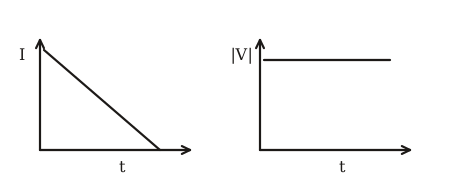
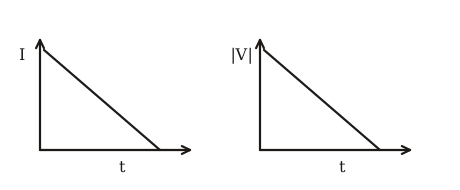
Light of fixed frequency, above the threshold for the emitter, falls on a photocell. When only the intensity of this light is varied, which measured quantity stays unchanged?

Show answer and why every option is right or wrong

Answer: D. D is correct. The stopping potential measures the maximum kinetic energy of the emitted electrons, which depends on frequency alone; NCERT Class 12 Physics, Chapter 11, page 280 records that it is unaltered by intensity.

Why A is wrong: A is wrong because the saturation current is directly proportional to intensity — more intense light liberates proportionally more electrons per second, all of which are collected at saturation.

Why B is wrong: B is wrong because a current flows even at zero applied potential, carried by electrons that reach the collector on their own kinetic energy, and its size scales with the number emitted per second and hence with intensity.

Why C is wrong: C is wrong because on the rising part of the current–voltage curve the current at any given collector potential is larger for brighter light; the whole curve is scaled up by intensity.

MCQ 4Direct ApplicationPractice

In a photoelectric experiment the emitter has work function 2.20 eV, and the fastest electrons leaving its surface are measured to have kinetic energy 1.30 eV. The energy carried by each incident photon is:

Show answer and why every option is right or wrong

Answer: B. B is correct. Maximum kinetic energy equals photon energy minus work function, so the photon energy is 1.30 eV + 2.20 eV = 3.50 eV, following the relation stated in NCERT Class 12 Physics, Chapter 11, page 281.

Why A is wrong: A is wrong because it subtracts the kinetic energy from the work function (2.20 − 1.30) instead of adding the two; the photon must supply both the escape energy and the kinetic energy, so it cannot be smaller than either.

Why C is wrong: C is wrong because it equates photon energy with maximum kinetic energy, dropping the work function term entirely — the standard photoelectric error of writing maximum kinetic energy as photon energy alone.

Why D is wrong: D is wrong because it equates photon energy with the work function; that would be light exactly at the threshold, which ejects electrons with zero kinetic energy, not 1.30 eV.

MCQ 5Direct ApplicationPractice

In a photoelectric experiment the collector is held at a small negative potential with respect to the illuminated emitter, smaller in magnitude than the stopping potential. A measurable current still flows. The reason is that:

Show answer and why every option is right or wrong

Answer: D. D is correct. Emitted electrons carry a spread of kinetic energies from zero up to the maximum, so a partial retarding field turns back only the slower ones while the faster ones still arrive, as described in NCERT Class 12 Physics, Chapter 11, page 279.

Why A is wrong: A is wrong because the light is directed onto the emitter, not the collector; and even if the collector emitted electrons, they would be repelled by its own negative potential rather than driven to the emitter.

Why B is wrong: B is wrong because the positive charge left on the emitter resides in the metal lattice and is replenished through the external circuit; it is not free to travel across the evacuated gap as a current carrier.

Why C is wrong: C is wrong because photons are uncharged — the current in a photocell is carried entirely by the emitted electrons, which is why a retarding potential can control it at all.

MCQ 6Direct ApplicationPractice

Monochromatic light whose photons carry 3.10 eV falls on a metal surface, and the photocurrent is just reduced to zero by a retarding potential of 0.70 V. The work function of the metal is:

Show answer and why every option is right or wrong

Answer: A. A is correct. The stopping potential of 0.70 V fixes the maximum kinetic energy at 0.70 eV, so the work function is 3.10 eV − 0.70 eV = 2.40 eV, using the relation in NCERT Class 12 Physics, Chapter 11, page 281.

Why B is wrong: B is wrong because it adds the stopping energy to the photon energy; the photon energy is the total available, and the work function is the part of it consumed in escaping, so the work function must be less than 3.10 eV.

Why C is wrong: C is wrong because it treats the whole photon energy as the work function, leaving nothing for the kinetic energy that the 0.70 V retarding potential had to remove — the same slip as writing maximum kinetic energy as photon energy alone, seen from the other side.

Why D is wrong: D is wrong because 0.70 eV is the maximum kinetic energy of the emitted electrons, read off the stopping potential; it is the quantity to be subtracted, not the work function itself.
MCQ 7Concept TrapPractice

Among the results obtained from the photocell experiment, which one is irreconcilable with the classical picture of light as a continuous wave delivering energy to the surface?

Show answer and why every option is right or wrong

Answer: C. C is correct. On a wave picture, energy accumulates at the surface, so intense enough or prolonged enough light of any frequency should eventually free an electron; the sharp frequency cut-off recorded in NCERT Class 12 Physics, Chapter 11, page 280 has no wave explanation.

Why A is wrong: A is wrong because a wave of greater amplitude delivering more energy per second, freeing more electrons per second, is exactly what classical theory would predict; this result creates no difficulty for it.

Why B is wrong: B is wrong because stopping charged particles with a retarding field is ordinary electrostatics and is independent of how the light is modelled; only the constancy of that stopping potential with intensity is the quantum signature.

Why D is wrong: D is wrong because the rise-then-plateau shape simply reflects a more positive collector sweeping up a larger fraction of the emitted electrons until all of them are collected — a counting effect, not a statement about the nature of light.

MCQ 8CalculationPractice

For one emitter in a photocell, photons of energy 2.80 eV are found to give a stopping potential of 0.90 V, and photons of energy 3.60 eV give a stopping potential of 1.70 V. The work function of the emitter is:

Show answer and why every option is right or wrong

Answer: B. B is correct. Each stopping potential fixes a maximum kinetic energy, and subtracting it from the corresponding photon energy gives 2.80 − 0.90 = 1.90 eV and 3.60 − 1.70 = 1.90 eV, the consistent work function required by the relation in NCERT Class 12 Physics, Chapter 11, page 281.

Why A is wrong: A is wrong because 0.80 is the difference between the two stopping potentials, which equals the difference between the two photon energies; that difference cancels the work function out rather than revealing it.

Why C is wrong: C is wrong because it takes the first photon energy as the work function, discarding the 0.90 V stopping potential — the error of treating all the photon energy as escape energy; it also fails the second measurement, where the same metal would then need a work function of 3.60 eV.

Why D is wrong: D is wrong because it adds a photon energy to a stopping energy instead of subtracting; the work function is a part of the photon energy, so it cannot exceed the smaller photon energy of 2.80 eV.

Free NEET study resources

Get a structured 30-day Mechanics plan and a complete formula booklet — delivered to your inbox instantly.

Photoelectric Effect: quick recall before you leave

How do you solve a Photoelectric Effect question? A worked example

  1. 1

    Given

    • Incident frequency in the first run: ν₁ = 8.0 × 10¹⁴ Hz• Measured stopping potential in the first run: V₀₁ = 0.80 V• Incident frequency in the second run, same emitter: ν₂ = 1.6 × 10¹⁵ Hz• Planck constant: h = 6.6 × 10⁻³⁴ J·s• Elementary charge: e = 1.6 × 10⁻¹⁹ C

  2. 2

    Required

    The work function of the emitter, its threshold frequency, and the stopping potential recorded in the second run.

  3. 3

    Concept

    The stopping potential is the retarding potential that just turns back the fastest photoelectron, so the energy removed from that electron, (elementary charge × stopping potential), equals its maximum kinetic energy. That maximum kinetic energy is what remains of the photon's energy after the work function has been paid.

  4. 4

    Formula

    maximum kinetic energy = (Planck constant × frequency) − work function, with (elementary charge × stopping potential) = maximum kinetic energy; threshold frequency = work function ÷ Planck constant.

  5. 5

    Substitution

    First run: (6.6 × 10⁻³⁴ J·s)(8.0 × 10¹⁴ Hz) − W = (1.6 × 10⁻¹⁹ C)(0.80 V).

  6. 6

    Calculation

    Photon energy in the first run: (6.6 × 10⁻³⁴)(8.0 × 10¹⁴) = 5.28 × 10⁻¹⁹ J, which is 5.28 × 10⁻¹⁹ ÷ 1.6 × 10⁻¹⁹ = 3.3 eV.
    Maximum kinetic energy in the first run: 0.80 eV, straight from the stopping potential.
    Work function: W = 3.3 eV − 0.80 eV = 2.5 eV, that is 4.0 × 10⁻¹⁹ J.
    Threshold frequency: ν₀ = 4.0 × 10⁻¹⁹ ÷ 6.6 × 10⁻³⁴ = 6.1 × 10¹⁴ Hz.
    Photon energy in the second run: (6.6 × 10⁻³⁴)(1.6 × 10¹⁵) = 1.06 × 10⁻¹⁸ J, which is 6.6 eV.
    Second stopping potential: V₀₂ = (6.6 eV − 2.5 eV) ÷ e = 4.1 V.

  7. 7

    Final answer

    Work function 2.5 eV; threshold frequency 6.1 × 10¹⁴ Hz; stopping potential in the second run 4.1 V. No exact constants enter this calculation — the Planck constant and the elementary charge are measured constants quoted here to two significant figures, and the two frequencies and the stopping potential are each given to two significant figures, so every result is reported to two significant figures.

  8. 8

    Common trap

    Reading the second run as V₀₂ = photon energy ÷ elementary charge = 6.6 V. That drops the work function, which the first run was supplied precisely to determine. The 2.5 eV does not disappear when the frequency is raised; it is a property of the metal surface and is subtracted every time. The tell is that 6.6 V is numerically identical to the photon energy in electronvolts — whenever a stopping potential in volts equals the photon energy in electronvolts, the work function has been lost.

  9. 9

    Similar NEET-style question

    A photocell emitter is illuminated at 9.0 × 10¹⁴ Hz and the current is just extinguished at 1.2 V. Taking the Planck constant as 6.6 × 10⁻³⁴ J·s and the elementary charge as 1.6 × 10⁻¹⁹ C, find the threshold frequency of the emitter, and state whether light of frequency 5.0 × 10¹⁴ Hz will produce any current from it however intense the beam.

What to remember before solving Photoelectric Effect questions

Emission of electrons from a metal when light of suitable frequency falls on it. Discovered by Hertz, studied by Lenard. Below threshold frequency ν₀, no electrons emitted regardless of intensity.

-- NCERT Class 12 Physics, Ch. 11, p. 276

Which Photoelectric Effect formulas do you need for NEET?

1 formula — click to collapse

Einstein's photoelectric equation

Maximum kinetic energy of photoelectron equals photon energy minus work function. Stopping potential V0 satisfies eV0 = K_max.

SymbolQuantitySI Unit
K_maxmax KEJ
hPlanck constantJ*s
nuphoton freqHz
Wwork functionJ
V0stopping potentialV
eelectron chargeC

Valid when

  • nu > nu_threshold = W/h (else no emission)
  • One-photon absorption

Where do students lose marks on Photoelectric Effect?

These are the exact patterns that cause wrong answers in NEET. Each trap includes when it triggers and how to avoid it.

2 items — click to collapse

Category: Similar Terms

Student writes K_max = hν (forgets W). For frequencies above threshold, K_max = hν − W; W is non-zero.

When it triggers

Photoelectric question with given metal work function or threshold frequency.

How to avoid

Always: K_max = hν − W. If asked for stopping potential V_0: eV_0 = K_max = hν − W.

More in Dual Nature of Matter and Radiation: 2 formulas · 1 question pattern from its other lessons.

Photoelectric Effect questions from past NEET papers

6 questions from NEET 2020, 2022, 2023, 2026. Answers verified against NTA official keys. — click to collapse
NEET 2026

A ray of light with wavelength λ is incident on three different photo-electric cells namely 1, 2 and 3. The threshold wavelength of these photo-electric cells are λ₁, λ₂ and λ₃, respectively and the magnitude of stopping potentials of these cells are V₁, V₂ and V₃, respectively. The relation between λ and threshold wavelengths are λ₁ < λ, λ₂ > λ and λ₃ >> λ. The correct option is :

1V₁ = 0, V₂ < V₃
2V₁ = 0, V₂ > V₃
3V₁ > V₂, V₃ = 0
4V₁ < V₂, V₃ = 0
NTA Answer: Option 1(final)

All 11 past-paper questions from Dual Nature of Matter and Radiation →

How does NEET ask about Photoelectric Effect?

1 recurring pattern from past papers — click to collapse

Sources

NCERT refs: Class 12 Physics Chapter 11, p.278

Page numbers are the ones printed in the current NCERT textbook (2023 rationalised edition), unless marked pre-2023. The books are free at ncert.nic.in.

Report an error · Every fix is public: corrections log

Test yourself on this topic with real past-paper questions:

Practice this topic →