sin θ₁ / sin θ₂ = n₂ / n₁ (= n₂₁, refractive index of medium 2 wrt medium 1). When light enters denser medium, it bends toward normal.
-- NCERT Class 12 Physics, Ch. 9, p. 228Refraction Light
8 MCQs1 revision card9-step worked example
Source: NCERT OpticsPYQ coverage: NEET 2022, 2026Official key: NTA-verifiedLast updated: 26 Sep 2026
Refraction Light, explained for NEET
The refraction error that costs marks is not arithmetic. It is measuring the angle from the surface instead of from the normal. Snell's law is stated for angles between the ray and the normal at the point of incidence, and a stem that says "makes 30° with the surface" is handing you 60° to substitute. The same slip flips which side of the equation the larger index sits on.
Snell's law, in NCERT Class 12 Physics Chapter 9 at page 228, is n₁ sin θ₁ = n₂ sin θ₂. Read it as a statement about a product that is conserved across the interface: whichever medium has the larger refractive index must carry the smaller angle, because the two must multiply to the same value. That one sentence settles the bend direction without a diagram. Going air → glass, n goes up, so θ must come down: the ray bends towards the normal. Going glass → air, the ray bends away.
Two consequences follow directly and are worth holding as facts, not derivations. A ray along the normal (θ₁ = 0) has sin θ₁ = 0, so sin θ₂ = 0 — normal incidence passes through undeviated, whatever the indices. And the relation is symmetric under swapping the two media, so a ray retraces its own path if reversed.
At a spherical refracting surface the same law applies locally, but the normal is now the radius drawn to the point of incidence, not the axis. Students who carry over the plane-surface habit of measuring from the axis get every angle wrong on a curved boundary.
For NEET, refraction at a plane surface is usually one substitution embedded in a longer question — the prism, the lens, the critical-angle condition all start here. The condition of use is a plane interface and monochromatic light; a different wavelength means a different n in the same glass.
Watch out for: angles quoted from the surface, and the assumption that a larger n means a larger angle.
Can you answer these Refraction Light MCQs?
Select an option to see the explanation. Wrong answers show why your choice was tempting — and name the exact trap it exploits.
MCQ 1Easy RecallPractice
In Snell's law, n₁ sin θ₁ = n₂ sin θ₂, the angles θ₁ and θ₂ are measured between the ray and the
Show answer and why every option is right or wrong
Answer: D. Snell's law is stated for angles measured from the normal at the point of incidence, as given in NCERT Class 12 Physics Chapter 9, page 228.
Why A is wrong: A is wrong because the horizontal has no physical role here — the reference direction is set by the orientation of the interface, not by the laboratory frame.
Why B is wrong: B is wrong because angles taken from the surface are the complements of the correct ones; substituting them directly is the single most frequent way this law is misapplied.
Why C is wrong: C is wrong because the principal axis is a construction line for lens and mirror systems; refraction at a general interface has no principal axis, and even where one exists the relevant reference is still the local normal.
MCQ 2Easy RecallPractice
For light passing from a rarer medium into a denser medium at a plane interface, the refracted ray bends
Show answer and why every option is right or wrong
Answer: B. With n₂ > n₁, the product n sin θ is conserved, so the larger index must carry the smaller angle; the ray bends towards the normal (NCERT Class 12 Physics Chapter 9, page 228).
Why A is wrong: A is wrong because bending away from the normal is what happens going denser to rarer, where n decreases and θ must therefore increase.
Why C is wrong: C is wrong because grazing emergence along the interface is the limiting case of the denser-to-rarer direction at the critical angle, not what happens entering a denser medium.
Why D is wrong: D is wrong because undeviated passage occurs only at normal incidence (θ₁ = 0) or when the two indices are equal, neither of which is stated here.
MCQ 3Easy RecallPractice
A ray of light is incident normally on a plane boundary between two transparent media of different refractive indices. The angle of refraction is
Show answer and why every option is right or wrong
Answer: C. At normal incidence θ₁ = 0, so sin θ₁ = 0 and Snell's law forces sin θ₂ = 0, giving θ₂ = 0 whatever the indices (NCERT Class 12 Physics Chapter 9, page 228).
Why A is wrong: A is wrong because a 90° refraction angle means the refracted ray grazes the surface, which is the limiting denser-to-rarer case, not normal incidence.
Why B is wrong: B is wrong because the critical angle describes the incidence at which refraction ceases; it plays no part when the incident ray is along the normal.
Why D is wrong: D is wrong because 45° would require a non-zero angle of incidence; nothing in Snell's law produces a finite refraction angle from zero incidence.
MCQ 4Direct ApplicationPractice
A ray travelling in air (n = 1.00) strikes a plane glass surface so that it makes an angle of 60.0° with the surface. Taking the glass to have n = 1.50, the correct substitution into Snell's law is
Show answer and why every option is right or wrong
Answer: C. The angle from the surface is 60.0°, so the angle from the normal is 90.0° − 60.0° = 30.0°; air is the incident medium, so n₁ = 1.00 pairs with 30.0° (NCERT Class 12 Physics Chapter 9, page 228).
Why A is wrong: A is wrong because it substitutes the surface angle directly as the angle of incidence, which is exactly the complement error this stem is built to catch.
Why B is wrong: B is wrong because it puts the glass index with the incident angle; the ray starts in air, so n₁ = 1.00 must multiply the angle of incidence.
Why D is wrong: D is wrong because cos 30.0° equals sin 60.0°, so this is the surface-angle error rewritten — the same wrong number reached by a different route.
MCQ 5Direct ApplicationPractice
Light travels from a medium of refractive index 1.60 into a medium of refractive index 1.20 at a plane interface, with an angle of incidence of 20.0°. Without computing the refraction angle, you can state that it is
Show answer and why every option is right or wrong
Answer: B. Since n drops from 1.60 to 1.20, the conserved product n sin θ requires sin θ to rise, so the refraction angle exceeds the incidence angle (NCERT Class 12 Physics Chapter 9, page 228).
Why A is wrong: A is wrong because equal angles require equal refractive indices, and 1.60 ≠ 1.20.
Why C is wrong: C is wrong because a decrease in angle accompanies an increase in refractive index; here the index decreases, so this reverses the relation.
Why D is wrong: D is wrong because the two indices are supplied as fixed numbers for this light; wavelength would matter only if the question changed the colour of the light.
MCQ 6Direct ApplicationPractice
A ray in air is incident at 30.0° on the flat face of a transparent slab and refracts at 20.0° inside the slab. If the ray is now sent back along the refracted path from inside the slab, striking the same face at 20.0° from the normal, the angle of emergence into air is
Show answer and why every option is right or wrong
Answer: D. Snell's law is symmetric in the two media, so reversing the ray retraces the original path and it emerges at the original angle of 30.0° (NCERT Class 12 Physics Chapter 9, page 228).
Why A is wrong: A is wrong because 20.0° is the angle inside the slab; the ray crossing into air must bend away from the normal, so the emergent angle cannot equal it.
Why B is wrong: B is wrong because it halves the internal angle, which corresponds to no relation in Snell's law.
Why C is wrong: C is wrong because doubling the internal angle is not what reversibility predicts; the emergent angle is fixed by the same index ratio that produced 30.0° → 20.0° originally.
MCQ 7Concept TrapPractice
A ray strikes a spherical refracting surface at a point away from the pole. To apply Snell's law correctly at that point, the angle of incidence must be measured from
Show answer and why every option is right or wrong
Answer: A. The normal to a spherical surface at any point lies along the radius through that point, so that radius is the reference line for both angles (NCERT Class 12 Physics Chapter 9, page 232, applying Snell's law locally).
Why B is wrong: B is wrong because the axis coincides with the normal only at the pole; at any other point on a curved surface the axis and the normal are different lines.
Why C is wrong: C is wrong because the tangent plane is the surface itself at that point; angles measured from it are the complements of the required ones.
Why D is wrong: D is wrong because the object–pole line is a ray direction, not a normal; it changes with object position while the normal is fixed by the geometry of the surface.
MCQ 8CalculationPractice
Monochromatic light passes from medium X into medium Y at a plane interface and the angle of refraction is found to be smaller than the angle of incidence. The same light is then sent from medium Y into a third medium Z, and the angle of refraction is again smaller than the angle of incidence. Which ordering of refractive indices is consistent with both observations?
Show answer and why every option is right or wrong
Answer: A. A refraction angle smaller than the incidence angle means the index increased at that interface; applying this to X → Y and then Y → Z gives n_Y > n_X and n_Z > n_Y, so n_Z > n_Y > n_X (NCERT Class 12 Physics Chapter 9, page 228).
Why B is wrong: B is wrong because a decreasing index at each step would make each refraction angle larger than its incidence angle, the opposite of what is observed.
Why C is wrong: C is wrong because n_Y below n_X contradicts the first observation, which requires the index to rise on entering Y.
Why D is wrong: D is wrong because equal indices give equal angles at every interface, so neither refraction angle could be smaller than its incidence angle.
Free NEET study resources
Get a structured 30-day Mechanics plan and a complete formula booklet — delivered to your inbox instantly.
Refraction Light: quick recall before you leave
How do you solve a Refraction Light question? A worked example
- 1
Given
A ray of light travelling in air (n₁ = 1.00, exact by definition of the reference medium) strikes the plane surface of a transparent block, making an angle of 30.0° with the surface. Inside the block the ray makes an angle of 35.0° with the normal.
- 2
Required
The refractive index n₂ of the block.
- 3
Concept
Refraction at a plane interface obeys Snell's law. The stated 30.0° is measured from the surface, so it must first be converted to an angle from the normal — Snell's law accepts nothing else.
- 4
Formula
n₁ sin θ₁ = n₂ sin θ₂ (NCERT Class 12 Physics Chapter 9, page 228).
- 5
Substitution
θ₁ = 90.0° − 30.0° = 60.0° (the 90.0° here is the exact right angle between surface and normal, not a measurement).
1.00 × sin 60.0° = n₂ × sin 35.0° - 6
Calculation
sin 60.0° = 0.8660; sin 35.0° = 0.5736.
n₂ = 0.8660 / 0.5736 = 1.5098…
The 90.0° used in the complement step is an exact geometric right angle, and n₁ = 1.00 for air is a defined reference value; neither contributes to the significant-figure count. The measured quantities are the two angles, each to three significant figures. - 7
Final answer
n₂ = 1.51 (three significant figures, dimensionless).
- 8
Common trap
Substituting 30.0° directly as θ₁ gives n₂ = sin 30.0° / sin 35.0° = 0.500 / 0.574 = 0.872 — a refractive index below 1.00 for a transparent solid, which is physically impossible. Treat any n₂ < 1.00 from a rarer-to-denser problem as a signal that the surface angle was used instead of the normal angle. A result below 1 is the cheapest self-check available on this topic.
- 9
Similar NEET-style question
A ray in air meets the flat face of a liquid surface at 25.0° to the surface and refracts at 48.0° to the normal. Find the refractive index of the liquid. *(Answer: θ₁ = 65.0°; n = sin 65.0° / sin 48.0° = 0.9063 / 0.7431 = 1.22.)*
What to remember before solving Refraction Light questions
Which Refraction Light formulas do you need for NEET?
1 formula — click to collapse
Snell's law
Refraction at boundary between two media of different refractive indices.
| Symbol | Quantity | SI Unit |
|---|---|---|
| n1, n2 | refractive indices | - |
| theta1, theta2 | angles from normal | rad |
Valid when
- Plane interface
- Monochromatic light
More in Optics: 9 exam traps and mistakes · 10 formulas · 7 question patterns from its other lessons.
Refraction Light questions from past NEET papers
3 questions from NEET 2022, 2026. Answers verified against NTA official keys. — click to collapse
NEET 2026
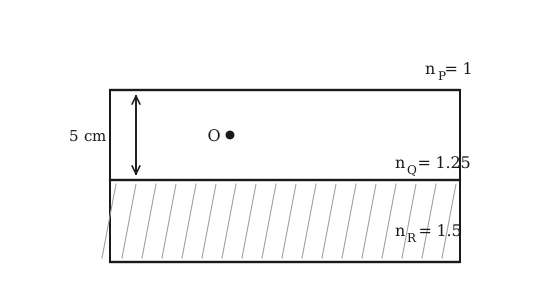
10
21
32
43
NTA Answer: Option 2(final)
NEET 2022
1120°
230°
360°
490°
NTA Answer: Option 4(final)
NEET 2022
1tan⁻¹ (0.750)
2sin⁻¹ (0.500)
3sin⁻¹ (0.750)
4tan⁻¹ (0.500)
NTA Answer: Option 3(final)
Sources
Page numbers are the ones printed in the current NCERT textbook (2023 rationalised edition), unless marked pre-2023. The books are free at ncert.nic.in.
Test yourself on this topic with real past-paper questions:
Practice this topic →