Formula
Lenses in contact
1/F = 1/f₁ + 1/f₂. Equivalently P = P₁ + P₂. Sign of focal length matters (concave is negative).
-- NCERT Class 12 Physics, Ch. 9, p. 238You add the reciprocals, get 1/F = 5, and write F = 5 m. That single missed step is the documented high-frequency error on this topic: reporting Σ(1/f) as if it were F. The number 5 is not a focal length at all — it is a power, in dioptres, and F is its reciprocal, 0.2 m. Because the wrong value is a clean-looking number, it is almost always sitting in the options.
For thin lenses placed in contact on a common axis, the combination behaves as a single thin lens whose focal length F satisfies
1/F = 1/f₁ + 1/f₂ + …
NCERT Class 12 Physics Part 2, Chapter 9, page 235 derives this by treating the image formed by the first lens as the object for the second, with the separation taken as zero. Because power is defined as P = 1/f with f in metres, the same statement reads P = P₁ + P₂ + … — powers add directly, which is why opticians stack lenses and simply sum the prescriptions.
Two things make this arithmetic go wrong under exam pressure. First, signs: a diverging (concave) lens carries negative f, so it subtracts from the sum. Second, units: the reciprocal relation only gives dioptres when f is in metres, so a focal length quoted in centimetres must be converted before P is computed, not after.
The safe procedure is fixed. Write each f with its sign. Convert every length to metres. Add the reciprocals. Then — deliberately, as a separate step — invert the sum to recover F, unless the question asked for power, in which case the sum is already the answer.
Watch for the question that hands you the combination's power and one component, asking for the other. Rearranging P₂ = P − P₁ is easy; the trap is that a negative result means the missing lens is diverging, and the magnitude alone is offered as a distractor.
Select an option to see the explanation. Wrong answers show why your choice was tempting — and name the exact trap it exploits.
For two thin lenses placed in contact on the same optical axis, the equivalent focal length F is given by
Answer: B. B is the relation stated in NCERT Class 12 Physics Part 2, Chapter 9, page 235: the reciprocals of the individual focal lengths add to give the reciprocal of the equivalent focal length.
Why A is wrong: A is wrong because focal lengths themselves do not add; only their reciprocals (the powers) do.
Why C is wrong: C is wrong because this is the form for two lenses separated by a distance, with the wrong sign in the denominator; for lenses in contact the separation is zero and the relation reduces to the reciprocal sum.
Why D is wrong: D is wrong because the second term is subtracted only when f₂ is itself negative; the formula adds reciprocals, with the sign carried inside each f.
For thin lenses in contact, the powers of the individual lenses
Answer: D. D is correct: since P = 1/f, the reciprocal-sum relation on page 235 of NCERT Class 12 Physics Part 2, Chapter 9 becomes a direct algebraic sum of powers, P = P₁ + P₂.
Why A is wrong: A is wrong because averaging would make a combination weaker than its stronger component, whereas stacking lenses strengthens the combination.
Why B is wrong: B is wrong because the relation is a sum of reciprocals, not a product; multiplying powers does not even give a quantity with the dimension of power.
Why C is wrong: C is wrong because the sum is algebraic and holds for any mix of lens types — a diverging lens simply contributes a negative power.
The condition under which the relation 1/F = 1/f₁ + 1/f₂ may be applied is that the two lenses are
Answer: B. B states the conditions of use given with the formula in NCERT Class 12 Physics Part 2, Chapter 9, page 235 — thin lenses, in contact, on the same optical axis.
Why A is wrong: A is wrong because nothing in the derivation requires equal focal lengths or a common material; the relation holds for any pair of thin lenses in contact.
Why C is wrong: C is wrong because a non-zero separation invalidates this form; the formula assumes the separation is effectively zero.
Why D is wrong: D is wrong because the relation is a property of the lens combination itself, independent of lens type or where the object sits.
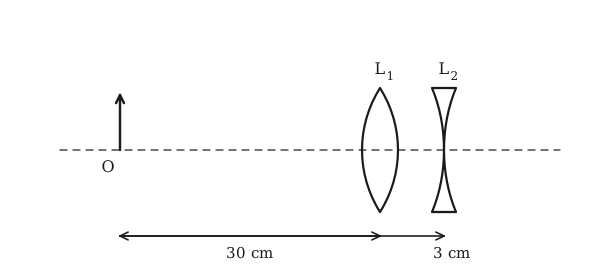
A converging lens of focal length 0.200 m is placed in contact with a diverging lens of focal length 0.300 m in magnitude. The equivalent focal length of the combination is
Answer: C. C is correct: with f₁ = +0.200 m and f₂ = −0.300 m, 1/F = 5.00 − 3.33 = +1.67 per metre, so F = +0.600 m and the combination converges. This is the signed reciprocal sum of NCERT Class 12 Physics Part 2, Chapter 9, page 235.
Why A is wrong: A is wrong because it comes from treating the diverging lens as positive, giving 1/F = 5.00 + 3.33; the concave lens must carry a negative focal length.
Why B is wrong: B is wrong because 0.500 m is f₁ + f₂ in magnitude divided by two ways of mis-combining, and the sign of the result is misread; the algebra gives a positive, converging F.
Why D is wrong: D is wrong because it takes the difference of the focal lengths themselves (0.300 − 0.200) rather than the difference of their reciprocals.
Two thin lenses of powers +3.0 D and −8.0 D are placed in contact. The power of the combination is
Answer: A. A is correct: powers add algebraically, so P = (+3.0) + (−8.0) = −5.0 D. The combination is diverging. This follows directly from the power form of the contact relation on page 235 of NCERT Class 12 Physics Part 2, Chapter 9.
Why B is wrong: B is wrong because it adds the magnitudes and discards the negative sign of the second lens.
Why C is wrong: C is wrong because it reports the reciprocal of the summed power; the sum of powers is already a power, and inverting it here converts to focal length in metres.
Why D is wrong: D is wrong because it has the correct magnitude but the wrong sign — the larger-magnitude lens is the diverging one, so the combination must be negative.
Two thin converging lenses, each of focal length 20.0 cm, are placed in contact. The power of the combination, in dioptres, is
Answer: C. C is correct: each focal length is 0.200 m, so each power is +5.00 D, and the powers add to +10.0 D. Converting centimetres to metres before taking the reciprocal is required by the definition P = 1/f used on page 235 of NCERT Class 12 Physics Part 2, Chapter 9.
Why A is wrong: A is wrong because it takes reciprocals of the focal lengths left in centimetres (1/20.0 + 1/20.0 = 0.100), giving a number in per-centimetre rather than dioptres.
Why B is wrong: B is wrong because it adds the focal lengths in metres, 0.200 + 0.200 = 0.400, and reports that sum as a power; powers add, focal lengths do not.
Why D is wrong: D is wrong because it gives the reciprocal of the summed focal lengths in metres (1/0.400) instead of the sum of the individual powers.
A thin lens of focal length 0.150 m is placed in contact with a second thin lens, and the combination is found to have a power of +2.00 D. The second lens is
Answer: D. D is correct: the first lens has power 1/0.150 = +6.67 D, so P₂ = 2.00 − 6.67 = −4.67 D, giving f₂ = −0.214 m — a diverging lens. The subtraction follows from P = P₁ + P₂ on page 235 of NCERT Class 12 Physics Part 2, Chapter 9.
Why A is wrong: A is wrong because 0.500 m is the reciprocal of the combination's power, which describes the combination, not the second lens.
Why B is wrong: B is wrong because it reports the correct magnitude but discards the negative sign; a negative power means the missing lens must be diverging.
Why C is wrong: C is wrong because it adds the powers (2.00 + 6.67 = 8.67 D) instead of subtracting: 1/8.67 ≈ 0.115 m. The second lens's power is what must be added to +6.67 D to reach +2.00 D, so P₂ = 2.00 − 6.67.
Three thin lenses of focal lengths +0.100 m, −0.200 m and +0.500 m are placed in contact on a common axis. The equivalent focal length of the combination is
Answer: A. A is correct: 1/F = 10.0 − 5.00 + 2.00 = 7.00 per metre, so F = 1/7.00 = +0.143 m. The reciprocal sum extends to any number of thin lenses in contact, as noted on page 235 of NCERT Class 12 Physics Part 2, Chapter 9.
Why B is wrong: B is wrong because it reports the summed reciprocal 7.00 as the focal length; 7.00 is the power in dioptres, and the final reciprocal step has been skipped.
Why C is wrong: C is wrong because it sums the focal lengths themselves with signs (0.100 − 0.200 + 0.500), which is not how lens combinations behave.
Why D is wrong: D is wrong because +0.250 m does not follow from any consistent use of 1/F = 1/f₁ + 1/f₂ + 1/f₃. The powers add with their signs: 10.0 − 5.00 + 2.00 = 7.00 m⁻¹, so F = +0.143 m.
Get a structured 30-day Mechanics plan and a complete formula booklet — delivered to your inbox instantly.
Pattern: lens combination — equivalent focal length and power of thin lenses in contact.
Given
• Lens 1: converging, focal length f₁ = +0.250 m• Lens 2: diverging, focal length magnitude 0.400 m, so f₂ = −0.400 m• Both thin, in contact, on a common axis
Required
The equivalent focal length F of the combination, and its power P in dioptres.
Concept
Thin lenses in contact act as one lens whose reciprocal focal length is the signed sum of the individual reciprocal focal lengths. A diverging lens enters the sum with a negative focal length, so it reduces the converging power of the pair.
Formula
1/F = 1/f₁ + 1/f₂, with P = 1/F when every focal length is expressed in metres.
Substitution
1/F = 1/(+0.250 m) + 1/(−0.400 m)
Calculation
1/(+0.250) = +4.00 per metre
1/(−0.400) = −2.50 per metre
1/F = 4.00 − 2.50 = +1.50 per metre
The digits 1 and 2 in the subscripts f₁ and f₂ are labels, not measurements, and the "+" signs are exact sign information — none of these affects the significant-figure count. The given focal lengths carry three significant figures each, so the result is quoted to three.
Final answer
Taking the reciprocal of the summed value:
F = 1/1.50 = +0.667 m
P = +1.50 D
The combination is converging, with an equivalent focal length of 0.667 m.
Common trap
The value 1.50 is complete-looking and appears in the options as "1.50 m". It is not a focal length — it is the power in dioptres, and the reciprocal step has not yet been taken. Before writing anything down, check which quantity was asked for: if the question says focal length, the summed reciprocal must still be inverted; if it says power, the sum is already the answer and inverting it is the same error in the opposite direction. The second habit that protects you here is entering the diverging lens as −0.400 m at the substitution line rather than remembering to fix the sign later — carrying the sign forward from the start removes one chance to lose it.
Similar NEET-style question
A thin converging lens of focal length 0.120 m is placed in contact with a thin diverging lens, and the combination has an equivalent focal length of 0.300 m. Find the power of the diverging lens.
1/F = 1/f₁ + 1/f₂. Equivalently P = P₁ + P₂. Sign of focal length matters (concave is negative).
-- NCERT Class 12 Physics, Ch. 9, p. 238Equivalent focal length for thin lenses in contact. Powers add.
| Symbol | Quantity | SI Unit |
|---|---|---|
| F | equivalent focal length | m |
| f_i | individual | m |
These are the exact patterns that cause wrong answers in NEET. Each trap includes when it triggers and how to avoid it.
Category: Negative Marking
Sequential 1/F = 1/f1 + 1/f2 across multiple lenses. Each f sign error or reciprocal-skip propagates. Common with diopter conversions (P = 1/f in metres).
Multi-lens optical system; asks for equivalent focal length or power.
Standard procedure: (1) note signs of each f (concave negative); (2) sum 1/f_i; (3) take reciprocal at end. Skip the final reciprocal and the answer is off by orders of magnitude — always present as distractor.
Root cause: arithmetic
Procedure: (1) compute Σ1/f_i with signed f values; (2) take reciprocal at end to get F. Skipping the final reciprocal gives 1/F (in 1/m = dioptres) instead of F (in metres).
More in Optics: 7 exam traps and mistakes · 10 formulas · 6 question patterns from its other lessons.
forgets sign of concave
Treats concave f as positive
Page numbers are the ones printed in the current NCERT textbook (2023 rationalised edition), unless marked pre-2023. The books are free at ncert.nic.in.
Test yourself on this topic with real past-paper questions:
Practice this topic →