Optics: past NEET questions with answers

21 questions from NEET 2020, 2021, 2022, 2023, 2024, 2025, 2026, newest first. Answers verified against NTA official keys.

By year in our set: 2020 (2) · 2021 (3) · 2022 (4) · 2023 (3) · 2024 (3) · 2025 (4) · 2026 (2)

Lesson: Refraction Light

NEET 2026

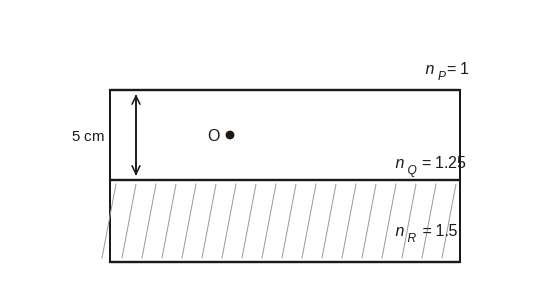
Consider three media P, Q and R with refractive indices 1, 1.25, and 1.5, respectively. The medium Q having a thickness of 5 cm is placed between extended media P and R as shown in the figure. An object O is placed at the center of medium Q. If viewed from medium P near the normal direction, the apparent depth of O is h₁. For similar observation from medium R, the apparent depth is h₂. The value of |h₁ − h₂|, in cm, is :

Question diagram
10
21
32
43
NTA Answer: Option 2(final)

Why the other options are wrong

  • Option 1: Zero would mean the two apparent depths are equal. From P (n = 1), 'the apparent depth (h1 ) is real depth (h2 ) divided by the refractive index of the medium': h₁ = 2.5/1.25 = 2 cm. From R (n = 1.5) the relative index is 1.25/1.5, so h₂ = 2.5 × 1.5/1.25 = 3 cm, and |h₁ − h₂| = 1 cm.
  • Option 3: 2 cm is h₁ alone: seen from P, the object 2.5 cm deep in Q appears at 2.5/1.25 = 2 cm. Seen from R (n = 1.5, greater than 1.25) it appears deeper, at 2.5 × 1.5/1.25 = 3 cm, so the difference is 1 cm.
  • Option 4: 3 cm is h₂ alone, not the difference: h₁ = 2.5/1.25 = 2 cm seen from P and h₂ = 2.5 × 1.5/1.25 = 3 cm seen from R give |h₁ − h₂| = 1 cm.
Lesson: Lenses in Contact

NEET 2026

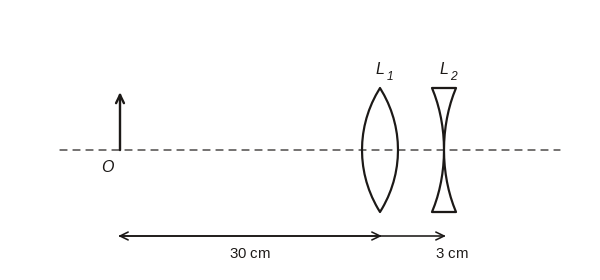
The lens combination as shown in the figure, consists of two lenses, L₁ and L₂, of the focal lengths +10 cm and −10 cm, respectively. The position of the image formed is :

Question diagram
120 cm to the left of the concave lens
260 cm to the left of the concave lens
330 cm to the right of the concave lens
460 cm to the right of the concave lens
NTA Answer: Option 2(final)

Why the other options are wrong

  • Option 1: 20 cm to the left does not satisfy the lens formula. L₁ (f = +10 cm, u = −30 cm) forms its image at v = +15 cm, 12 cm beyond L₂; for L₂ this is a virtual object at u = +12 cm. With 1/v − 1/u = 1/f and f = −10 cm, 1/v = −1/10 + 1/12 = −1/60, so v = −60 cm: 60 cm to the left of the concave lens.
  • Option 3: A real image to the right would need the light to leave L₂ converging. The rays from L₁ are heading for a point 12 cm beyond L₂, and the concave lens (f = −10 cm) spreads them more than that: 1/v = −1/10 + 1/12 = −1/60, v = −60 cm, a virtual image on the left.
  • Option 4: The distance is right but the side is wrong: 1/v = 1/f + 1/u = −1/10 + 1/12 gives v = −60 cm, and the negative sign puts the image 60 cm to the left of the concave lens, on the side the light comes from.

Lesson: Lenses in Contact

NEET 2025

In a certain camera, a combination of four similar thin convex lenses are arranged axially in contact. Then the power of the combination and the total magnification in comparison to the power (p) and magnification (m) for each lens will be, respectively

1p⁴ and m⁴
24p and 4m
3p⁴ and 4m
44p and m⁴
NTA Answer: Option 4(final)

Why the other options are wrong

  • Option 1: Powers add, they do not multiply: 'P = P1 + P2 + P3 + …', so four equal lenses give 4p, not p⁴. It is the magnification that multiplies, giving m⁴.
  • Option 2: The powers do add to 4p, but magnifications multiply: 'the total magnification m of the combination is a product of magnification' of the individual lenses, so m × m × m × m = m⁴, not 4m.
  • Option 3: Both are swapped. Powers add ('P = P1 + P2 + P3 + …', giving 4p), and 'the total magnification m of the combination is a product of magnification' of the lenses (m⁴).

Lesson: Microscope

NEET 2025

A microscope has an objective of focal length 2 cm, eyepiece of focal length 4 cm and the tube length of 40 cm. If the distance of distinct vision of eye is 25 cm, the magnification in the microscope is

1250
2100
3125
4150
NTA Answer: Option 3(final)

Why the other options are wrong

  • Option 1: m = (L/fo)(D/fe) = (40/2)(25/4) = 20 × 6.25 = 125, not 250.
  • Option 2: (L/fo)(D/fe) = (40/2)(25/4) = 125, not 100.
  • Option 4: (L/fo)(D/fe) = (40/2)(25/4) = 125, not 150.

Lesson: Polaroid

NEET 2025

The intensity of transmitted light when a polaroid sheet, placed between two crossed polaroids at 22.5° from the polarization axis of one of the polaroids, is (I₀ is the intensity of polarised light after passing through the first polaroid):

1I₀/16
2I₀/2
3I₀/4
4I₀/8
NTA Answer: Option 4(final)

Why the other options are wrong

  • Option 1: NCERT's three-polaroid result is I = (I0/4) sin²2θ; with θ = 22.5°, sin²45° = 1/2, so I = I0/8, not I0/16.
  • Option 2: I0/2 ignores the two polaroids after the first: I = I0 cos²θ sin²θ = (I0/4) sin²2θ = I0/8.
  • Option 3: I0/4 is the maximum, reached when θ = π/4; at θ = 22.5° the intensity is (I0/4) × 1/2 = I0/8.

Lesson: Polarization Brewster

NEET 2025

An unpolarized light beam travelling in air is incident on a medium of refractive index 1.73 at Brewster’s angle. Then

1Transmitted light is completely polarized with angle of refraction close to 30°
2Reflected light is completely polarized and the angle of reflection is close to 60°
3Reflected light is partially polarized and the angle of reflection is close to 30°
4Both reflected and transmitted light are perfectly polarized with angles of reflection and refraction close to 60° and 30°, respectively
NTA Answer: Option 2(final)

Why the other options are wrong

  • Option 1: tan iB = µ = 1.73 gives iB = 60° and a refraction angle of 30°, but it is the reflected light that is completely polarised, not the transmitted light.
  • Option 3: At Brewster's angle the reflected wave is a totally polarised wave, and the angle of reflection equals iB = 60° (tan 60° = 1.73), not 30°.
  • Option 4: Only the reflected light is completely polarised at Brewster's angle; both polarisations are still present in the refracted wave, so it is not perfectly polarised.

Lesson: Interference YDSE

NEET 2024Revised key

If the monochromatic source in Young’s double slit experiment is replaced by white light, then

1Interference pattern will disappear.
2There will be a central dark fringe surrounded by a few coloured fringes.
3There will be a central bright white fringe surrounded by a few coloured fringes.
4All bright fringes will be of equal width.
NTA Answer: Option 3(revised_final)

Why the other options are wrong

  • Option 1: The pattern does not disappear: 'The interference patterns due to different component colours of white light overlap (incoherently)', giving a white central fringe with a few coloured fringes on either side.
  • Option 2: The centre is bright, not dark: 'The central bright fringes for different colours are at the same position. Therefore, the central fringe is white.'
  • Option 4: Each colour has its own fringe spacing, so away from the centre the colours separate; where the blue component is absent 'the fringe will appear red in colour'. The bright fringes are not all of one width.

Lesson: Polarization Brewster

NEET 2024Revised key

An unpolarised light beam strikes a glass surface at Brewster's angle. Then

1The reflected light will be partially polarised.
2The refracted light will be completely polarised.
3Both the reflected and refracted light will be completely polarised.
4The reflected light will be completely polarised but the refracted light will be partially polarised.
NTA Answer: Option 4(revised_final)

Why the other options are wrong

  • Option 1: At Brewster's angle the reflected light is completely, not partially, polarised: 'when reflected wave is perpendicular to the refracted wave, the reflected wave is a totally polarised wave'.
  • Option 2: The refracted light is not completely polarised. At Brewster's angle 'only part of light with electric field vector perpendicular to the plane of incidence will be reflected'; the rest of that component and all of the other go into the glass, so the refracted light is only partially polarised.
  • Option 3: Only the reflected light is completely polarised ('the reflected wave is a totally polarised wave'). The refracted light still carries both components of the electric field, so it is partially polarised.

Lesson: Astronomical Telescope

NEET 2024Revised key

A small telescope has an objective of focal length 140 cm and an eye piece of focal length 5.0 cm. The magnifying power of telescope for viewing a distant object is:

134
228
317
432
NTA Answer: Option 2(revised_final)

Why the other options are wrong

  • Option 1: For a telescope in normal adjustment m = fo/fe = 140/5.0 = 28, not 34.
  • Option 3: m = fo/fe = 140/5.0 = 28; 17 does not follow from these focal lengths.
  • Option 4: m = fo/fe = 140/5.0 = 28, not 32.

Lesson: Total Internal Reflection

NEET 2023

Light travels a distance x in time t₁ in air and 10x in time t₂ in another denser medium. What is the critical angle for this medium?

1sin⁻¹(10t₂/t₁)
2sin⁻¹(t₁/(10 t₂))
3sin⁻¹(10 t₁/t₂)
4sin⁻¹(t₂/t₁)
NTA Answer: Option 3(final)

Why the other options are wrong

  • Option 1: 10t₂/t₁ inverts the result. Optical density is 'the ratio of the speed of light in two media': n = (x/t₁)/(10x/t₂) = t₂/(10t₁), and since 'n12 = 1/sini c', sin ic = 10t₁/t₂.
  • Option 2: t₁/(10t₂) puts the factor 10 on the wrong side and is a hundredth of the correct value. The speeds are x/t₁ in air and 10x/t₂ in the medium, so n = t₂/(10t₁) and sin ic = 1/n = 10t₁/t₂.
  • Option 4: t₂/t₁ forgets that the medium distance is 10x, not x: the speed there is 10x/t₂. Then n = (x/t₁)/(10x/t₂) = t₂/(10t₁) and sin ic = 1/n = 10t₁/t₂.

Lesson: Interference YDSE

NEET 2023

For Young’s double slit experiment, two statements are given below: Statement I : If screen is moved away from the plane of slits, angular separation of the fringes remains constant. Statement II : If the monochromatic source is replaced by another monochromatic source of larger wavelength, the angular separation of fringes decreases. In the light of the above statements, choose the correct answer from the options given below:

1Both Statement I and Statement II are false.
2Statement I is true but Statement II is false.
3Statement I is false but Statement II is true.
4Both Statement I and Statement II are true.
NTA Answer: Option 2(final)

Why the other options are wrong

  • Option 1: Statement I is true: when the screen is moved away from the plane of the slits, the 'Angular separation of the fringes remains constant'; only the actual separation grows. It is Statement II alone that is false.
  • Option 3: Statement I is true, not false: with the screen moved away the 'Angular separation of the fringes remains constant'. Statement II is false: the angular separation is λ/d, so it decreases for a source 'of shorter wavelength' and increases for a longer one.
  • Option 4: Statement II is false. For a source 'of shorter wavelength' the separation of the fringes 'and also angular separation' decreases; since the angular separation is λ/d, a larger wavelength increases it.

Lesson: Lenses in Contact

NEET 2023

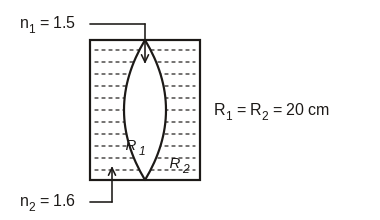
In the figure shown here, what is the equivalent focal length of the combination of lenses (Assume that all layers are thin)?

Question diagram
1–40 cm
2–100 cm
3–50 cm
440 cm
NTA Answer: Option 2(final)

Why the other options are wrong

  • Option 1: −40 cm does not come out of the sum. The glass lens (n = 1.5, R = 20 cm on both faces) has 1/f = 0.5 × 2/20 = +1/20 cm⁻¹; each thin layer of the 1.6 medium is plano-concave with 1/f = 0.6 × (−1/20) = −0.03 cm⁻¹. For thin lenses in contact 'the effective focal length of their combination is given by' 1/F = 0.05 − 0.06 = −0.01 cm⁻¹, so F = −100 cm.
  • Option 3: −50 cm would need 1/F = −0.02 cm⁻¹. The three thin layers in contact add: +1/20 for the n = 1.5 lens and −0.6/20 for each of the two plano-concave layers of n = 1.6, so 1/F = (1 − 1.2)/20 = −1/100 cm⁻¹ and F = −100 cm.
  • Option 4: +40 cm is converging, but the two plano-concave layers of the denser 1.6 medium together (−1.2/20 cm⁻¹) outweigh the glass lens (+1/20 cm⁻¹). The sum 'is an algebraic sum of individual powers': 1/F = −1/100 cm⁻¹, so F = −100 cm.

Lesson: Lens Makers Formula

NEET 2022

A biconvex lens has radii of curvature, 20 cm each. If the refractive index of the material of the lens is 1.5, the power of the lens is

1Infinity
2+2 D
3+20 D
4+5 D
NTA Answer: Option 4(final)

Why the other options are wrong

  • Option 1: The power is finite: 1/f = (n − 1)(1/R1 − 1/R2) = 0.5 × (1/20 + 1/20) = 1/20 cm–1, so f = 20 cm = 0.2 m and P = +5 D.
  • Option 2: +2 D would mean f = 50 cm; the lens maker's formula gives f = 20 cm, so P = 1/0.2 m = +5 D.
  • Option 3: 20 is the focal length in centimetres, not the power. The SI unit for power of a lens is dioptre (D): 1D = 1m–1, so P = 1/0.20 m = +5 D.

Lesson: Fringe Width YDSE

NEET 2022

In a Young’s double slit experiment, a student observes 8 fringes in a certain segment of screen when a monochromatic light of 600 nm wavelength is used. If the wavelength of light is changed to 400 nm, then the number of fringes he would observe in the same region of the screen is

112
26
38
49
NTA Answer: Option 1(final)

Why the other options are wrong

  • Option 2: β = λD/d, so a shorter wavelength narrows the fringes and more fit in the same region: N ∝ 1/λ gives 8 × 600/400 = 12, not 6.
  • Option 3: The count changes because the fringe width is proportional to λ; 8 × 600/400 = 12.
  • Option 4: N ∝ 1/λ gives 8 × 600/400 = 12, not 9.

Lesson: Refraction Light

NEET 2022

A light ray falls on a glass surface of refractive index √3, at an angle 60°. The angle between the refracted and reflected rays would be

1120°
230°
360°
490°
NTA Answer: Option 4(final)

Why the other options are wrong

  • Option 1: 120° is 180° − 60°, which leaves out the refracted ray's angle. By Snell's law sin r = sin 60°/√3 = 1/2, so r = 30°; the reflected ray is at 60° to the normal on the other side, and the angle between the reflected and refracted rays is 180° − 60° − 30° = 90°.
  • Option 2: 30° is the angle of refraction itself (sin r = sin 60°/√3 = 1/2), measured from the normal, not the angle between the two rays. With the reflected ray at 60° to the normal, the rays enclose 180° − 60° − 30° = 90°.
  • Option 3: 60° is the angle of reflection (equal to the angle of incidence), not the angle between the rays. Using n21, which 'is a constant, called the refractive index of the second medium with respect to the first medium', sin r = sin 60°/√3 gives r = 30°, and the rays enclose 180° − 60° − 30° = 90°.

Lesson: Refraction Light

NEET 2022

Two transparent media A and B are separated by a plane boundary. The speed of light in those media are 1.5 × 10⁸ m/s and 2.0 × 10⁸ m/s, respectively. The critical angle for a ray of light for these two media is

1tan⁻¹ (0.750)
2sin⁻¹ (0.500)
3sin⁻¹ (0.750)
4tan⁻¹ (0.500)
NTA Answer: Option 3(final)

Why the other options are wrong

  • Option 1: The critical angle is fixed by its sine, not its tangent: 'n12 = 1/sini c' for the denser medium A with respect to B. Optical density is 'the ratio of the speed of light in two media', so n of A with respect to B is 2.0/1.5 and sin ic = 1.5/2.0 = 0.750.
  • Option 2: sin ic = 0.500 does not follow from these speeds. A, where light travels at 1.5 × 10⁸ m/s, is the denser medium, and its refractive index with respect to B is 2.0/1.5; then 'n12 = 1/sini c' gives sin ic = 1.5/2.0 = 0.750.
  • Option 4: A tangent does not give the critical angle, and 0.500 is not the ratio of these speeds. With 'n12 = 1/sini c' and n12 = 2.0/1.5 (the speed ratio), sin ic = 0.750, so ic = sin⁻¹(0.750).

Lesson: Lenses in Contact

NEET 2021

A convex lens 'A' of focal length 20 cm and a concave lens 'B' of focal length 5 cm are kept along the same axis with a distance 'd' between them. If a parallel beam of light falling on 'A' leaves 'B' as a parallel beam, then the distance 'd' in cm will be

130
225
315
450
NTA Answer: Option 3(final)

Why the other options are wrong

  • Option 1: At d = 30 cm the rays from A cross at A's focus 10 cm before reaching B and arrive diverging, so the concave lens cannot make them parallel. A parallel beam converges to A's focus ('The point where image of an object placed at infinity is formed is called the focus'), 20 cm away; that point must be B's focus, 5 cm behind B, so d = 20 − 5 = 15 cm.
  • Option 2: d = 25 cm = 20 + 5 adds the focal lengths, as for two convex lenses. B is concave: the rays from A, heading for A's focus 20 cm away, must be aimed at B's focus 5 cm beyond B to come out parallel, so d = 20 − 5 = 15 cm.
  • Option 4: At d = 50 cm the rays from A cross at A's focus 30 cm before B and reach B diverging; a concave lens only spreads them further, so the beam cannot leave parallel. A ray parallel to the axis 'appears to diverge (in a concave lens) from the first principal focus', so the converging rays must head for B's focus: d = 20 − 5 = 15 cm.

Lesson: Refraction Prism

NEET 2021

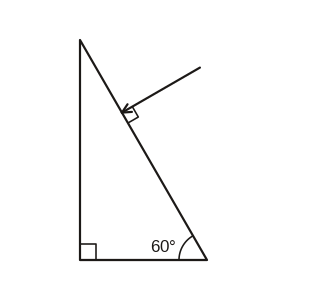
Find the value of the angle of emergence from the prism. Refractive index of the glass is √3.

Question diagram
190°
260°
330°
445°
NTA Answer: Option 2(final)

Why the other options are wrong

  • Option 1: 90° would mean the ray grazes along the face, which needs sin 30° = 1/√3; that is false. The ray enters the slanted face normally, undeviated, and meets the vertical face at 30° (the prism's top angle). By Snell's law sin e = √3 × sin 30° = √3/2, so e = 60°.
  • Option 3: 30° is the angle of incidence inside the glass at the second face, not the angle of emergence. 'When a ray of light enters from a denser medium to a rarer medium, it bends away from the normal': sin e = √3 × sin 30° = √3/2, so e = 60°.
  • Option 4: 45° would need √3 × sin 30° = 1/√2, but √3 × 1/2 = 0.866 = sin 60°. The ray enters the first face normally, meets the second face at 30°, and bends away from the normal on leaving the glass: e = 60°.

Lesson: Lenses in Contact

NEET 2021

A point object is placed at a distance of 60 cm from a convex lens of focal length 30 cm. If a plane mirror were put perpendicular to the principal axis of the lens and at a distance of 40 cm from it, the final image would be formed at a distance of 60 cm 40 cm

120 cm from the plane mirror, it would be a virtual image
220 cm from the lens, it would be a real image
330 cm from the lens, it would be a real image
430 cm from the plane mirror, it would be a virtual image
NTA Answer: Option 1(final)

Why the other options are wrong

  • Option 2: The point 20 cm from the lens is only the intermediate real image formed by the mirror. Those rays pass back through the lens as an object 20 cm away with f = 30 cm, giving a virtual image 60 cm from the lens, which is 20 cm behind the mirror.
  • Option 3: No image forms 30 cm from the lens. The lens first images the object at 60 cm (1/v − 1/u = 1/f with u = −60 cm, f = 30 cm), the mirror returns it to 20 cm from the lens, and the lens then forms a virtual image 20 cm behind the mirror.
  • Option 4: The distance is 20 cm, not 30 cm: the final virtual image lies 60 cm from the lens, which is 20 cm behind the mirror placed at 40 cm.

Lesson: Polarization Brewster

NEET 2020

The Brewsters angle ib for an interface should be :

1ib = 908
208 < ib < 308
3308 < ib < 458
4458 < ib < 908
NTA Answer: Option 4(final)

Why the other options are wrong

  • Option 1: At 90° the light only grazes the surface. Brewster's law gives tan iB = µ, which is finite, so iB is below 90°.
  • Option 2: For light going from a rarer to a denser medium, tan iB = µ > 1, so iB is above 45°; for an air to glass interface tan iB = µ = 1.5 gives iB = 57°.
  • Option 3: tan iB = µ, and µ > 1 makes iB exceed 45°: the air-glass value is iB = 57°.

Lesson: Fringe Width YDSE

NEET 2020

In Young’s double slit experiment, if the separation between coherent sources is halved and the distance of the screen from the coherent sources is doubled, then the fringe width becomes :

1one-fourth
2double
3half
4four times
NTA Answer: Option 4(final)

Why the other options are wrong

  • Option 1: Fringe width β = λD/d. Halving d doubles β and doubling D doubles it again, so β becomes four times, not one-fourth.
  • Option 2: Both changes act together: β = λD/d gives (2D)/(d/2) = 4 times the width, not double.
  • Option 3: β = λD/d grows when d is halved and D doubled; it becomes four times, not half.