Thermodynamics

7 lessons

Practice this unit →

Try this first: NEET 2025 PYQ

A container has two chambers of volumes V 1 = 2 litres and V 2 = 3 litres separated by a partition made of a thermal insulator. The chambers contain n 1 = 5 and n 2 = 4 moles of ideal gas at pressures p 1 = 1 atm and p 2 = 2 atm, respectively. When the partition is removed, the mixture attains an equilibrium pressure of
  1. A.1.8 atm
  2. B.1.3 atm
  3. C.1.6 atm
  4. D.1.4 atm
Tap to see the answer

Answer: C.

A is wrong: 1.8 atm does not follow from any conserved quantity. The walls are insulating and the gas does no outside work, so by ΔQ = ΔU + ΔW the internal energy stays fixed; since PV = (2/3) E, total PV stays fixed: p × 5 L = 1 × 2 + 2 × 3 = 8 atm L, so p = 1.6 atm.

B is wrong: 1.3 atm undercounts the total PV. With ΔQ = 0 and ΔW = 0, ΔU = 0, and PV = (2/3) E keeps p × 5 L = 2 + 6 = 8 atm L, so p = 1.6 atm.

D is wrong: 1.4 atm is the mole-weighted average (5 × 1 + 4 × 2)/9 ≈ 1.44 atm. The internal energy, not the mole count, fixes PV here, so p = (p1V1 + p2V2)/(V1 + V2) = 8/5 = 1.6 atm.

All 6 past-paper questions from this unit →

Topic index in NCERT order

7 of 7 lessons by the NCERT chapter they teach from, in book order. The page is the first printed page of your NCERT book the lesson cites; PYQs are the past NEET questions on that topic.

Class 11 Physics, Chapter 11

  1. Concept of Temperaturep. 2280 PYQs
  2. Thermal Equilibrium Zeroth Lawp. 2280 PYQs
  3. First Law Thermodynamicsp. 2302 PYQs
  4. Heat Work Internal Energyp. 2300 PYQs
  5. Isothermal Adiabatic Processesp. 2353 PYQs
  6. Reversible Irreversible Processesp. 2360 PYQs
  7. Second Law Thermodynamicsp. 2361 PYQ

All 7 lessons

Questions, revision cards and difficulty mix per lesson

Past-paper questions from this unit

6 questions, NEET 2022–2026

6 questions from NEET 2022, 2023, 2024, 2025, 2026. Answers verified against NTA official keys.

By year in our set: 2022 (1) · 2023 (1) · 2024 (1) · 2025 (1) · 2026 (2)

Lesson: Isothermal Adiabatic Processes

NEET 2026

In an adiabatic expansion, the temperature of one mole of an ideal monatomic gas (γ = 5/3) decreases from 60 K to 50 K. The work done by the gas in the process is : (Take the universal gas constant as R = 8.3 J mol⁻¹ K⁻¹)

141.5 J
283 J
3124.5 J
4166 J
NTA Answer: Option 3(final)

Why the other options are wrong

  • Option 1: 41.5 J is RΔT/2 = 8.3 × 10 / 2, which drops the factor 1/(γ − 1). For an adiabatic change W = μR(T1 − T2)/(γ − 1) = 1 × 8.3 × 10 / (2/3) = 124.5 J.
  • Option 2: 83 J is RΔT = 8.3 × 10, the size of the work in an isobaric change, W = μR(T2 − T1). Adiabatic work divides by γ − 1 = 2/3: W = 83/(2/3) = 124.5 J.
  • Option 4: 166 J is 2RΔT, dividing by 1/2 instead of γ − 1 = 2/3. W = μR(T1 − T2)/(γ − 1) = 83 J × 3/2 = 124.5 J.
Lesson: First Law Thermodynamics

NEET 2025

A container has two chambers of volumes V 1 = 2 litres and V 2 = 3 litres separated by a partition made of a thermal insulator. The chambers contain n 1 = 5 and n 2 = 4 moles of ideal gas at pressures p 1 = 1 atm and p 2 = 2 atm, respectively. When the partition is removed, the mixture attains an equilibrium pressure of

11.8 atm
21.3 atm
31.6 atm
41.4 atm
NTA Answer: Option 3(final)

Why the other options are wrong

  • Option 1: 1.8 atm does not follow from any conserved quantity. The walls are insulating and the gas does no outside work, so by ΔQ = ΔU + ΔW the internal energy stays fixed; since PV = (2/3) E, total PV stays fixed: p × 5 L = 1 × 2 + 2 × 3 = 8 atm L, so p = 1.6 atm.
  • Option 2: 1.3 atm undercounts the total PV. With ΔQ = 0 and ΔW = 0, ΔU = 0, and PV = (2/3) E keeps p × 5 L = 2 + 6 = 8 atm L, so p = 1.6 atm.
  • Option 4: 1.4 atm is the mole-weighted average (5 × 1 + 4 × 2)/9 ≈ 1.44 atm. The internal energy, not the mole count, fixes PV here, so p = (p1V1 + p2V2)/(V1 + V2) = 8/5 = 1.6 atm.

Lesson: First Law Thermodynamics

NEET 2024Revised key

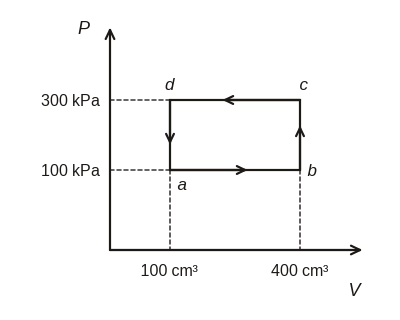
A thermodynamic system is taken through the cycle abcda. The work done by the gas along the path bc is:

Question diagram
1Zero
230 J
3–90 J
4–60 J
NTA Answer: Option 1(revised_final)

Why the other options are wrong

  • Option 2: 30 J is the size of the work on the 100 kPa leg (100 kPa × 300 cm³ = 30 J). Along bc the volume stays at 400 cm³, and in an isochoric process no work is done on or by the gas.
  • Option 3: 90 J is the size of the work on the 300 kPa leg (300 kPa × 300 cm³). bc is a vertical line at V = 400 cm³, so ΔV = 0 and the work along bc is zero.
  • Option 4: 60 J is the size of the net work of the whole cycle abcda (90 J − 30 J, the enclosed area), not of one leg. On bc, V is constant, so no work is done.

Lesson: Second Law Thermodynamics

NEET 2023

A Carnot engine has an efficiency of 50% when its source is at a temperature 327°C. The temperature of the sink is

115°C
2100°C
3200°C
427°C
NTA Answer: Option 4(final)

Why the other options are wrong

  • Option 1: 15°C is 288 K; with the source at 600 K it gives η = 1 − 288/600 = 52%, not 50%. From η = 1 − T2/T1, T2 = 0.5 × 600 K = 300 K = 27°C.
  • Option 2: 100°C (373 K) gives η = 1 − 373/600 ≈ 38%. Temperatures must be in kelvin: T1 = 327 + 273 = 600 K, and T2 = (1 − 0.5) × 600 K = 300 K = 27°C.
  • Option 3: 200°C (473 K) gives η = 1 − 473/600 ≈ 21%. With η = 1 − T2/T1 and T1 = 600 K, the sink is at 300 K = 27°C.

Exam traps and common mistakes in this unit

2 items

Lesson: Isothermal Adiabatic Processes

Category: Graph Interpretation

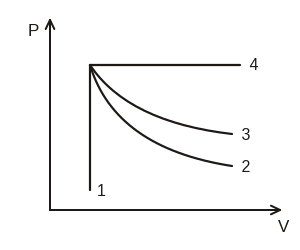
Student misidentifies which P-V curve is adiabatic (steeper) vs isothermal.

When it triggers

P-V graph showing one or more processes; question asks for process type.

How to avoid

Adiabatic curve is STEEPER than isothermal at the same point (slope ratio = γ). Adiabat: PV^γ; isotherm: PV = const.

Lesson: Isothermal Adiabatic Processes

Formulas in this unit

4 formulas

Lesson: First Law Thermodynamics

First law of thermodynamics

Change in internal energy = heat ADDED minus work DONE BY the system. Energy conservation including thermal energy.

SymbolQuantitySI Unit
Delta_Uchange in internal energyJ
Qheat added to systemJ
Wwork done BY systemJ

Valid when

  • Closed system (no mass exchange)
  • Sign convention: Q>0 heat in, W>0 system does work

Lesson: Heat Work Internal Energy

Mayer's relation (Cp - Cv = R)

For ideal gas: difference of molar specific heats equals gas constant R. Useful for converting between Cp and Cv.

SymbolQuantitySI Unit
Cpmolar specific heat at const PJ/mol/K
Cvmolar specific heat at const VJ/mol/K
R8.314J/mol/K

Valid when

  • Ideal gas
  • Per mole basis

Lesson: Isothermal Adiabatic Processes

Adiabatic relations for ideal gas

Relations holding during reversible adiabatic process. gamma = Cp/Cv.

SymbolQuantitySI Unit
PpressurePa
Vvolumem^3
TtemperatureK
gammaadiabatic index-

Valid when

  • Q = 0 (no heat exchange)
  • Quasi-static (reversible)
  • Ideal gas

Lesson: Isothermal Adiabatic Processes

Work done in isothermal process (ideal gas)

Work done by ideal gas during isothermal expansion. Q = W (since Delta_U = 0). Reverse for compression.

SymbolQuantitySI Unit
nmolesmol
Rgas constant 8.314J/mol/K
TtemperatureK
V_i, V_finitial/final volumem^3

Valid when

  • Ideal gas
  • Quasi-static (reversible) isothermal

NEET question patterns in this unit

2 patterns

Lesson: First Law Thermodynamics

Lesson: Isothermal Adiabatic Processes

Questions about this unit

What does Thermodynamics cover for NEET Physics?
7 lessons: Concept of Temperature, First Law Thermodynamics, Heat Work Internal Energy, Isothermal Adiabatic Processes, Reversible Irreversible Processes, Second Law Thermodynamics and Thermal Equilibrium Zeroth Law.
How often has Thermodynamics come up in NEET past papers?
Our set of verified past papers has 6 questions from this unit, from NEET 2022, 2023, 2024, 2025 and 2026. Each is answered against the official NTA key.
Is the Thermodynamics material free?
Yes. All 7 lessons and 65 practice questions are free, with no login needed.