Definition
Isothermal process
Process at constant temperature. For ideal gas: ΔU = 0, so Q = W. Work done: W = nRT ln(V_f/V_i).
-- NCERT Class 11 Physics, Ch. 11, p. 235The trap: On a P–V diagram, which curve is steeper — isothermal or adiabatic? Students routinely swap them. The adiabatic curve is always steeper than the isothermal at the same point. The slope ratio is γ (the adiabatic index, Cₚ/Cᵥ). This single confusion costs marks in graph-interpretation MCQs that appear roughly every 2–3 years.
Isothermal process. Temperature stays constant. For an ideal gas, PV = constant. All the heat supplied converts into work (ΔU = 0 because temperature doesn't change). Work done by the gas during isothermal expansion: W = nRT ln(V_f / V_i) (NCERT Class 11 Physics, Chapter 11, page 231). The process requires the system to exchange heat with a reservoir slowly enough to maintain thermal equilibrium — quasi-static by definition.
Adiabatic process. No heat exchange: Q = 0. The gas does work at the expense of its internal energy, so temperature changes. The governing relations are PVᵞ = constant and TVᵞ⁻¹ = constant (NCERT Class 11 Physics, Chapter 11, page 232). During adiabatic expansion the gas cools; during adiabatic compression it heats up.
Why the adiabat is steeper. Differentiate PV = const → dP/dV = −P/V. Differentiate PVᵞ = const → dP/dV = −γP/V. Since γ > 1 for all ideal gases, the adiabatic slope magnitude is γ times the isothermal slope at the same (P, V) point. Memorise: "adiabatic angles down sharper."
Watch-out for NEET: When a P–V diagram shows two curves through the same initial state, the steeper one is adiabatic. If the question asks which process does more work between the same initial and final volumes, compare the areas — the isothermal curve lies above the adiabat during expansion, so isothermal work > adiabatic work for the same volume change.
Select an option to see the explanation. Wrong answers show why your choice was tempting — and name the exact trap it exploits.
In an isothermal process involving an ideal gas, which quantity remains constant?
Answer: D. In an isothermal process, temperature is constant. For an ideal gas, internal energy depends only on temperature, so ΔU = 0 as well — both T and U remain constant (NCERT Class 11 Physics, Chapter 11, page 231).
Why A is wrong: A is wrong because pressure changes as volume changes along PV = constant; only temperature is held fixed.
Why B is wrong: B is wrong because volume changes during an isothermal expansion or compression; it is not constrained to be constant.
Why C is wrong: C is wrong because for an ideal gas U depends only on T, so the internal energy cannot hold steady while the temperature falls. The two are locked together — which is exactly why an isothermal process has ΔU = 0.
In an adiabatic process, which of the following is true?
Answer: A. An adiabatic process is defined by Q = 0. Since ΔU = Q − W and Q = 0, the gas does work at the expense of internal energy, so temperature changes (NCERT Class 11 Physics, Chapter 11, page 232).
Why B is wrong: B is wrong because Q = 0 is correct but temperature does NOT remain constant — the gas cools during expansion and heats during compression (trap: confusing adiabatic with isothermal).
Why C is wrong: C is wrong because work is done by or on the gas in an adiabatic process; W = 0 describes an isochoric process instead.
Why D is wrong: D is wrong because with Q = 0 and W ≠ 0, the first law gives ΔU = −W, so internal energy changes.
Which equation governs an isothermal process for an ideal gas?
Answer: C. At constant temperature, the ideal gas law PV = nRT reduces to PV = constant (Boyle's law). This is the defining relation for an isothermal process (NCERT Class 11 Physics, Chapter 11, page 231).
Why A is wrong: A is wrong because PV^γ = constant governs an adiabatic process, not isothermal (trap: swapping the two process equations).
Why B is wrong: B is wrong because TV^(γ−1) = constant is the temperature–volume relation for an adiabatic process.
Why D is wrong: D is wrong because P/T = constant holds for a constant-volume (isochoric) process, not isothermal.
Two moles of an ideal gas expand isothermally at 300 K from volume V to 2V. The work done by the gas is:
Answer: C. W = nRT ln(V_f/V_i) = 2 × 8.314 × 300 × ln(2V/V) = 2 × 8.314 × 300 × ln 2 J. Direct substitution into the isothermal work formula (NCERT Class 11 Physics, Chapter 11, page 231).
Why A is wrong: A is wrong because ln(1/2) = −ln 2, giving negative work — this would describe compression, not expansion (trap: inverting the volume ratio).
Why B is wrong: B is wrong because it uses n = 1 instead of n = 2; the factor of moles was dropped.
Why D is wrong: D is wrong because dividing by ln 2 instead of multiplying has no physical basis; this is an arithmetic distractor.
On a P–V diagram, an isothermal and an adiabatic curve pass through the same point. At that point, the ratio of the magnitude of the adiabatic slope to the isothermal slope is:
Answer: B. Isothermal: |dP/dV| = P/V. Adiabatic: |dP/dV| = γP/V. The ratio is γ. This is why the adiabatic curve is steeper (NCERT Class 11 Physics, Chapter 11, pages 231–232).
Why A is wrong: A is wrong because a ratio of 1 would mean equal slopes, but the adiabatic curve is steeper by a factor of γ > 1 (trap: assuming both curves have the same steepness).
Why C is wrong: C is wrong because 1/γ < 1 would make the adiabat flatter than the isotherm, which is the reverse of reality (trap: inverting the slope ratio).
Why D is wrong: D is wrong because γ² has no basis in the slope derivation; the differential of PV^γ yields a single factor of γ, not γ².
A gas is first compressed isothermally from 8 L to 4 L, and then compressed further adiabatically from 4 L to 2 L (γ = 1.5). The ratio of the final pressure to the initial pressure is closest to:
Answer: C. The isothermal segment (8 L → 4 L) obeys PV = constant, so P₂ = P₁ × (V₁/V₂) = P₁ × (8/4) = 2P₁. The adiabatic segment (4 L → 2 L) obeys PVᵞ = constant, so P₃ = P₂ × (V₂/V₃)^γ = P₂ × 2^1.5 ≈ 2.83P₂. Each segment must be evaluated with its own governing relation, in sequence, before combining: P₃/P₁ = 2 × 2.83 ≈ 5.66 (NCERT Class 11 Physics, Chapter 11, page 234 for PV = constant; page 235 for PVᵞ = constant).
Why A is wrong: A gives only the isothermal-segment ratio P₂/P₁ = V₁/V₂ = 8/4 = 2; it stops before applying the adiabatic segment from 4 L to 2 L.
Why B is wrong: B gives only the adiabatic-segment ratio (V₂/V₃)^γ = 2^1.5 ≈ 2.83; it ignores the pressure build-up already produced by the isothermal segment.
Why D is wrong: D treats the entire compression (8 L to 2 L) as if PV = constant held throughout, giving V₁/V₃ = 4; it ignores that the second segment is adiabatic and follows the steeper PVᵞ relation instead.
An ideal gas is compressed from volume V₁ to V₂ (V₂ < V₁) first isothermally and then adiabatically. In which process is the magnitude of work done by the gas greater?
Answer: D. During compression from V₁ to V₂, the adiabatic curve rises more steeply (slope = γP/V vs P/V). The area under the adiabatic P–V curve (between the same volume limits) is therefore larger, meaning the magnitude of work done on the gas is greater in the adiabatic case. Equivalently, |W_adiabatic| > |W_isothermal| for the same volume compression.
Why A is wrong: A is wrong because the isothermal curve is flatter, enclosing less area under the P–V curve between V₁ and V₂; less area means less work magnitude (trap: assuming constant-temperature processes always involve more work).
Why B is wrong: B is wrong because regardless of the specific value of γ (as long as γ > 1, which is always true for ideal gases), the adiabatic slope is steeper, so the conclusion holds for all ideal gases.
Why C is wrong: C is wrong because the different slopes (factor of γ) mean different areas under the curves; equality would require γ = 1, which doesn't hold for any real gas.
During isothermal expansion of an ideal gas, the heat absorbed by the gas is:
Answer: B. Isothermal ⟹ ΔT = 0 ⟹ ΔU = 0 for an ideal gas. From the first law, Q = ΔU + W = W. All heat absorbed converts entirely into work (NCERT Class 11 Physics, Chapter 11, page 231).
Why A is wrong: A is wrong because Q = 0 describes an adiabatic process; in isothermal expansion the gas must absorb heat from the reservoir to keep temperature constant while doing work (trap: confusing isothermal with adiabatic).
Why C is wrong: C is wrong because ΔU = 0 in an isothermal process for an ideal gas; Q equals the work done, not the internal energy change (which is zero).
Why D is wrong: D is wrong because energy conservation (first law) requires Q = W exactly when ΔU = 0; Q cannot exceed W without violating the first law.
Get a structured 30-day Mechanics plan and a complete formula booklet — delivered to your inbox instantly.
Given
• Initial state: (P₀, V₀) for both processes• Final volume: 2V₀• Curve A: PV = constant• Curve B: PVᵞ = constant, γ = 1.4
Required
(a) Identify which curve is isothermal and which is adiabatic.
(b) Determine which process has greater work done by the gas.
Concept
Isothermal: PV = constant (Boyle's law at constant T).
Adiabatic: PVᵞ = constant (no heat exchange).
The adiabatic curve is steeper — its slope magnitude is γ times the isothermal slope at any common (P, V) point. During expansion to the same final volume, the isothermal curve lies above the adiabat, enclosing more area.
Formula
Isothermal work: W_iso = nRT ln(V_f / V_i)
Adiabatic: PVᵞ = constant governs the curve shape.
Substitution
Both curves start at (P₀, V₀) and end at volume 2V₀.
For the isothermal curve, final pressure: P_f = P₀V₀ / (2V₀) = P₀/2.
For the adiabatic curve, final pressure: P_f = P₀(V₀/2V₀)ᵞ = P₀ / 2^1.4 = P₀ / 2.639.
Calculation
Since P₀/2 > P₀/2.639, the isothermal curve has a higher final pressure than the adiabatic curve at the same volume 2V₀. This means the isothermal curve lies above the adiabat throughout the expansion. The area under the P–V curve (which equals the work done) is larger for the isothermal process.
Note: γ = 1.4 is exact (given in the problem). The value 2^1.4 ≈ 2.639 uses the exact exponent; the decimal is for comparison purposes.
Final answer
(a) Curve A (PV = constant) is the isothermal process; Curve B (PVᵞ = constant) is the adiabatic process.
(b) The gas does more work during the isothermal expansion (larger area under the P–V curve).
Common trap
Swapping which curve is steeper. The adiabat drops more steeply because its slope is −γP/V compared to −P/V for the isotherm. Students who think the adiabat is flatter will incorrectly conclude adiabatic work > isothermal work for expansion.
Similar NEET-style question
"An ideal monoatomic gas (γ = 5/3) expands from state (P₁, V₁) to volume 3V₁ via (i) an isothermal process and (ii) an adiabatic process. In which case is the final pressure higher? In which case does the gas do more work?" (Answer: isothermal final pressure is higher; isothermal work is greater.)
---
Process at constant temperature. For ideal gas: ΔU = 0, so Q = W. Work done: W = nRT ln(V_f/V_i).
-- NCERT Class 11 Physics, Ch. 11, p. 235Process with no heat exchange (Q = 0). For ideal gas: PV^γ = constant, where γ = C_p/C_v. Also TV^(γ-1) = const and TP^((1-γ)/γ) = const. ΔU = -W; system cools when expanding adiabatically.
-- NCERT Class 11 Physics, Ch. 11, p. 235Relations holding during reversible adiabatic process. gamma = Cp/Cv.
| Symbol | Quantity | SI Unit |
|---|---|---|
| P | pressure | Pa |
| V | volume | m^3 |
| T | temperature | K |
| gamma | adiabatic index | - |
Work done by ideal gas during isothermal expansion. Q = W (since Delta_U = 0). Reverse for compression.
| Symbol | Quantity | SI Unit |
|---|---|---|
| n | moles | mol |
| R | gas constant 8.314 | J/mol/K |
| T | temperature | K |
| V_i, V_f | initial/final volume | m^3 |
These are the exact patterns that cause wrong answers in NEET. Each trap includes when it triggers and how to avoid it.
Category: Graph Interpretation
Student misidentifies which P-V curve is adiabatic (steeper) vs isothermal.
P-V graph showing one or more processes; question asks for process type.
Adiabatic curve is STEEPER than isothermal at the same point (slope ratio = γ). Adiabat: PV^γ; isotherm: PV = const.
Root cause: graph misread
Adiabatic curve is STEEPER than isothermal at the same P-V point. Slope ratio at same point: adiabatic / isothermal = γ. Memorise: 'adiabatic angles down sharper'.
More in Thermodynamics: 2 formulas · 1 question pattern from its other lessons.
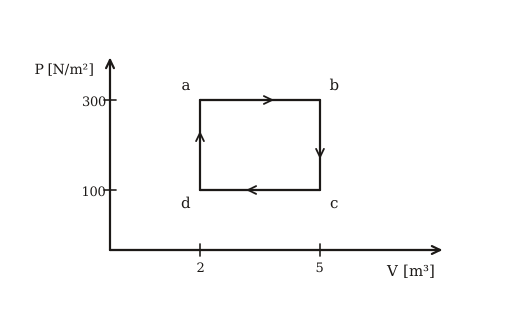
swaps adiabatic isothermal curves
Confuses which curve is steeper
Page numbers are the ones printed in the current NCERT textbook (2023 rationalised edition), unless marked pre-2023. The books are free at ncert.nic.in.
Test yourself on this topic with real past-paper questions:
Practice this topic →