Electrostatics: past NEET questions with answers

25 questions from NEET 2020, 2021, 2022, 2023, 2024, 2025, 2026, newest first. Answers verified against NTA official keys.

By year in our set: 2020 (4) · 2021 (2) · 2022 (4) · 2023 (4) · 2024 (5) · 2025 (2) · 2026 (4)

Lesson: Energy in Capacitor

NEET 2026

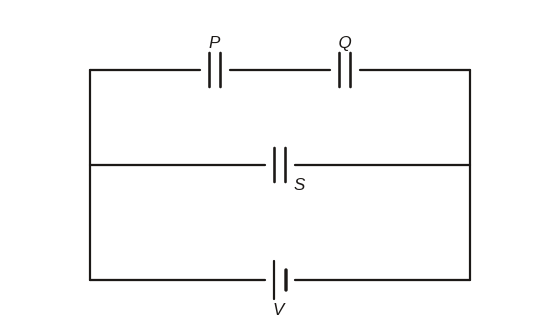
Three identical capacitors P, Q and S, each of the capacitance C, are connected to a battery of voltage V, as shown in the figure. If the energy stored in the capacitor P and total energy stored in the system are UP and UT, respectively, then the ratio UP/UT is :

Question diagram
12/3
21/3
31/2
41/6
NTA Answer: Option 4(final)

Why the other options are wrong

  • Option 1: 2/3 is the share of the energy in S alone: U_S = (1/2)CV² and U_T = (3/4)CV². P is in series with Q, and each takes half of V, so U_P = (1/2)C(V/2)² = CV²/8 and U_P/U_T = 1/6.
  • Option 2: 1/3 is the share of the P–Q branch (CV²/4 out of 3CV²/4), not of P alone. P and Q are identical and carry the same charge, so they split that branch energy equally: U_P/U_T = 1/6.
  • Option 3: 1/2 would need P to hold as much energy as Q and S together. S is directly across the battery ('the same potential difference is applied across both the capacitors' in parallel) and stores CV²/2, while P, in series with Q, sees only V/2 and stores CV²/8: U_P/U_T = (1/8)/(3/4) = 1/6.
Lesson: Field Spherical Shell Gauss

NEET 2026

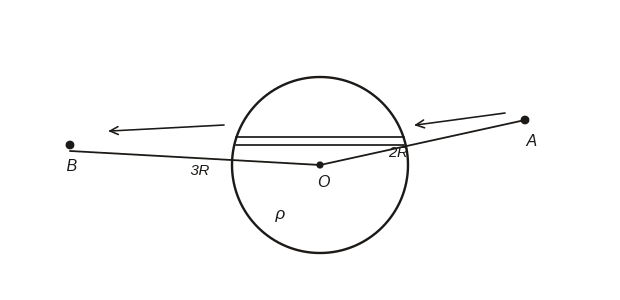
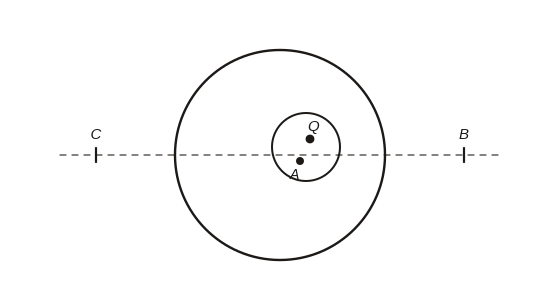
A unit positive point charge is taken slowly through an infinitesimally thin tube that is inside a charged dielectric sphere of radius R, having uniform positive charge density ρ, as shown in the figure. The initial and final positions of the charge are marked by A and B at distances 2R and 3R respectively, from the centre of the sphere. In this process, the magnitude of the total work done on the point charge is ρR²/(nε₀). The value of n is : (ε₀ is the permittivity of vacuum)

Question diagram
12
26
39
418
NTA Answer: Option 4(final)

Lesson: Field Spherical Shell Gauss

Lesson: Electric Potential

NEET 2026

Consider a fixed uniformly charged insulating sphere with radius R and total charge +Q. A point charge −q (q << Q) with mass m is released from rest at a distance of 3R from the centre of the charged sphere. When the point charge reaches the surface of the sphere, its speed is : (ε₀ is the permittivity of vacuum, neglect gravitational forces)

1√(3Qq/(4πε₀mR))
2√(2Qq/(3πε₀mR))
3√(Qq/(3πε₀mR))
4√(Qq/(4πε₀mR))
NTA Answer: Option 3(final)

Lesson: Torque Dipole

NEET 2025

An electric dipole with dipole moment 5 × 10⁻⁶ C m is aligned with the direction of a uniform electric field of magnitude 4 × 10⁵ N/C. The dipole is then rotated through an angle of 60° with respect to the electric field. The change in the potential energy of the dipole is:

11.5 J
20.8 J
31.0 J
41.2 J
NTA Answer: Option 3(final)

Why the other options are wrong

  • Option 1: With U = −pE cos θ, ΔU = pE(1 − cos 60°) = 2 J × 0.5 = 1.0 J; 1.5 J would need cos θ = 0.25.
  • Option 2: pE = 5 × 10⁻⁶ × 4 × 10⁵ = 2 J, and the change is pE(1 − cos 60°) = 1.0 J, not 0.8 J.
  • Option 4: With pE = 2 J, rotating from 0° to 60° changes the energy by pE(1 − cos 60°) = 1.0 J.

Lesson: Parallel Plate Capacitor

NEET 2025

The plates of a parallel plate capacitor are separated by d. Two slabs of different dielectric constant K₁ and K₂ with thickness (3/8)d and d/2, respectively are inserted in the capacitor. Due to this, the capacitance becomes two times larger than when there is nothing between the plates. If K₁ = 1.25 K₂, the value of K₁ is:

11.33
22.66
32.33
41.60
NTA Answer: Option 2(final)

Why the other options are wrong

  • Option 1: K₁ = 1.33 gives K₂ = 1.064, and then d/8 + 3d/(8K₁) + d/(2K₂) = (0.125 + 0.282 + 0.470)d = 0.877d, so C is only 1.14 C₀, not 2C₀. Setting that sum equal to d/2 with K₂ = K₁/1.25 gives K₁ = 8/3 ≈ 2.66.
  • Option 3: K₁ = 2.33 (K₂ = 1.864) gives (0.125 + 0.161 + 0.268)d = 0.554d, so C = 1.8 C₀, short of 2C₀. Each slab counts as its thickness divided by its K, since 'the electric field in the dielectric will be E = E0 /K'; d/8 + 3d/(8K₁) + d/(2K₂) = d/2 gives K₁ = 8/3 ≈ 2.66.
  • Option 4: K₁ = 1.60 (K₂ = 1.28) gives (0.125 + 0.234 + 0.391)d = 0.750d, so C = 1.33 C₀. For C = 2C₀ the effective gap must be d/2: 1/8 + (3/8 + 5/8)/K₁ = 1/2, so K₁ = 8/3 ≈ 2.66.

Lesson: Electric Charges Conservation

NEET 2024Revised key

Given below are two statements: Statement I: Atoms are electrically neutral as they contain equal number of positive and negative charges. Statement II: Atoms of each element are stable and emit their characteristic spectrum. In the light of the above statements, choose the most appropriate answer from the options given below.

1Both Statement I and Statement II are correct
2Both Statement I and Statement II are incorrect
3Statement I is correct but Statement II is incorrect
4Statement I is incorrect but Statement II is correct
NTA Answer: Option 3(revised_final)

Why the other options are wrong

  • Option 1: Statement II is not correct as written. NCERT says 'Atoms of most of the elements are stable and emit characteristic spectrum', not atoms of each element. Statement I is correct: matter is normally neutral and 'their charges are exactly balanced'.
  • Option 2: Statement I is correct: 'Although normally the materials are electrically neutral, they do contain charges; but their charges are exactly balanced'. Only Statement II is incorrect, because it is atoms of most elements, not each, that are stable.
  • Option 4: This reverses the verdicts. Statement I is correct (in neutral matter 'their charges are exactly balanced'), and Statement II is incorrect: 'Atoms of most of the elements are stable and emit characteristic spectrum', not each element.

Lesson: Field Spherical Shell Gauss

NEET 2024Revised key

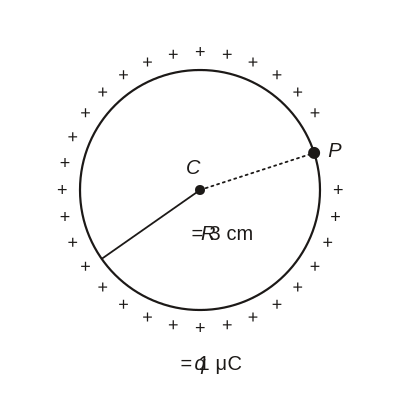
A thin spherical shell is charged by some source. The potential difference between the two points C and P (in V) shown in the figure is: (Take 1/(4πε₀) = 9 × 10⁹ SI units)

Question diagram
13 × 10⁵
21 × 10⁵
30.5 × 10⁵
4Zero
NTA Answer: Option 4(revised_final)

Why the other options are wrong

  • Option 1: 3 × 10⁵ V is the potential of the shell itself, q/(4πε₀R) = 9 × 10⁹ × 10⁻⁶/0.03 V, not a difference. C, the centre, is inside the shell, where the 'potential is constant inside the shell' and 'equals its value at the surface', so V(C) − V(P) = 0.
  • Option 2: 1 × 10⁵ V assumes the potential changes inside the shell. 'The electric field inside the shell is zero', so the potential at the centre C equals the potential at P on the surface: the difference is zero.
  • Option 3: 0.5 × 10⁵ V would need a field between C and P. 'The electric field inside the shell is zero', so no work is done in moving a charge from C to P and V(C) = V(P).

Lesson: Capacitors Series Parallel

Lesson: Electric Potential

NEET 2024Revised key

Given below are two statements: one is labelled as Assertion A and the other is labelled as Reason R. Assertion A: The potential (V) at any axial point, at 2 m distance (r) from the centre of the dipole of dipole moment vector P⃗ of magnitude, 4 × 10⁻⁶ C m, is ± 9 × 10³ V. (Take 1/(4πε₀) = 9 × 10⁹ SI units) Reason R: V = ± 2P/(4πε₀r²), where r is the distance of any axial point, situated at 2 m from the centre of the dipole. In the light of the above statements, choose the correct answer from the options given below:

1Both A and R are true and R is the correct explanation of A.
2Both A and R are true and R is NOT the correct explanation of A.
3A is true but R is false.
4A is false but R is true.
NTA Answer: Option 3(revised_final)

Why the other options are wrong

  • Option 1: R is false, so it cannot explain A. On the axis the page gives V = ±(1/4πε₀) p/r², with no factor 2; that gives 9 × 10⁹ × 4 × 10⁻⁶ / 4 = 9 × 10³ V, as A says.
  • Option 2: R is false: the axial potential is ±p/(4πε₀r²). With the factor 2 it would give 1.8 × 10⁴ V, which contradicts A's correct 9 × 10³ V.
  • Option 4: A is true: V = ±(1/4πε₀) p/r² = ±9 × 10⁹ × 4 × 10⁻⁶ / 2² = ±9 × 10³ V. It is R, with its extra factor 2, that is false.

Lesson: Parallel Plate Capacitor

NEET 2024Revised key

If the plates of a parallel plate capacitor connected to a battery are moved close to each other, then A. the charge stored in it, increases. B. the energy stored in it, decreases. C. its capacitance increases. D. the ratio of charge to its potential remains the same. E. the product of charge and voltage increases. Choose the most appropriate answer from the options given below:

1A, B and E only
2A, C and E only
3B, D and E only
4A, B and C only
NTA Answer: Option 2(revised_final)

Why the other options are wrong

  • Option 1: It includes B, which is false: the battery holds V fixed while the capacitance grows (it 'depends only on the geometry of the system', C = ε₀A/d), so the energy (1/2)CV² increases rather than decreases. It also leaves out C, which is true.
  • Option 3: B and D are false. Moving the plates closer raises C = ε₀A/d, and with V held by the battery the energy (1/2)CV² rises (not B). The ratio of charge to potential is the capacitance itself ('The constant C is called the capacitance of the capacitor'), and it grows here (not D).
  • Option 4: B is false and E is left out. With V fixed and C increasing, Q = CV rises (A), and so do the energy (1/2)CV² (so B is wrong) and the product QV = CV² (so E is right).

Lesson: Capacitors Series Parallel

NEET 2023

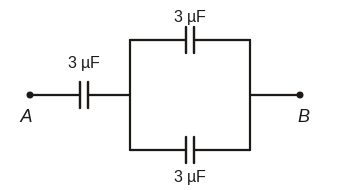
The equivalent capacitance of the system shown in the following circuit is

Question diagram
13 µF
26 µF
39 µF
42 µF
NTA Answer: Option 4(final)

Why the other options are wrong

  • Option 1: 3 µF is one capacitor alone. The two 3 µF capacitors in parallel give C = C1 + C2 = 6 µF, which is in series with 3 µF: 1/C = 1/3 + 1/6, so C = 2 µF.
  • Option 2: 6 µF is only the parallel pair. It is in series with the first 3 µF capacitor, which brings the total down to 2 µF.
  • Option 3: 9 µF adds all three as if in parallel. The first capacitor is in series with the parallel pair, so 1/C = 1/3 + 1/6 and C = 2 µF.

Lesson: Gauss's Law

NEET 2023

If ∮ₛ E⃗ · dS⃗ = 0 over a surface, then

1The magnitude of electric field on the surface is constant
2All the charges must necessarily be inside the surface
3The electric field inside the surface is necessarily uniform
4The number of flux lines entering the surface must be equal to the number of flux lines leaving it
NTA Answer: Option 4(final)

Why the other options are wrong

  • Option 1: Zero flux says only that the total charge contained in the closed surface is zero. The field on the surface can still vary from point to point, for example because of charges outside.
  • Option 2: It is the opposite: whenever the net electric flux through a closed surface is zero, the total charge contained in the closed surface is zero.
  • Option 3: Gauss's law fixes only the total charge inside, not the shape of the field. The field on the left side of the law comes from all charges, inside and outside, while the q on the right represents only the total charge inside S.

Lesson: Torque Dipole

NEET 2023

An electric dipole is placed at an angle of 30° with an electric field of intensity 2 × 10⁵ N C⁻¹. It experiences a torque equal to 4 N m. Calculate the magnitude of charge on the dipole, if the dipole length is 2 cm.

16 mC
24 mC
32 mC
48 mC
NTA Answer: Option 3(final)

Why the other options are wrong

  • Option 1: 6 mC does not fit. The torque is 2qaE sin θ, so q = τ / (2aE sin θ) = 4 / (0.02 × 2 × 10⁵ × 0.5) = 4/2000 = 2 × 10⁻³ C = 2 mC.
  • Option 2: 4 mC is twice the answer. With 2a = 0.02 m, E = 2 × 10⁵ N C⁻¹ and sin 30° = 0.5, 2aE sin θ = 2000, so q = 4/2000 C = 2 mC.
  • Option 4: 8 mC is four times the answer. From τ = 2qaE sin θ, q = 4 / (0.02 × 2 × 10⁵ × 0.5) = 2 × 10⁻³ C.

Lesson: Electric Dipole

NEET 2023

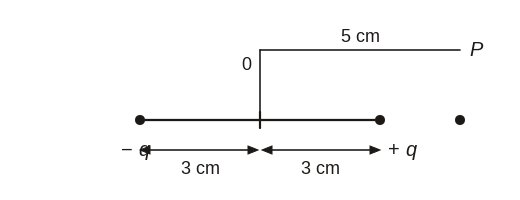
An electric dipole is placed as shown in the figure. The electric potential (in 10² V) at point P due to the dipole is (∈₀ = permittivity of free space and 1/(4π∈₀) = K)

Question diagram
1(5/8)qK
2(8/5)qK
3(8/3)qK
4(3/8)qK
NTA Answer: Option 4(final)

Why the other options are wrong

  • Option 1: (5/8)qK × 10² = 62.5 qK adds the two terms, Kq(1/0.02 + 1/0.08). The charges have opposite signs, and the potential at P 'is the algebraic sum of the potentials due to the individual charges': V = Kq(1/0.02 − 1/0.08) = 37.5 qK = (3/8)qK × 10² V.
  • Option 2: (8/5)qK × 10² = 160 qK does not come from the two distances. P is on the axis 5 cm from the centre, so 2 cm from +q and 8 cm from −q: V = Kq/0.02 − Kq/0.08 = (50 − 12.5)qK = (3/8)qK × 10² V.
  • Option 3: (8/3)qK inverts the fraction. With distances 2 cm from +q and 8 cm from −q and the potentials summed algebraically, V = Kq(50 − 12.5) = 37.5 qK = (3/8) × 10² qK, so the fraction is 3/8.

Lesson: Electric Potential

NEET 2022

Two hollow conducting spheres of radii R₁ and R₂ (R₁ >> R₂) have equal charges. The potential would be

1Dependent on the material property of the sphere
2More on bigger sphere
3More on smaller sphere
4Equal on both the spheres
NTA Answer: Option 3(final)

Why the other options are wrong

  • Option 1: The potential depends only on charge and radius. Outside a charged spherical shell the field is as if the charge were at the centre, so the surface potential is Q/(4πε₀R); the material does not enter.
  • Option 2: V = Q/(4πε₀R) falls as R grows, so with equal charges the bigger sphere (R₁) has the lower potential.
  • Option 4: Equal charges give equal potentials only for equal radii. Since V = Q/(4πε₀R) and R₁ >> R₂, the smaller sphere is at the higher potential.

Lesson: Equipotential Surfaces

NEET 2022

The angle between the electric lines of force and the equipotential surface is

1180°
20°
345°
490°
NTA Answer: Option 4(final)

Why the other options are wrong

  • Option 1: At 180° the field would point along the surface, and a field with a non-zero component along the surface contradicts the definition of an equipotential surface. The field is normal to it, at 90°.
  • Option 2: A field along the surface would have a non-zero component along it, yet no work is required to move a test charge on the surface. The electric field must be normal to the equipotential surface at every point.
  • Option 3: A slanted field would still have a non-zero component along the surface. The page concludes that the electric field must be normal to the equipotential surface at every point.

Lesson: Coulomb's Law

NEET 2022

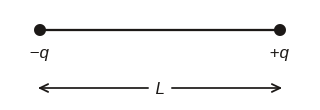
Two point charges –q and +q are placed at a distance of L, as shown in the figure. The magnitude of electric field intensity at a distance R(R >> L) varies as:

Question diagram
11/R⁶
21/R²
31/R³
41/R⁴
NTA Answer: Option 3(final)

Why the other options are wrong

  • Option 1: Far from a dipole the field falls off as 1/r³ (E = 2p/4πε₀r³ on the axis), not as 1/R⁶.
  • Option 2: 1/R² is the field of a single point charge. The dipole field at large distances falls off not as 1/r² but as 1/r³.
  • Option 4: The dipole field goes as p/r³ on both the axis and the equatorial plane, so it varies as 1/R³, not 1/R⁴.

Lesson: Energy in Capacitor

NEET 2022

A capacitor of capacitance C = 900 pF is charged fully by 100 V battery B as shown in figure (a). Then it is disconnected from the battery and connected to another uncharged capacitor of capacitance C = 900 pF as shown in figure (b). The electrostatic energy stored by the system (b) is

11.5 × 10⁻⁶ J
24.5 × 10⁻⁶ J
33.25 × 10⁻⁶ J
42.25 × 10⁻⁶ J
NTA Answer: Option 4(final)

Why the other options are wrong

  • Option 1: 1.5 × 10⁻⁶ J is one third of the initial 4.5 × 10⁻⁶ J, but sharing the charge halves it. Q = CV = 9 × 10⁻⁸ C spreads over two equal capacitors, each at V/2 = 50 V, so U = (1/2)(1800 pF)(50 V)² = 2.25 × 10⁻⁶ J.
  • Option 2: 4.5 × 10⁻⁶ J is the energy of system (a), (1/2)CV² with C = 900 pF and V = 100 V. After the second capacitor is connected, 'though no charge is lost; the final energy is only half the initial energy': 2.25 × 10⁻⁶ J.
  • Option 3: 3.25 × 10⁻⁶ J does not come from U = (1/2)QV′. With Q = 9 × 10⁻⁸ C and V′ = V/2 = 50 V, U = (1/2)(9 × 10⁻⁸)(50) = 2.25 × 10⁻⁶ J; the rest of the initial energy is lost 'in the form of heat and electromagnetic radiation'.

Lesson: Electric Dipole

NEET 2021

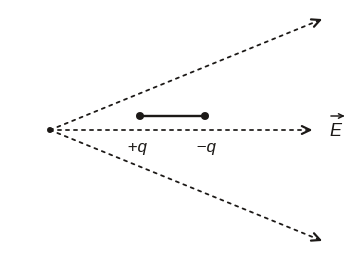
A dipole is placed in an electric field as shown. In which direction will it move?

Question diagram
1Towards the right as its potential energy will increase.
2Towards the left as its potential energy will increase.
3Towards the right as its potential energy will decrease.
4Towards the left as its potential energy will decrease.
NTA Answer: Option 3(final)

Why the other options are wrong

  • Option 1: It does move right, but a free dipole moves so that its potential energy falls, not rises. Here p points from −q to +q, to the left, against E, and 'When p is antiparallel to E, the net force on the dipole is in the direction of decreasing field', which is to the right, where the field lines spread out.
  • Option 2: Moving left, towards the point the lines diverge from, would take the dipole into a stronger field. With p (from −q to +q) pointing left, against E, 'the net force on the dipole is in the direction of decreasing field', that is to the right; and that force lowers its potential energy.
  • Option 4: The potential energy does decrease, but the direction is wrong. p points left while E points right, so they are antiparallel, and then 'the net force on the dipole is in the direction of decreasing field': the field weakens to the right as the lines spread, so the dipole moves right.

Lesson: Electric Potential

NEET 2021

Twenty seven drops of same size are charged at 220 V each. They combine to form a bigger drop. Calculate the potential of the bigger drop.

11980 V
2660 V
31320 V
41520 V
NTA Answer: Option 1(final)

Why the other options are wrong

  • Option 2: 660 V is 3 × 220. The big drop carries 27 times the charge but only 3 times the radius (27 = 3³ by volume), and potential due to a point charge goes as Q/r, so V = 27/3 × 220 = 1980 V.
  • Option 3: 1320 V is 6 × 220. Charge ×27 over radius ×3 is a factor of 9, giving 1980 V.
  • Option 4: 1520 V does not follow from V ∝ Q/r. Charge ×27 and radius ×3 give 9 × 220 = 1980 V.

Lesson: Electric Dipole

NEET 2020

A short electric dipole has a dipole moment of 16 × 10⁻⁹ C m. The electric potential due to the dipole at a point at a distance of 0.6 m from the centre of the dipole, situated on a line making an angle of 60° with the dipole axis is : (1/(4πε₀) = 9 × 10⁹ N m²/C²)

1zero
250 V
3200 V
4400 V
NTA Answer: Option 3(final)

Why the other options are wrong

  • Option 1: Zero holds only in the equatorial plane (θ = 90°). At 60°, V = (1/4πε₀)(p cos θ)/r² = 9 × 10⁹ × 16 × 10⁻⁹ × 0.5 / 0.36 = 200 V.
  • Option 2: V = 9 × 10⁹ × 16 × 10⁻⁹ × cos 60° / (0.6)² = 72 / 0.36 = 200 V; 50 V is a quarter of that.
  • Option 4: 400 V leaves out cos 60° = ½. The potential due to a dipole depends on the angle: V = 144 × 0.5 / 0.36 = 200 V.

Lesson: Electric Potential

NEET 2020

In a certain region of space with volume 0.2 m³, the electric potential is found to be 5 V throughout. The magnitude of electric field in this region is :

15 N/C
2zero
30.5 N/C
41 N/C
NTA Answer: Option 2(final)

Why the other options are wrong

  • Option 1: 5 is the potential in volts, not the field. The field's magnitude is the change in potential per unit displacement, and V does not change anywhere in the region, so E = 0.
  • Option 3: The volume plays no part. With V the same (5 V) throughout, the change in potential per unit displacement is zero, so E = 0.
  • Option 4: The field is set by how fast V changes, not by V itself; a constant 5 V gives E = 0.

Lesson: Field Spherical Shell Gauss

NEET 2020

A spherical conductor of radius 10 cm has a charge of 3.2 × 10⁻⁷ C distributed uniformly. What is the magnitude of electric field at a point 15 cm from the centre of the sphere ? (1/(4πε₀) = 9 × 10⁹ N m²/C²)

11.28 × 10⁷ N/C
21.28 × 10⁴ N/C
31.28 × 10⁵ N/C
41.28 × 10⁶ N/C
NTA Answer: Option 3(final)

Why the other options are wrong

  • Option 1: Outside the shell the field is as if the entire charge were concentrated at its centre: E = 9 × 10⁹ × 3.2 × 10⁻⁷ / (0.15)² = 1.28 × 10⁵ N/C, not 10⁷.
  • Option 2: Ten times too small. With r = 0.15 m, E = 2880 / 0.0225 = 1.28 × 10⁵ N/C.
  • Option 4: Ten times too large. E = (1/4πε₀)q/r² = 9 × 10⁹ × 3.2 × 10⁻⁷ / 0.0225 = 1.28 × 10⁵ N/C.

Lesson: Parallel Plate Capacitor

NEET 2020

The capacitance of a parallel plate capacitor with air as medium is 6 µF. With the introduction of a dielectric medium, the capacitance becomes 30 µF. The permittivity of the medium is : (ε₀=8.85×10⁻¹² C² N⁻¹ m⁻²)

15.00 C² N⁻¹ m⁻²
20.44×10⁻¹³ C² N⁻¹ m⁻²
31.77×10⁻¹² C² N⁻¹ m⁻²
40.44×10⁻¹⁰ C² N⁻¹ m⁻²
NTA Answer: Option 4(final)

Why the other options are wrong

  • Option 1: 5 is the dielectric constant K = C/C₀ = 30/6, a dimensionless ratio. The permittivity is ε = ε₀K = 5 × 8.85 × 10⁻¹² ≈ 0.44 × 10⁻¹⁰ C² N⁻¹ m⁻².
  • Option 2: The digits are right but the power of ten is not: ε = ε₀K = 5 × 8.85 × 10⁻¹² = 4.4 × 10⁻¹¹ = 0.44 × 10⁻¹⁰.
  • Option 3: 1.77 × 10⁻¹² is ε₀/K, dividing instead of multiplying. The product ε₀K is called the permittivity of the medium: 8.85 × 10⁻¹² × 5 ≈ 0.44 × 10⁻¹⁰.