Definition
Self inductance
L = Φ/I (flux linkage per unit current). Induced emf: ε = -L dI/dt. Solenoid: L = μ₀ n² V, where V = volume.
-- NCERT Class 12 Physics, Ch. 6, p. 168The energy stored in an inductor is U = ½LI², not ½LI. Dropping the square is the documented error on this topic, and it is invisible when you check your own work — ½LI looks like a formula. It is the one line worth slowing down on.
Self-inductance is the property by which a coil opposes changes in its own current. When the current through a coil changes, the flux it links through itself changes, and by Faraday's law an EMF appears in that same coil:
ε = −L (dI/dt)
L is the self-inductance, measured in henry (H). NCERT Class 12 Physics Chapter 6 defines it on printed page 168. The minus sign is Lenz's law — the EMF opposes the change that produced it. A coil carrying a steady current has dI/dt = 0 and therefore zero self-induced EMF, however large the current.
One henry means one volt of back-EMF for a current changing at one ampere per second. That gives you a clean unit check: H = V·s/A.
Building the current from zero to I costs work, and that work is stored in the magnetic field of the coil:
U = ½LI² (Chapter 6, printed page 169)
Note the structure. It is the same shape as kinetic energy ½mv² and capacitor energy ½CV², with L playing the role of inertia. That analogy is worth carrying, because it tells you what the square is doing there: double the current, quadruple the energy. A distractor built on ½LI gives exactly half the correct answer when I = 1 A and diverges everywhere else — which is why the I = 1 case is a bad self-test.
Watch out: the two formulas answer different questions. ε = −L(dI/dt) asks how fast is the current changing; U = ½LI² asks what is the current now. A problem giving you a rate of change wants the first; a problem giving you a steady value wants the second.
Select an option to see the explanation. Wrong answers show why your choice was tempting — and name the exact trap it exploits.
The SI unit of self-inductance is the
Answer: C. C is correct. Self-inductance is measured in henry (H), defined in NCERT Class 12 Physics Chapter 6, printed page 165.
Why A is wrong: A is wrong because the weber is the unit of magnetic flux, not of inductance.
Why B is wrong: B is wrong because the tesla is the unit of magnetic field strength B.
Why D is wrong: D is wrong because the farad is the unit of capacitance — the electrostatic analogue, not the magnetic one.
The energy stored in an inductor of inductance L carrying a steady current I is given by
Answer: A. A is correct. U = ½LI², stated in NCERT Class 12 Physics Chapter 6, printed page 169 — the same ½-and-square structure as ½mv² and ½CV².
Why B is wrong: B is wrong because it omits the factor of ½, giving twice the stored energy.
Why C is wrong: C is wrong because it drops the square on I. This is the documented formula-misuse error on this topic: ½LI happens to agree with the correct value only at I = 1 A.
Why D is wrong: D is wrong because it squares the inductance instead of the current; L appears to the first power only.
A coil carries a large but perfectly steady direct current. The self-induced EMF in the coil is
Answer: B. B is correct. From ε = −L(dI/dt), a steady current gives dI/dt = 0 and hence zero self-induced EMF, whatever the magnitude of I (NCERT Class 12 Physics Chapter 6, printed page 168).
Why A is wrong: A is wrong because self-induced EMF depends on the rate of change of current, not on its magnitude.
Why C is wrong: C is wrong because LI is the flux linkage of the coil, not an EMF; it has units of weber, not volt.
Why D is wrong: D is wrong because ½LI² is the stored energy in joule, not an EMF in volt. The coil does store energy here — but the question asks for EMF.
An inductor of 0.40 H carries a current of 3.0 A. The energy stored in its magnetic field is closest to
Answer: C. C is correct. U = ½LI² = ½ × 0.40 × (3.0)² = ½ × 0.40 × 9.0 = 1.8 J. The ½ is exact and does not affect the two-significant-figure result (NCERT Class 12 Physics Chapter 6, printed page 169).
Why A is wrong: A is wrong because it uses ½LI = ½ × 0.40 × 3.0, dropping the square on the current.
Why B is wrong: B is wrong because it uses LI = 0.40 × 3.0, dropping both the ½ and the square.
Why D is wrong: D is wrong because it uses LI² = 0.40 × 9.0, omitting the factor of ½.
The current in a coil of self-inductance 0.25 H changes uniformly at a rate of 8.0 A s⁻¹. The magnitude of the self-induced EMF is
Answer: B. B is correct. |ε| = L(dI/dt) = 0.25 × 8.0 = 2.0 V, using the self-inductance relation of NCERT Class 12 Physics Chapter 6, printed page 168.
Why A is wrong: A is wrong because it divides L by the rate instead of multiplying, giving 0.25/8.0.
Why C is wrong: C is wrong because it divides the rate by L, giving 8.0/0.25 ÷ 10 — an inverted use of the relation.
Why D is wrong: D is wrong because it divides the rate by L, giving 8.0/0.25. The relation is ε = −L(dI/dt), a product.
A coil develops a back-EMF of magnitude 6.0 V when the current through it changes at a steady rate of 1.5 A s⁻¹. Its self-inductance is
Answer: B. B is correct. Rearranging |ε| = L(dI/dt) gives L = 6.0 / 1.5 = 4.0 H (NCERT Class 12 Physics Chapter 6, printed page 168).
Why A is wrong: A is wrong because it inverts the rearrangement, computing 1.5/6.0 instead of 6.0/1.5.
Why C is wrong: C is wrong because it multiplies EMF by the rate, 6.0 × 1.5, instead of dividing.
Why D is wrong: D is wrong because it multiplies the EMF by 2.5 with no basis in the relation; L is a simple ratio of EMF to current-rate here.
The current through an inductor is increased from 2.0 A to 6.0 A. The energy stored in the inductor increases by a factor of
Answer: C. C is correct. U ∝ I² for a fixed L, so tripling the current (6.0/2.0 = 3, exact ratio) multiplies the stored energy by 3² = 9 (NCERT Class 12 Physics Chapter 6, printed page 169).
Why A is wrong: A is wrong because it takes U ∝ I, which is the ½LI error with the square dropped.
Why B is wrong: B is wrong because it reads the final current 6.0 A as the factor rather than forming the ratio 6.0/2.0.
Why D is wrong: D is wrong because it forms 3 × 4 by mixing the current ratio with the difference in energies; the ratio of energies is the square of the current ratio alone.
Two inductors A and B store equal energy. A has inductance 1.6 H and carries 1.0 A. If B has inductance 0.40 H, the current in B is
Answer: C. C is correct. Equating ½L_A I_A² = ½L_B I_B² gives I_B² = L_A I_A²/L_B = 1.6 × 1.0/0.40 = 4.0, so I_B = 2.0 A. The ½ cancels and is exact; it does not enter the significant-figure count (NCERT Class 12 Physics Chapter 6, printed page 169).
Why A is wrong: A is wrong because 0.50 A inverts the inductance ratio inside the square root: √(0.40/1.6) × 1.0 = 0.50 A. Equal energy means L_A I_A² = L_B I_B², so I_B = √(1.6/0.40) × 1.0 = 2.0 A.
Why B is wrong: B is wrong because it assumes equal energy implies equal current, ignoring that the two inductances differ.
Why D is wrong: D is wrong because it takes the inductance ratio 1.6/0.40 = 4 as the current ratio directly, forgetting to take the square root. Since U ∝ I², a fourfold ratio of L needs only a twofold ratio of I.
Get a structured 30-day Mechanics plan and a complete formula booklet — delivered to your inbox instantly.
Pattern: P.PHY.U14.INDUCTOR_ENERGY — energy stored in an inductor (observed 2023, 2025; frequency 2).
Given
• Self-inductance L = 0.80 H (two significant figures)• Initial current I₁ = 2.5 A (two significant figures)• Final current I₂ = 5.0 A (two significant figures)
Required
The increase in stored magnetic energy, ΔU, in joule.
Concept
Energy is stored in the magnetic field of an inductor carrying current, referenced to zero energy at zero current. The additional energy is the difference between the two stored energies — not the energy computed at the difference in currents. Those are different numbers, and the question wants the first.
Formula
U = ½LI² (NCERT Class 12 Physics Chapter 6, printed page 169)
ΔU = U₂ − U₁ = ½L(I₂² − I₁²)
Substitution
ΔU = ½ × 0.80 × [(5.0)² − (2.5)²]
ΔU = ½ × 0.80 × [25 − 6.25]
Calculation
ΔU = ½ × 0.80 × 18.75
ΔU = 0.40 × 18.75
ΔU = 7.5 J
The factor ½ in U = ½LI² is an exact mathematical constant and does not contribute to the significant-figure count. Both given data carry two significant figures, so the answer carries two.
Final answer
ΔU = 7.5 J
Common trap
Two errors sit on this problem, and they give different wrong answers.
The first is dropping the square: computing ½L(I₂ − I₁) = ½ × 0.80 × 2.5 = 1.0 J. This is the documented formula-misuse error on this topic — writing ½LI instead of ½LI². It will not announce itself, because 1.0 J is a perfectly plausible-looking answer.
The second is squaring the difference instead of differencing the squares: ½L(I₂ − I₁)² = ½ × 0.80 × 6.25 = 2.5 J. This is arithmetically tidy and physically wrong, because energy is not additive in current. Write out U₂ and U₁ separately if you are unsure — the extra line costs five seconds and removes the ambiguity entirely.
Note also that 5.0 A is exactly twice 2.5 A, so U₂ = 4U₁ and ΔU = 3U₁. Checking that ΔU/U₁ = 7.5/2.5 = 3 confirms the answer in one division.
Similar NEET-style question
An inductor of 0.50 H carries a current of 4.0 A. The current is reduced to 2.0 A. The energy released from the magnetic field is closest to (A) 1.0 J (B) 2.0 J (C) 3.0 J (D) 4.0 J. [Answer: C — ΔU = ½ × 0.50 × (16 − 4.0) = 3.0 J.]
L = Φ/I (flux linkage per unit current). Induced emf: ε = -L dI/dt. Solenoid: L = μ₀ n² V, where V = volume.
-- NCERT Class 12 Physics, Ch. 6, p. 168U = (1/2) L I². Energy density u = B² / (2μ₀) (J/m³).
-- NCERT Class 12 Physics, Ch. 6, p. 169Magnetic field energy stored in inductor carrying current I.
| Symbol | Quantity | SI Unit |
|---|---|---|
| L | inductance | H |
| I | current | A |
EMF induced in coil due to its own changing current. L = inductance.
| Symbol | Quantity | SI Unit |
|---|---|---|
| L | self inductance | H |
| I | current | A |
These are the exact patterns that cause wrong answers in NEET. Each trap includes when it triggers and how to avoid it.
Root cause: formula misuse
U = ½ L I² (analogous to capacitor's ½ C V² and KE's ½mv²). Common error: writes ½LI dropping the square.
More in Electromagnetic Induction and Alternating Currents: 3 exam traps and mistakes · 9 formulas · 5 question patterns from its other lessons.
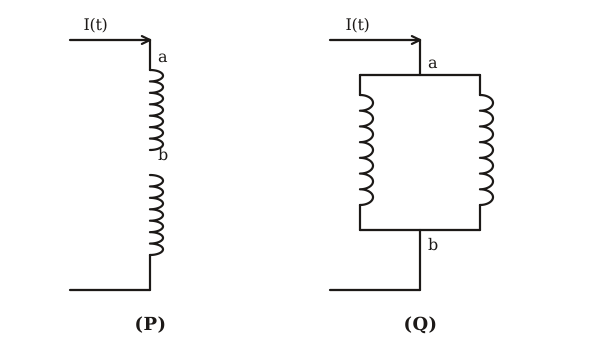
The magnetic energy stored in an inductor of inductance 4 µH carrying a current of 2 A is
All 20 past-paper questions from Electromagnetic Induction and Alternating Currents →
uses LI not LI squared
Drops square on I
forgets 1 2 factor
Uses LI^2 without 1/2
Page numbers are the ones printed in the current NCERT textbook (2023 rationalised edition), unless marked pre-2023. The books are free at ncert.nic.in.
Test yourself on this topic with real past-paper questions:
Practice this topic →