Structural Stereoisomerism

8 MCQs9-step worked example
Source: NCERT Organic Chemistry — Some Basic PrinciplesPYQ coverage: NEET 2021, 2022, 2025, 2026Official key: NTA-verifiedLast updated: 27 Sep 2026

Structural Stereoisomerism, explained for NEET

The trap: Students conflate optical isomerism with geometrical isomerism. Both fall under "stereoisomerism," but they arise from completely different molecular features. Getting this distinction wrong costs marks because NEET questions frequently ask you to classify a compound's isomerism type — and the wrong classification means the wrong answer.

Structural vs. stereo — the first split. Isomers with the same molecular formula divide into two families. Structural isomers differ in the connectivity of atoms (chain, position, functional group, metamerism, tautomerism). Stereoisomers have identical connectivity but differ in the spatial arrangement of atoms (NCERT Class 11 Chemistry, Chapter 8, page 271).

Stereoisomerism branches into two.

Geometrical (cis-trans) isomerism requires restricted rotation — typically a C=C double bond — with two different substituents on each doubly-bonded carbon. If the condition fails (two identical groups on one carbon of the double bond), geometrical isomerism is impossible.

Optical isomerism requires a chiral centre — an sp³ carbon bonded to four different groups. Mirror-image molecules (enantiomers) are non-superimposable. No double bond is needed; no restricted rotation is needed.

The distinguishing test: ask yourself — is the structural requirement a double bond with dissimilar groups (geometrical), or an sp³ carbon with four different substituents (optical)? One molecule can show both if it has both features, but they are independent phenomena.

Watch-out: A compound like 2-butene shows geometrical isomerism (cis/trans) but NOT optical isomerism (no chiral centre). Conversely, 2-bromobutane shows optical isomerism (C2 is chiral) but NOT geometrical isomerism (no restricted rotation with dissimilar groups). Do not assume one implies the other.


Can you answer these Structural Stereoisomerism MCQs?

Select an option to see the explanation. Wrong answers show why your choice was tempting — and name the exact trap it exploits.

MCQ 1Easy RecallPractice

Which of the following is the necessary condition for a compound to show geometrical isomerism?

Show answer and why every option is right or wrong

Answer: B. Geometrical isomerism requires restricted rotation (e.g., C=C) with two different substituents on each doubly-bonded carbon. This is the defining condition for geometrical isomerism, which NCERT Class 11 Chemistry, Chapter 8, page 271 names as a type of stereoisomerism.

Why A is wrong: A describes the requirement for optical isomerism (chirality), not geometrical isomerism (trap: confusing optical with geometrical).

Why C is wrong: C is irrelevant — lone pairs on a central atom relate to molecular geometry/VSEPR, not geometrical isomerism of organic molecules.

Why D is wrong: D describes a necessary condition for chirality (optical isomerism). Geometrical isomerism needs sp² carbons in a double bond, not sp³.

MCQ 2Direct ApplicationPractice

Which of the following compounds exhibits optical isomerism?

Show answer and why every option is right or wrong

Answer: B. 2-Bromobutane has a chiral centre at C2 (bonded to H, Br, CH₃, and C₂H₅ — four different groups), satisfying the requirement for optical isomerism.

Why A is wrong: A (2-butene) shows geometrical isomerism (cis/trans), not optical. It has no chiral centre (trap: confusing geometrical with optical).

Why C is wrong: C (propane) has no chiral centre and no restricted rotation — it shows neither optical nor geometrical isomerism.

Why D is wrong: D (ethene) has identical groups on each carbon of the double bond — no geometrical or optical isomerism possible.

MCQ 3CalculationPractice

How many structural isomers have the molecular formula C₄H₁₀O?

Show answer and why every option is right or wrong

Answer: C. Count the alcohols and the ethers separately. Alcohols (C₄H₉–OH): butan-1-ol, butan-2-ol, 2-methylpropan-1-ol and 2-methylpropan-2-ol, which is 4. Ethers: methoxypropane, 2-methoxypropane and ethoxyethane, which is 3. Total 4 + 3 = 7. NCERT uses this formula as its example of metamerism, isomers with different alkyl groups on either side of the functional group: methoxypropane and ethoxyethane (NCERT Class 11 Chemistry, Chapter 8, page 271). Butan-2-ol also has two optical isomers, but they are stereoisomers, not structural isomers, so they are not counted twice.

Why A is wrong: A counts only the four alcohols and forgets that C₄H₁₀O also fits ethers (trap: counting one functional group class only).

Why B is wrong: B counts only the three ethers.

Why D is wrong: D misses one isomer, most often 2-methylpropan-2-ol or 2-methoxypropane, when the branched skeletons are not listed systematically.
MCQ 4Direct ApplicationPractice

Which type of isomerism is shown by CH₃CH=CHCH₃?

Show answer and why every option is right or wrong

Answer: C. CH₃CH=CHCH₃ (2-butene) has a C=C with different groups on each carbon (H and CH₃ on each side), giving cis-trans isomerism. No sp³ carbon bears four different groups, so no optical isomerism.

Why A is wrong: A is wrong — optical isomerism requires a chiral centre (sp³ C with 4 different groups). No such carbon exists in 2-butene (trap: optical vs geometrical confusion).

Why B is wrong: B is wrong — while geometrical isomerism is present, there is no chiral centre in this molecule for optical isomerism.

Why D is wrong: D is wrong — the molecule clearly satisfies the conditions for geometrical isomerism (restricted rotation + dissimilar groups on each doubly-bonded carbon).

MCQ 5Easy RecallPractice

An sp³ carbon bonded to four different groups is called:

Show answer and why every option is right or wrong

Answer: C. A carbon with four different substituents in a tetrahedral arrangement is termed a chiral centre or asymmetric carbon — the structural basis for optical isomerism.

Why A is wrong: A is a made-up term. Geometrical isomerism relates to double bonds with restricted rotation, not to tetrahedral sp³ centres.

Why B is wrong: B is wrong — resonance involves delocalisation of π electrons across conjugated systems; it has nothing to do with sp³ carbons bearing four different groups.

Why D is wrong: D is not a standard term in organic chemistry. All sp³ carbons are hybridised centres, but that does not define chirality.

MCQ 6Direct ApplicationPractice

Which of the following does NOT show geometrical isomerism?

Show answer and why every option is right or wrong

Answer: D. CH₂=CHCl has two identical groups (both H) on one carbon of the double bond. The condition for geometrical isomerism requires two DIFFERENT groups on EACH doubly-bonded carbon. This fails at C1.

Why A is wrong: A (CHCl=CHCl) has H and Cl on each carbon — two different groups on each end — so it shows geometrical isomerism (cis/trans).

Why B is wrong: B (ClCH=CHBr) has Cl and H on one carbon, H and Br on the other — both have two different groups, so geometrical isomerism exists.

Why C is wrong: C (CH₃CH=CHCH₃) has H and CH₃ on each doubly-bonded carbon — satisfies the condition for geometrical isomerism.

MCQ 7Concept TrapPractice

A compound shows both optical and geometrical isomerism. Which structural features must it possess?

Show answer and why every option is right or wrong

Answer: A. Optical isomerism requires a chiral centre (sp³ C with 4 different groups). Geometrical isomerism requires restricted rotation with dissimilar groups on each end. Both features must be present simultaneously in the same molecule.

Why B is wrong: B is insufficient — two C=C bonds may give geometrical isomerism but provide no guarantee of a chiral centre for optical isomerism.

Why C is wrong: C is wrong — lone pairs relate to molecular geometry (VSEPR), not to the structural requirements for chirality or cis-trans isomerism.

Why D is wrong: D is wrong — two chiral centres give optical isomerism (and possibly meso forms), but without a suitably substituted double bond, geometrical isomerism cannot arise.

MCQ 8Easy RecallPractice

Enantiomers are stereoisomers that are:

Show answer and why every option is right or wrong

Answer: A. Enantiomers are defined as non-superimposable mirror images of each other, arising from the presence of a chiral centre. They have identical physical properties except for the direction of optical rotation.

Why B is wrong: B is wrong — superimposable mirror images are identical molecules, not isomers. Enantiomers are specifically NON-superimposable.

Why C is wrong: C is wrong — enantiomers differ in the direction of plane-polarised light rotation (+/−). All other physical properties (m.p., b.p., density) are identical.

Why D is wrong: D is wrong — enantiomers are stereoisomers (same connectivity, different spatial arrangement), not structural isomers (which differ in connectivity).

Free NEET study resources

Get a structured 30-day study plan and a complete formula booklet — delivered to your inbox instantly.

How do you solve a Structural Stereoisomerism question? A worked example

  1. 1

    Given

    Compound: 3-chlorobut-1-ene. Structure: CH₂=CH−CHCl−CH₃.

  2. 2

    Required

    Identify whether the compound shows (a) geometrical isomerism, (b) optical isomerism, or (c) both.

  3. 3

    Concept

    Geometrical isomerism requires a C=C with two different groups on EACH doubly-bonded carbon. Optical isomerism requires an sp³ carbon with four different substituents (chiral centre).

  4. 4

    Check for geometrical isomerism

    The double bond is between C1 and C2.• C1 carries: H and H → two IDENTICAL groups.• Since C1 has two identical groups, the condition for geometrical isomerism FAILS.
    Conclusion: No geometrical isomerism.

  5. 5

    Check for optical isomerism

    Examine C3: bonded to H, Cl, CH=CH₂ (vinyl group), and CH₃ — four DIFFERENT groups on an sp³ carbon.

    Conclusion: C3 is a chiral centre → optical isomerism exists.

  6. 6

    Classification

    3-Chlorobut-1-ene shows optical isomerism only (not geometrical).

  7. 7

    Final answer

    The compound exhibits optical isomerism (one chiral centre at C3, giving one pair of enantiomers). It does NOT exhibit geometrical isomerism.

  8. 8

    Common trap

    Students see a double bond and immediately assume geometrical isomerism. But the test requires two DIFFERENT groups on EACH carbon of the double bond. Here C1 has two H atoms — condition fails. Separately, some students miss the chiral centre at C3 because they focus only on the double bond when thinking about stereoisomerism.

  9. 9

    Similar NEET-style question

    "Which of the following compounds shows optical isomerism but NOT geometrical isomerism? (A) 2-Butene (B) 1,2-Dichloroethene (C) 2-Chlorobutane (D) Propene." [Answer: C — C2 in 2-chlorobutane is chiral; no double bond means no geometrical isomerism.]

    ---

What to remember before solving Structural Stereoisomerism questions

Definition

Isomerism

Compounds with same molecular formula but different structures or arrangements. Structural: chain, position, functional group, metamerism, tautomerism. Stereoisomerism: geometrical (cis/trans), optical (chirality, R/S, d/l).

-- NCERT Class 11 Chemistry, Ch. 8, p. 270

Where do students lose marks on Structural Stereoisomerism?

These are the exact patterns that cause wrong answers in NEET. Each trap includes when it triggers and how to avoid it.

Category: Similar Terms

Student conflates optical (chirality, R/S) with geometrical (cis/trans). They're different stereoisomerism types.

When it triggers

Question about isomerism of a specific compound.

How to avoid

Optical isomerism requires chiral center (sp³ with 4 different groups). Geometrical isomerism requires restricted rotation (C=C with two different groups on each carbon).

More in Organic Chemistry — Some Basic Principles: 7 exam traps and mistakes · 1 formula · 1 question pattern from its other lessons.

Structural Stereoisomerism questions from past NEET papers

6 questions from NEET 2021, 2022, 2025, 2026. Answers verified against NTA official keys.

NEET 2026

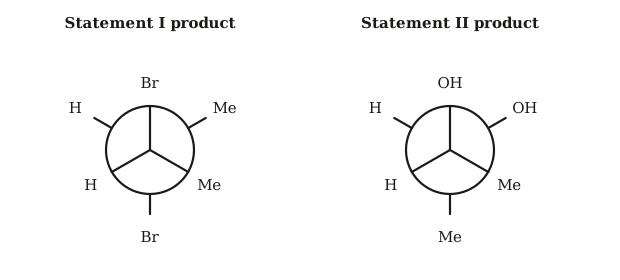
Given below are two statements, with the products shown in the figure: Statement-I : trans-But-2-ene upon treatment with Br₂ in CCl₄ gives the product drawn on the left. Statement-II : cis-But-2-ene upon treatment with alkaline KMnO₄ gives the product drawn on the right. In the light of the above statements, choose the most appropriate answer from the options given below.

Question diagram
1Both Statement I and Statement II are correct
2Both Statement I and Statement II are incorrect
3Statement-I is correct, but Statement-II is incorrect
4Statement-I is incorrect, but Statement-II is correct
NTA Answer: Option 4(final)

All 12 past-paper questions from Organic Chemistry — Some Basic Principles →

Sources

NCERT refs: Class 11 Chemistry Chapter 8, p.271

Page numbers are the ones printed in the current NCERT textbook (2023 rationalised edition), unless marked pre-2023. The books are free at ncert.nic.in.

Report an error · Every fix is public: corrections log

Test yourself on this topic with real past-paper questions:

Practice this topic →