NEET 2026
1filled σ and filled π orbitals
2empty σ and empty π* orbitals
3empty σ* and filled π orbitals
4empty σ* and empty π* orbitals
NTA Answer: Option 1(final)
11 lessons
11 of 11 lessons by the NCERT chapter they teach from, in book order. The page is the first printed page of your NCERT book the lesson cites; PYQs are the past NEET questions on that topic.
12 questions from NEET 2020, 2021, 2022, 2023, 2024, 2025, 2026. Answers verified against NTA official keys.
By year in our set: 2020 (1) · 2021 (1) · 2022 (2) · 2023 (1) · 2024 (1) · 2025 (3) · 2026 (3)
Lesson: Hyperconjugation
Lesson: Structural Stereoisomerism
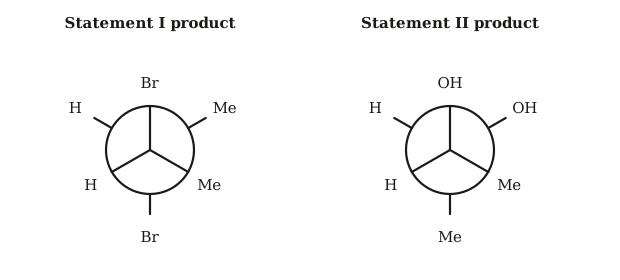
Lesson: Structural Stereoisomerism
Lesson: Structural Stereoisomerism
Which one of the following compounds can exist as cis-trans isomers?
Lesson: Hyperconjugation
Lesson: Structural Stereoisomerism
Lesson: IUPAC Nomenclature Organic
A compound with a molecular formula of C₆H₁₄ has two tertiary carbons. Its IUPAC name is :
Lesson: Hybridization Organic
The number of σ bonds, π bonds and lone pair of electrons in pyridine, respectively are:
Lesson: Structural Stereoisomerism
The incorrect statement regarding chirality is
Lesson: IUPAC Nomenclature Organic
The correct IUPAC name of the following compound is
Lesson: Structural Stereoisomerism
The compound which shows metamerism is :
Lesson: Hyperconjugation
Lesson: Free Radicals Carbocations
Category: Similar Terms
Student writes 1° > 2° > 3° (linear with substitution count, but inverted) or treats methyl as more stable.
Question gives multiple carbocations and asks for stability ranking.
Stability: 3° > 2° > 1° > methyl. Hyperconjugation (more α-H = more stable). Resonance can elevate (allyl, benzyl > 1°).
Lesson: Inductive Effect
Category: Similar Terms
Student treats inductive (through sigma bonds, decreases with distance) like resonance (through pi system, often dominant).
Comparison of substituent effects (acidity, basicity, dipole moment).
Inductive: through-bond, weakens with distance, only sigma. Resonance: through-pi-system, often more powerful, requires conjugation.
Lesson: IUPAC Nomenclature Organic
Category: Similar Terms
Student numbers carbon chain from wrong end, giving higher locants to substituents than necessary.
IUPAC naming question with multiple substituents.
Choose end that gives the LOWEST set of locants for all substituents (compare set, not first-encountered). Functional group has priority for lowest locant.
Lesson: Structural Stereoisomerism
Category: Similar Terms
Student conflates optical (chirality, R/S) with geometrical (cis/trans). They're different stereoisomerism types.
Question about isomerism of a specific compound.
Optical isomerism requires chiral center (sp³ with 4 different groups). Geometrical isomerism requires restricted rotation (C=C with two different groups on each carbon).
Lesson: Free Radicals Carbocations
Root cause: concept gap
Stability follows hyperconjugation: more α-H → more stable. Order: 3° > 2° > 1° > methyl. Allyl/benzyl resonance-stabilised.
Lesson: Hyperconjugation
Root cause: concept gap
Hyperconjugation requires α-C-H bond. tert-Butyl carbocation: 9 α-H → very stable. No-α-H carbocation: no hyperconjugation.
Lesson: Inductive Effect
Root cause: concept gap
Inductive: through sigma, weakens with distance, weak. Resonance: through pi, often dominant for activated systems.
Lesson: IUPAC Nomenclature Organic
Root cause: rushed under time pressure
Try numbering from BOTH ends; pick the one giving the lowest SET of locants. Functional group has priority for lowest locant.
Lesson: Structural Stereoisomerism
Root cause: concept gap
Optical: chirality (sp³ with 4 different groups). Geometrical: restricted rotation (C=C). Different molecular features required.
Lesson: Free Radicals Carbocations
Stability from hyperconjugation (more α-H) and inductive donation (alkyl groups). Resonance can elevate primary cations.
| Symbol | Quantity | SI Unit |
|---|---|---|
| stability | relative | - |
Lesson: Free Radicals Carbocations
ignores resonance
Compares only by alkyl substitution