Equilibrium Rigid Body

8 MCQs9-step worked example
Source: NCERT System of Particles and Rotational MotionPYQ coverage: NEET 2021Official key: NTA-verifiedLast updated: 7 Oct 2026

Try this first

Which pair of conditions must hold for a rigid body to be in mechanical equilibrium?
  1. A.The total force is zero, and nothing else is needed.
  2. B.The total force is zero and the total torque is zero.
  3. C.The total torque is zero, and nothing else is needed.
  4. D.The total force and the total angular momentum are each equal to one.
Tap to see the answer

Answer: B. B is correct: mechanical equilibrium needs both the vector sum of the forces and the vector sum of the torques to be zero (NCERT Class 11 Physics, Chapter 6, page 109).

A is wrong: A is wrong because a zero total force gives only translational equilibrium; the torques may still turn the body.

C is wrong: C is wrong because a zero total torque gives only rotational equilibrium; the body may still accelerate in a straight line.

D is wrong: D is wrong because the conditions are that the sums are zero; they are not equal to one.

All practice questions for this lesson →

Equilibrium Rigid Body, explained for NEET

The trap is stopping at "the forces add to zero". That is only half of equilibrium: two equal and opposite forces on different lines still turn the body.

A rigid body is in mechanical equilibrium if neither its linear momentum nor its angular momentum changes with time. That needs two conditions: the vector sum of the forces is zero, which is translational equilibrium, and the vector sum of the torques is zero, which is rotational equilibrium (NCERT Class 11 Physics, Chapter 6, page 109).

When all the forces are coplanar, three conditions are enough: the sums of the force components along two perpendicular axes in the plane are zero, and the sum of the torques about an axis perpendicular to the plane is zero (NCERT Class 11 Physics, Chapter 6, page 110). A body can be in partial equilibrium: translational without rotational, or rotational without translational (NCERT Class 11 Physics, Chapter 6, page 110).

A pair of forces of equal magnitude but opposite directions, with different lines of action, is a couple. A couple produces rotation without translation (NCERT Class 11 Physics, Chapter 6, page 110).

For a lever pivoted at a fulcrum, with load F1 at load arm d1 and effort F2 at effort arm d2, the principle of moments is d1F1 = d2F2. The ratio F1/F2 is the mechanical advantage, equal to d2/d1 (NCERT Class 11 Physics, Chapter 6, page 111).

For a uniform rod, the weight acts at its centre of gravity, which is at the centre of the rod. Taking moments about a convenient point removes the unknown reaction there (NCERT Class 11 Physics, Chapter 6, page 113).

Watch-out: choose one point for all the moments and take every force's moment about that same point, including the rod's own weight.

How do you solve a Equilibrium Rigid Body question? A worked example

  1. 1

    Given

    A uniform rod AB is 1.20 m long and weighs 6.0 N. It lies horizontal on two supports: R1 at 0.20 m from A and R2 at 1.00 m from A. A load of 9.0 N hangs at 0.30 m from A.

  2. 2

    Required

    The reactions R1 and R2 of the supports.

  3. 3

    Concept

    Both conditions of mechanical equilibrium must hold: the total force is zero and the total torque is zero (NCERT Class 11 Physics, Chapter 6, page 109). The weight of a uniform rod acts at its centre, here at 0.60 m from A. Moments are taken about one convenient point, so that one unknown reaction drops out (NCERT Class 11 Physics, Chapter 6, page 113).

  4. 4

    Formula

    Translational: R1 + R2 = 6.0 + 9.0. Rotational about the point of R1: R2 × (1.00 - 0.20) = 6.0 × (0.60 - 0.20) + 9.0 × (0.30 - 0.20).

  5. 5

    Substitution

    R2 × 0.80 = 6.0 × 0.40 + 9.0 × 0.10, and R1 = 15 - R2.

  6. 6

    Calculation

    R2 × 0.80 = 2.4 + 0.90 = 3.3, so R2 = 4.1 N. Then R1 = 15 - 4.1 = 11 N. Check with moments about the point of R2: R1 × 0.80 = 6.0 × 0.40 + 9.0 × 0.70 = 8.7, so R1 = 10.9 N, which agrees to two significant figures. The distances such as 0.60 m are given or derived from the given length, with no exact constants involved.

  7. 7

    Final answer

    R1 is about 11 N and R2 is about 4.1 N; together they equal the total downward weight of 15 N.

  8. 8

    Common trap

    Writing only R1 + R2 = 15 N and stopping, or taking moments about different points in different terms. The force equation alone cannot give both reactions, and the rod's own weight must be placed at its centre, not at an end.

  9. 9

    Similar NEET-style question

    A crowbar has a load of 6.0 × 10² N at 0.10 m from the fulcrum, and the effort is applied at 1.20 m from the fulcrum. What effort balances the load, and what is the mechanical advantage? (Answer: effort = d1F1 / d2 = 0.10 × 6.0 × 10² / 1.20 = 5.0 × 10¹ N; mechanical advantage = d2 / d1 = 1.20 / 0.10 = 12.)

    ---

Can you answer these Equilibrium Rigid Body MCQs?

Select an option to see the explanation. Wrong answers show why your choice was tempting — and name the exact trap it exploits.

MCQ 1Easy RecallPractice

Which pair of conditions must hold for a rigid body to be in mechanical equilibrium?

Show answer and why every option is right or wrong

Answer: B. B is correct: mechanical equilibrium needs both the vector sum of the forces and the vector sum of the torques to be zero (NCERT Class 11 Physics, Chapter 6, page 109).

Why A is wrong: A is wrong because a zero total force gives only translational equilibrium; the torques may still turn the body.

Why C is wrong: C is wrong because a zero total torque gives only rotational equilibrium; the body may still accelerate in a straight line.

Why D is wrong: D is wrong because the conditions are that the sums are zero; they are not equal to one.

MCQ 2Easy RecallPractice

What is a pair of forces of equal magnitude, acting in opposite directions along different lines of action, called, and what does it produce?

Show answer and why every option is right or wrong

Answer: D. D is correct: such a pair is a couple, and it produces rotation without translation (NCERT Class 11 Physics, Chapter 6, page 110).

Why A is wrong: A is wrong because the vector sum of the two forces is zero, so there is no translation.

Why B is wrong: B is wrong because a couple is not an equilibrium: its torque is not zero, so the body rotates.

Why C is wrong: C is wrong because concurrent forces act at one point; the couple's two lines of action differ, and the body rotates.

MCQ 3Easy RecallPractice

The total force on a rigid body is zero. What does that guarantee about its total linear momentum?

Show answer and why every option is right or wrong

Answer: A. A is correct: if the total force is zero, the total linear momentum does not change with time, which is the condition for translational equilibrium (NCERT Class 11 Physics, Chapter 6, page 109).

Why B is wrong: B is wrong because the angular momentum stays constant only when the total torque is zero, which is a separate condition.

Why C is wrong: C is wrong because an unchanging linear momentum can be non-zero; the body may move at a steady velocity.

Why D is wrong: D is wrong because rotational equilibrium needs the total torque to be zero, which a zero total force does not give.

MCQ 4Direct ApplicationPractice

A lever has a load of 5.0 × 10² N at a load arm of 0.20 m from the fulcrum. The effort is applied at an effort arm of 1.00 m. What effort balances the load?

Show answer and why every option is right or wrong

Answer: C. C is correct: the principle of moments gives load arm × load = effort arm × effort, so the effort is 0.20 × 5.0 × 10² / 1.00 = 1.0 × 10² N (NCERT Class 11 Physics, Chapter 6, page 111).

Why A is wrong: A is wrong because 2.5 × 10³ N comes from swapping the arms (5.0 × 10² × 1.00 / 0.20).

Why B is wrong: B is wrong because 4.0 × 10² N subtracts the arms (1.00 - 0.20) in place of using the ratio of the arms.

Why D is wrong: D is wrong because 1.0 × 10² N m is the torque of the load about the fulcrum; the effort is a force, in newtons.

MCQ 5Direct ApplicationPractice

In a lever the load arm is 0.25 m and the effort arm is 1.50 m. What is the mechanical advantage?

Show answer and why every option is right or wrong

Answer: A. A is correct: the mechanical advantage is F1/F2 = d2/d1 = 1.50 / 0.25 = 6.0 (NCERT Class 11 Physics, Chapter 6, page 111).

Why B is wrong: B is wrong because 0.17 is d1 / d2, the ratio of the arms upside down.

Why C is wrong: C is wrong because 1.25 is the difference of the arms, which has no role in the principle of moments.

Why D is wrong: D is wrong because 1.75 is the sum of the arms, which also has no role in the principle of moments.

MCQ 6Direct ApplicationPractice

Two forces of equal magnitude act perpendicular to a light rod, one at each end, in opposite directions. Which statement describes the rod?

Show answer and why every option is right or wrong

Answer: B. B is correct: the total force is zero, so the rod is in translational equilibrium, but the two moments act in the same sense, so it is not in rotational equilibrium and it undergoes pure rotation (NCERT Class 11 Physics, Chapter 6, page 110).

Why A is wrong: A is wrong because the two moments about the midpoint have the same sense and add up; the net torque is not zero.

Why C is wrong: C is wrong because it describes the other case, in which the two forces point the same way and the moments cancel.

Why D is wrong: D is wrong because the rod is in translational equilibrium and it does rotate; it is partial equilibrium, not neither.

MCQ 7CalculationPractice

A uniform rod of length 1.00 m and weight 6.0 N rests on a support at 0.20 m from its left end. A load hung at the left end keeps the rod horizontal and balanced. What is the force exerted by the support?

Show answer and why every option is right or wrong

Answer: D. D is correct: taking moments about the support, load × 0.20 = 6.0 × (0.50 - 0.20), so the load is 9.0 N. The support force balances the load and the rod's weight: 9.0 + 6.0 = 15 N (NCERT Class 11 Physics, Chapter 6, pages 109 and 113).

Why A is wrong: A is wrong because 9.0 N is the load only; the support also carries the rod's weight.

Why B is wrong: B is wrong because 6.0 N is the rod's weight only; the support also carries the load.

Why C is wrong: C is wrong because 3.0 N is the difference of the load and the rod's weight; the support force is their sum.

MCQ 8CalculationPractice

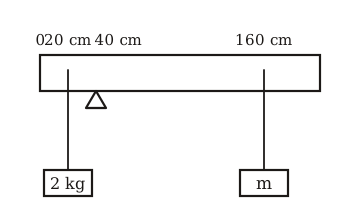
A uniform rod of length 1.00 m and mass 0.40 kg is balanced on a wedge at the 0.30 m mark. A mass of 1.0 kg hangs at the 0.10 m mark. A mass m hangs at the 0.90 m mark and the rod stays horizontal. What is m?

Show answer and why every option is right or wrong

Answer: C. C is correct: the rod's weight acts at its centre, the 0.50 m mark. Moments about the wedge: 1.0 × 0.20 = 0.40 × 0.20 + m × 0.60, so 0.20 = 0.080 + 0.60 m and m = 0.20 kg. g cancels (NCERT Class 11 Physics, Chapter 6, page 113).

Why A is wrong: A is wrong because 0.33 kg ignores the rod's own weight (0.20 / 0.60), which also acts to the right of the wedge.

Why B is wrong: B is wrong because 0.47 kg adds the rod's moment to the left-hand side instead of subtracting it ((0.20 + 0.080) / 0.60), a sign error.

Why D is wrong: D is wrong because 0.60 kg uses 0.20 m as the arm of m (0.12 / 0.20) instead of 0.60 m.

Free NEET study resources

Get a structured 30-day Mechanics plan and a complete formula booklet — delivered to your inbox instantly.

What to remember before solving Equilibrium Rigid Body questions

7 NCERT lines

The moment of a force (torque) about a point is τ = r × F, where r is the position vector from the pivot to the point of force application. Magnitude |τ| = r F sin θ. SI unit: N·m.

-- NCERT Class 11 Physics, Ch. 6, p. 106

A rigid body is said to be in mechanical equilibrium, if both its linear momentum and angular momentum are not changing with time, or equivalently, the body has neither linear acceleration nor angular acceleration. This means (1) the total force, i.e. the vector sum of the forces, on the rigid body is zero; F F F F 1 2 1 + + + = = =∑ ... n i i n 0 (6.30a) If the total force on the body is zero, then the total linear momentum of the body does not change with time. Eq. (6.30a) gives the condition for the translational equilibrium of the body. (2) The total torque, i.e. the vector sum of the torques on the rigid body is zero, 1 2 1 + + + = = =∑ ... n i i n 0 τ τ τ τ (6.30b) If the total torque on the rigid body is zero, the total angular momentum of the body does not change with time. Eq. (6.30 b) gives the condition for the rotational equilibrium of the body.

-- NCERT Class 11 Physics, Ch. 6, p. 109

In a number of problems all the forces acting on the body are coplanar. Then we need only three conditions to be satisfied for mechanical equilibrium. Two of these conditions correspond to translational equilibrium; the sum of the components of the forces along any two perpendicular axes in the plane must be zero. The third condition corresponds to rotational equilibrium. The sum of the components of the torques along any axis perpendicular to the plane of the forces must be zero.

-- NCERT Class 11 Physics, Ch. 6, p. 110

In the case of the lever force F1 is usually some weight to be lifted. It is called the load and its distance from the fulcrum d1 is called the load arm. Force F2 is the effort applied to lift the load; distance d2 of the effort from the fulcrum is the effort arm. Eq. (ii) can be written as d1F1 = d2 F2 (6.32a) or load arm × load = effort arm × effort The above equation expresses the principle of moments for a lever.

-- NCERT Class 11 Physics, Ch. 6, p. 111

Note the weight of the rod W acts at its centre of gravity G. The rod is uniform in cross section and homogeneous; hence G is at the centre of the rod; AB = 70 cm. AG = 35 cm, AP = 30 cm, PG = 5 cm, AK1= BK2 = 10 cm and K1G = K2G = 25 cm. Also, W= weight of the rod = 4.00 kg and W 1= suspended load = 6.00 kg; R1 and R2 are the normal reactions of the support at the knife edges. For translational equilibrium of the rod, R1+R2 –W1 –W = 0 (i) Note W1 and W act vertically down and R1 and R2 act vertically up. For considering rotational equilibrium, we take moments of the forces. A convenient point to take moments about is G. The moments of R2 and W1 are anticlockwise (+ve), whereas the moment of R1 is clockwise (-ve). For rotational equilibrium, –R1 (K1G) + W1 (PG) + R2 (K2G) = 0 (ii)

-- NCERT Class 11 Physics, Ch. 6, p. 113

Equilibrium Rigid Body: NEET previous year questions (PYQs) with answers

1 question from NEET 2021, answers verified against NTA official keys

More in System of Particles and Rotational Motion: 7 exam traps and mistakes · 8 formulas · 4 question patterns from its other lessons.

Sources

NCERT refs: Class 11 Physics Chapter 6, p.109 | Class 11 Physics Chapter 6, p.110 | Class 11 Physics Chapter 6, p.111 | Class 11 Physics Chapter 6, p.113

Page numbers are the ones printed in the current NCERT textbook (2023 rationalised edition), unless marked pre-2023. The books are free at ncert.nic.in.

Report an error · Every fix is public: corrections log

Every past-paper question from this chapter:

Practice the whole chapter →

Prefer to watch this?

  • 8 real NEET Rotational Motion questions (2021 to the 2026 re-exam), each traced to its NCERT line, on bodies that actually turn (16 min)

    Watch on YouTube
Practice this topic8 questions