Induced emf in a closed circuit equals the negative rate of change of magnetic flux: ε = -dΦ/dt. Flux Φ = ∫ B · dA.
-- NCERT Class 12 Physics, Ch. 6, p. 157Induced EMF Current
8 MCQs1 revision card9-step worked example
Source: NCERT Electromagnetic Induction and Alternating CurrentsPYQ coverage: NEET 2026Official key: NTA-verifiedLast updated: 25 Sep 2026
Induced EMF Current, explained for NEET
A rod slides on rails inside a magnetic field. An aspirant writes ε = BLv, gets 0.6 V, and moves on — without noticing the rod was sliding along the field lines, where the answer is zero. The formula ε = BLv is not a general rule. It holds only when the rod, its velocity, and B are mutually perpendicular. Any other geometry needs the component of velocity perpendicular to B, and the component of rod length perpendicular to both.
Where does the emf come from? A free charge inside the moving rod feels a magnetic force qv × B. That force drives positive charge to one end and leaves the other end negative, and charge piles up until the electrostatic pull back balances the magnetic push. The rod is then a battery of emf ε = BLv, with the ends as terminals. NCERT Class 12 Physics Chapter 6 develops this on page 161; it is the same ε = −dΦ_B/dt result you meet as Faraday's law (page 157), arrived at from the force on carriers rather than from flux.
Both routes agree, and that agreement is the useful part. Sweep area in time dt: the rod covers Lv dt, so dΦ_B = B L v dt and ε = BLv. Flux-counting and force-on-charges are two views of one phenomenon.
The distinction that earns marks: emf exists whenever the rod moves; current flows only if the circuit is closed. An isolated rod moving through B has a potential difference across its ends and zero current. Close it through a resistance R and I = BLv/R appears — and with it a retarding force on the rod.
Watch out for: velocity not perpendicular to B; an open circuit (emf yes, current no); and quoting a rate of flux change when the question wants the total change.
Can you answer these Induced EMF Current MCQs?
Select an option to see the explanation. Wrong answers show why your choice was tempting — and name the exact trap it exploits.
MCQ 1Easy RecallPractice
In the standard derivation of motional emf for a conducting rod, the emf arises because the free charges inside the moving rod experience
Show answer and why every option is right or wrong
Answer: B. Charges carried along with the rod move with velocity v through field B, so each feels qv × B, which drives them toward one end — NCERT Class 12 Physics Chapter 6, page 161.
Why A is wrong: A is wrong because no external source is connected; the rod itself becomes the seat of emf, so the driving force cannot be electrostatic in origin.
Why C is wrong: C is wrong because friction acts on the rod as a whole, not selectively on charge carriers, and cannot separate positive from negative charge.
Why D is wrong: D is wrong because gravity acts identically on all carriers regardless of sign and is far too weak to produce measurable charge separation.
MCQ 2Easy RecallPractice
The relation ε = BLv for a straight conducting rod is valid only when
Show answer and why every option is right or wrong
Answer: A. The stated condition for ε = BLv is v ⊥ rod ⊥ B in a uniform field; any other geometry requires resolving components — NCERT Class 12 Physics Chapter 6, page 161.
Why B is wrong: B is wrong because motion along B gives v × B = 0, so no emf is induced at all — this is the null case, not the valid case.
Why C is wrong: C is wrong because closing the circuit is what allows current to flow; the emf itself exists whether or not the circuit is closed.
Why D is wrong: D is wrong because motional emf comes from the rod's motion in a steady field; a time-varying B is a different mechanism for producing emf.
MCQ 3Concept TrapPractice
A conducting rod slides at constant speed on frictionless rails in a uniform magnetic field perpendicular to the plane of the rails. The rail circuit is left open at the far end. Which statement is correct?
Show answer and why every option is right or wrong
Answer: C. Charge separation inside the moving rod produces a potential difference across its ends regardless of the external circuit; current requires a closed conducting path — NCERT Class 12 Physics Chapter 6, page 161.
Why A is wrong: A is wrong because the magnetic force on carriers acts as soon as the rod moves; the emf does not wait for the circuit to be completed.
Why B is wrong: B is wrong because a steady current needs a closed loop, and the open end prevents any continuous flow of charge.
Why D is wrong: D is wrong because current without emf is impossible here; it inverts the actual dependency, since emf is the cause and current the consequence.
MCQ 4Direct ApplicationPractice
A rod of length 0.50 m moves at 4.0 m s⁻¹ perpendicular to both its own length and a uniform magnetic field of 0.20 T. The emf induced between its ends is
Show answer and why every option is right or wrong
Answer: B. ε = BLv = (0.20 T)(0.50 m)(4.0 m s⁻¹) = 0.40 V — NCERT Class 12 Physics Chapter 6, page 161.
Why A is wrong: A is wrong because 0.10 V = BL = 0.20 × 0.50 leaves the speed out; the emf is the product of all three, BLv.
Why C is wrong: C is wrong because it doubles the correct product, as if the rod length were taken as 1.0 m instead of 0.50 m.
Why D is wrong: D is wrong because it squares the speed: BLv² = 0.20 × 0.50 × 16 = 1.6. The motional emf is linear in v.
MCQ 5Direct ApplicationPractice
A rod of length 0.40 m moves at 5.0 m s⁻¹ in a uniform field of 0.30 T. The rod is perpendicular to B, but its velocity makes an angle of 30° with the field direction. The emf induced is
Show answer and why every option is right or wrong
Answer: D. Only the velocity component perpendicular to B drives charge separation: v_⊥ = 5.0 sin 30° = 2.5 m s⁻¹, so ε = (0.30)(0.40)(2.5) = 0.30 V — NCERT Class 12 Physics Chapter 6, page 161.
Why A is wrong: A is wrong because it uses the full speed 5.0 m s⁻¹ in ε = BLv, ignoring that the motion is not perpendicular to the field.
Why B is wrong: B is wrong because it resolves with cos 30° instead of sin 30°, taking the component along B rather than across it.
Why C is wrong: C is wrong because the velocity is not parallel to B; a 30° angle leaves a non-zero perpendicular component, so the emf does not vanish.
MCQ 6Direct ApplicationPractice
A rod of length 0.25 m slides on rails at 8.0 m s⁻¹ perpendicular to a uniform field of 0.40 T. The rails are closed by a resistance of 2.0 Ω, and the rod and rails themselves have negligible resistance. The current in the circuit is
Show answer and why every option is right or wrong
Answer: C. ε = BLv = (0.40)(0.25)(8.0) = 0.80 V, so I = ε/R = 0.80/2.0 = 0.40 A — NCERT Class 12 Physics Chapter 6, pages 157 and 161.
Why A is wrong: A is wrong because it multiplies the emf by R instead of dividing, inverting Ohm's law at the last step.
Why B is wrong: B is wrong because it reports the emf, 0.80 V, as though it were the current — the division by R has been skipped.
Why D is wrong: D is wrong because it squares the speed in the emf, BLv² = 0.40 × 0.25 × 64 = 6.4 V, and then divides by R: 6.4/2.0 = 3.2 A. The motional emf is linear in v.
MCQ 7CalculationPractice
A rod of length L slides on rails closed by a resistance R, moving at speed v perpendicular to a uniform field B. The speed is then doubled while B, L and R are unchanged. The power dissipated in the resistance becomes
Show answer and why every option is right or wrong
Answer: D. ε = BLv doubles, so I = ε/R doubles, and P = ε²/R scales as the square of the emf, giving a factor of four — NCERT Class 12 Physics Chapter 6, page 161.
Why A is wrong: A is wrong because it inverts the dependency, treating faster motion as reducing the dissipated power.
Why B is wrong: B is wrong because it assumes the power is independent of speed, which ignores that the emf itself is proportional to v.
Why C is wrong: C is wrong because it stops at the linear step: emf and current double, but power depends on their product and so scales as v², not v.
MCQ 8CalculationPractice
A rod of length 0.20 m slides on horizontal rails closed by a resistance of 0.50 Ω, in a vertical uniform field of 0.50 T. At the instant the rod moves at 3.0 m s⁻¹ perpendicular to the field, the magnitude of the magnetic force opposing the rod's motion is
Show answer and why every option is right or wrong
Answer: A. ε = (0.50)(0.20)(3.0) = 0.30 V, I = 0.30/0.50 = 0.60 A, and the force on the current-carrying rod is F = BIL = (0.50)(0.60)(0.20) = 0.060 N — NCERT Class 12 Physics Chapter 6, page 161.
Why B is wrong: B is wrong because it reports the emf value 0.30 as a force, stopping one step short of the current and the force calculation.
Why C is wrong: C is wrong because it omits the field factor in F = BIL, multiplying only the current by the rod length.
Why D is wrong: D is wrong because it reports the current 0.60 A as a force, skipping the final multiplication by B and L.
Free NEET study resources
Get a structured 30-day Mechanics plan and a complete formula booklet — delivered to your inbox instantly.
Induced EMF Current: quick recall before you leave
How do you solve a Induced EMF Current question? A worked example
- 1
Given
Rod length L = 0.30 m; speed v = 6.0 m s⁻¹; uniform magnetic field B = 0.25 T, perpendicular to both rod and velocity; external resistance R = 1.5 Ω closing the rails; rod and rail resistance negligible.
- 2
Required
(a) The emf induced across the rod. (b) The current in the circuit. (c) The external force needed to keep the rod moving at constant speed on frictionless rails.
- 3
Concept
Charges in the moving rod feel qv × B and separate until an electrostatic field balances the magnetic push; the rod acts as a source of emf. With the rails closed, that emf drives a current, and the current-carrying rod then experiences a magnetic force opposing its motion — the mechanical restatement of Lenz's law. Keeping the speed constant means supplying a force equal in magnitude to that opposing force.
- 4
Formula
ε = B L v; I = ε/R; F = B I L.
- 5
Substitution
ε = (0.25 T)(0.30 m)(6.0 m s⁻¹)
I = ε / (1.5 Ω)
F = (0.25 T) × I × (0.30 m) - 6
Calculation
ε = 0.25 × 0.30 × 6.0 = 0.45 V
I = 0.45 / 1.5 = 0.30 A
F = 0.25 × 0.30 × 0.30 = 0.0225 N ≈ 2.3 × 10⁻² N
All three given quantities carry two significant figures, so each result is quoted to two. No exact constants enter this calculation — every number here is a measured quantity and contributes to the significant-figure count. - 7
Final answer
ε = 0.45 V; I = 0.30 A; applied force F = 2.3 × 10⁻² N.
- 8
Common trap
Two slips recur. First, stopping at the emf and reporting 0.45 as the current — the division by R is easy to skip when the numbers are clean. Second, forgetting that the required applied force is not zero on frictionless rails: the induced current guarantees an opposing magnetic force, so constant speed demands a matching applied force. A rod on frictionless rails with an open circuit needs no force; the same rod with the circuit closed does.
- 9
Similar NEET-style question
A rod of length 0.50 m slides on frictionless rails closed by a 2.0 Ω resistance, in a uniform field of 0.40 T perpendicular to the plane of the rails. If an external agent maintains the rod at a constant 5.0 m s⁻¹, at what rate does the agent do work? *(Compute ε, then I, then F, then P = Fv; check it against P = ε²/R.)*
What to remember before solving Induced EMF Current questions
Formula
Motional emf
Rod of length L moving with velocity v in field B perpendicular to both: ε = B L v. Induced by the magnetic Lorentz force on charge carriers.
-- NCERT Class 12 Physics, Ch. 6, p. 163Which Induced EMF Current formulas do you need for NEET?
1 formula — click to collapse
Motional EMF
Rod of length L moving with v perpendicular to both rod and B; induced EMF from magnetic force on charges.
| Symbol | Quantity | SI Unit |
|---|---|---|
| B | field | T |
| L | rod length | m |
| v | speed | m/s |
Valid when
- v ⊥ rod ⊥ B (all mutually perpendicular)
- Uniform B
More in Electromagnetic Induction and Alternating Currents: 4 exam traps and mistakes · 10 formulas · 6 question patterns from its other lessons.
Induced EMF Current questions from past NEET papers
1 question from NEET 2026. Answers verified against NTA official keys. — click to collapse
NEET 2026
1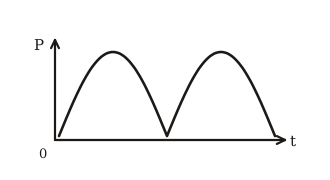
2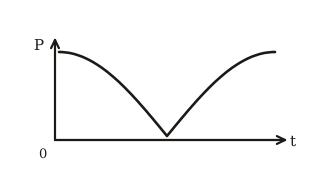
3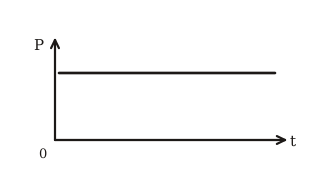
4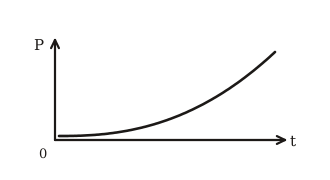
NTA Answer: Option 2(final)
All 20 past-paper questions from Electromagnetic Induction and Alternating Currents →
Sources
Page numbers are the ones printed in the current NCERT textbook (2023 rationalised edition), unless marked pre-2023. The books are free at ncert.nic.in.
Test yourself on this topic with real past-paper questions:
Practice this topic →