Structural Organisation in Animals and Plants: past NEET questions with answers

38 questions from NEET 2020, 2021, 2022, 2023, 2024, 2025, 2026, newest first. Answers verified against NTA official keys.

By year in our set: 2020 (3) · 2021 (2) · 2022 (6) · 2023 (6) · 2024 (9) · 2025 (7) · 2026 (5)

Lesson: Frog Anatomy

NEET 2026

In water, frogs respire using ______.

1skin
2buccal cavity
3lungs
4trachea
NTA Answer: Option 1(final)

Why the other options are wrong

  • Option 2: The buccal cavity is a land organ: on land, the buccal cavity, skin and lungs act as the respiratory organs.
  • Option 3: Lungs work on land, not in water. The respiration by lungs is called pulmonary respiration, and it is listed for land only.
  • Option 4: Frogs take air through the nostrils into the buccal cavity and then to lungs, and in water skin acts as aquatic respiratory organ, so no trachea is used.
Lesson: Morphology Leaf Inflorescence

NEET 2026

Phyllotaxy is the pattern of arrangement of ______.

1leaves
2flowers
3fruits
4sepals
NTA Answer: Option 1(final)

Why the other options are wrong

  • Option 2: The arrangement of flowers is inflorescence, not phyllotaxy. Phyllotaxy is the pattern of arrangement of leaves on the stem or branch.
  • Option 3: Fruits are not part of the definition: phyllotaxy is the pattern of arrangement of leaves on the stem or branch.
  • Option 4: Sepals are floral parts; phyllotaxy refers to leaves on the stem or branch, with types alternate, opposite and whorled.

Lesson: Families Fabaceae Solanaceae

NEET 2026

Which of the following are characteristic features of Solanaceae family ? (a) Flowers are bisexual and actinomorphic (b) Calyx have five sepals and are united (c) Androecium have five stamens and are epipetalous (d) Ovary is inferior. Choose the correct answer from the options given below :

1(a), (b) and (c) only
2(d) only
3(a) and (b) only
4(b), (c) and (d) only
NTA Answer: Option 1(final)

Why the other options are wrong

  • Option 2: (d) is the only false statement: in Solanaceae the gynoecium is bicarpellary, syncarpous, with the ovary superior, not inferior. (a), (b) and (c) are all true.
  • Option 3: It leaves out (c), which is true: Androecium: stamens five, epipetalous. So the correct set is (a), (b) and (c).
  • Option 4: (d) is false (the ovary is superior), and this option leaves out (a), which is true: Flower: bisexual, actinomorphic.

Lesson: Morphology Flowering Plants

NEET 2026

Match List-I with List-II. List-I : A. Marginal placentation, B. Axile placentation, C. Parietal placentation, D. Free central placentation. List-II : I. Argemone, II. Tomato, III. Primrose, IV. Pea. Choose the correct answer from the options given below :

1A-II, B-IV, C-I, D-III
2A-IV, B-II, C-III, D-I
3A-IV, B-III, C-I, D-II
4A-IV, B-II, C-I, D-III
NTA Answer: Option 4(final)

Why the other options are wrong

  • Option 1: Marginal placentation is seen in pea (A-IV), not tomato: the ovules are borne on a ridge along the ventral suture forming two rows. Tomato has axile placentation (B-II).
  • Option 2: Parietal and free central are swapped. Argemone has parietal placentation, with ovules on the inner wall of the ovary (C-I), and Primrose has free central, with ovules on the central axis and septa absent (D-III).
  • Option 3: Axile placentation is tomato (B-II), as in china rose, tomato and lemon, and free central is Primrose (D-III), not the other way round.

Lesson: Frog Anatomy

NEET 2026

In frogs, the number of pairs of cranial nerves arising from the brain are ______.

16
29
310
412
NTA Answer: Option 3(final)

Why the other options are wrong

  • Option 1: 6 is too few: there are ten pairs of cranial nerves arising from the brain in the frog.
  • Option 2: 9 is one pair short: the frog has ten pairs of cranial nerves arising from the brain.
  • Option 4: 12 is too many for the frog: there are ten pairs of cranial nerves arising from the brain.

Lesson: Morphology Flowering Plants

NEET 2025

Which of the following is an example of a zygomorphic flower?

1Chilli
2Petunia
3Datura
4Pea
NTA Answer: Option 4(final)

Why the other options are wrong

  • Option 1: Chilli is actinomorphic: it is said to be actinomorphic, e.g., mustard, datura, chilli.
  • Option 2: Petunia belongs to Solanaceae, whose flower is bisexual, actinomorphic; NCERT lists it among the family's ornamentals (petunia).
  • Option 3: Datura is actinomorphic, e.g., mustard, datura, chilli.

Lesson: Frog Anatomy

NEET 2025

Frogs respire in water by skin and buccal cavity and on land by skin, buccal cavity and lungs. Choose the correct answer from the following :

1The statement is false for both the environment
2The statement is true for water but false for land
3The statement is true for both the environment
4The statement is false for water but true for land
NTA Answer: Option 4(final)

Why the other options are wrong

  • Option 1: The land half is true: on land, the buccal cavity, skin and lungs act as the respiratory organs.
  • Option 2: It is the other way round. In water, skin acts as aquatic respiratory organ (cutaneous respiration), so adding the buccal cavity makes the water half false, while the land half is true.
  • Option 3: The water half is false: in water, only the skin is named, skin acts as aquatic respiratory organ (cutaneous respiration).

Lesson: Frog Anatomy

NEET 2025

In frog, the Renal portal system is a special venous connection that acts to link :

1Kidney and lower part of body
2Liver and intestine
3Liver and kidney
4Kidney and intestine
NTA Answer: Option 1(final)

Why the other options are wrong

  • Option 2: The link between liver and intestine is the other portal system: the former is called hepatic portal system.
  • Option 3: The special venous connections are between liver and intestine as well as the kidney and lower parts of the body; neither joins liver and kidney.
  • Option 4: Kidney and intestine are not linked by a portal system in frogs; the renal portal system joins the kidney and lower parts of the body.

Lesson: Anatomy Dicot Monocot

NEET 2025

Find the statement that is NOT correct with regard to the structure of monocot stem.

1Phloem parenchyma is absent.
2Hypodermis is parenchymatous.
3Vascular bundles are scattered.
4Vascular bundles are conjoint and closed.
NTA Answer: Option 2(final)

Why the other options are wrong

  • Option 1: This statement is correct, so it is not the answer: in the monocot stem the phloem parenchyma is absent, and water-containing cavities are present within the vascular bundles.
  • Option 3: This statement is correct: the monocot stem has a large number of scattered vascular bundles, each surrounded by a sclerenchymatous bundle sheath.
  • Option 4: This statement is correct: in the monocot stem, vascular bundles are conjoint and closed.

Lesson: Frog Anatomy

NEET 2025

Which of the following statement is correct about location of the male frog copulatory pad?

1First digit of the fore limb
2First and Second digit of fore limb
3First digit of hind limb
4Second digit of fore limb
NTA Answer: Option 1(final)

Why the other options are wrong

  • Option 2: The pad is on one digit only: a copulatory pad on the first digit of the fore limbs.
  • Option 3: It is on the fore limb, not the hind limb: a copulatory pad on the first digit of the fore limbs.
  • Option 4: It is the first digit, not the second: a copulatory pad on the first digit of the fore limbs.

Lesson: Morphology Flowering Plants

NEET 2025

Given below are two statements: Statement I: In a floral formula ⊕ stands for zygomorphic nature of the flower, and G̲ stands for inferior ovary. Statement II: In a floral formula ⊕ stands for actinomorphic nature of the flower and G̲ stands for superior ovary. In the light of the above statements, choose the correct answer from the options given below:

1Statement I is incorrect but Statement II is correct
2Both Statement I and Statement II are correct
3Both Statement I and Statement II are incorrect
4Statement I is correct but Statement II is incorrect
NTA Answer: Option 1(final)

Why the other options are wrong

  • Option 2: Statement I is incorrect on both symbols: ⊕ stands for actinomorphic, not zygomorphic, and G with a line below (G̲) stands for superior ovary, while a line above the G marks an inferior ovary. Statement II gives both symbols correctly.
  • Option 3: Statement II is correct: in the floral formula ⊕ for actinomorphic and G̲ (line below the G) for superior ovary. Only Statement I, which calls ⊕ zygomorphic and G̲ inferior, is incorrect.
  • Option 4: Statement I is the incorrect one: ⊕ is the symbol for actinomorphic, and the underlined G̲ means a superior ovary; an inferior ovary has the line above the G.

Lesson: Frog Anatomy

NEET 2025

What is the name of the blood vessel that carries deoxygenated blood from the body to the heart in a frog?

1Vena cava
2Aorta
3Pulmonary artery
4Pulmonary vein
NTA Answer: Option 1(final)

Why the other options are wrong

  • Option 2: The aorta is an artery, and arteries carry blood away from the heart: the blood from the heart is carried to all parts of the body by the arteries (arterial system).
  • Option 3: The pulmonary artery is also an artery, so it carries blood from the heart, not to it.
  • Option 4: The pulmonary vein returns blood from the lungs, not from the body. Blood from the body reaches the sinus venosus, which receives blood through the major veins called vena cava.

Lesson: Anatomy Flowering Plants

NEET 2024Revised key

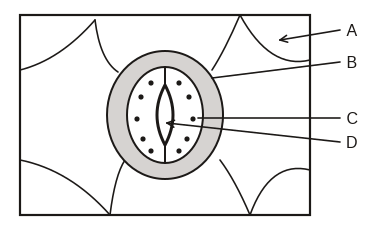
In the given figure, which component has thin outer walls and highly thickened inner walls?

Question diagram
1C
2D
3A
4B
NTA Answer: Option 1(revised_final)

Why the other options are wrong

  • Option 2: D is the stomatal pore, the opening that the two guard cells enclose, not a cell with walls of its own. The thin outer walls and highly thickened inner walls belong to the guard cells, and C marks a guard cell.
  • Option 3: A is an ordinary epidermal cell of the surface. Only the guard cells, the two bean-shaped cells which enclose the stomatal pore, have outer walls (away from the stomatal pore) that are thin and inner walls (towards the stomatal pore) that are highly thickened; C marks a guard cell.
  • Option 4: B is a subsidiary cell: a few epidermal cells in the vicinity of the guard cells become specialised in their shape and size and are known as subsidiary cells. The thin-outer, thick-inner walls belong to the guard cell, C.

Lesson: Morphology Flowering Plants

NEET 2024Revised key

Which of the following is an example of actinomorphic flower?

1Datura
2Cassia
3Pisum
4Sesbania
NTA Answer: Option 1(revised_final)

Why the other options are wrong

  • Option 2: Cassia is zygomorphic. It can be divided into two similar halves only in one particular vertical plane, it is zygomorphic, e.g., pea, gulmohur, bean, Cassia.
  • Option 3: Pisum is pea, and pea is NCERT's first example of a zygomorphic flower: pea, gulmohur, bean, Cassia.
  • Option 4: Sesbania is a legume with a pea-type flower, so it is zygomorphic like pea and bean. NCERT's actinomorphic examples are mustard, datura, chilli.

Lesson: Morphology Fruit Seed

NEET 2024Revised key

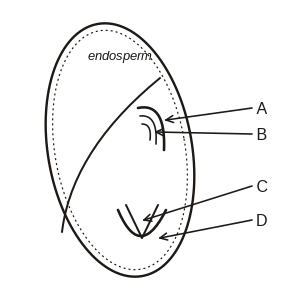
Identify the part of the seed from the given figure which is destined to form root when the seed germinates.

Question diagram
1A
2B
3C
4D
NTA Answer: Option 3(revised_final)

Why the other options are wrong

  • Option 1: A is the coleoptile, the sheath that encloses the plumule in a monocot seed. The root comes from the radicle (C): the direct elongation of the radicle leads to the formation of primary root.
  • Option 2: B is the plumule, which sits at the other end of the embryonal axis from the radicle (at the two ends of the embryonal axis are present the radicle and the plumule). The root comes from the radicle, C.
  • Option 4: D is the coleorhiza, the sheath around the radicle: the plumule and radicle are enclosed in sheaths which are called coleoptile and coleorhiza respectively. The root forms from the radicle it encloses (C), since the direct elongation of the radicle leads to the formation of primary root.

Lesson: Morphology Flowering Plants

NEET 2024Revised key

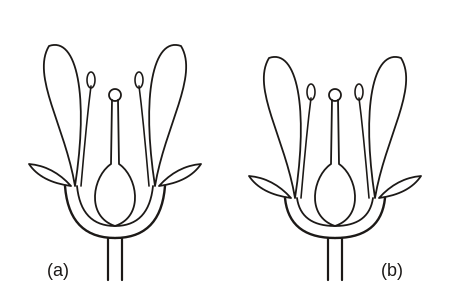
Identify the type of flowers based on the position of calyx, corolla and androecium with respect to the ovary from the given figures (a) and (b)

Question diagram
1(a) Epigynous; (b) Hypogynous
2(a) Hypogynous; (b) Epigynous
3(a) Perigynous; (b) Epigynous
4(a) Perigynous; (b) Perigynous
NTA Answer: Option 4(revised_final)

Why the other options are wrong

  • Option 1: Neither flower is epigynous or hypogynous. In an epigynous flower the margin of thalamus grows upward enclosing the ovary completely and getting fused with it, and in a hypogynous flower the other parts are situated below the gynoecium. In both (a) and (b) the ovary sits free in a cup of thalamus with the other parts on its rim: perigynous.
  • Option 2: (a) is not hypogynous, where the gynoecium occupies the highest position while the other parts are situated below it, and (b) is not epigynous, since its ovary is not enclosed by and fused with the thalamus. In both, the other parts of the flower are located on the rim of the thalamus almost at the same level: perigynous.
  • Option 3: (a) is perigynous, but so is (b): its ovary sits free in a shallow cup, with the other parts on the rim of the thalamus almost at the same level. It is not enclosed completely and fused with the thalamus as in an epigynous flower.

Lesson: Anatomy Flowering Plants

NEET 2024Revised key

Formation of interfascicular cambium from fully developed parenchyma cells is an example for

1Differentiation
2Redifferentiation
3Dedifferentiation
4Maturation
NTA Answer: Option 3(revised_final)

Why the other options are wrong

  • Option 1: Differentiation is the maturing of meristem-derived cells: this act leading to maturation is termed as differentiation. Interfascicular cambium forms from cells that had already differentiated and regain the capacity of division, which is dedifferentiation.
  • Option 2: Redifferentiation is the next step: the new meristem's cells once again lose the capacity to divide but mature to perform specific functions. Forming the cambium itself from parenchyma is dedifferentiation.
  • Option 4: Maturation is the end of differentiation, not a return to division. The book's example of dedifferentiation is exactly this: formation of meristems – interfascicular cambium and cork cambium from fully differentiated parenchyma cells.

Lesson: Anatomy Flowering Plants

NEET 2024Revised key

Bulliform cells are responsible for

1Inward curling of leaves in monocots.
2Protecting the plant from salt stress.
3Increased photosynthesis in monocots.
4Providing large spaces for storage of sugars.
NTA Answer: Option 1(revised_final)

Why the other options are wrong

  • Option 2: NCERT ties bulliform cells to water, not salt: when they are flaccid due to water stress, they make the leaves curl inwards to minimise water loss.
  • Option 3: Bulliform cells are large, empty, colourless cells; their role is leaf rolling, not extra photosynthesis.
  • Option 4: They are not storage cells. In grasses, certain adaxial epidermal cells along the veins modify themselves into large, empty, colourless cells.

Lesson: Morphology Flowering Plants

NEET 2024Revised key

Match List I with List II List I List II A. Rose I. Twisted aestivation B. Pea II. Perigynous flower C. Cotton III. Drupe D. Mango IV. Marginal placentation Choose the correct answer from the options given below :

1A-II, B-IV, C-I, D-III
2A-I, B-II, C-III, D-IV
3A-IV, B-III, C-II, D-I
4A-II, B-III, C-IV, D-I
NTA Answer: Option 1(revised_final)

Why the other options are wrong

  • Option 2: Rose is not twisted; it is perigynous, e.g., plum, rose, peach. Twisted aestivation is found as in china rose, lady's finger and cotton.
  • Option 3: Mango is a drupe, not twisted: in mango and coconut, the fruit is known as a drupe. Pea is marginal, not a drupe.
  • Option 4: Pea is not a drupe; its placentation is marginal (as in pea). Cotton is twisted, and mango is the drupe.

Lesson: Morphology Flowering Plants

NEET 2024Revised key

Match List I with List II List I List II (Types of Stamens) (Example) A. Monoadelphous I. Citrus B. Diadelphous II. Pea C. Polyadelphous III. Lily D. Epiphyllous IV. China-rose Choose the correct answer from the options given below:

1A-IV, B-II, C-I, D-III
2A-IV, B-I, C-II, D-III
3A-I, B-II, C-IV, D-III
4A-III, B-I, C-IV, D-II
NTA Answer: Option 1(revised_final)

Why the other options are wrong

  • Option 2: Diadelphous is pea and polyadelphous is citrus, not the reverse: two bundles (diadelphous) as in pea, or into more than two bundles (polyadelphous) as in citrus.
  • Option 3: Monoadelphous is china rose, not citrus: one bundle (monoadelphous) as in china rose. Citrus is polyadelphous.
  • Option 4: Epiphyllous is lily (attached to the perianth as in the flowers of lily), and monoadelphous is china rose; this option swaps them with other pairs.

Lesson: Animal Tissues

NEET 2024Revised key

Match List I with List II: List I List II A. Unicellular glandular I. Salivary glands epithelium B. Compound epithelium II. Pancreas C. Multicellular glandular III. Goblet cells of alimentary canal epithelium D. Endocrine glandular IV. Moist surface of buccal cavity epithelium Choose the correct answer from the options given below:

1A-II, B-I, C-III, D-IV
2A-IV, B-III, C-I, D-II
3A-III, B-IV, C-I, D-II
4A-II, B-I, C-IV, D-III
NTA Answer: Option 3(revised_final)

Why the other options are wrong

  • Option 1: Unicellular glandular epithelium (A) is the goblet cells of the alimentary canal (III), not the pancreas, and compound epithelium (B) covers the moist surface of buccal cavity (IV), not the salivary glands.
  • Option 2: A and B are swapped: goblet cells are the unicellular glandular epithelium (A-III), and compound epithelia cover the moist surface of buccal cavity (B-IV).
  • Option 4: Goblet cells, isolated glandular cells, make the unicellular type (A-III), and the salivary gland is the multicellular type (C-I). The pancreas, which acts as both exocrine and endocrine gland, fits D (II).

Lesson: Anatomy Flowering Plants

NEET 2023

Given below are two statements : Statement I : Endarch and exarch are the terms often used for describing the position of secondary xylem in the plant body. Statement II : Exarch condition is the most common feature of the root system. In the light of the above statements, choose the correct answer from the options given below:

1Both Statement I and Statement II are false
2Statement I is correct but Statement II is false
3Statement I is incorrect but Statement II is true
4Both Statement I and Statement II are true
NTA Answer: Option 3(final)

Lesson: Morphology Flowering Plants

NEET 2023

Axile placentation is observed in

1China rose, Beans and Lupin
2Tomato, Dianthus and Pea
3China rose, Petunia and Lemon
4Mustard, Cucumber and Primrose
NTA Answer: Option 3(final)

Why the other options are wrong

  • Option 1: Beans and lupin are legumes like pea, whose placentation is marginal: the ovules are borne on this ridge forming two rows, as in pea.
  • Option 2: Only tomato is axile. Dianthus is free central (as in Dianthus and Primrose), and pea is marginal.
  • Option 4: Mustard is parietal (e.g., mustard and Argemone) and primrose is free central (as in Dianthus and Primrose), so this set is not axile.

Lesson: Families Fabaceae Solanaceae

NEET 2023

Family Fabaceae differs from Solanaceae and Liliaceae. With respect to the stamens, pick out the characteristics specific to family Fabaceae but not found in Solanaceae or Liliaceae.

1Polyadelphous and epipetalous stamens
2Monoadelphous and Monothecous anthers
3Epiphyllous and Dithecous anthers
4Diadelphous and Dithecous anthers
NTA Answer: Option 4(final)

Why the other options are wrong

  • Option 1: Polyadelphous stamens are united into more than two bundles, as in citrus, and epipetalous stamens are the Solanaceae condition (stamens five, epipetalous). Fabaceae has ten diadelphous stamens with dithecous anthers.
  • Option 2: Monoadelphous stamens are united into one bundle, as in china rose. Fabaceae's androecium is ten, diadelphous (two bundles, as in pea), and its anthers are dithecous, not monothecous.
  • Option 3: Epiphyllous stamens are attached to the perianth, as in the flowers of lily, so that is the Liliaceae condition. Dithecous anthers alone do not single out Fabaceae; its stamens are diadelphous.

Lesson: Morphology Flowering Plants

NEET 2023

Given below are two statements : One is labelled as Assertion A and the other is labelled as Reason R : Assertion A : A flower is defined as modified shoot wherein the shoot apical meristem changes to floral meristem. Reason R : Internode of the shoot gets condensed to produce different floral appendages laterally at successive node instead of leaves. In the light of the above statements, choose the correct answer from the options given below :

1Both A and R are true but R is NOT the correct explanation of A
2A is true but R is false
3A is false but R is true
4Both A and R are true and R is the correct explanation of A
NTA Answer: Option 4(final)

Why the other options are wrong

  • Option 1: R does explain A. The shoot becomes a flower because internodes do not elongate and the axis gets condensed, and the apex produces different kinds of floral appendages laterally at successive nodes instead of leaves.
  • Option 2: R is true. NCERT says internodes do not elongate and the axis gets condensed, and floral appendages form laterally at successive nodes instead of leaves.
  • Option 3: A is true. NCERT's own definition: a flower is a modified shoot wherein the shoot apical meristem changes to floral meristem.

Lesson: Animal Tissues

NEET 2023

Given below are two statements: Statement I: Ligaments are dense irregular tissue. Statement II: Cartilage is dense regular tissue. In the light of the above statements, choose the correct answer from the options given below:

1Both Statement I and Statement II are false
2Statement I is true but Statement II is false
3Statement I is false but Statement II is true
4Both Statement I and Statement II are true
NTA Answer: Option 1(final)

Why the other options are wrong

  • Option 2: Statement I is false: ligaments, which attach one bone to another, are examples of dense regular connective tissue, not dense irregular. Statement II is also false, so both are false.
  • Option 3: Statement II is false: cartilage is not dense regular tissue; cartilage, bones and blood are various types of specialised connective tissues. Tendons and ligaments are the dense regular examples.
  • Option 4: Neither statement holds. Ligaments are dense regular connective tissue, and cartilage is a specialised connective tissue whose intercellular material is solid and pliable.

Lesson: Animal Tissues

NEET 2023

Match List I with List II. List I List II A. Mast cells I. Ciliated epithelium B. Inner surface of bronchiole II. Areolar connective tissue C. Blood III. Cuboidal epithelium D. Tubular parts of nephron IV. Specialised connective tissue Choose the correct answer from the options give below:

1A-II, B-III, C-I, D-IV
2A-II, B-I, C-IV, D-III
3A-III, B-IV, C-II, D-I
4A-I, B-II, C-IV, D-III
NTA Answer: Option 2(final)

Why the other options are wrong

  • Option 1: The inner surface of bronchioles (B) carries ciliated epithelium (I), not cuboidal, and blood (C) is a specialised connective tissue (IV), not ciliated epithelium. Cuboidal epithelium is found in the tubular parts of nephrons (D-III).
  • Option 3: Mast cells (A) belong to areolar tissue, a loose connective tissue that contains fibroblasts, macrophages and mast cells (II), not cuboidal epithelium. Blood is a specialised connective tissue (IV).
  • Option 4: Mast cells are found in areolar connective tissue (II), not ciliated epithelium, and the inner surface of bronchioles carries ciliated epithelium (I), not areolar tissue.

Lesson: Anatomy Dicot Monocot

NEET 2022

Read the following statements about the vascular bundles : (a) In roots, xylem and phloem in a vascular bundle are arranged in an alternate manner along the different radii. (b) Conjoint closed vascular bundles do not possess cambium (c) In open vascular bundles, cambium is present in between xylem and phloem (d) The vascular bundles of dicotyledonous stem possess endarch protoxylem (e) In monocotyledonous root, usually there are more than six xylem bundles present Choose the correct answer from the options given below :

1(a), (c), (d) and (e) Only
2(a), (b) and (d) Only
3(b), (c), (d) and (e) Only
4(a), (b), (c) and (d) Only
NTA Answer: Option 3(final)

Why the other options are wrong

  • Option 1: This set leaves out (b), which is true: closed vascular bundles have no cambium. It also includes (a). NCERT states (a) as true (xylem and phloem on alternate radii is the radial arrangement, 'such as in roots'), but NTA's final key treats (a) as false and keys (3).
  • Option 2: This set leaves out (c), which is true (open bundles have cambium between xylem and phloem), and (e), which is true (monocot roots usually have more than six xylem bundles). It also includes (a), which NTA's final key treats as false although NCERT states it.
  • Option 4: This set leaves out (e), which is true: monocot roots are usually polyarch, with more than six xylem bundles. It also includes (a), which NTA's final key treats as false although NCERT states the radial arrangement in roots as true.

Lesson: Morphology Flowering Plants

NEET 2022

The flowers are Zygomorphic in: (a) Mustard (b) Gulmohar (c) Cassia (d) Datura (e) Chilly Choose the correct answer from the options given below:

1(c), (d), (e) Only
2(a), (b), (c) Only
3(b), (c) Only
4(d), (e) Only
NTA Answer: Option 3(final)

Why the other options are wrong

  • Option 1: Datura and chilli are actinomorphic: it is said to be actinomorphic, e.g., mustard, datura, chilli. Only Cassia here is zygomorphic.
  • Option 2: Mustard is actinomorphic, not zygomorphic; only gulmohur and Cassia are in NCERT's zygomorphic list: pea, gulmohur, bean, Cassia.
  • Option 4: Both are actinomorphic: a flower that can be divided into two equal radial halves in any radial plane passing through the centre, e.g., mustard, datura, chilli.

Lesson: Morphology Root Stem

NEET 2022

Identify the correct set of statements : (a) The leaflets are modified into pointed hard thorns in Citrus and Bougainvillea (b) Axillary buds form slender and spirally coiled tendrils in cucumber and pumpkin (c) Stem is flattened and fleshy in Opuntia and modified to perform the function of leaves (d) Rhizophora shows vertically upward growing roots that help to get oxygen for respiration (e) Subaerially growing stems in grasses and strawberry help in vegetative propagation Choose the correct answer from the options given below :

1(a), (b), (d) and (e) Only
2(b) and (c) Only
3(a) and (d) Only
4(b), (c), (d) and (e) Only
NTA Answer: Option 4(final)

Why the other options are wrong

  • Option 1: (a) is wrong: the thorns of Citrus and Bougainvillea come from axillary buds of stems, which get modified into woody, straight and pointed thorns, not from leaflets. The correct set is (b), (c), (d) and (e).
  • Option 2: (d) and (e) are also correct: in Rhizophora many roots come out of the ground and grow vertically upwards to get oxygen for respiration, and the stems of grass and strawberry spread to new niches and form new plants.
  • Option 3: (a) is wrong (the thorns of Citrus and Bougainvillea are modified axillary buds), and this option leaves out (b) and (c): stem tendrils develop from axillary buds in cucumber and pumpkin, and Opuntia has a flattened stem.

Lesson: Families Fabaceae Solanaceae

NEET 2022

Which one of the following plants shows vexillary aestivation and diadelphous stamens?

1Solanum nigrum
2Colchicum autumnale
3Pisum sativum
4Allium cepa
NTA Answer: Option 3(final)

Why the other options are wrong

  • Option 1: Solanum belongs to Solanaceae, whose flower has petals five, united; valvate aestivation and stamens five, epipetalous, so neither feature fits.
  • Option 2: NCERT gives both features only for pea: vexillary aestivation is described in pea and bean flowers, and diadelphous stamens as two bundles (diadelphous) as in pea. Colchicum is not given either.
  • Option 4: Allium (onion) is not an example of either feature. NCERT names pea for both: two bundles (diadelphous) as in pea, and the standard, wings and keel of pea and bean flowers for vexillary aestivation.

Lesson: Animal Tissues

NEET 2022

Which of the following is not a connective tissue?

1Neuroglia
2Blood
3Adipose tissue
4Cartilage
NTA Answer: Option 1(final)

Why the other options are wrong

  • Option 2: Blood is a connective tissue: a fluid connective tissue containing plasma, red blood cells (RBC), white blood cells (WBC) and platelets. The odd one is neuroglia, which belong to neural tissue.
  • Option 3: Adipose tissue is another type of loose connective tissue located mainly beneath the skin; its cells are specialised to store fats. Neuroglia are neural tissue.
  • Option 4: Cartilage, bones and blood are various types of specialised connective tissues. Neuroglia are the cells of neural tissue that protect and support neurons, so neuroglia is the answer.

Lesson: Animal Tissues

NEET 2022

Match List-I with List-II List-I List-II (a) Bronchioles (i) Dense Regular Connective Tissue (b) Goblet Cell (ii) Loose Connective Tissue (c) Tendons (iii) Glandular Tissue (d) Adipose Tissue (iv) Ciliated Epithelium Choose the correct answer from the options given below:

1(a) - (iii), (b) - (iv), (c) - (ii), (d) - (i)
2(a) - (iv), (b) - (iii), (c) - (i), (d) - (ii)
3(a) - (i), (b) - (ii), (c) - (iii), (d) - (iv)
4(a) - (ii), (b) - (i), (c) - (iv), (d) - (iii)
NTA Answer: Option 2(final)

Why the other options are wrong

  • Option 1: Bronchioles are lined by ciliated epithelium, not glandular tissue: ciliated epithelium is mainly present in the inner surface of hollow organs like bronchioles. Goblet cells are unicellular glandular epithelium (iii), and tendons are dense regular tissue (i).
  • Option 3: Bronchioles (a) carry ciliated epithelium (iv), not dense regular tissue. Tendons, which attach skeletal muscles to bones, are the dense regular example (i), and adipose tissue is another type of loose connective tissue (ii).
  • Option 4: Goblet cells are glandular (iii): unicellular glandular epithelium consists of isolated glandular cells (goblet cells of the alimentary canal). Tendons are dense regular (i), not ciliated epithelium, and adipose is loose connective tissue (ii).

Lesson: Families Fabaceae Solanaceae

NEET 2021

Diadelphous stamens are found in

1China rose and citrus
2China rose
3Citrus
4Pea
NTA Answer: Option 4(final)

Why the other options are wrong

  • Option 1: Neither has two bundles. The stamens may be united into one bunch or one bundle (monoadelphous) as in china rose, and into more than two bundles (polyadelphous) as in citrus.
  • Option 2: China rose has one bundle of stamens, not two: one bundle (monoadelphous) as in china rose.
  • Option 3: Citrus stamens are united into more than two bundles (polyadelphous) as in citrus, not into two.

Lesson: Families Fabaceae Solanaceae

NEET 2021

Match Column-I with Column-II (a) %⚥ K₍₅₎ C₁₊₂₊₍₂₎ A₍₉₎₊₁ G̲₁ — (i) Brassicaceae; (b) ⊕⚥ K₍₅₎ C͡₍₅₎A₅ G̲₂ — (ii) Liliaceae; (c) ⊕⚥ P͡₍₃₊₃₎ A₃₊₃ G̲₍₃₎ — (iii) Fabaceae; (d) ⊕⚥ K₂₊₂ C₄ A₂₋₄ G̲₍₂₎ — (iv) Solanaceae. Select the correct answer from the options given below. (a) (b) (c) (d)

1(iv) (ii) (i) (iii)
2(iii) (iv) (ii) (i)
3(i) (ii) (iii) (iv)
4(ii) (iii) (iv) (i)
NTA Answer: Option 2(final)

Lesson: Morphology Flowering Plants

NEET 2020

Ray florets have :

1Half inferior ovary
2Inferior ovary
3Superior ovary
4Hypogynous ovary
NTA Answer: Option 2(final)

Why the other options are wrong

  • Option 1: Half inferior belongs to perigynous flowers, e.g., plum, rose, peach, not to ray florets.
  • Option 3: A superior ovary is found in hypogynous flowers, e.g., mustard, china rose and brinjal. Ray florets are epigynous.
  • Option 4: Hypogynous flowers have a superior ovary. In ray florets, the margin of thalamus grows upward enclosing the ovary completely, so the ovary is inferior.

Lesson: Morphology Root Stem

NEET 2020

The roots that originate from the base of the stem are :

1Lateral roots
2Fibrous roots
3Primary roots
4Prop roots
NTA Answer: Option 2(final)

Why the other options are wrong

  • Option 1: Lateral roots branch from the primary root, not the stem base: it bears lateral roots of several orders that are referred to as secondary, tertiary, etc. roots.
  • Option 3: The primary root comes from the radicle: the direct elongation of the radicle leads to the formation of primary root.
  • Option 4: Prop roots, as in banyan, are adventitious roots from aerial parts: roots arise from parts of the plant other than the radicle and are called adventitious roots. The roots that originate from the base of the stem are fibrous.

Lesson: Morphology Flowering Plants

NEET 2020

The ovary is half inferior in :

1Plum
2Brinjal
3Mustard
4Sunflower
NTA Answer: Option 1(final)

Why the other options are wrong

  • Option 2: Brinjal is hypogynous with a superior ovary: the ovary in such flowers is said to be superior, e.g., mustard, china rose and brinjal.
  • Option 3: Mustard is hypogynous, so its ovary is superior, not half inferior.
  • Option 4: Sunflower ray florets are epigynous. NCERT says the ovary is said to be inferior as in flowers of guava and cucumber, and the ray florets of sunflower.