Human Physiology: past NEET questions with answers (page 1 of 2)

61 questions from NEET 2020, 2021, 2022, 2023, 2024, 2025, 2026, newest first; this page has 31 (2024–2026). Answers verified against NTA official keys.

By year in our set: 2020 (2) · 2021 (7) · 2022 (10) · 2023 (11) · 2024 (12) · 2025 (6) · 2026 (13)

Lesson: Locomotion Skeleton Joints Disorders

NEET 2026

The number of vertebrae in a human is

17
212
326
4206
NTA Answer: Option 3(final)

Why the other options are wrong

  • Option 1: 7 is the number of cervical vertebrae; the page says the whole vertebral column is formed by 26 vertebrae.
  • Option 2: 12 is the number of thoracic vertebrae (and of rib pairs); the page gives 26 vertebrae in all.
  • Option 4: 206 is not a vertebra count; the page says the vertebral column is formed by 26 serially arranged vertebrae.
Lesson: Neural Human Nervous System

NEET 2026

Which of the following is not a part of human central neural system ?

1Arachnoid
2Dura mater
3Pia mater
4Pericardium
NTA Answer: Option 4(final)

Why the other options are wrong

  • Option 1: Arachnoid is one of the cranial meninges that cover the brain: a very thin middle layer called arachnoid.
  • Option 2: Dura mater is the outer layer of the cranial meninges covering the brain.
  • Option 3: Pia mater is the inner meningeal layer, in contact with the brain tissue. The pericardium is around the heart.

Lesson: Endocrine Hypothalamus Pituitary Thyroid

NEET 2026

Which of the following statements related to pituitary gland are correct? (a) It is divided anatomically into adenohypophysis and neurohypophysis (b) It secretes follicle stimulating hormone (c) It secretes melanocyte stimulating hormone (d) It does not secrete prolactin. Choose the correct answer from the options given below :

1(a) and (b) only
2(a), (b) and (c) only
3(c) and (d) only
4(b) and (c) only
NTA Answer: Option 2(final)

Why the other options are wrong

  • Option 1: Misses (c): the pars intermedia secretes only one hormone called melanocyte stimulating hormone (MSH).
  • Option 3: (d) is false: the anterior pituitary produces prolactin (PRL). It also misses (a) and (b).
  • Option 4: Misses (a): the pituitary is divided anatomically into adenohypophysis and neurohypophysis.

Lesson: Locomotion Skeleton Joints Disorders

NEET 2026

Which of the following represents the correct sequence of arrangement of bones in the lower limb of humans ?

1Femur-tibia-patella-tarsal
2Patella-femur-tibia-tarsal
3Femur-patella-tibia-tarsal
4Femur-tarsal-patella-tibia
NTA Answer: Option 3(final)

Why the other options are wrong

  • Option 1: The patella is the cup-shaped bone covering the knee, where the femur meets the leg bones, so it comes between femur and tibia, not after the tibia.
  • Option 2: The page's leg starts with the femur (thigh bone); the patella covers the knee below the thigh, so it cannot come first.
  • Option 4: Tarsals are the ankle bones on the page, so they come last, after the patella at the knee and the tibia.

Lesson: Circulation Heart Cardiac Cycle

NEET 2026

The number of action potentials generated by sino-atrial node (SAN) in a healthy human is ______ per minute.

128 - 30
270 - 75
3100 - 110
4120 - 140
NTA Answer: Option 2(final)

Why the other options are wrong

  • Option 1: 28-30 is far too low. 'The SAN can generate the maximum number of action potentials, i.e., 70-75 min–1'.
  • Option 3: 100-110 is too high. NCERT gives the SAN's rate as '70-75 min–1'.
  • Option 4: 120-140 is well above the SAN's rate of '70-75 min–1'.

Lesson: Circulation Blood Groups Coagulation

NEET 2026

Which of the following statements is incorrect ?

1Blood coagulates in response to an injury
2Blood clot consists of fibrins
3Fibrin is produced from fibrinogen
4Fibrinogen is produced from fibrin
NTA Answer: Option 4(final)

Why the other options are wrong

  • Option 1: This is correct: blood exhibits coagulation or clotting in response to an injury or trauma.
  • Option 2: This is correct: the clot is formed mainly of a network of threads called fibrins.
  • Option 3: This is correct: fibrins are formed by the conversion of inactive fibrinogens in the plasma by the enzyme thrombin.

Lesson: Endocrine Adrenal Pancreas Gonads

NEET 2026

Which one of the following statements is incorrect ?

1α-cells of pancreas secrete glucagon
2α-cells of pancreas secrete insulin
3Glucagon stimulates glycogenolysis
4β-cells of pancreas secrete insulin
NTA Answer: Option 2(final)

Why the other options are wrong

  • Option 1: This is correct: the α-cells secrete a hormone called glucagon.
  • Option 3: This is correct: glucagon acts mainly on the liver cells and stimulates glycogenolysis.
  • Option 4: This is correct: the β-cells secrete insulin.

Lesson: Endocrine Hypothalamus Pituitary Thyroid

NEET 2026

Match List-I with List-II. List-I : A. Excess growth hormone, B. Luteinizing hormone, C. Vasopressin, D. Oxytocin. List-II : I. Reabsorption of water and electrolytes in kidney, II. Contraction of uterus during child birth, III. Acromegaly, IV. Ovulation. Choose the correct answer from the options given below :

1A-III, B-IV, C-II, D-I
2A-III, B-IV, C-I, D-II
3A-II, B-IV, C-I, D-III
4A-IV, B-III, C-I, D-II
NTA Answer: Option 2(final)

Why the other options are wrong

  • Option 1: C and D are swapped. Oxytocin stimulates a vigorous contraction of uterus at the time of child birth (II); vasopressin acts on water reabsorption in the kidney (I).
  • Option 3: A and D are swapped. Excess growth hormone in adults causes Acromegaly (III), and oxytocin causes contraction of the uterus (II).
  • Option 4: A and B are swapped. Excess growth hormone gives Acromegaly (III); in females, LH induces ovulation of fully mature follicles (IV).

Lesson: Circulation Heart Cardiac Cycle

NEET 2026

The opening between the right atrium and the right ventricle is guarded by ______.

1bicuspid valve
2tricuspid valve
3semilunar valve
4sino-atrial node
NTA Answer: Option 2(final)

Why the other options are wrong

  • Option 1: The bicuspid or mitral valve 'guards the opening between the left atrium and the left ventricle', not the right side.
  • Option 3: Semilunar valves are at the openings of the 'pulmonary artery and the aorta', not between the right atrium and ventricle.
  • Option 4: The sino-atrial node is 'A patch of this tissue' in the right atrium that generates action potentials. It is not a valve.

Lesson: Breathing Respiratory Organs

NEET 2026

Sponges exchange O₂ with CO₂ by ______.

1simple diffusion over their entire body surfaces
2moist cuticle
3tracheal tubes
4gills
NTA Answer: Option 1(final)

Why the other options are wrong

  • Option 2: 'Earthworms use their moist cuticle'. Sponges exchange gases 'by simple diffusion over their entire body surface'.
  • Option 3: Insects 'have a network of tubes (tracheal tubes)'. Sponges use simple diffusion over the body surface.
  • Option 4: Gills 'are used by most of the aquatic arthropods and molluscs', and by fishes. Sponges have none and rely on diffusion.

Lesson: Locomotion Muscle Contraction

NEET 2026

Muscle contraction is initiated by a signal sent by the central nervous system by the release of ______.

1acetyl choline
2acetyl coenzyme A
3cyclic guanine monophosphate
4cyclic adenine monophosphate
NTA Answer: Option 1(final)

Why the other options are wrong

  • Option 2: Acetyl coenzyme A is not the signal on the page: at the neuromuscular junction the neural signal releases the neurotransmitter acetyl choline.
  • Option 3: The page has no cyclic GMP step: the signal releases acetyl choline, which generates an action potential in the sarcolemma.
  • Option 4: Cyclic AMP is not in the page's sequence: acetyl choline is released, an action potential spreads through the fibre, and calcium ions are released into the sarcoplasm.

Lesson: Excretion Urine Formation

NEET 2026

Which of the following statements about the reabsorption process in Henle's loop are correct ? (a) The descending limb of Henle's loop is permeable to water but almost impermeable to electrolytes. (b) Urine gets concentrated in Henle's loop. (c) Reabsorption of Na⁺ and water takes place in Henle's loop. (d) Active or passive transport of electrolytes occurs in the ascending limb of Henle's loop. Choose the correct answer from the options given below :

1(a) and (b) only
2(b), (c) and (d) only
3(a), (b) and (c) only
4(a), (b) and (d) only
NTA Answer: Option 4(final)

Why the other options are wrong

  • Option 1: Misses (d): the ascending limb allows transport of electrolytes actively or passively.
  • Option 2: (c) is false: reabsorption is minimum in its ascending limb, and the descending limb is almost impermeable to electrolytes. It also misses (a).
  • Option 3: (c) is false (reabsorption is minimum in Henle's loop), and (d) is missing: the ascending limb transports electrolytes actively or passively.

Lesson: Locomotion Skeleton Joints Disorders

NEET 2026

Which of the following is the correct order of arrangement of vertebrate column from the head to toe ?

1Cervical vertebra, thoracic vertebra, sacrum, lumbar vertebra
2Sacrum, lumbar vertebra, thoracic vertebra, cervical vertebra
3Cervical vertebra, lumbar vertebra, thoracic vertebra, sacrum
4Cervical vertebra, thoracic vertebra, lumbar vertebra, sacrum
NTA Answer: Option 4(final)

Why the other options are wrong

  • Option 1: The sacrum does not come before the lumbar vertebrae: starting from the skull, the page lists cervical, thoracic, lumbar, sacral and coccygeal.
  • Option 2: This is the order from the other end; the page lists the regions starting from the skull, beginning with cervical.
  • Option 3: Thoracic comes before lumbar: starting from the skull, the page lists cervical (7), thoracic (12), lumbar (5), then sacral.

Lesson: Endocrine Adrenal Pancreas Gonads

NEET 2025

Consider the following statements regarding function of adrenal medullary hormones : (A) It causes pupilary constriction. (B) It is a hyperglycemic hormone. (C) It causes piloerection. (D) It increases strength of heart contraction. Choose the correct answer from the options given below :

1D only
2C and D only
3B, C and D only
4A, C and D only
NTA Answer: Option 3(final)

Why the other options are wrong

  • Option 1: Too few. The medullary hormones also cause piloerection (C) and stimulate the breakdown of glycogen resulting in an increased concentration of glucose in blood (B).
  • Option 2: B is missing: catecholamines stimulate the breakdown of glycogen resulting in an increased concentration of glucose in blood, so they are hyperglycemic.
  • Option 4: A is false: these hormones increase pupilary dilation, not constriction. B is missing.

Lesson: Endocrine Hypothalamus Pituitary Thyroid

NEET 2025

Which of the following hormones released from the pituitary is actually synthesized in the hypothalamus?

1Adrenocorticotropic hormone (ACTH)
2Luteinizing hormone (LH)
3Anti-diuretic hormone (ADH)
4Follicle-stimulating hormone (FSH)
NTA Answer: Option 3(final)

Why the other options are wrong

  • Option 1: ACTH is produced by the pars distalis (anterior pituitary) itself. Only oxytocin and vasopressin are actually synthesised by the hypothalamus.
  • Option 2: LH is produced by the anterior pituitary. The posterior pituitary stores and releases oxytocin and vasopressin, which are actually synthesised by the hypothalamus.
  • Option 4: FSH is an anterior pituitary hormone. ADH (vasopressin) is the one synthesised by the hypothalamus and transported axonally to neurohypophysis.

Lesson: Endocrine Adrenal Pancreas Gonads

NEET 2025

Match List-I with List-II. List-I List-II A. Heart (I) Erythropoietin B. Kidney (II) Aldosterone C. Gastro-intestinal tract (III) Atrial natriuretic factor D. Adrenal Cortex (IV) Secretin Choose the correct answer from the options given below :

1A-III, B-I, C-IV, D-II
2A-II, B-I, C-III, D-IV
3A-IV, B-III, C-II, D-I
4A-I, B-III, C-IV, D-II
NTA Answer: Option 1(final)

Why the other options are wrong

  • Option 2: The heart secretes atrial natriuretic factor (III), not aldosterone, and the GI tract secretes secretin (IV). Aldosterone is the main mineralocorticoid of the adrenal cortex.
  • Option 3: All four are off. The atrial wall secretes ANF, the juxtaglomerular cells of kidney produce erythropoietin, the GI tract secretes secretin, and the adrenal cortex aldosterone.
  • Option 4: A and B are swapped. The heart makes atrial natriuretic factor (III) and the kidney makes erythropoietin (I).

Lesson: Circulation Heart Cardiac Cycle

NEET 2025

Cardiac activities of the heart are regulated by: A. Nodal tissue B. A special neural centre in the medulla oblongata C. Adrenal medullary hormones D. Adrenal cortical hormones Choose the correct answer from the options given below :

1A, B and D Only
2A, B and C Only
3A, B, C and D
4A, C and D Only
NTA Answer: Option 2(final)

Why the other options are wrong

  • Option 1: D is not named: NCERT gives adrenal medullary hormones, not cortical ones, as able to increase the cardiac output. C is missing.
  • Option 3: D is extra. The regulators NCERT names are nodal tissue, a special neural centre in the medulla oblongata and adrenal medullary hormones.
  • Option 4: B is missing and D is extra. A special neural centre in the medulla oblangata can moderate the cardiac function through the ANS.

Lesson: Circulation Heart Cardiac Cycle

NEET 2025

Match List-I with List-II. List-I List-II A. Emphysema I. Rapid spasms in muscle due to low Ca++ in body fluid B. Angina Pectoris II. Damaged alveolar walls and decreased respiratory surface C. Glomerulonephritis III. Acute chest pain when not enough oxygen is reaching to heart muscle D. Tetany IV. Inflammation of glomeruli of kidney Choose the correct answer from the options given below :

1A-II, B-III, C-IV, D-I
2A-III, B-I, C-IV, D-II
3A-III, B-I, C-II, D-IV
4A-II, B-IV, C-III, D-I
NTA Answer: Option 1(final)

Why the other options are wrong

  • Option 2: Emphysema is not angina, and angina is not tetany. In emphysema 'alveolar walls are damaged due to which respiratory surface is decreased'; tetany is 'rapid spasms (wild contractions) in muscle due to low Ca++ in body fluid'.
  • Option 3: Glomerulonephritis is 'Inflammation of glomeruli of kidney', not muscle spasm, and emphysema is damaged alveolar walls, not chest pain.
  • Option 4: Angina is 'acute chest pain', not inflammation of the glomeruli, and glomerulonephritis is not chest pain.

Lesson: Excretion Kidney Nephron

NEET 2025

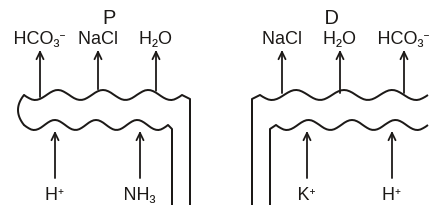
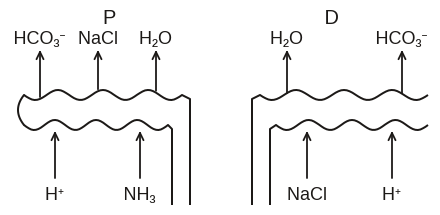
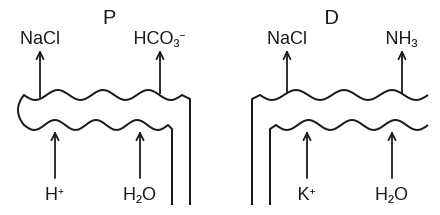
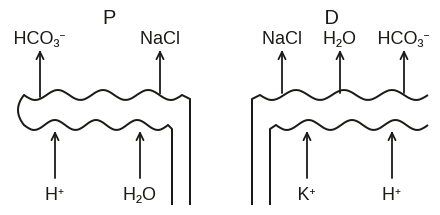
Which of the following diagrams is correct with regard to the proximal (P) and distal (D) tubule of the Nephron.

1Option 1 diagram
2Option 2 diagram
3Option 3 diagram
4Option 4 diagram
NTA Answer: Option 3(final)

Why the other options are wrong

  • Option 1: It shows H2O secreted in both P and D, and NH3 reabsorbed in D. In the PCT, 70-80 per cent of electrolytes and water are reabsorbed, and the DCT carries out conditional reabsorption of Na+ and water and selective secretion of hydrogen and potassium ions and NH3.
  • Option 2: Its D is right, but its P secretes H2O and does not secrete ammonia. In the PCT, 70-80 per cent of electrolytes and water are reabsorbed, and the PCT selectively secretes hydrogen ions and ammonia into the filtrate.
  • Option 4: Its P is right, but its D secretes NaCl. In the DCT, conditional reabsorption of Na+ and water takes place; the DCT secretes hydrogen and potassium ions and NH3, not NaCl.

Lesson: Circulation Heart Cardiac Cycle

NEET 2024Revised key

Following are the stages of pathway for conduction of an action potential through the heart A. AV bundle B. Purkinje fibres C. AV node D. Bundle branches E. SA node Choose the correct sequence of pathway from the options given below

1E-C-A-D-B
2A-E-C-B-D
3B-D-E-C-A
4E-A-D-B-C
NTA Answer: Option 1(revised_final)

Why the other options are wrong

  • Option 2: The impulse starts at the SA node (the pacemaker), not the AV bundle. The order is SAN, AVN, AV bundle, bundle branches, Purkinje fibres.
  • Option 3: Purkinje fibres are the last stage, the minute fibres throughout the ventricular musculature, not the first.
  • Option 4: The AV node must come before the AV bundle: the AV bundle continues from the AVN. Purkinje fibres are last.

Lesson: Endocrine Adrenal Pancreas Gonads

NEET 2024Revised key

Which of the following is not a steroid hormone?

1Cortisol
2Testosterone
3Progesterone
4Glucagon
NTA Answer: Option 4(revised_final)

Why the other options are wrong

  • Option 1: Cortisol is a steroid: NCERT lists steroids (e.g., cortisol, testosterone, estradiol and progesterone).
  • Option 2: Testosterone is listed among the steroids, with cortisol, estradiol and progesterone.
  • Option 3: Progesterone is a steroid. Glucagon is the odd one: glucagon is a peptide hormone.

Lesson: Breathing Mechanism Volumes

NEET 2024Revised key

Match List I with List II List I List II A. Expiratory capacity I. Expiratory reserve volume + Tidal volume + Inspiratory reserve volume B. Functional residual II. Tidal volume + Expiratory reserve volume capacity C. Vital capacity III. Tidal volume + Inspiratory reserve volume D. Inspiratory capacity IV. Expiratory reserve volume + Residual volume Choose the correct answer from the options given below :

1A-II, B-IV, C-I, D-III
2A-III, B-II, C-IV, D-I
3A-II, B-I, C-IV, D-III
4A-I, B-III, C-II, D-IV
NTA Answer: Option 1(revised_final)

Why the other options are wrong

  • Option 2: Expiratory capacity is TV + ERV (II), FRC is ERV + RV (IV), vital capacity is ERV + TV + IRV (I) and inspiratory capacity is TV + IRV (III).
  • Option 3: B and C are swapped. Functional residual capacity includes ERV + RV (IV), and vital capacity is ERV + TV + IRV (I).
  • Option 4: All four are off. Expiratory capacity includes tidal volume and expiratory reserve volume (TV+ERV, II), FRC is ERV+RV (IV), vital capacity is I and inspiratory capacity is TV+IRV (III).

Lesson: Neural Human Nervous System

NEET 2024Revised key

Match List I with List II : List-I List-II A. Pons I. Provides additional space for Neurons, regulates posture and balance. B. Hypothalamus II. Controls respiration and gastric secretions. C. Medulla III. Connects different regions of the brain. D. Cerebellum IV Neurosecretory cells Choose the correct answer from the options given below :

1A-II, B-III, C-I, D-IV
2A-III, B-IV, C-II, D-I
3A-I, B-III, C-II, D-IV
4A-II, B-I, C-III, D-IV
NTA Answer: Option 2(revised_final)

Why the other options are wrong

  • Option 1: Pons consists of fibre tracts that interconnect different regions of the brain (III), not respiration control; the medulla controls respiration and gastric secretions (II).
  • Option 3: Pons is III, not I. The cerebellum has a very convoluted surface to provide the additional space for many more neurons (I).
  • Option 4: All four are off. Pons interconnects brain regions (III), the hypothalamus contains neurosecretory cells (IV), the medulla controls respiration and gastric secretions (II), and the cerebellum gives additional space for neurons (I).

Lesson: Locomotion Muscle Contraction

NEET 2024Revised key

Three types of muscles are given as a, b and c. Identify the correct matching pair along with their location in human body: Name of muscle/location

1(a) Smooth - Toes (b) Skeletal – Legs (c) Cardiac – Heart
2(a) Skeletal - Triceps (b) Smooth – Stomach (c) Cardiac – Heart
3(a) Skeletal - Biceps (b) Involuntary – Intestine (c) Smooth – Heart
4(a) Involuntary – Nose tip (b) Skeletal – Bone (c) Cardiac – Heart
NTA Answer: Option 2(revised_final)

Why the other options are wrong

  • Option 1: Smooth muscle does not go with the toes: the page places smooth (visceral) muscle in the inner walls of hollow visceral organs such as the alimentary canal, while muscles tied to the skeleton are skeletal.
  • Option 3: The heart is not smooth muscle: the page says cardiac muscles are the muscles of the heart and are striated.
  • Option 4: (a) is the problem: the page's involuntary muscles line hollow visceral organs such as the alimentary canal or form the heart, and the nose tip is neither.

Lesson: Breathing Gas Transport

NEET 2024Revised key

Which of the following factors are favourable for the formation of oxyhaemoglobin in alveoli?

1High pO₂ and High pCO₂
2High pO₂ and Lesser H⁺ concentration
3Low pCO₂ and High H⁺ concentration
4Low pCO₂ and High temperature
NTA Answer: Option 2(revised_final)

Why the other options are wrong

  • Option 1: High pCO2 is a tissue condition that favours dissociation. In the alveoli, high pO2 goes with low pCO2, lesser H+ concentration and lower temperature.
  • Option 3: Low pCO2 is right, but high H+ concentration belongs to the tissues and favours dissociation of oxygen from the oxyhaemoglobin.
  • Option 4: Low pCO2 is right, but the alveoli have lower temperature; higher temperature is a tissue condition that favours dissociation.

Lesson: Excretion Kidney Nephron

NEET 2024Revised key

Given below are two statements : Statement I : In the nephron, the descending limb of loop of Henle is impermeable to water and permeable to electrolytes. Statement II : The proximal convoluted tubule is lined by simple columnar brush border epithelium and increases the surface area for reabsorption. In the light of the above statements, choose the correct answer from the option given below :

1Both statement I and Statement II are true
2Both statement I and Statement II are false
3Statement I is true but Statement II is false
4Statement I is false but Statement II is true
NTA Answer: Option 2(revised_final)

Why the other options are wrong

  • Option 1: Both are false. The descending limb is permeable to water but almost impermeable to electrolytes, and the PCT is lined by simple cuboidal, not columnar, brush border epithelium.
  • Option 3: Statement I is false: the descending limb of loop of Henle is permeable to water but almost impermeable to electrolytes.
  • Option 4: Statement II is false too: PCT is lined by simple cuboidal brush border epithelium, not columnar.

Lesson: Locomotion Skeleton Joints Disorders

NEET 2024Revised key

Match List I with List II : List I List II A. Fibrous joints I. Adjacent vertebrae, limited movement B. Cartilaginous joints II. Humerus and Pectoral girdle, rotational movement C. Hinge joints III. Skull, don’t allow any movement D. Ball and socket joints IV. Knee, help in locomotion Choose the correct answer from the options given below :

1A-IV, B-II, C-III, D-I
2A-I, B-III, C-II, D-IV
3A-II, B-III, C-I, D-IV
4A-III, B-I, C-IV, D-II
NTA Answer: Option 4(revised_final)

Why the other options are wrong

  • Option 1: Fibrous joints are in the skull and allow no movement, and the page gives the knee as a hinge joint; this option swaps them, and also swaps cartilaginous with ball and socket.
  • Option 2: Fibrous joints are the skull sutures, not adjacent vertebrae, which the page calls cartilaginous joints with limited movement. The knee is a hinge joint, not ball and socket.
  • Option 3: The humerus-pectoral girdle joint is ball and socket, not fibrous; the page's fibrous joints are skull bones that allow no movement, and the knee is a hinge joint.

Lesson: Excretion Kidney Nephron

NEET 2024Revised key

Choose the correct statement given below regarding juxta medullary nephron.

1Juxta medullary nephrons are located in the columns of Bertini.
2Renal corpuscle of juxta medullary nephron lies in the outer portion of the renal medulla.
3Loop of Henle of juxta medullary nephron runs deep into medulla.
4Juxta medullary nephrons outnumber the cortical nephrons.
NTA Answer: Option 3(revised_final)

Why the other options are wrong

  • Option 1: The Columns of Bertini are cortical extensions between the medullary pyramids. Juxta medullary nephrons are defined by their very long loop of Henle.
  • Option 2: The renal corpuscle of every nephron sits in the cortex; only the loop of Henle of a juxta medullary nephron runs deep into the medulla.
  • Option 4: The reverse: in majority of nephrons the loop of Henle is too short, and such nephrons are called cortical nephrons.

Lesson: Neural Human Nervous System

NEET 2024Revised key

Given below are two statements: Statement I: The cerebral hemispheres are connected by nerve tract known as corpus callosum. Statement II: The brain stem consists of the medulla oblongata, pons and cerebrum. In the light of the above statements, choose the most appropriate answer from the options given below:

1Both Statement I and Statement II are correct.
2Both Statement I and Statement II are incorrect.
3Statement I is correct but Statement II is incorrect.
4Statement I is incorrect but Statement II is correct.
NTA Answer: Option 3(revised_final)

Why the other options are wrong

  • Option 1: Statement II is wrong: three major regions make up the brain stem; mid brain, pons and medulla oblongata. The cerebrum is forebrain.
  • Option 2: Statement I is correct: the hemispheres are connected by a tract of nerve fibres called corpus callosum.
  • Option 4: Reversed. Statement I is correct (corpus callosum), and Statement II is wrong because the brain stem has the mid brain, not the cerebrum.

Lesson: Circulation Heart Cardiac Cycle

NEET 2024Revised key

Match List I with List II : List - I List – II A. P wave I. Heart muscles are electrically silent. B. QRS complex II. Depolarisation of ventricles. C. T wave III. Depolarisation of atria. D. T-P gap IV. Repolarisation of ventricles. Choose the correct answer from the options given below :

1A-I, B-III, C-IV, D-II
2A-III, B-II, C-IV, D-I
3A-II, B-III, C-I, D-IV
4A-IV, B-II, C-I, D-III
NTA Answer: Option 2(revised_final)

Why the other options are wrong

  • Option 1: The P-wave represents depolarisation of the atria (III), not silence, and the QRS complex is ventricular depolarisation (II).
  • Option 3: The P-wave is atrial, not ventricular, depolarisation; the QRS is ventricular depolarisation; and the T-wave is repolarisation of the ventricles, not silence.
  • Option 4: The P-wave is depolarisation of the atria (III), not ventricular repolarisation; the T-wave is the return of the ventricles to normal state (IV).

Lesson: Endocrine Hypothalamus Pituitary Thyroid

NEET 2024Revised key

Match List I with List II : List - I List – II A. Exophthalmic goiter I. Excess secretion of cortisol, moon face & hypergylcemia. B. Acromegaly II. Hypo-secretion of thyroid hormone and stunted growth. C. Cushing’s syndrome III. Hyper secretion of thyroid hormone & protruding eye balls. D. Cretinism IV. Excessive secretion of growth hormone. Choose the correct answer from the options given below

1A-I, B-III, C-II, D-IV
2A-IV, B-II, C-I, D-III
3A-III, B-IV, C-II, D-I
4A-III, B-IV, C-I, D-II
NTA Answer: Option 4(revised_final)

Why the other options are wrong

  • Option 1: Exophthalmic goitre is hyperthyroidism with protrusion of the eyeballs (III), acromegaly is excess growth hormone (IV), and cretinism is stunted growth from hypothyroidism (II).
  • Option 2: A and B are off. Exopthalmic goitre is a form of hyperthyroidism with protrusion of the eyeballs (III); acromegaly comes from over-secretion of growth hormone in adults (IV).
  • Option 3: C and D are swapped. Cretinism is stunted growth from hypothyroidism during pregnancy (II), so Cushing's syndrome takes I.