Reproduction: past NEET questions with answers (page 2 of 2)

59 questions from NEET 2020, 2021, 2022, 2023, 2024, 2025, 2026, newest first; this page has 29 (2020–2024). Answers verified against NTA official keys.

By year in our set: 2020 (3) · 2021 (7) · 2022 (8) · 2023 (9) · 2024 (8) · 2025 (12) · 2026 (12)

Lesson: Female Reproductive System

NEET 2024Revised key

Given below are two statements: Statement I: The presence or absence of hymen is not a reliable indicator of virginity. Statement II: The hymen is torn during the first coitus only. In the light of the above above statements, choose the correct answer from the options given below :

1Both Statement I and Statement II are true
2Both Statement I and Statement II are false
3Statement I is true but Statement II is false
4Statement I is false but Statement II is true
NTA Answer: Option 3(revised_final)

Why the other options are wrong

  • Option 1: Statement II is false. The hymen can also be broken by a sudden fall or jolt, insertion of a vaginal tampon or sports, and in some women the hymen persists even after coitus.
  • Option 2: Statement I is true: the presence or absence of hymen is not a reliable indicator of virginity.
  • Option 4: Reversed. Statement I is true and Statement II is false, because the hymen is not torn during the first coitus only.
Lesson: Male Reproductive System

NEET 2024Revised key

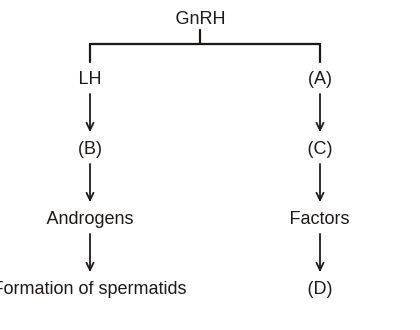
Identify the correct option (A), (B), (C), (D) with respect to spermatogenesis.

Question diagram
1FSH, Leydig cells, Sertoli cells, Spermiogenesis.
2ICSH, Interstitial cells, Leydig cells, spermiogenesis.
3FSH, Sertoli cells, Leydig cells, spermatogenesis.
4ICSH, Leydig cells, Sertoli cells, spermatogenesis.
NTA Answer: Option 1(revised_final)

Why the other options are wrong

  • Option 2: Leydig cells cannot be (C): LH acts at the Leydig cells and stimulates synthesis and secretion of androgens, which is the (B) branch. (C) makes the factors, and FSH acts on the Sertoli cells and stimulates secretion of some factors which help in the process of spermiogenesis, so (C) is the Sertoli cells and (A), the gonadotropin other than LH, is FSH.
  • Option 3: (B) and (C) are swapped: LH acts at the Leydig cells, which make the androgens, so (B) is Leydig cells, and FSH acts on the Sertoli cells, which make the factors, so (C) is Sertoli cells. (D) is spermiogenesis, which those factors help, not spermatogenesis.
  • Option 4: (A) is FSH, the gonadotropin other than LH, and (D) is spermiogenesis: FSH acts on the Sertoli cells and stimulates secretion of some factors which help in the process of spermiogenesis. It is the androgens, on the LH branch, that stimulate the process of spermatogenesis.

Lesson: Pollination Fertilization

NEET 2023

Large, colourful, fragrant flowers with nectar are seen in

1Bird pollinated plants
2Bat pollinated plants
3Wind pollinated plants
4Insect pollinated plants
NTA Answer: Option 4(final)

Why the other options are wrong

  • Option 1: Birds are among the animal pollinators, but NCERT gives large, colourful, fragrant and nectar-rich flowers as the mark of insect-pollinated flowers.
  • Option 2: Bats are among the pollinating agents, but the description matches the majority of insect-pollinated flowers.
  • Option 3: Wind pollinated flowers are not very colourful and do not produce nectar.

Lesson: Pollination Fertilization

NEET 2023

What is the function of tassels in the corn cob?

1To trap pollen grains
2To disperse pollen grains
3To protect seeds
4To attract insects
NTA Answer: Option 1(final)

Why the other options are wrong

  • Option 2: They do not disperse pollen. The stigma and style wave in the wind to trap pollen grains.
  • Option 3: They are the stigma and style, not a seed covering; they wave in the wind to trap pollen grains.
  • Option 4: Maize is wind-pollinated, and wind pollinated flowers are not very colourful and do not produce nectar; the tassels trap pollen instead of attracting insects.

Lesson: Pollination Fertilization

NEET 2023

In angiosperm, the haploid, diploid and triploid structures of a fertilized embryo sac sequentially are :

1Antipodals, synergids, and primary endosperm nucleus
2Synergids, Zygote and Primary endosperm nucleus
3Synergids, antipodals and Polar nuclei
4Synergids, Primary endosperm nucleus and zygote
NTA Answer: Option 2(final)

Why the other options are wrong

  • Option 1: Synergids are haploid cells of the embryo sac, not diploid. The diploid cell is the zygote.
  • Option 3: Antipodals are haploid, not diploid, and the polar nuclei are two haploid nuclei; only after fusing with a male gamete do they give the triploid primary endosperm nucleus.
  • Option 4: Order reversed. The primary endosperm nucleus is triploid and the zygote is diploid.

Lesson: Birth Control Methods

NEET 2023

Match List I with List II. List I List II A. Vasectomy I. Oral method B. Coitus interruptus II. Barrier method C. Cervical caps III. Surgical method D. Saheli IV. Natural method Choose the correct answer from the options given below:

1A-III, B-IV, C-II, D-I
2A-II, B-III, C-I, D-IV
3A-IV, B-II, C-I, D-III
4A-III, B-I, C-IV, D-II
NTA Answer: Option 1(final)

Why the other options are wrong

  • Option 2: Vasectomy is a surgical method (III), coitus interruptus a natural method (IV), cervical caps a barrier (II) and Saheli an oral contraceptive (I).
  • Option 3: Vasectomy is the sterilisation procedure in the male, a surgical method (III), not natural; cervical caps are barriers (II), not oral.
  • Option 4: B, C and D are off. Withdrawal or coitus interruptus is a natural method (IV), cervical caps are barriers (II), and Saheli is the new oral contraceptive (I).

Lesson: Reproductive Health STDs

NEET 2023

Which one of the following common sexually transmitted diseases is completely curable when detected early and treated properly?

1Gonorrhoea
2Hepatitis-B
3HIV Infection
4Genital herpes
NTA Answer: Option 1(final)

Why the other options are wrong

  • Option 2: Hepatitis-B is an exception: except for hepatitis-B, genital herpes and HIV infections, other diseases are completely curable.
  • Option 3: HIV infection is one of the three exceptions that are not completely curable.
  • Option 4: Genital herpes is one of the exceptions, with hepatitis-B and HIV.

Lesson: Male Reproductive System

NEET 2023

Given below are two statements: Statement I: Vas deferens receives a duct from seminal vesicle and opens into urethra as the ejaculatory duct. Statement Il: The cavity of the cervix is called cervical canal which along with vagina forms birth canal. In the light of the above statements, choose the correct answer from the options given below:

1Both Statement I and Statement II are false.
2Statement I is correct but Statement II is false.
3Statement I is incorrect but Statement II is true.
4Both Statement I and Statement II are true.
NTA Answer: Option 4(final)

Why the other options are wrong

  • Option 1: Both are true: the vas deferens receives a duct from seminal vesicle and opens into urethra as the ejaculatory duct, and the cervical canal along with vagina forms the birth canal.
  • Option 2: Statement II is also true: the cavity of the cervix is called cervical canal, which along with vagina forms the birth canal.
  • Option 3: Statement I is also true: it receives a duct from seminal vesicle and opens into urethra as the ejaculatory duct.

Lesson: Amniocentesis Art

NEET 2023

Given below are two statements: one is labelled as Assertion A and other is labelled as Reason R. Assertion A : Amniocentesis for sex determination is one of the strategies of Reproductive and Child Health Care Programme. Reason R : Ban on amniocentesis checks increasing menace of female foeticide. In the light of the above statements, choose the correct answer from the options given below.

1Both A and R are true and R is NOT the correct explanation of A.
2A is true but R is false.
3A is false but R is true.
4Both A and R are true and R is the correct explanation of A.
NTA Answer: Option 3(final)

Why the other options are wrong

  • Option 1: A is false. The RCH strategy is the opposite: a statutory ban on amniocentesis for sex-determination to legally check increasing menace of female foeticides.
  • Option 2: Reversed. A is false (the strategy is a ban on amniocentesis for sex-determination), and R is true.
  • Option 4: A is false, so R cannot explain it. The strategy is the statutory ban on amniocentesis for sex-determination, which R correctly describes.

Lesson: Menstrual Cycle

NEET 2023

Which of the following statements are correct regarding female reproductive cycle? A. In non-primate mammals cyclical changes during reproduction are called oestrus cycle. B. First menstrual cycle begins at puberty and is called menopause. C. Lack of menstruation may be indicative of pregnancy. D. Cyclic menstruation extends between menarche and menopause. Choose the most appropriate answer from the options given below.

1A and B only
2A, B and C only
3A, C and D only
4A and D only
NTA Answer: Option 3(final)

Why the other options are wrong

  • Option 1: B is false: 'The first menstruation begins at puberty and is called menarche', not menopause. The option also leaves out C and D, which are true.
  • Option 2: B is false. The first menstruation is menarche; 'menstrual cycles ceases around 50 years of age; that is termed as menopause'.
  • Option 4: C is true as well: 'Lack of menstruation may be indicative of pregnancy'. Leaving it out makes the option incomplete.

Lesson: Fertilization Pregnancy

NEET 2023

Given below are two statements: one is labelled as Assertion A and the other is labelled as Reason R. Assertion A: Endometrium is necessary for implantation of blastocyst. Reason R: In the absence of fertilization, the corpus luteum degenerates that causes disintegration of endometrium. In the light of the above statements, choose the correct answer from the options given below:

1Both A and R are true but R is NOT the correct explanation of A.
2A is true but R is false.
3A is false but R is true.
4Both A and R are true and R is the correct explanation of A.
NTA Answer: Option 1(final)

Why the other options are wrong

  • Option 2: R is also true: in the absence of fertilisation, the corpus luteum degenerates, causing disintegration of the endometrium.
  • Option 3: A is true: such an endometrium is necessary for implantation of the fertilised ovum.
  • Option 4: Both are true, but R explains menstruation, not why the endometrium is needed. A rests on the progesterone-maintained endometrium being necessary for implantation.

Lesson: Pollination Fertilization

NEET 2022

Identify the incorrect statement related to Pollination :

1Moths and butterflies are the most dominant pollinating agents among insects
2Pollination by water is quite rare in flowering plants
3Pollination by wind is more common amongst abiotic pollination
4Flowers produce foul odours to attract flies and beetles to get pollinated
NTA Answer: Option 1(final)

Why the other options are wrong

  • Option 2: This is correct: pollination by water is quite rare in flowering plants and is limited to about 30 genera.
  • Option 3: This is correct: pollination by wind is more common amongst abiotic pollinations.
  • Option 4: This is correct: the flowers pollinated by flies and beetles secrete foul odours to attract these animals. The false one is (1): bees are the dominant biotic pollinating agents.

Lesson: Pollination Fertilization

NEET 2022

Given below are two statements : Statement I : Cleistogamous flowers are invariably autogamous Statement II : Cleistogamy is disadvantageous as there is no chance for cross pollination In the light of the above statements, choose the correct answer from the options given below :

1Statement I is incorrect but Statement II is correct
2Both Statement I and Statement II are correct
3Both Statement I and Statement II are incorrect
4Statement I is correct but Statement II is incorrect
NTA Answer: Option 2(final)

Why the other options are wrong

  • Option 1: Statement I is the book's own sentence: cleistogamous flowers are invariably autogamous as there is no chance of cross-pollen landing on the stigma. So it is correct, and Statement II is correct too.
  • Option 3: Both cannot be incorrect, because Statement I is exactly what NCERT says. Statement II follows from the same line: with no chance of cross-pollen landing on the stigma, cleistogamy allows only selfing, which is its disadvantage.
  • Option 4: Statement II is also correct. The flowers do not open at all, so there is no chance of cross-pollen landing on the stigma: the plant gets assured seed-set but loses cross-pollination, which is the disadvantage.

Lesson: Post Fertilization Seed Fruit

NEET 2022

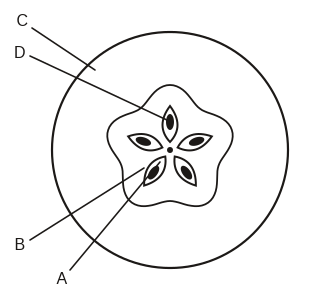
Which part of the fruit, labelled in the given figure makes it a false fruit?

Question diagram
1D → Seed
2A → Mesocarp
3B → Endocarp
4C → Thalamus
NTA Answer: Option 4(final)

Why the other options are wrong

  • Option 1: The seed develops from the ovule and is part of every fruit, so it does not make a fruit false. A fruit is false when the thalamus also contributes to fruit formation, as in apple (C).
  • Option 2: The mesocarp is part of the pericarp, and the wall of the ovary develops into the wall of fruit called pericarp. Parts made from the ovary give a true fruit; the thalamus (C) makes apple a false fruit.
  • Option 3: The endocarp, like the mesocarp, is part of the pericarp, the ovary wall. Most fruits develop only from the ovary and are called true fruits; apple is false because the thalamus also contributes.

Lesson: Birth Control Methods

NEET 2022

Lippe’s loop is a type of contraceptive used as:

1Copper releasing IUD
2Cervical barrier
3Vault barrier
4Non-Medicated IUD
NTA Answer: Option 4(final)

Why the other options are wrong

  • Option 1: Copper releasing IUDs are CuT, Cu7 and Multiload 375. Lippes loop is a non-medicated IUD.
  • Option 2: Lippes loop is an intra uterine device placed in the uterus, not a barrier covering the cervix.
  • Option 3: Vaults are rubber barriers that cover the cervix. Lippes loop is the example NCERT gives of a non-medicated IUD.

Lesson: Female Reproductive System

NEET 2022

At which stage of life the oogenesis process is initiated?

1Adult
2Puberty
3Embryonic development stage
4Birth
NTA Answer: Option 3(final)

Why the other options are wrong

  • Option 1: Not adulthood. Oogenesis is initiated during the embryonic development stage.
  • Option 2: Puberty is when spermatogenesis begins. Oogenesis is initiated during the embryonic development stage, in each fetal ovary.
  • Option 4: By birth it has already begun: no more oogonia are formed and added after birth.

Lesson: Male Reproductive System

NEET 2022

Which of the following statements are true for spermatogenesis but do not hold true for Oogenesis? (a) It results in the formation of haploid gametes (b) Differentiation of gamete occurs after the completion of meiosis (c) Meiosis occurs continuously in a mitotically dividing stem cell population (d) It is controlled by the Luteinising hormone (LH) and Follicle Stimulating Hormone (FSH) secreted by the anterior pituitary (e) It is initiated at puberty Choose the most appropriate answer from the options given below:

1(b), (c) and (e) only
2(c) and (e) only
3(b) and (c) only
4(b), (d) and (e) only
NTA Answer: Option 1(final)

Why the other options are wrong

  • Option 2: Misses (b): spermatids are transformed into spermatozoa by spermiogenesis, after meiosis.
  • Option 3: Misses (e): spermatogenesis begins at puberty, while oogenesis is initiated during the embryonic development stage.
  • Option 4: (d) holds for both: LH and FSH also stimulate follicular development in females. It also misses (c): no more oogonia are formed after birth, while spermatogonia keep multiplying.

Lesson: Male Reproductive System

NEET 2022

Given below are two statements: Statement I : The release of sperms into the seminiferous tubules is called spermiation. Statement II : Spermiogenesis is the process of formation of sperms from spermatogonia. In the light of the above statements, choose the most appropriate answer from the options given below :

1Statement I is incorrect but Statement II is correct
2Both Statement I and Statement II are correct
3Both Statement I and Statement II are incorrect
4Statement I is correct but Statement II is incorrect
NTA Answer: Option 4(final)

Why the other options are wrong

  • Option 1: Reversed. Statement I is correct (sperms are released from the seminiferous tubules by spermiation), and Statement II is wrong: spermiogenesis transforms spermatids into spermatozoa.
  • Option 2: Statement II is wrong: the spermatids are transformed into spermatozoa (sperms) by the process called spermiogenesis, not from spermatogonia.
  • Option 3: Statement I is correct: sperms are finally released from the seminiferous tubules by the process called spermiation.

Lesson: Birth Control Methods

NEET 2022

Match List-I with List-II with respect to methods of Contraception and their respective actions. List-I List-II (a) Diaphragms (i) Inhibit ovulation and Implantation (b) Contraceptive Pills (ii) Increase phagocytosis of sperm within Uterus (c) Intra Uterine Devices (iii) Absence of Menstrual cycle and ovulation following parturition (d) Lactational Amenorrhea (iv) They cover the cervix blocking the entry of sperms Choose the correct answer from the options given below:

1(a) - (iii), (b) - (ii), (c) - (i), (d) - (iv)
2(a) - (iv), (b) - (i), (c) - (iii), (d) - (ii)
3(a) - (iv), (b) - (i), (c) - (ii), (d) - (iii)
4(a) - (ii), (b) - (iv), (c) - (i), (d) - (iii)
NTA Answer: Option 3(final)

Why the other options are wrong

  • Option 1: All four are off. Diaphragms cover the cervix (iv), pills inhibit ovulation and implantation (i), IUDs increase phagocytosis of sperms (ii), and lactational amenorrhea is (iii).
  • Option 2: C and D are swapped. IUDs increase phagocytosis of sperms within the uterus (ii); lactational amenorrhea relies on ovulation and the cycle not occurring during intense lactation following parturition (iii).
  • Option 4: A and B are off. Diaphragms cover the cervix and block the entry of sperms (iv); pills inhibit ovulation and implantation (i).

Lesson: Pollination Fertilization

NEET 2021

The term used for transfer of pollen grains from anthers of one plant to stigma of a different plant which, during pollination, brings genetically different types of pollen grains to stigma, is :

1Cleistogamy
2Xenogamy
3Geitonogamy
4Chasmogamy
NTA Answer: Option 2(final)

Why the other options are wrong

  • Option 1: Cleistogamous flowers are invariably autogamous: there is no chance of cross-pollen landing on the stigma.
  • Option 3: Geitonogamy transfers pollen to another flower of the same plant, so genetically it is similar to autogamy.
  • Option 4: Chasmogamous flowers are similar to flowers of other species with exposed anthers and stigma; the term does not name pollen transfer to a different plant.
NEET 2021

Match List-I with List-II. List-I: (a) Cristae (b) Thylakoids (c) Centromere (d) Cisternae. List-II: (i) Primary constriction in chromosome (ii) Disc-shaped sacs in Golgi apparatus (iii) Infoldings in mitochondria (iv) Flattened membranous sacs in stroma of plastids. Choose the correct answer from the options given below. (a) (b) (c) (d)

1(ii) (iii) (iv) (i)
2(iv) (iii) (ii) (i)
3(i) (iv) (iii) (ii)
4(iii) (iv) (i) (ii)
NTA Answer: Option 4(final)

Why the other options are wrong

  • Option 1: Cristae are not the disc-shaped sacs of the Golgi: the inner membrane of the mitochondrion forms a number of infoldings called the cristae, so (a) is (iii). The Golgi's flat, disc-shaped sacs are the cisternae, so (d) is (ii).
  • Option 2: (a)-(iv) is wrong: the thylakoids, not the cristae, are the organised flattened membranous sacs in the stroma of the chloroplast. The centromere (c) is the primary constriction (i), not (ii).
  • Option 3: The centromere, not the cristae, is the primary constriction: every chromosome essentially has a primary constriction or the centromere. Cristae (a) are mitochondrial infoldings (iii), and cisternae (d) are the Golgi's disc-shaped sacs (ii).

Lesson: Pollination Fertilization

NEET 2021

In some members of which of the following pairs of families, pollen grains retain their viability for months after release?

1Rosaceae ; Leguminosae
2Poaceae ; Rosaceae
3Poaceae ; Leguminosae
4Poaceae ; Solanaceae
NTA Answer: Option 1(final)

Why the other options are wrong

  • Option 2: Poaceae is the wrong member: in some cereals such as rice and wheat, pollen grains lose viability within 30 minutes of their release.
  • Option 3: Poaceae does not fit. Rice and wheat pollen lose viability within 30 minutes; the months-long viability is in Rosaceae, Leguminoseae and Solanaceae.
  • Option 4: Solanaceae is right but Poaceae is not: rice and wheat pollen grains lose viability within 30 minutes of their release.

Lesson: Fertilization Pregnancy

NEET 2021

Receptors for sperm binding in mammals are present on :

1Zona pellucida
2Corona radiata
3Vitelline membrane
4Perivitelline space
NTA Answer: Option 1(final)

Why the other options are wrong

  • Option 2: Not the corona radiata. During fertilisation, a sperm comes in contact with the zona pellucida layer of the ovum and induces the changes that block additional sperms.
  • Option 3: The contact that triggers the block to other sperms is at the zona pellucida layer of the ovum, not a vitelline membrane.
  • Option 4: The perivitelline space is not a binding surface. The sperm comes in contact with the zona pellucida layer of the ovum.

Lesson: Birth Control Methods

NEET 2021

Match List-I with List-II. List-I List-II (a) (b) (c) (d) (i) (ii) (iii) (iv) Vaults IUDs Vasectomy Tubectomy Entry of sperm through Cervix is blocked Removal of Vas deferens Phagocytosis of sperms within the Uterus Removal of fallopian tube Choose the correct answer from the option given below (a) (b) (c) (d)

1(iii) (i) (iv) (ii)
2(iv) (ii) (i) (iiii)
3(i) (iii) (ii) (iv)
4(ii) (iv) (iii) (i)
NTA Answer: Option 3(final)

Why the other options are wrong

  • Option 1: All four are shifted. Vaults cover the cervix (i), IUDs increase phagocytosis of sperms within the uterus (iii), vasectomy removes part of the vas deferens (ii), tubectomy part of the fallopian tube (iv).
  • Option 2: Vaults block entry of sperms through the cervix (i), not tube removal, and IUDs act by phagocytosis of sperms (iii).
  • Option 4: Vaults are barriers covering the cervix (i); in vasectomy, a small part of the vas deferens is removed or tied up (ii), and tubectomy removes part of the fallopian tube (iv).

Lesson: Birth Control Methods

Lesson: Fertilization Pregnancy

Lesson: Flower Structure Gametogenesis

NEET 2020

The plant parts which consist of two generations - one within the other : (a) Pollen grains inside the anther (b) Germinated pollen grain with two male gametes (c) Seed inside the fruit (d) Embryo sac inside the ovule

1(a) and (d)
2(a) only
3(a), (b) and (c)
4(c) and (d)
NTA Answer: Option 1(final)

Why the other options are wrong

  • Option 2: Misses (d): the embryo sac or female gametophyte is located in the nucellus of the ovule, a second generation inside the first.
  • Option 3: (b) and (c) do not fit. The two male gametes are inside the same pollen grain (one gametophyte), and (d) is missing.
  • Option 4: (c) does not fit the gametophyte-within-sporophyte pairing, and (a) is missing: pollen grains represent the male gametophytes, formed inside the anther.

Lesson: Reproductive Health STDs

NEET 2020

Select the option including all sexually transmitted diseases.

1Cancer, AIDS, Syphilis
2Gonorrhoea, Syphilis, Genital herpes
3Gonorrhoea, Malaria, Genital herpes
4AIDS, Malaria, Filaria
NTA Answer: Option 2(final)

Why the other options are wrong

  • Option 1: Cancer is not sexually transmitted. The common STIs NCERT lists include gonorrhoea, syphilis, genital herpes and HIV.
  • Option 3: Malaria is not an STI; it is not in NCERT's list of common STIs.
  • Option 4: Malaria and filaria are not STIs. Of the three, only AIDS (HIV) is in the list.

Lesson: Female Reproductive System

NEET 2020

Meiotic division of the secondary oocyte is completed :

1At the time of fusion of a sperm with an ovum
2Prior to ovulation
3At the time of copulation
4After zygote formation
NTA Answer: Option 1(final)

Why the other options are wrong

  • Option 2: Before ovulation only the secondary oocyte forms; the Graafian follicle ruptures to release the secondary oocyte. Its meiosis completes when a sperm enters.
  • Option 3: Copulation only deposits sperm. The completion of the meiotic division of the secondary oocyte is induced when the sperm comes in contact with the zona pellucida.
  • Option 4: The zygote forms after this division: the sperm's entry induces the completion of the meiotic division, and only then do the nuclei fuse.