Biotechnology and its Applications: past NEET questions with answers (page 1 of 2)

44 questions from NEET 2020, 2021, 2022, 2023, 2024, 2025, 2026, newest first; this page has 22 (2024–2026). Answers verified against NTA official keys.

By year in our set: 2020 (5) · 2021 (2) · 2022 (8) · 2023 (6) · 2024 (9) · 2025 (9) · 2026 (5)

Lesson: Biotech Agriculture Bt GM

NEET 2026

The inactive form of Bt toxin is converted to the active form in the insect gut ______.

1due to alkaline pH
2due to acidic pH
3by proteases
4by nucleases
NTA Answer: Option 1(final)

Why the other options are wrong

  • Option 2: The insect gut is alkaline, not acidic. The toxin becomes active 'due to the alkaline pH of the gut which solubilise the crystals'.
  • Option 3: NCERT puts activation down to 'the alkaline pH of the gut', not to proteases.
  • Option 4: NCERT names the alkaline pH of the gut, not nucleases, as what converts the inactive protoxin to the active toxin.
Lesson: rDNA Process PCR Blotting

NEET 2026

During PCR, primers bind to the DNA strands in the ______ step.

1denaturation
2extension
3annealing
4ligation
NTA Answer: Option 3(final)

Why the other options are wrong

  • Option 1: Denaturation separates the double stranded DNA at high temperature; primers bind in the next step. Each cycle has three steps: (i) Denaturation; (ii) Primer annealing; and (iii) Extension of primers.
  • Option 2: Extension comes after the primers bind: the enzyme extends the primers using the nucleotides provided in the reaction and the genomic DNA as template.
  • Option 4: Ligation is not a PCR step. Each cycle has three steps: (i) Denaturation; (ii) Primer annealing; and (iii) Extension of primers.

Lesson: rDNA Tools Restriction Ligase

NEET 2026

Given below are two statements : Statement I : Plasmids are autonomously replicating DNA. Statement II : Plasmids are extrachromosomal DNA. In the light of the above statements, choose the most appropriate answer from the options given below :

1Both Statement I and Statement II are correct
2Both Statement I and Statement II are incorrect
3Statement I is correct but Statement II is incorrect
4Statement I is incorrect but Statement II is correct
NTA Answer: Option 1(final)

Why the other options are wrong

  • Option 2: Both are correct. A native plasmid is 'autonomously replicating circular extra-chromosomal DNA'.
  • Option 3: Statement II is also correct: plasmids are 'extra-chromosomal DNA'.
  • Option 4: Statement I is also correct: plasmids are 'autonomously replicating'.

Lesson: rDNA Principles

NEET 2026

Given below are two statements : one is labelled as Assertion A and the other is labelled as Reason R. Assertion A : In recombinant DNA technology, lysozyme is used for disrupting bacterial cells while cellulase is for plant cells. Reason R : Isolation of genetic material needs disruption of cells. In the light of the above statements, choose the most appropriate answer from the options given below :

1Both A and R are correct and R is the correct explanation of A
2Both A and R are correct but R is not the correct explanation of A
3A is correct but R is not correct
4A is not correct but R is correct
NTA Answer: Option 1(final)

Why the other options are wrong

  • Option 2: R is the explanation. 'Since the DNA is enclosed within the membranes, we have to break the cell open to release DNA', and lysozyme and cellulase do this.
  • Option 3: R is correct: the cell has to be broken open to release the DNA.
  • Option 4: A is correct. NCERT lists 'lysozyme (bacteria), cellulase (plant cells), chitinase (fungus)'.

Lesson: rDNA Tools Restriction Ligase

NEET 2026

Match List-I with List-II. List-I : A. Transformation, B. Cloning site, C. Selection, D. Ori. List-II : I. Restriction enzyme, II. Transfer DNA to host bacteria, III. Replication, IV. Antibiotic. Choose the correct answer from the options given below :

1A-II, B-I, C-IV, D-III
2A-I, B-II, C-IV, D-III
3A-III, B-IV, C-II, D-I
4A-IV, B-I, C-III, D-II
NTA Answer: Option 1(final)

Why the other options are wrong

  • Option 2: Transformation is not the restriction enzyme. It 'is a procedure through which a piece of DNA is introduced in a host bacterium'. The cloning site is the restriction enzyme's recognition site.
  • Option 3: Transformation is not replication, and ori is not the restriction enzyme. Ori is the sequence 'from where replication starts'.
  • Option 4: Transformation is not the antibiotic, and ori is not DNA transfer. Genes 'encoding resistance to antibiotics' are the selectable markers used in selection.

Lesson: rDNA Process PCR Blotting

NEET 2025

Given below are two statements : Statement I : The DNA fragments extracted from gel electrophoresis can be used in construction of recombinant DNA. Statement II : Smaller size DNA fragments are observed near anode while larger fragments are found near the wells in an agarose gel. In the light of the above statements, choose the most appropriate answer from the options given below :

1Statement I is incorrect but statement II is correct
2Both statement I and statement II are correct
3Both statement I and statement II are incorrect
4Statement I is correct but statement II is incorrect
NTA Answer: Option 2(final)

Why the other options are wrong

  • Option 1: Statement I is also correct: the DNA fragments purified in this way are used in constructing recombinant DNA by joining them with cloning vectors.
  • Option 3: Both are correct. DNA fragments move towards the anode, and the smaller the fragment size, the farther it moves, so small fragments lie near the anode and large ones stay near the wells.
  • Option 4: Statement II is also correct: the smaller the fragment size, the farther it moves towards the anode, so larger fragments remain nearer the wells where the sample was loaded.

Lesson: rDNA Tools Restriction Ligase

NEET 2025

The blue and white selectable markers have been developed which differentiate recombinant colonies from non￾recombinant colonies on the basis of their ability to produce colour in the presence of a chromogenic substrate. Given below are two statements about this method: Statement I : The blue coloured colonies have DNA insert in the plasmid and they are identified as recombinant colonies. Statement II : The colonies without blue colour have DNA insert in the plasmid and are identified as recombinant colonies. In the light of the above statements, choose the most appropriate answer from the options given below:

1Statement I is incorrect but Statement II is correct
2Both Statement I and Statement II are correct
3Both Statement I and Statement II are incorrect
4Statement I is correct but Statement II is incorrect
NTA Answer: Option 1(final)

Why the other options are wrong

  • Option 2: Statement I is incorrect: the presence of a chromogenic substrate gives blue coloured colonies if the plasmid in the bacteria does not have an insert.
  • Option 3: Statement II is correct: with an insert, the colonies do not produce any colour, these are identified as recombinant colonies.
  • Option 4: It is the reverse: blue colonies mean the plasmid does not have an insert, and colonies without colour are identified as recombinant colonies.

Lesson: rDNA Tools Restriction Ligase

Lesson: Biotech Medicine Insulin

Lesson: Biotech Agriculture Bt GM

NEET 2025

Silencing of specific mRNA is possible via RNAi because of

1Non-complementary ssRNA
2Complementary dsRNA
3Inhibitory ssRNA
4Complementary tRNA
NTA Answer: Option 2(final)

Why the other options are wrong

  • Option 1: The RNA must be complementary and double-stranded: silencing of a specific mRNA is due to a complementary dsRNA molecule that binds to and prevents translation of the mRNA.
  • Option 3: Not single-stranded. The silencing agent is a complementary dsRNA molecule that binds to the mRNA and prevents its translation.
  • Option 4: tRNA plays no part here. The method involves silencing of a specific mRNA due to a complementary dsRNA molecule.

Lesson: rDNA Process PCR Blotting

NEET 2025

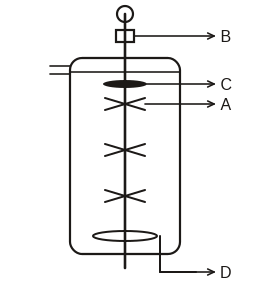
Identify the part of a bio-reactor which is used as a foam braker from the given figure.

Question diagram
1C
2A
3B
4D
NTA Answer: Option 1(final)

Why the other options are wrong

  • Option 2: A is the flat bladed impeller, the stirrer blades in the culture broth. In Figure 9.7 (a) the foam braker is the paddle on the shaft just below the lid, which is C.
  • Option 3: B is the motor at the top of the shaft, which drives the agitator system. The foam braker sits just below it, inside the lid, at C.
  • Option 4: D is where sterile air enters at the base of the vessel, part of the oxygen delivery system. The foam braker, part of the foam control system, is at the top of the shaft, at C.

Lesson: rDNA Process PCR Blotting

Lesson: Biotech Medicine Insulin

NEET 2025

Which of the following genetically engineered organisms was used by Eli Lilly to prepare human insulin?

1Phage
2Bacterium
3Yeast
4Virus
NTA Answer: Option 2(final)

Why the other options are wrong

  • Option 1: Not a phage. Eli Lilly introduced the A and B chain DNA sequences in plasmids of E. coli, a bacterium, to produce insulin chains.
  • Option 3: Not yeast. The two DNA sequences were introduced in plasmids of E. coli to produce insulin chains.
  • Option 4: No virus was the host. Eli Lilly used plasmids of E. coli, a bacterium, to produce the insulin chains.

Lesson: rDNA Tools Restriction Ligase

NEET 2025

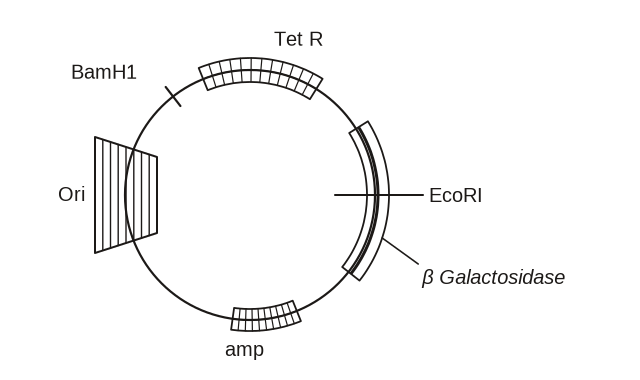
In the above represented plasmid, an alien piece of DNA is inserted at EcoRI site. Which of the following strategies will be chosen to select the recombinant colonies?

Question diagram
1Blue color colonies grown on ampicillin plates can be selected.
2Using ampicillin & tetracycline containing medium plate.
3Blue color colonies will be selected.
4White color colonies will be selected.
NTA Answer: Option 4(final)

Why the other options are wrong

  • Option 1: Blue colonies carry a plasmid with no insert: their β-galactosidase gene still works. The ampicillin plate lets both kinds grow, so it does not pick the recombinants.
  • Option 2: The insert sits in the β-galactosidase gene, so ampR and tetR both stay intact. Recombinant and non-recombinant plasmids grow alike on ampicillin plus tetracycline.
  • Option 3: Blue colour means the β-galactosidase gene is intact, i.e. no insert. Recombinants give white (colourless) colonies by insertional inactivation.

Lesson: rDNA Tools Restriction Ligase

NEET 2024Revised key

Hind II always cuts DNA molecules at a particular point called recognition sequence and it consists of:

18 bp
26 bp
34 bp
410 bp
NTA Answer: Option 2(revised_final)

Why the other options are wrong

  • Option 1: Not 8 bp: Hind II always cut DNA molecules at a particular point by recognising a specific sequence of six base pairs.
  • Option 3: Not 4 bp: its recognition sequence is a specific sequence of six base pairs.
  • Option 4: Not 10 bp: Hind II recognises a specific sequence of six base pairs, known as the recognition sequence for Hind II.

Lesson: Biotech Agriculture Bt GM

NEET 2024Revised key

The capacity to generate a whole plant from any cell of the plant is called:

1Totipotency
2Micropropagation
3Differentiation
4Somatic hybridization
NTA Answer: Option 1(revised_final)

Why the other options are wrong

  • Option 2: Micropropagation is the tissue-culture method of raising many plants. The capacity itself has its own name: this capacity to generate a whole plant from any cell/explant is called totipotency.
  • Option 3: Differentiation is not this capacity. NCERT: this capacity to generate a whole plant from any cell/explant is called totipotency.
  • Option 4: Somatic hybridisation fuses protoplasts of two varieties: these hybrids are called somatic hybrids while the process is called somatic hybridisation. It is not the capacity to regenerate a plant.

Lesson: Biotech Agriculture Bt GM

NEET 2024Revised key

Given below are two statements: Statement I : Bt toxins are insect group specific and coded by a gene cry IAc. Statement II : Bt toxin exists as inactive protoxin in B. thuringiensis. However, after ingestion by the insect the inactive protoxin gets converted into active form due to acidic pH of the insect gut. In the light of the above statements, choose the correct answer from the options given below:

1Both Statement I and Statement II are true
2Both Statement I and Statement II are false
3Statement I is true but Statement II is false
4Statement I is false but Statement II is true
NTA Answer: Option 3(revised_final)

Why the other options are wrong

  • Option 1: Statement II is false. The protoxin is converted to the active form 'due to the alkaline pH of the gut which solubilise the crystals', not an acidic pH.
  • Option 2: Statement I is true: 'Most Bt toxins are insect-group specific', and the toxin is coded by a cry gene such as cryIAc, which controls cotton bollworms.
  • Option 4: It is the other way round. Statement I is true, and Statement II is false because activation needs the alkaline, not acidic, pH of the gut.

Lesson: rDNA Principles

NEET 2024Revised key

What is the fate of a piece of DNA carrying only gene of interest which is transferred into an alien organism? A. The piece of DNA would be able to multiply itself independently in the progeny cells of the organism. B. It may get integrated into the genome of the recipient. C. It may multiply and be inherited along with the host DNA. D. The alien piece of DNA is not an integral part of chromosome. E. It shows ability to replicate. Choose the correct answer from the options given below:

1A and B only
2D and E only
3B and C only
4A and E only
NTA Answer: Option 3(revised_final)

Why the other options are wrong

  • Option 1: A is false: 'Most likely, this piece of DNA would not be able to multiply itself in the progeny cells of the organism.' B is true, but it is not enough alone.
  • Option 2: D and E do not match NCERT. The piece multiplies only 'when it gets integrated into the genome of the recipient', and then it 'may multiply and be inherited along with the host DNA'.
  • Option 4: A and E both claim the piece replicates by itself, which NCERT rules out: it 'would not be able to multiply itself'.

Lesson: Biotech Agriculture Bt GM

NEET 2024Revised key

Which of the following are fused in somatic hybridization involving two varieties of plants?

1Callus
2Somatic embryos
3Protoplasts
4Pollens
NTA Answer: Option 3(revised_final)

Why the other options are wrong

  • Option 1: Callus is not what is fused. The page's fusion starts from single cells whose walls are digested: isolated protoplasts from two different varieties of plants can be fused to get hybrid protoplasts.
  • Option 2: Somatic embryos are not fused. What the page fuses is naked protoplasts (cells with the wall digested away, surrounded by plasma membranes) from the two varieties.
  • Option 4: Pollen grains are not used. The page fuses protoplasts isolated from single plant cells after digesting their cell walls.

Lesson: Biotech Medicine Insulin

NEET 2024Revised key

Match List I with List II : List I List II A. –I antitrypsin I. Cotton bollworm B. Cry IAb II. ADA deficiency C. Cry IAc III. Emphysema D Enzyme replacement therapy IV Corn borer Choose the correct answer form the options given below:

1A-II, B-I, C-IV, D-III
2A-III, B-I, C-II, D-IV
3A-III, B-IV, C-I, D-II
4A-II, B-IV, C-I, D-III
NTA Answer: Option 3(revised_final)

Why the other options are wrong

  • Option 1: α-1-antitrypsin is 'used to treat emphysema', not ADA deficiency, and cryIAb 'controls corn borer', not cotton bollworm.
  • Option 2: Cry IAb controls corn borer, not cotton bollworm, and enzyme replacement therapy is for ADA deficiency: 'functional ADA is given to the patient by injection'.
  • Option 4: α-1-antitrypsin treats emphysema, not ADA deficiency, and enzyme replacement therapy treats ADA deficiency, not emphysema.

Lesson: rDNA Tools Restriction Ligase

NEET 2024Revised key

The “Ti plasmid” of Agrobacterium tumefaciens stands for

1Tumour inhibiting plasmid
2Tumor independent plasmid
3Tumor inducing plasmid
4Temperature independent plasmid
NTA Answer: Option 3(revised_final)

Why the other options are wrong

  • Option 1: Ti means tumor inducing, not inhibiting. NCERT names the tumor inducing plasmid of Agrobacterium tumifaciens, now modified into a cloning vector.
  • Option 2: Ti means tumor inducing, not tumor independent. The plasmid has now been modified into a cloning vector which is no more pathogenic to the plants.
  • Option 4: The T stands for tumor, not temperature: it is the tumor inducing plasmid of Agrobacterium tumifaciens.

Lesson: rDNA Process PCR Blotting

NEET 2024Revised key

Which of the following statements is incorrect?

1A bio-reactor provides optimal growth conditions for achieving the desired product
2Most commonly used bio-reactors are of stirring type
3Bio-reactors are used to produce small scale bacterial cultures
4Bio-reactors have an agitator system, an oxygen delivery system foam control system
NTA Answer: Option 3(revised_final)

Why the other options are wrong

  • Option 1: This statement is correct, so it is not the answer: a bioreactor provides the optimal conditions for achieving the desired product by providing optimum growth conditions.
  • Option 2: This statement is correct: the most commonly used bioreactors are of stirring type.
  • Option 4: This statement is correct: the bioreactor has an agitator system, an oxygen delivery system and a foam control system.