Biotechnology and its Applications: past NEET questions with answers (page 2 of 2)

44 questions from NEET 2020, 2021, 2022, 2023, 2024, 2025, 2026, newest first; this page has 22 (2020–2024). Answers verified against NTA official keys.

By year in our set: 2020 (5) · 2021 (2) · 2022 (8) · 2023 (6) · 2024 (9) · 2025 (9) · 2026 (5)

Lesson: rDNA Tools Restriction Ligase

NEET 2024Revised key
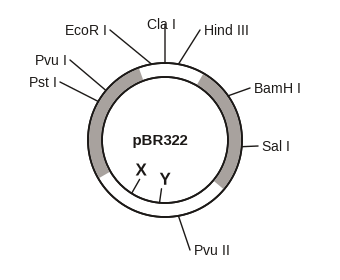
The following diagram shown restriction sites in E. coli cloning vector pBR322. Find the role of ‘X’ and ‘Y’ gens :

Question diagram
1The gene ‘X’ is responsible for resistance to antibiotics and ‘Y’ for protein involved in the replication of Plasmid.
2The gene ‘X’ is responsible for controlling the copy number of the linked DNA and ‘Y’ for protein involved in the replication of Plasmid.
3The gene ‘X’ is for protein involved in replication of Plasmid and ‘Y’ for resistance to antibiotics.
4Gene ’X’ is responsible for recognitions sites and ‘Y’ is responsible for antibiotic resistance
NTA Answer: Option 2(revised_final)

Why the other options are wrong

  • Option 1: X is not an antibiotic resistance gene: in Figure 9.4 those are ampR and tetR, and X sits where the figure has ori, the sequence also responsible for controlling the copy number of the linked DNA. Y is rop, which codes for the proteins involved in the replication of the plasmid.
  • Option 3: The roles are swapped: X is ori, which controls the copy number of the linked DNA, and Y is rop, which codes for the proteins involved in the replication of the plasmid. Neither is an antibiotic resistance gene; those are ampR and tetR.
  • Option 4: The recognition sites are the restriction sites marked around the ring (Hind III, EcoR I, BamH I, Sal I, Pvu II, Pst I, Cla I), not gene X, which is ori. Y is rop, which codes for the proteins involved in the replication of the plasmid, not for antibiotic resistance.

Lesson: rDNA Process PCR Blotting

NEET 2023

Upon exposure to UV radiation, DNA stained with ethidium bromide will show

1Bright blue colour
2Bright yellow colour
3Bright orange colour
4Bright red colour
NTA Answer: Option 3(final)

Why the other options are wrong

  • Option 1: Not blue: you can see bright orange coloured bands of DNA in a ethidium bromide stained gel exposed to UV light.
  • Option 2: Not yellow: the ethidium bromide stained bands appear bright orange under UV light.
  • Option 4: Not red: NCERT describes them as bright orange coloured bands of DNA.

Lesson: rDNA Principles

NEET 2023

During the purification process for recombinant DNA technology, addition of chilled ethanol precipitates out

1DNA
2Histones
3Polysaccharides
4RNA
NTA Answer: Option 1(final)

Why the other options are wrong

  • Option 2: Histones are proteins, and proteins can be removed by treatment with protease. Chilled ethanol precipitates the purified DNA, not histones.
  • Option 3: Polysaccharides are released with the DNA but taken out earlier: other molecules can be removed by appropriate treatments, and then purified DNA ultimately precipitates out after the addition of chilled ethanol.
  • Option 4: RNA is removed before the ethanol step: the RNA can be removed by treatment with ribonuclease.

Lesson: Biotech Agriculture Bt GM

NEET 2023

In gene gun method used to introduce alien DNA into host cells, microparticles of ________ metal are used.

1Zinc
2Tungsten or gold
3Silver
4Copper
NTA Answer: Option 2(final)

Why the other options are wrong

  • Option 1: Not zinc. In the gene gun, cells are bombarded with high velocity micro-particles of gold or tungsten coated with DNA.
  • Option 3: Not silver. The method known as biolistics or gene gun uses micro-particles of gold or tungsten coated with DNA.
  • Option 4: Not copper. NCERT names only gold or tungsten as the metal of the micro-particles in the gene gun.
NEET 2023

Main steps in the formation of Recombinant DNA are given below. Arrange these steps in a correct sequence. A. Insertion of recombinant DNA into the host cell B. Cutting of DNA at specific location by restriction enzyme C. Isolation of desired DNA fragment D. Amplification of gene of interest using PCR Choose the correct answer from the options given below :

1C, A, B, D
2C, B, D, A
3B, D, A, C
4B, C, D, A
NTA Answer: Option multi:2,4(final)

Lesson: rDNA Tools Restriction Ligase

NEET 2023

Which of the following is not a cloning vector?

1YAC
2pBR322
3Probe
4BAC
NTA Answer: Option 3(final)

Why the other options are wrong

  • Option 1: YAC is a vector: in the Human Genome Project the vectors were called as BAC (bacterial artificial chromosomes), and YAC (yeast artificial chromosomes).
  • Option 2: pBR322 is a cloning vector: NCERT shows the E. coli cloning vector pBR322 with its ori and antibiotic resistance genes.
  • Option 4: BAC is a vector too: the vectors were called as BAC (bacterial artificial chromosomes), and YAC (yeast artificial chromosomes).

Lesson: Biotech Medicine Insulin

NEET 2023

Which one of the following techniques does not serve the purpose of early diagnosis of a disease for its early treatment?

1Serum and Urine analysis
2Polymerase Chain Reaction (PCR) technique
3Enzyme Linked Immuno-Sorbent Assay (ELISA) technique
4Recombinant DNA Technology
NTA Answer: Option 1(final)

Why the other options are wrong

  • Option 2: PCR does serve early diagnosis: Recombinant DNA technology, Polymerase Chain Reaction (PCR) and ELISA are some of the techniques that serve the purpose of early diagnosis.
  • Option 3: ELISA is one of the techniques that serve the purpose of early diagnosis, alongside recombinant DNA technology and PCR.
  • Option 4: Recombinant DNA technology is named first among the techniques that serve the purpose of early diagnosis. It is the conventional methods of diagnosis (serum and urine analysis, etc.) that cannot give early detection.

Lesson: rDNA Process PCR Blotting

NEET 2022

Given below are two statements : one is labelled as Assertion (A) and the other is labelled as Reason (R). Assertion (A) : Polymerase chain reaction is used in DNA amplification. Reason (R) : The ampicillin resistant gene is used as a selectable marker to check transformation In the light of the above statements, choose the correct answer from the options given below :

1(A) is not correct but (R) is correct
2Both (A) and (R) are correct and (R) is the correct explanation of (A)
3Both (A) and (R) are correct but (R) is not the correct explanation of (A)
4(A) is correct but (R) is not correct
NTA Answer: Option 3(final)

Why the other options are wrong

  • Option 1: Assertion (A) is correct: PCR stands for Polymerase Chain Reaction, and in it multiple copies of the gene (or DNA) of interest is synthesised in vitro.
  • Option 2: Both are true, but (R) does not explain (A). The ampicillin resistance gene in this case is called a selectable marker; it selects transformed cells and plays no part in amplifying DNA.
  • Option 4: (R) is also correct: due to ampicillin resistance gene, one is able to select a transformed cell in the presence of ampicillin.

Lesson: rDNA Process PCR Blotting

NEET 2022

Which one of the following statement is not true regarding gel electrophoresis technique?

1Bright orange coloured bands of DNA can be observed in the gel when exposed to UV light.
2The process of extraction of separated DNA strands from gel is called elution.
3The separated DNA fragments are stained by using ethidium bromide.
4The presence of chromogenic substrate gives blue coloured DNA bands on the gel.
NTA Answer: Option 4(final)

Why the other options are wrong

  • Option 1: This statement is true, so it is not the answer: you can see bright orange coloured bands of DNA in a ethidium bromide stained gel exposed to UV light.
  • Option 2: This statement is true: the separated bands of DNA are cut out from the agarose gel and extracted from the gel piece, and this step is known as elution.
  • Option 3: This statement is true: the fragments are visualised only after staining the DNA with a compound known as ethidium bromide.

Lesson: rDNA Tools Restriction Ligase

NEET 2022

In the following palindromic base sequences of DNA, which one can be cut easily by particular restriction enzyme?

15′ GTATTC 3′; 3′ CATAAG 5′
25′ GATACT 3′; 3′ CTATGA 5′
35′ GAATTC 3′; 3′ CTTAAG 5′
45′ CTCAGT 3′; 3′ GAGTCA 5′
NTA Answer: Option 3(final)

Why the other options are wrong

  • Option 1: This is not a palindrome. Read 5'→3', the lower strand CATAAG gives GAATAC, not the upper strand's GTATTC. A restriction endonuclease 'recognises a specific palindromic nucleotide sequences', such as 5' GAATTC 3'.
  • Option 2: Read 5'→3', the lower strand is AGTATC, not GATACT, so the two strands do not read the same. The palindrome NCERT shows is 5' GAATTC 3' / 3' CTTAAG 5'.
  • Option 4: Read 5'→3', the lower strand is ACTGAG, not CTCAGT. It is not a palindrome, so it is not the kind of site a restriction enzyme recognises.

Lesson: rDNA Process PCR Blotting

NEET 2022

Transposons can be used during which one of the following ?

1Gene sequencing
2Polymerase Chain Reaction
3Gene Silencing
4Autoradiography
NTA Answer: Option 3(final)

Why the other options are wrong

  • Option 1: NCERT links transposons to RNAi, not to sequencing: the complementary RNA that silences an mRNA can come from mobile genetic elements (transposons) that replicate via an RNA intermediate.
  • Option 2: PCR amplifies DNA with primers and the enzyme DNA polymerase; transposons are not part of it. Their role in NCERT is as a source of the RNA that causes silencing of a specific mRNA.
  • Option 4: Autoradiography only detects a radioactive probe, as in detection using autoradiography of a hybridised clone; transposons have no role there.

Lesson: rDNA Tools Restriction Ligase

NEET 2022

Given below are two statements: Statement I: Restriction endonucleases recognise specific sequence to cut DNA known as palindromic nucleotide sequence. Statement II: Restriction endonucleases cut the DNA strand a little away from the centre of the palindromic site. In the light of the above statements, choose the most appropriate answer from the options given below:

1Statement I is incorrect but Statement II is correct
2Both Statement I and Statement II are correct
3Both Statement I and Statement II are incorrect
4Statement I is correct but Statement II is incorrect
NTA Answer: Option 2(final)

Why the other options are wrong

  • Option 1: Statement I is also correct: each restriction endonuclease recognises a specific palindromic nucleotide sequences in the DNA.
  • Option 3: Both are correct: the enzyme recognises a palindromic sequence, and restriction enzymes cut the strand of DNA a little away from the centre of the palindrome sites.
  • Option 4: Statement II is also correct: restriction enzymes cut the strand of DNA a little away from the centre of the palindrome sites, but between the same two bases on the opposite strands.

Lesson: Biotech Medicine Insulin

NEET 2022

In gene therapy of Adenosine Deaminase (ADA) deficiency, the patient requires periodic infusion of genetically engineered lymphocytes because :

1Genetically engineered lymphocytes are not immortal cells.
2Retroviral vector is introduced into these lymphocytes.
3Gene isolated from marrow cells producing ADA is introduced into cells at embryonic stages
4Lymphocytes from patient's blood are grown in culture, outside the body.
NTA Answer: Option 1(final)

Why the other options are wrong

  • Option 2: A functional ADA cDNA is introduced 'using a retroviral vector', but that is how the cells are made, not why the infusions are repeated. NCERT: 'as these cells are not immortal, the patient requires periodic infusion'.
  • Option 3: Putting the gene into 'cells at early embryonic stages' is what NCERT says 'could be a permanent cure'. Infusions are repeated because the engineered lymphocytes are not immortal.
  • Option 4: Lymphocytes 'are grown in a culture outside the body' as a step of the therapy. The reason for repeating it is that 'these cells are not immortal'.

Lesson: Biotech Medicine Insulin

NEET 2022

Statements related to human Insulin are given below. Which statement(s) is/are correct about genetically engineered Insulin? (a) Pro-hormone insulin contain extra stretch of C-peptide (b) A-peptide and B-peptide chains of insulin were produced separately in E.coli, extracted and combined by creating disulphide bond between them. (c) Insulin used for treating Diabetes was extracted from Cattles and Pigs. (d) Pro-hormone Insulin needs to be processed for converting into a mature and functional hormone. (e) Some patients develop allergic reactions to the foreign insulin. Choose the most appropriate answer from the options given below:

1(c), (d) and (e) only
2(a), (b) and (d) only
3(b) only
4(c) and (d) only
NTA Answer: Option 3(final)

Why the other options are wrong

  • Option 1: (c) and (e) describe the older animal insulin: insulin used for diabetes was earlier extracted from pancreas of slaughtered cattle and pigs, and it caused some patients to develop allergy. (d) describes the natural pro-hormone, not the rDNA product.
  • Option 2: (a) and (d) describe insulin made in the body as a pro-hormone that needs to be processed. In the genetically engineered route, chains A and B were produced separately, so only (b) describes it.
  • Option 4: Neither is about genetically engineered insulin: (c) is the earlier animal source (cattle and pigs), and (d) is the natural pro-hormone. The rDNA step is (b): chains A and B were produced separately, extracted and combined by creating disulfide bonds.

Lesson: rDNA Tools Restriction Ligase

NEET 2022

Which of the following is not a desirable feature of a cloning vector?

1Presence of two or more recognition sites
2Presence of origin of replication
3Presence of a marker gene
4Presence of single restriction enzyme site
NTA Answer: Option 1(final)

Why the other options are wrong

  • Option 2: An ori is needed: any piece of DNA when linked to this sequence can be made to replicate within the host cells.
  • Option 3: A marker is needed: in addition to ori, the vector requires a selectable marker to pick out the transformants.
  • Option 4: A single site is desirable: the vector needs to have very few, preferably single, recognition sites for the commonly used restriction enzymes.

Lesson: Biotech Medicine Insulin

NEET 2021

With regard to insulin choose correct options. (a) C-peptide is not present in mature insulin. (b) The insulin produced by rDNA technology has C￾peptide. (c) The pro-insulin has C-peptide (d) A-peptide and B-peptide of insulin are interconnected by disulphide bridges. Choose the correct answer from the option given below

1(a) and (d) only
2(b) and (d) only
3(b) and (c) only
4(a), (c) and (d) only
NTA Answer: Option 4(final)

Why the other options are wrong

  • Option 1: Misses (c), which is true: insulin is synthesised as a pro-hormone which contains an extra stretch called the C peptide.
  • Option 2: (b) is false: in the rDNA route, chains A and B were produced separately, extracted and combined by creating disulfide bonds, so no C peptide is made. It also misses (a) and (c).
  • Option 3: (b) is false, because Eli Lilly produced chains A and B separately. It also misses (a) and (d): the C peptide is not present in the mature insulin, and chains A and B are linked together by disulphide bridges.

Lesson: Biotech Medicine Insulin

NEET 2021

The Adenosine deaminase deficiency results into

1Addison's disease
2Dysfunction of Immune system
3Parkinson's disease
4Digestive disorder
NTA Answer: Option 2(final)

Why the other options are wrong

  • Option 1: Not Addison's disease. Adenosine deaminase is crucial for the immune system to function, so its deficiency is an immune disorder.
  • Option 3: Not Parkinson's disease. This enzyme is crucial for the immune system to function; the disorder is caused due to the deletion of the gene for adenosine deaminase.
  • Option 4: Not a digestive disorder. NCERT says this enzyme is crucial for the immune system to function, and the gene therapy introduces a functional ADA cDNA into the patient's lymphocytes.

Lesson: Biotech Medicine Insulin

NEET 2020

Match the following columns and select the correct option. Column - I Column - II (a) Bt cotton (i) Gene therapy (b) Adenosine (ii) Cellular defence deaminase deficiency (c) RNAi (iii) Detection of HIV infection (d) PCR (iv) Bacillus thuringiensis (a) (b) (c) (d)

1(i) (ii) (iii) (iv)
2(iv) (i) (ii) (iii)
3(iii) (ii) (i) (iv)
4(ii) (iii) (iv) (i)
NTA Answer: Option 2(final)

Why the other options are wrong

  • Option 1: Bt cotton is not gene therapy. It resists insects because the Bt toxin gene, from 'a bacterium called Bacillus thuringiensis', was cloned and expressed in the plant. Gene therapy was first given in 1990 for adenosine deaminase (ADA) deficiency.
  • Option 3: PCR is not gene therapy, and Bt cotton does not detect HIV. NCERT: 'PCR is now routinely used to detect HIV in suspected AIDS patients'. Bt cotton goes with Bacillus thuringiensis.
  • Option 4: RNAi is not Bacillus thuringiensis. It 'takes place in all eukaryotic organisms as a method of cellular defense'. PCR detects HIV; it is not gene therapy.

Lesson: rDNA Tools Restriction Ligase

NEET 2020

Identify the wrong statement with regard to Restriction Enzymes.

1Sticky ends can be joined by using DNA ligases.
2Each restriction enzyme functions by inspecting the length of a DNA sequence.
3They cut the strand of DNA at palindromic sites.
4They are useful in genetic engineering.
NTA Answer: Option 1(final)

Why the other options are wrong

  • Option 2: NCERT states this as true: each restriction endonuclease works by 'inspecting' the length of a DNA sequence until it finds its recognition sequence. NTA's final key marks (1) instead: joining sticky ends is done by DNA ligase, not by a restriction enzyme, although NCERT states the sentence itself as true (p7).
  • Option 3: True: each restriction enzyme recognises a specific palindromic sequence and cuts both strands there, a little away from the centre of the palindrome. NTA's key marks (1), because joining sticky ends is done by DNA ligase, not by the restriction enzyme.
  • Option 4: True: restriction enzymes are the 'molecular scissors' of recombinant DNA technology. NTA's key marks (1), because joining sticky ends is a ligase property, not a restriction enzyme one, even though the sentence itself is true.

Lesson: rDNA Tools Restriction Ligase

NEET 2020

The sequence that controls the copy number of the linked DNA in the vector, is termed :

1Recognition site
2Selectable marker
3Ori site
4Palindromic sequence
NTA Answer: Option 3(final)

Why the other options are wrong

  • Option 1: A recognition site is where a restriction enzyme cuts; it does not set copy number. The ori sequence is also responsible for controlling the copy number of the linked DNA.
  • Option 2: A selectable marker helps in identifying and eliminating non-transformants; the copy number is controlled by ori.
  • Option 4: A palindromic sequence is what a restriction endonuclease recognises in the DNA; it does not control copy number.

Lesson: rDNA Process PCR Blotting

NEET 2020

In gel electrophoresis, separated DNA fragments can be visualized with the help of :

1Ethidium bromide in infrared radiation
2Acetocarmine in bright blue light
3Ethidium bromide in UV radiation
4Acetocarmine in UV radiation
NTA Answer: Option 3(final)

Why the other options are wrong

  • Option 1: The exposure is to UV, not infrared: staining the DNA with a compound known as ethidium bromide followed by exposure to UV radiation.
  • Option 2: Neither acetocarmine nor blue light is used. The stain is ethidium bromide, followed by exposure to UV radiation.
  • Option 4: The stain is ethidium bromide, not acetocarmine: the separated DNA fragments can be visualised only after staining the DNA with a compound known as ethidium bromide.

Lesson: rDNA Tools Restriction Ligase

NEET 2020

Choose the correct pair from the following :

1Exonucleases - Make cuts at specific positions within DNA
2Ligases - Join the two DNA molecules
3Polymerases - Break the DNA into fragments
4Nucleases - Separate the two strands of DNA
NTA Answer: Option 2(final)

Why the other options are wrong

  • Option 1: That describes endonucleases. Exonucleases remove nucleotides from the ends of the DNA whereas, endonucleases make cuts at specific positions within the DNA.
  • Option 3: Polymerases build DNA rather than break it: DNA-dependent DNA polymerase uses a DNA template to catalyse the polymerisation of deoxynucleotides.
  • Option 4: Nucleases cut DNA; they do not separate its strands. Exonucleases remove nucleotides from the ends, and endonucleases make cuts at specific positions within the DNA.