NEET 2026
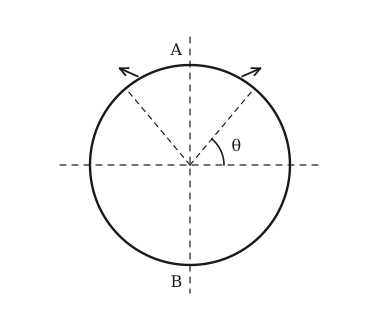
1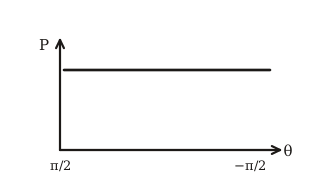
2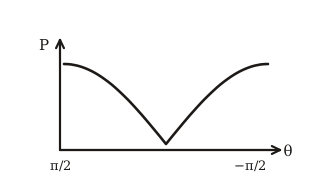
3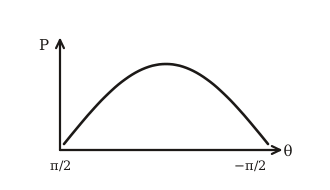
4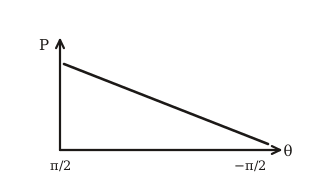
NTA Answer: Option 3(final)
16 lessons
16 of 16 lessons by the NCERT chapter they teach from, in book order. The page is the first printed page of your NCERT book the lesson cites; PYQs are the past NEET questions on that topic.
13 questions from NEET 2020, 2021, 2022, 2023, 2024, 2025, 2026. Answers verified against NTA official keys.
By year in our set: 2020 (1) · 2021 (1) · 2022 (2) · 2023 (2) · 2024 (2) · 2025 (3) · 2026 (2)
Lesson: Momentum
Lesson: Vehicle Banked Road
Lesson: Static Friction
Lesson: Impulse
Lesson: Equilibrium Concurrent Forces
Lesson: Newton 2
A particle moving with uniform speed in a circular path maintains:
Lesson: Newton 2
Lesson: Static Friction
Lesson: Conservation Linear Momentum
Lesson: Impulse
Lesson: Newton 2
Lesson: Conservation Linear Momentum
Category: Sign Convention
Student adds magnitudes of momenta of fragments instead of vectors; ignores cancellation when fragments fly perpendicular or in opposite directions.
Question describes a body at rest exploding into multiple fragments with given mass ratios and partial velocity info.
Total momentum is a VECTOR. Initial p = 0; therefore Σ m_i v_i = 0 as a vector equation. Decompose along chosen axes (often natural symmetry axes); sum = 0 in each.
Lesson: Equilibrium Concurrent Forces
Category: Overthinking
Student takes torque about the centre of mass (introducing all 4 forces with non-zero moment arms) instead of about the floor contact (where 2 forces have zero moment arm and the equation simplifies).
Question gives a uniform rod or ladder leaning against a wall; asks for friction coefficient or limiting condition.
Pick the pivot to ELIMINATE unknown forces from the torque equation. Floor-contact pivot: normal force and friction at floor contribute zero torque; only weight (mid-length) and wall normal (top) appear. Result: μ_min = 1 / (2 tan θ).
Lesson: Equilibrium Concurrent Forces
Category: Overthinking
Student tries to apply F=ma to the system as a whole (using net force = (m1-m2)g and total mass m1+m2) but loses track of the tension. The correct approach writes Newton's Second Law SEPARATELY for each mass and treats T as an unknown in two simultaneous equations.
Question contains a frictionless pulley with two unequal masses tied to a string. Asks for tension T or acceleration a (or both).
Draw a free-body diagram for EACH mass. Write F=ma per body, treating T as the same magnitude on both sides of the string. Solve simultaneously: a = (m1 - m2) g / (m1 + m2); T = 2 m1 m2 g / (m1 + m2).
Lesson: Equilibrium Concurrent Forces
Category: Negative Marking
Multi-mass pulley problem requires computing acceleration first, then tension. T = 2 m1 m2 g/(m1+m2). Sign errors in m1−m2 propagate.
Atwood machine or pulley system with multiple masses.
Compute a = (m1-m2)g/(m1+m2) first with m1 the heavier mass and downward as positive. Then T from F=ma on either mass. Always re-check by plugging back into both Newton's 2nd Law equations.
Lesson: Impulse
Category: Sign Convention
Student forgets that velocity DIRECTION reverses on bounce; computes |v₁ - v₂| instead of |v₁ + v₂|.
Question describes ball dropped from height h₁, rebounding to height h₂; asks for impulse on ball.
Impulse J = Δp = m(v_after - v_before). Take down as positive: v_before = +v₁, v_after = -v₂. So J = m(-v₂ - v₁) = -m(v₁ + v₂); magnitude = m(v₁ + v₂).
Lesson: Kinetic Friction
Category: Sign Convention
Student writes a = g sin θ for a rough incline (which is the smooth-incline answer); forgets to subtract μ g cos θ.
Question contrasts rough vs smooth inclines, or asks for acceleration on a rough incline.
On a rough incline (block sliding down): a = g(sin θ - μ_k cos θ). On a rough incline (block sliding up): a = -g(sin θ + μ_k cos θ). Smooth case (μ = 0): just g sin θ.
Lesson: Momentum
Category: Sign Convention
Student picks the direction of MOTION as the direction of the net force, instead of the direction of the change in momentum (Δp). When velocity changes direction at constant speed, the force is perpendicular to BOTH the initial and final velocity vectors (in the limit) — it's the direction of Δv.
Question describes a body changing direction (e.g. turning) and asks for the force direction or the direction of Δp.
F ∝ Δp = m Δv = m (v_f − v_i). Always draw v_i and v_f as vectors and subtract; the result (v_f − v_i) is the direction of net force.
Lesson: Newton 2
Category: Unit Conversion
Student computes μmg (friction FORCE in Newtons) when asked for the friction-limited ACCELERATION. The two differ by a factor of m: a = μg, F = μmg.
Question gives μ, g, and a body's mass and asks for the maximum acceleration of the supporting surface OR the friction force on the body.
Read carefully: 'maximum acceleration of the vehicle so the body stays still' = μg (no mass). 'Friction force on the body' = μmg (mass present). Units expose the error: N for force, m/s² for acceleration.
Lesson: Newton 2
Category: Overthinking
Student applies the full external force F to a single block instead of recognising the system needs to be analysed for the contact (internal) force.
Question gives horizontal force F on block A which pushes block B; asks for contact force between A and B or acceleration.
System acceleration: a = F / (m_A + m_B). Contact force on B from A = m_B × a. The full F acts on the system, not on each block independently.
Lesson: Newton 2
Category: Overthinking
Student computes P = Mgv (just lifting against gravity) and ignores the friction-opposing-motion term.
Question describes a lift moving at constant speed with explicit friction force on cable or guides.
At constant speed, net force = 0, so cable tension T = Mg + f_friction. Power = T × v = (Mg + f) × v. Always add friction when stated.
Unit-wide
Category: Similar Terms
Student claims velocity is constant in uniform circular motion (it's not — direction changes).
Question asks 'in uniform circular motion at constant speed, which is also constant?'
In UCM: SPEED constant; KE constant. VELOCITY (vector) NOT constant. ACCELERATION (centripetal, magnitude v²/r) constant in MAGNITUDE but NOT in direction.
Lesson: Centripetal Force
Root cause: concept gap
Centripetal force is NOT a new fundamental force. It is the NET inward radial component of the real forces (tension, friction, normal, gravity, etc.). On a free-body diagram, draw only the real forces; their net inward component must equal m*v^2/r.
Distractor sums tension + 'centripetal force' as separate inward forces.
Lesson: Conservation Linear Momentum
Root cause: concept gap
Linear momentum is conserved only when the net EXTERNAL force is zero. Gravity over a finite time changes momentum. For collision problems we use conservation because the collision happens over a brief time interval where external impulses are negligible compared to internal collision forces.
Distractor sets initial momentum = final momentum for a free-fall problem where gravity has acted for several seconds.
Lesson: Equilibrium Concurrent Forces
Root cause: concept gap
Action-reaction pairs ALWAYS act on DIFFERENT bodies. The pair to the book's weight is the gravitational pull the book exerts on the Earth. The pair to the normal force from table on book is the force the book exerts on the table. Equal-and-opposite forces on the SAME body are an equilibrium statement, not third-law statement.
Distractor labels two forces on the same body as a Newton's-third-law pair.
Lesson: Impulse
Root cause: unit error
Impulse J has dimensions of momentum (kg*m/s) and equals F*Delta_t. Force has dimensions kg*m/s^2. Confusing them inflates or deflates an answer by a factor of seconds. Always check units before declaring an answer.
Distractor reports an answer in newtons where the correct answer is in N*s (or vice versa).
Lesson: Laws of Friction
Root cause: formula misuse
Static friction is SELF-ADJUSTING: f_s exactly cancels the applied tangential force up to a ceiling f_s_max = mu_s * N. Below the ceiling, f_s = applied force. At the ceiling, motion is impending. Substituting mu_s * N too early over-estimates the friction.
Distractor uses mu_s * N for the static friction force in a no-slip scenario where the applied force is well below threshold.
Lesson: Centripetal Force
On a road banked at angle theta from horizontal with tyre-road friction coefficient mu_s, this is the maximum speed for safe negotiation of a curve of radius r.
| Symbol | Quantity | SI Unit |
|---|---|---|
| v_max | Maximum safe speed | m/s |
| g | Gravitational acceleration | m/s^2 |
| r | Radius of the curve | m |
| mu_s | Coefficient of static friction | (dimensionless) |
| theta | Banking angle | rad/deg |
Lesson: Centripetal Force
The net inward force required to keep a body of mass m moving in a circle of radius r at speed v is m*v^2/r. This 'centripetal' force is NOT a new fundamental force — it is whichever real force (tension, friction, gravity, etc.) provides the inward acceleration.
| Symbol | Quantity | SI Unit |
|---|---|---|
| F_c | Centripetal force | N |
| m | Mass of the body | kg |
| v | Tangential speed | m/s |
| r | Radius of the circle | m |
| omega | Angular speed | rad/s |
Lesson: Centripetal Force
Static friction is the only force available to provide centripetal acceleration on a level road. Setting mu_s*N = m*v^2/r and N = m*g gives this maximum-safe speed bound.
| Symbol | Quantity | SI Unit |
|---|---|---|
| v_max | Maximum safe speed (no skid) | m/s |
| mu_s | Coefficient of static friction (tyre vs road) | (dimensionless) |
| g | Gravitational acceleration | m/s^2 |
| r | Radius of the circular path | m |
Lesson: Conservation Linear Momentum
If the net external force on a system of particles is zero, the total linear momentum of the system is conserved (vector equality of total p before and after any internal interaction). Basis of all collision and recoil analysis.
| Symbol | Quantity | SI Unit |
|---|---|---|
| F_ext | Net external force on system | N |
| p_total | Sum of m_i*v_i over all particles | kg*m/s |
Lesson: Dynamics UCM
An object moving in a circle of radius r at constant speed v has acceleration of magnitude v^2/r (or equivalently omega^2 * r) directed toward the centre. This is centripetal (radially inward), not tangential.
| Symbol | Quantity | SI Unit |
|---|---|---|
| a_c | Centripetal acceleration | m/s^2 |
| v | Tangential speed | m/s |
| r | Radius of circle | m |
| omega | Angular speed | rad/s |
Lesson: Equilibrium Concurrent Forces
The net external force on a body equals the rate of change of its linear momentum. For a body of constant mass, this reduces to F = m*a — net force equals mass times acceleration. Both F and a are vectors; the acceleration is in the direction of the net force.
| Symbol | Quantity | SI Unit |
|---|---|---|
| F | Net external (vector) force | N |
| m | Mass of the body | kg |
| a | Acceleration (vector) | m/s^2 |
| p | Linear momentum (= m*v) | kg*m/s |
| t | Time | s |
Lesson: Impulse
Impulse equals the product of force and the time interval over which it acts. By Newton's Second Law, impulse equals the change in linear momentum during that interval.
| Symbol | Quantity | SI Unit |
|---|---|---|
| J | Impulse (vector) | N*s = kg*m/s |
| F | Force (treated as average) | N |
| Delta_t | Time interval | s |
| Delta_p | Change in momentum | kg*m/s |
Lesson: Kinetic Friction
When two surfaces slide relative to each other, kinetic friction opposes the motion with magnitude proportional to the normal force.
| Symbol | Quantity | SI Unit |
|---|---|---|
| f_k | Kinetic friction force | N |
| mu_k | Coefficient of kinetic friction | (dimensionless) |
| N | Normal force | N |
Lesson: Laws of Friction
The maximum value of static friction between two surfaces in contact equals the coefficient of static friction times the normal force. Below f_s_max, static friction self-adjusts to whatever value is needed to prevent relative motion.
| Symbol | Quantity | SI Unit |
|---|---|---|
| f_s_max | Maximum static friction | N |
| mu_s | Coefficient of static friction | (dimensionless) |
| N | Normal force | N |
Lesson: Conservation Linear Momentum
scalar sum of momenta
Treating momentum as scalar; ignores vector cancellation
Lesson: Dynamics UCM
treats velocity as scalar
Conflates speed (scalar) with velocity (vector)
Lesson: Equilibrium Concurrent Forces
torque about wrong pivot
Default pivot at center of mass adds complexity
Lesson: Equilibrium Concurrent Forces
uses g where a belongs
Forgetting that the system accelerates, so weight is balanced by net force minus T
confuses tension with weight
Treating T = m·g for one of the masses (which is true only when a=0)
Lesson: Impulse
subtracts v2 from v1 instead of adding
Forgetting velocity DIRECTION reversal at bounce
Lesson: Kinetic Friction
ignores mu cos theta term
Forgetting the friction-along-incline component
Lesson: Laws of Friction
uses mu times g times mass
Confusing force (μ·N = μmg) with acceleration
Lesson: Momentum
force along final velocity
Default to thinking force points in direction of motion
force along initial velocity
Newton-1 misread: object 'wants' to keep moving in original direction
Lesson: Newton 2
treats each block with full F
Forgetting Newton's 3rd law internal force decomposition
Lesson: Newton 2
forgets friction term
Ignoring opposing force