Genetics and Evolution: past NEET questions with answers (page 1 of 2)

81 questions from NEET 2020, 2021, 2022, 2023, 2024, 2025, 2026, newest first; this page has 41 (2023–2026). Answers verified against NTA official keys.

By year in our set: 2020 (6) · 2021 (10) · 2022 (14) · 2023 (12) · 2024 (15) · 2025 (13) · 2026 (11)

Lesson: Mutations Genetic Disorders

NEET 2026

Given below are two statements : Statement I : Down's syndrome is caused by the absence of one of the X-chromosomes. Statement II : Turner's syndrome is caused by the presence of an additional copy of the chromosomes. In the light of the above statements, choose the correct answer from the options given below :

1Both Statement I and Statement II are correct
2Both Statement I and Statement II are incorrect
3Statement I is correct but Statement II is incorrect
4Statement I is incorrect but Statement II is correct
NTA Answer: Option 2(final)

Why the other options are wrong

  • Option 1: Both statements are wrong on the page: Down's syndrome is an additional copy of chromosome 21, and Turner's syndrome is the absence of one X chromosome.
  • Option 3: Statement I is incorrect: absence of one of the X chromosomes is Turner's syndrome, while Down's syndrome is trisomy of 21.
  • Option 4: Statement II is incorrect: the page says Turner's syndrome is caused by the absence of one of the X chromosomes (45, X0), not an additional copy.
Lesson: Natural Selection Drift

NEET 2026

Natural selection can lead to ______. (a) stabilisation (b) genetic drift (c) directional change (d) disruption. Choose the correct answer from the options given below :

1(a) only
2(a), (c) and (d) only
3(a), (b), (c) and (d)
4(a) and (c) only
NTA Answer: Option 2(final)

Why the other options are wrong

  • Option 1: Stabilisation alone is incomplete: the page says natural selection can lead to stabilisation, directional change or disruption.
  • Option 3: Genetic drift is not an outcome of natural selection on the page; it is a change in allele frequency by chance.
  • Option 4: This leaves out disruption, the third outcome the page lists, in which more individuals acquire peripheral values at both ends.

Lesson: Hardy Weinberg Principle

NEET 2026

A population of diploid organisms is at Hardy-Weinberg equilibrium. If the frequency of allele A is 0.1, the frequency of AA is ______.

10.01
20.02
30.10
40.99
NTA Answer: Option 1(final)

Why the other options are wrong

  • Option 2: 0.02 is 2 × 0.1 × 0.1. The page gives the frequency of AA individuals as p², which is 0.1 × 0.1 = 0.01.
  • Option 3: 0.10 is p itself, the allele frequency; the frequency of AA individuals is p² = 0.01.
  • Option 4: 0.99 is 1 − p², the frequency of everyone who is not AA; AA alone is p² = 0.01.

Lesson: Gene Regulation Lac Operon

NEET 2026

Which of the following statements about lac-operon is correct ?

1Gene i is constitutively expressed
2Lactose activates repressor to bind to the operator
3Genes i, z, y and a share single common promoter
4Galactose can act as an inducer of lac operon
NTA Answer: Option 1(final)

Why the other options are wrong

  • Option 2: Lactose does the opposite: in the presence of an inducer, such as lactose or allolactose, the repressor is inactivated by interaction with the inducer, which frees the operator.
  • Option 3: Only the structural genes share the promoter: in lac operon a polycistronic structural gene (z, y, a) is regulated by a common promoter. The i gene is the separate regulatory gene that codes for the repressor and is expressed all the time.
  • Option 4: NCERT says the reverse: glucose or galactose cannot act as inducers for lac operon. Lactose or allolactose is the inducer.

Lesson: Evidences Evolution

NEET 2026

Which of the following is not evidence for evolution ?

1Convergent evolution of traits like wings of birds and butterflies
2Paleontological evidence from fossil records
3Embryological support for evolution as proposed by Ernst Heckel
4Divergent evolution of anatomical structures such as forelimbs
NTA Answer: Option 3(final)

Why the other options are wrong

  • Option 1: Convergent evolution is evidence for evolution. 'Wings of butterfly and of birds look alike', and 'analogous structures are a result of convergent evolution'.
  • Option 2: Fossils are evidence. Fossils of different life-forms in different rock layers show that life-forms varied over time: 'All this is called paleontological evidence.'
  • Option 4: Divergent evolution is evidence. The forelimbs of whales, bats, cheetah and humans share one pattern of bones, which 'is divergent evolution and these structures are homologous'.

Lesson: Hominid Evolution

NEET 2026

Given below are two statements : Statement I : Modern Homo sapiens arose in Australia and moved across continents. Statement II : Homo sapiens arose around 75000 to 10000 years ago. In the light of the above statements, choose the most appropriate answer from the options given below :

1Both Statement I and Statement II are correct
2Both Statement I and Statement II are incorrect
3Statement I is correct but Statement II is incorrect
4Statement I is incorrect but Statement II is correct
NTA Answer: Option 4(final)

Why the other options are wrong

  • Option 1: Statement I is wrong: Homo sapiens arose in Africa and moved across continents, not in Australia.
  • Option 2: Statement II is correct: during ice age between 75,000-10,000 years ago modern Homo sapiens arose. Only Statement I is incorrect.
  • Option 3: The reverse is true: Homo sapiens arose in Africa (Statement I is wrong), and modern Homo sapiens arose between 75,000-10,000 years ago (Statement II is right).

Lesson: Evidences Evolution

NEET 2026

Adaptive radiation in placental mammals and Australian Marsupials leading to similarity between distant species is an example of ______.

1divergent evolution
2convergent evolution
3founder effect
4genetic drift
NTA Answer: Option 2(final)

Why the other options are wrong

  • Option 1: Divergent evolution is one ancestral form spreading into different forms. Here each placental mammal appears similar to a corresponding marsupial, and when more than one adaptive radiation appeared to have occurred in an isolated geographical area, one can call this convergent evolution.
  • Option 3: The founder effect is a chance change in gene frequency in a small new population; it does not make two separate radiations produce look-alikes. The book calls the placental-marsupial similarity convergent evolution.
  • Option 4: Genetic drift changes allele frequencies by chance and does not make distant species resemble each other. Parallel radiations of Australian marsupials and placental mammals are convergent evolution.

Lesson: Transcription Translation

NEET 2026

Which of the following enzymes synthesizes precursor mRNA ?

1RNA polymerase I
2RNA polymerase II
3RNA polymerase III
4DNA polymerase
NTA Answer: Option 2(final)

Why the other options are wrong

  • Option 1: RNA polymerase I transcribes rRNAs (28S, 18S and 5.8S), not the precursor of mRNA.
  • Option 3: RNA polymerase III transcribes tRNA, 5srRNA and snRNAs; the precursor of mRNA (hnRNA) is made by RNA polymerase II.
  • Option 4: DNA-dependent DNA polymerase uses a DNA template to polymerise deoxynucleotides in replication (p12); the page says RNA polymerase II transcribes the precursor of mRNA, hnRNA (p17).

Lesson: Incomplete Dominance Codominance

NEET 2026

For a person with blood group 'O', which of the following is not a possible combination of parents' blood group genotypes ?

1Father : Iᴬ i and Mother : Iᴮ i
2Father : Iᴬ i and Mother : Iᴬ i
3Father : Iᴮ i and Mother : Iᴮ i
4Father : Iᴬ Iᴮ and Mother : Iᴬ i
NTA Answer: Option 4(final)

Why the other options are wrong

  • Option 1: IAi × IBi can give an O child: each parent can pass i, and a person with two i alleles expresses neither sugar (group O).
  • Option 2: IAi × IAi can give ii, an O child: IA is completely dominant over i, so both parents are group A yet each carries i.
  • Option 3: IBi × IBi can give ii, an O child, because each parent carries one i. Only IAIB × IAi cannot: the IAIB father has no i to pass.

Lesson: Evidences Evolution

NEET 2026

Given below are two statements : one is labelled as Assertion A and the other is labelled as Reason R. Assertion A : Forelimbs of human and bats are homologous. Reason R : Forelimbs of humans and bats have similar anatomical structure. In the light of the above statements, choose the most appropriate answer from the options given below :

1Both A and R are correct and R is the correct explanation of A
2Both A and R are true, but R is not the correct explanation of A
3A is true but R is false
4A is false but R is true
NTA Answer: Option 1(final)

Why the other options are wrong

  • Option 2: R does explain A: the page says these forelimbs have similar anatomical structure and that such structures are homologous.
  • Option 3: R is true: the page says the forelimbs of whales, bats, cheetah and human have similar anatomical structure, all with humerus, radius, ulna, carpals, metacarpals and phalanges.
  • Option 4: A is true: the page calls these forelimbs homologous structures, the result of divergent evolution.

Lesson: Mendel Inheritance

NEET 2026

Given below are two statements : one is labelled as Assertion A and the other is labelled as Reason R. Assertion A : In an experiment, Mendel observed that the F1 progeny plants are all tall and none are dwarf. Reason R : Stem height is a contrasting trait, with tall being dominant and dwarf being recessive. In the light of the above statements, choose the most appropriate answer from the options given below :

1Both A and R are correct and R is the correct explanation of A
2Both A and R are correct but R is not the correct explanation of A
3A is correct but R is not correct
4A is not correct but R is correct
NTA Answer: Option 1(final)

Why the other options are wrong

  • Option 2: R does explain A: the page says the law of dominance explains the expression of only one of the parental characters in a monohybrid cross in the F1.
  • Option 3: R holds: tall or dwarf plants is one of Mendel's contrasting traits (p4), and in a dissimilar pair one factor dominates the other (p9), which is why the F1 is all tall.
  • Option 4: A is correct: an all-tall F1 is the expression of only one parental character in a monohybrid cross, which the page explains by the law of dominance.

Lesson: Mendel Inheritance

NEET 2025

Genes R and Y follow independent assortment. If RRYY produce round yellow seeds and rryy produce wrinkled green seeds, what will be the phenotypic ratio of the F2 generation?

1Phenotypic ratio - 9 : 7
2Phenotypic ratio - 1 : 2 : 1
3Phenotypic ratio - 3 : 1
4Phenotypic ratio - 9 : 3 : 3 : 1
NTA Answer: Option 4(final)

Why the other options are wrong

  • Option 1: The page gives 9:3:3:1 as the ratio expected when two genes are independent; 9:7 does not appear.
  • Option 2: 1:2:1 is the ratio for one gene with incomplete dominance on the page, not a dihybrid F2.
  • Option 3: 3:1 is the F2 ratio for one character (law of dominance on the page), not for two independent genes.

Lesson: Mendelian Disorders Pedigree

NEET 2025

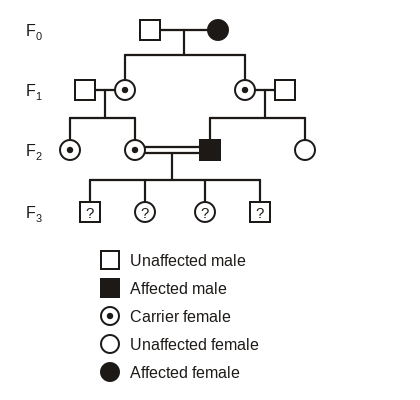
With the help of given pedigree, find out the probability for the birth of a child having no disease and being a carrier (has the disease mutation in one allele of the gene) in F3 generation.

Question diagram
1Zero
21/4
31/2
41/8
NTA Answer: Option 2(final)

Why the other options are wrong

  • Option 1: Zero would mean no F3 child can be an unaffected carrier. Read as X-linked recessive, the F2 cross is a carrier mother (XᶜX) and an affected father (XᶜY); every daughter gets the father's Xᶜ, and half of them get the mother's normal X, so 1 child in 4 is an unaffected carrier daughter.
  • Option 3: 1/2 is what the cross gives if the trait is autosomal recessive: carrier Aa x affected aa makes half the children Aa. The pedigree does not rule that out, because the unaffected F1 father of the affected F2 son could be a silent autosomal carrier. NTA's final key marks (2), 1/4, reading the trait as X-linked recessive (the legend has a carrier symbol for females only), and the key is kept as NTA published it.
  • Option 4: 1/8 needs one more factor of 1/2 than the cross has. Read as X-linked recessive, carrier mother (XᶜX) x affected father (XᶜY) gives four equally likely children: XᶜXᶜ affected daughter, XᶜX carrier daughter, XᶜY affected son, XY normal son. One in four is an unaffected carrier.

Lesson: Genetic Code

NEET 2025

Who proposed that the genetic code for amino acids should be made up of three nucleotides?

1Franklin Stahl
2George Gamow
3Francis Crick
4Jacque Monod
NTA Answer: Option 2(final)

Why the other options are wrong

  • Option 1: The page credits the physicist George Gamow, not Franklin Stahl, with proposing that the code be made up of three nucleotides.
  • Option 3: The page credits the three-nucleotide proposal to George Gamow, not Francis Crick.
  • Option 4: Jacque Monod appears in the chapter with Francois Jacob for the lac operon (p22); the page credits the triplet proposal to George Gamow.

Lesson: Evidences Evolution

NEET 2025

Sweet potato and potato represent a certain type of evolution. Select the correct combination of terms to explain the evolution.

1Analogy, divergent
2Analogy, convergent
3Homology, divergent
4Homology, convergent
NTA Answer: Option 2(final)

Why the other options are wrong

  • Option 1: Analogy is right for sweet potato and potato, but the page links analogous structures to convergent, not divergent, evolution.
  • Option 3: The page gives sweet potato (root modification) and potato (stem modification) as an example of analogy, not homology; homology goes with divergent evolution.
  • Option 4: The pair is an example of analogy on the page, not homology, so this fails on the first term even though convergent is right for analogy.

Lesson: Genetic Material DNA Packaging

NEET 2025

Histones are enriched with -

1Phenylalanine & Arginine
2Lysine & Arginine
3Leucine & Lysine
4Phenylalanine & Leucine
NTA Answer: Option 2(final)

Why the other options are wrong

  • Option 1: The page says histones are rich in lysine and arginine; phenylalanine is not one of them.
  • Option 3: Lysine is correct but leucine is not named; the page pairs lysine with arginine as the basic residues of histones.
  • Option 4: Neither phenylalanine nor leucine is named on the page; histones are rich in the basic residues lysine and arginine.

Lesson: Transcription Translation

Lesson: Sex Determination Linkage

Lesson: Genetic Material DNA Packaging

NEET 2025

Given below are two statements : Statement I : In the RNA world, RNA is considered the first genetic material evolved to carry out essential life processes. RNA acts as a genetic material and also as a catalyst for some important biochemical reactions in living systems. Being reactive, RNA is unstable. Statement II : DNA evolved from RNA and is a more stable genetic material. Its double helical strands being complementary, resist changes by evolving repairing mechanism. In the light of the above statements, choose the most appropriate answer from the options given below :

1Statement I is incorrect but statement II is correct
2Both statement I and statement II are correct
3Both statement I and statement II are incorrect
4Statement I is correct but statement II is incorrect
NTA Answer: Option 2(final)

Why the other options are wrong

  • Option 1: Statement I is true: the page says RNA was the first genetic material, acted as a catalyst too, and being reactive was unstable.
  • Option 3: Both statements are true on the page: RNA was reactive and unstable, and DNA evolved from it as a more stable material.
  • Option 4: Statement II is true: the page says DNA evolved from RNA with chemical modifications that make it stable, and its complementary strand lets it resist change by repair.

Lesson: Transcription Translation

NEET 2025

Given below are two statements : Statement I : Transfer RNAs and ribosomal RNA do not interact with mRNA. Statement II : RNA interference (RNAi) takes place in all eukaryotic organisms as a method of cellular defence. In the light of the above statements, choose the most appropriate answer from the options given below :

1Statement I is incorrect but statement II is correct
2Both statement I and statement II are correct
3Both statement I and statement II are incorrect
4Statement I is correct but statement II is incorrect
NTA Answer: Option 1(final)

Why the other options are wrong

  • Option 2: Statement I is incorrect: tRNA brings aminoacids and reads the genetic code carried by the mRNA, and rRNAs play structural and catalytic role during translation, so both work with mRNA. Only Statement II is correct.
  • Option 3: Statement II is correct: RNAi takes place in all eukaryotic organisms as a method of cellular defense. Only Statement I is incorrect.
  • Option 4: The truth values are the other way round. tRNA reads the genetic code on the mRNA, so Statement I is incorrect, while Statement II matches NCERT: RNAi takes place in all eukaryotic organisms as a method of cellular defense.

Lesson: Incomplete Dominance Codominance

Lesson: Transcription Translation

NEET 2025

Which of the following are the post-transcriptional events in an eukaryotic cell? A. Transport of pre-mRNA to cytoplasm prior to splicing. B. Removal of introns and joining of exons. C. Addition of methyl group at 5’ end of hnRNA. D. Addition of adenine residues at 3' end of hnRNA. E. Base pairing of two complementary RNAs. Choose the correct answer from the options given below :

1C, D, E only
2A, B, C only
3B, C, D only
4B, C, E only
NTA Answer: Option 3(final)

Why the other options are wrong

  • Option 1: Base pairing of two complementary RNAs (E) is not among the post-transcriptional processing steps on the page: splicing, capping and tailing.
  • Option 2: A is wrong: the page says only the fully processed hnRNA is transported out of the nucleus, so pre-mRNA is not exported before splicing.
  • Option 4: Base pairing of two complementary RNAs (E) is not a processing step on the page, and this option omits tailing (D), the adenylate residues added at the 3' end.

Lesson: Genetic Material DNA Packaging

NEET 2025

Match List I with List II: List-I List-II A. Alfred Hershey and Martha Chase I. Streptococcus pneumoniae B. Euchromatin II. Densely packed and dark-stained C. Frederick Griffith III. Loosely packed and light-stained D. Heterochromatin IV. DNA as genetic material confirmation Choose the correct answer from the options given below:

1A-III, B-II, C-IV, D-I
2A-II, B-IV, C-I, D-III
3A-IV, B-II, C-I, D-III
4A-IV, B-III, C-I, D-II
NTA Answer: Option 4(final)

Why the other options are wrong

  • Option 1: This pairs Hershey and Chase with loosely packed chromatin and Griffith with DNA confirmation; the page has Hershey and Chase proving DNA is the genetic material and Griffith working on Streptococcus pneumoniae.
  • Option 2: This swaps the chromatin terms: the page says euchromatin is loosely packed and stains light, heterochromatin densely packed and dark. It also pairs Hershey and Chase with the wrong statement.
  • Option 3: B and D are swapped: the page says euchromatin is loosely packed and light-stained and heterochromatin is densely packed and dark-stained.

Lesson: Human Genome Project

NEET 2025

Which chromosome in the human genome has the highest number of genes?

1Chromosome 10
2Chromosome X
3Chromosome Y
4Chromosome 1
NTA Answer: Option 4(final)

Why the other options are wrong

  • Option 1: The page says chromosome 1 has the most genes (2968), so chromosome 10 does not.
  • Option 2: The page says chromosome 1 has the most genes (2968), so chromosome X does not.
  • Option 3: The page says the Y chromosome has the fewest genes (231), the opposite of this option.

Lesson: Gene Regulation Lac Operon

NEET 2024Revised key

The lactose present in the growth medium of bacteria is transported to the cell by the action of

1Beta-galactosidase
2Acetylase
3Permease
4Polymerase
NTA Answer: Option 3(revised_final)

Why the other options are wrong

  • Option 1: Beta-galactosidase hydrolyses lactose into galactose and glucose; it does not carry it in. The page says lactose is transported into the cells through the action of permease.
  • Option 2: The page gives the a gene's transacetylase no transport role; lactose enters through the action of permease.
  • Option 4: RNA polymerase transcribes the operon; the page says lactose is transported into the cells through the action of permease.

Lesson: Mendel Inheritance

NEET 2024Revised key

Which one of the following can be explained on the basis of Mendel's Law of Dominance? A. Out of one pair of factors one is dominant and the other is recessive. B. Alleles do not show any expression and both the characters appear as such in F₂ generation. C. Factors occur in pairs in normal diploid plants. D. The discrete unit controlling a particular character is called factor. E. The expression of only one of the parental characters is found in a monohybrid cross. Choose the correct answer from the options given below:

1A, B and C only
2A, C, D and E only
3B, C and D only
4A, B, C, D and E
NTA Answer: Option 2(revised_final)

Why the other options are wrong

  • Option 1: Statement B belongs to the law of segregation on the page (alleles show no blending and both characters are recovered in F2), and this option also leaves out D and E.
  • Option 3: Statement B is the law of segregation on the page, and this option omits A and E, which the page gives as parts of the law of dominance.
  • Option 4: Statement B is the law of segregation on the page, not dominance, so including it makes this option wrong.

Lesson: Incomplete Dominance Codominance

NEET 2024Revised key

A pink flowered Snapdragon plant was crossed with a red flowered Snapdragon plant. What type of phenotype/s is/are expected in the progeny?

1Only red flowered plants
2Red flowered as well as pink flowered plants
3Only pink flowered plants
4Red, Pink as well as white flowered plants
NTA Answer: Option 2(revised_final)

Why the other options are wrong

  • Option 1: With incomplete dominance on the page, Rr is pink, so crossing pink Rr with red RR gives half Rr pink offspring, not only red.
  • Option 3: The red parent RR gives only R gametes, so half the progeny are RR, which the page says are red, not only pink.
  • Option 4: White needs rr, but the red parent RR gives only R gametes, so no white progeny appear; the page shows white only for rr.

Lesson: Transcription Translation

NEET 2024Revised key

A transcription unit in DNA is defined primarily by the three regions in DNA and these are with respect to upstream and down stream end;

1Repressor, Operator gene, Structural gene
2Structural gene, Transposons, Operator gene
3Inducer, Repressor, Structural gene
4Promotor, Structural gene, Terminator
NTA Answer: Option 4(revised_final)

Why the other options are wrong

  • Option 1: The page defines a transcription unit by a promoter, the structural gene and a terminator; repressor and operator are not among them.
  • Option 2: Transposons and an operator gene are not part of the page's three regions: promoter, structural gene and terminator.
  • Option 3: An inducer and a repressor are not among the three regions on the page: promoter, structural gene and terminator.

Lesson: Mendel Inheritance

NEET 2024Revised key

In a plant, black seed color (BB/Bb) is dominant over white seed color (bb). In order to find out the genotype of the black seed plant, with which of the following genotype will be cross it?

1BB
2bb
3Bb
4BB/Bb
NTA Answer: Option 2(revised_final)

Why the other options are wrong

  • Option 1: Crossing with BB gives all black seeds whether the plant is BB or Bb, so the genotype is not revealed.
  • Option 3: Crossing with Bb gives black seeds from a BB plant and black or white from Bb, so a black-only result cannot tell them apart cleanly; a test cross uses the recessive parent.
  • Option 4: BB/Bb is not the recessive parent a test cross needs; crossing with a dominant-phenotype plant cannot expose a hidden recessive allele.

Lesson: Mendel Inheritance

NEET 2024Revised key

Match List I with List II List I List II A. Two or more alternative forms of a gene I. Back cross B. Cross of F progeny with homozygous II. Ploidy 1 recessive parent C. Cross of F progeny with any of the parents III. Allele 1 D. Number of chromosome sets in plant IV. Test cross Choose the correct answer from the options given below:

1A-I, B-II, C-III, D-IV
2A-II, B-I, C-III, D-IV
3A-III, B-IV, C-I, D-II
4A-IV, B-III, C-II, D-I
NTA Answer: Option 3(revised_final)

Why the other options are wrong

  • Option 1: A is not back cross. Contrasting forms of one gene are alleles, 'slightly different forms of the same gene'. B, crossing with the recessive parent, is the test cross.
  • Option 2: A is not ploidy; alternative forms of a gene are alleles. B is IV: crossing with the recessive parent is what Mendel 'called a test cross'.
  • Option 4: A is not test cross. That name is for crossing with 'the recessive parent instead of self-crossing'. Alternative forms of a gene are alleles, III.

Lesson: DNA Replication

NEET 2024Revised key

Which of the following statement is correct regarding the process of replication in E.coli?

1The DNA dependent DNA polymerase catalyses polymerization in one direction that is 3’ → 5’
2The DNA dependent RNA polymerase catalyses polymerization in one direction, that is 5’ → 3’
3The DNA dependent DNA polymerase catalyses polymerization in 5’ → 3’ as well as 3’ → 5’ direction
4The DNA dependent DNA polymerase catalyses polymerization in 5’ → 3’ direction
NTA Answer: Option 4(revised_final)

Why the other options are wrong

  • Option 1: The page says DNA-dependent DNA polymerases catalyse polymerisation only in one direction, 5'→3', not 3'→5'.
  • Option 2: Replication uses DNA-dependent DNA polymerase, which polymerises deoxynucleotides on a DNA template; DNA-dependent RNA polymerase catalyses transcription (p15).
  • Option 3: Polymerisation runs in only one direction, 5'→3', which is why one strand is replicated continuously and the other discontinuously.

Lesson: Genetic Material DNA Packaging

NEET 2024Revised key

Match List I with List II List I List II A. Frederick Griffith I. Genetic code B. Francois Jacob & Jacque II. Semi-conservative mode of DNA replication C. Har Gobind Khorana III. Transformation D. Meselson & Stahl IV. Lac operon Choose the correct answer from the options given below:

1A-III, B-II, C-I, D-IV
2A-III, B-IV, C-I, D-II
3A-II, B-III, C-IV, D-I
4A-IV, B-I, C-II, D-III
NTA Answer: Option 2(revised_final)

Why the other options are wrong

  • Option 1: B and D are swapped: the page credits Meselson and Stahl (1958) with the semi-conservative replication experiment, so Jacob and Monod cannot take that slot.
  • Option 3: Griffith is matched with semi-conservative replication, but the page ties Griffith (1928) to the transforming principle, and Khorana to the genetic code, not the lac operon.
  • Option 4: Griffith is matched with the lac operon and Khorana with semi-conservative replication; the page ties Griffith to transformation and Khorana to the chemical method for the genetic code.

Lesson: Evidences Evolution

NEET 2024Revised key

The flippers of the Penguins and Dolphins are the example of the

1Adaptive radiation
2Natural selection
3Convergent evolution
4Divergent evolution
NTA Answer: Option 3(revised_final)

Why the other options are wrong

  • Option 1: Adaptive radiation is evolution of different species radiating from a point into other habitats of one area (Darwin's finches, Australian marsupials); the page does not use it for the flippers.
  • Option 2: The page classifies the flippers of Penguins and Dolphins as an example of analogy, a result of convergent evolution, not as natural selection.
  • Option 4: Divergent evolution gives homologous structures such as forelimb bones; the page lists the flippers under analogy, which is convergent.

Lesson: Hominid Evolution

NEET 2024Revised key

Given below are some stages of human evolution. Arrange them in correct sequence. (Past to Recent) A. Homo habilis B. Homo sapiens C. Homo neanderthalensis D. Homo erectus Choose the correct sequence of human evolution from the options given below:

1D-A-C-B
2B-A-D-C
3C-B-D-A
4A-D-C-B
NTA Answer: Option 4(revised_final)

Why the other options are wrong

  • Option 1: Homo habilis comes before Homo erectus: the page places habilis around two mya and erectus about 1.5 mya.
  • Option 2: Homo sapiens comes last, not first: modern Homo sapiens arose during the ice age, 75,000-10,000 years ago, after the Neanderthal man (1,00,000-40,000 years back).
  • Option 3: Homo habilis is the earliest of the four on the page (around two mya), so it cannot come last.

Lesson: Hardy Weinberg Principle

NEET 2024Revised key

Which one of the following factors will not affect the Hardy-Weinberg equilibrium?

1Genetic recombination
2Genetic drift
3Gene migration
4Constant gene pool
NTA Answer: Option 4(revised_final)

Why the other options are wrong

  • Option 1: Genetic recombination is one of the five factors the page says affect Hardy-Weinberg equilibrium.
  • Option 2: Genetic drift is one of the five factors the page says affect Hardy-Weinberg equilibrium.
  • Option 3: Gene migration (gene flow) is one of the five factors the page says affect Hardy-Weinberg equilibrium. A constant gene pool is the equilibrium itself.

Lesson: Mutations Genetic Disorders

NEET 2024Revised key

Match List I with List II List I List II A. Down’s syndrome I. 11th chormosome B. -Thalassemia II. ‘X’ chromosome C. -Thalassemia III. 21st chromosome D. Klinefelter’s syndrome IV. 16th chromosome Choose the correct answer from the options given below :

1A-I, B-II, C-III, D-IV
2A-II, B-III, C-IV, D-I
3A-III, B-IV, C-I, D-II
4A-IV, B-I, C-II, D-III
NTA Answer: Option 3(revised_final)

Why the other options are wrong

  • Option 1: Down's syndrome is trisomy of chromosome 21, not 11, and Klinefelter's syndrome is an additional copy of the X-chromosome, not chromosome 16.
  • Option 2: Down's syndrome is an extra chromosome 21, not X; the extra X is Klinefelter's. The alpha and beta thalassemia genes are on chromosomes 16 and 11.
  • Option 4: Alpha thalassemia's genes HBA1 and HBA2 are on chromosome 16 and beta thalassemia's HBB on chromosome 11. Down's syndrome is chromosome 21 and Klinefelter's is the X.

Lesson: Transcription Translation

NEET 2024Revised key

Which one is the correct product of DNA dependent RNA polymerase to the given template? 3’TACATGGCAAATATCCATTCA5’

15’AUGUACCGUUUAUAGGUAAGU3’
25’AUGUAAAGUUUAUAGGUAAGU3’
35’AUGUACCGUUUAUAGGGAAGU3’
45’ATGTACCGTTTATAGGTAAGT3’
NTA Answer: Option 1(revised_final)

Why the other options are wrong

  • Option 2: Bases 6 and 7 of the template (3'TACATGG...) are G and G, which pair with C and C, giving 5'AUGUACC...; option 2 has AA there. The RNA copies the 3'→5' template strand base by base, with U opposite A.
  • Option 3: Base 17 of the template is A (...ATCCATTCA5'), which pairs with U, so the transcript ends ...UAGGUAAGU3'. Option 3 puts G there (...UAGGGAAGU).
  • Option 4: Option 4 contains T, which RNA does not have: the coding strand has the sequence same as RNA (except thymine at the place of uracil). The RNA product is 5'AUGUACCGUUUAUAGGUAAGU3'.

Lesson: Transcription Translation

Lesson: Incomplete Dominance Codominance

NEET 2024Revised key

As per ABO blood grouping system, the blood group of father is B+, mother is A+ and child is O+. Their respective genotype can be A. IBi/IAi/ii B. IBIB/IAIA/ii C. IAIB/iIA/IBi D. IAi/IBi/IAi E. iIB/iIA/IAIB Choose the most appropriate answer from the options given below :

1A only
2B only
3C & B only
4D & E only
NTA Answer: Option 1(revised_final)

Why the other options are wrong

  • Option 2: B makes the father IBIB and the mother IAIA; every child then gets IA or IB and none can be ii, so an O child is impossible. IA and IB are completely dominant over i, and an O child needs i from both parents.
  • Option 3: C makes the father IAIB (group AB, not B) and the child IBi (group B, not O), and B fails as above. Only A fits: IBi × IAi can give ii.
  • Option 4: D makes the father IAi (group A, not B) and the child IAi (A, not O); E makes the child IAIB (AB). A person with two i alleles expresses neither sugar, and only set A gives that child.

Lesson: Incomplete Dominance Codominance

NEET 2023

The phenomenon of pleiotropism refers to

1Presence of two alleles, each of the two genes controlling a single trait
2A single gene affecting multiple phenotypic expression
3More than two genes affecting a single character
4Presence of several alleles of a single gene controlling a single crossover
NTA Answer: Option 2(final)

Why the other options are wrong

  • Option 1: Several genes acting on one trait is the polygenic idea, not pleiotropy. Pleiotropy is the reverse: a single gene can exhibit multiple phenotypic expression.
  • Option 3: More than two genes affecting a single character is polygenic inheritance: such traits are generally controlled by three or more genes. A pleiotropic gene is one gene with multiple phenotypic expression.
  • Option 4: Several alleles of one gene describe multiple alleles, and a crossover is not a character. A pleiotropic gene is a single gene that can exhibit multiple phenotypic expression.

Lesson: Transcription Translation

NEET 2023

What is the role of RNA polymerase III in the process of transcription in Eukaryotes?

1Transcription of tRNA, 5S rRNA and snRNA
2Transcription of precursor of mRNA
3Transcription of only snRNAs
4Transcription of rRNAs (28S, 18S and 5.8S)
NTA Answer: Option 1(final)

Why the other options are wrong

  • Option 2: The page gives the precursor of mRNA (hnRNA) to RNA polymerase II.
  • Option 3: Polymerase III also transcribes tRNA and 5S rRNA on the page, not only snRNAs.
  • Option 4: The page gives 28S, 18S and 5.8S rRNAs to RNA polymerase I.